Git-Backed Team Memory for Coding Agents: From Egregore to Codex Hooks
Git-Backed Team Memory for Coding Agents: From Egregore to Codex Hooks
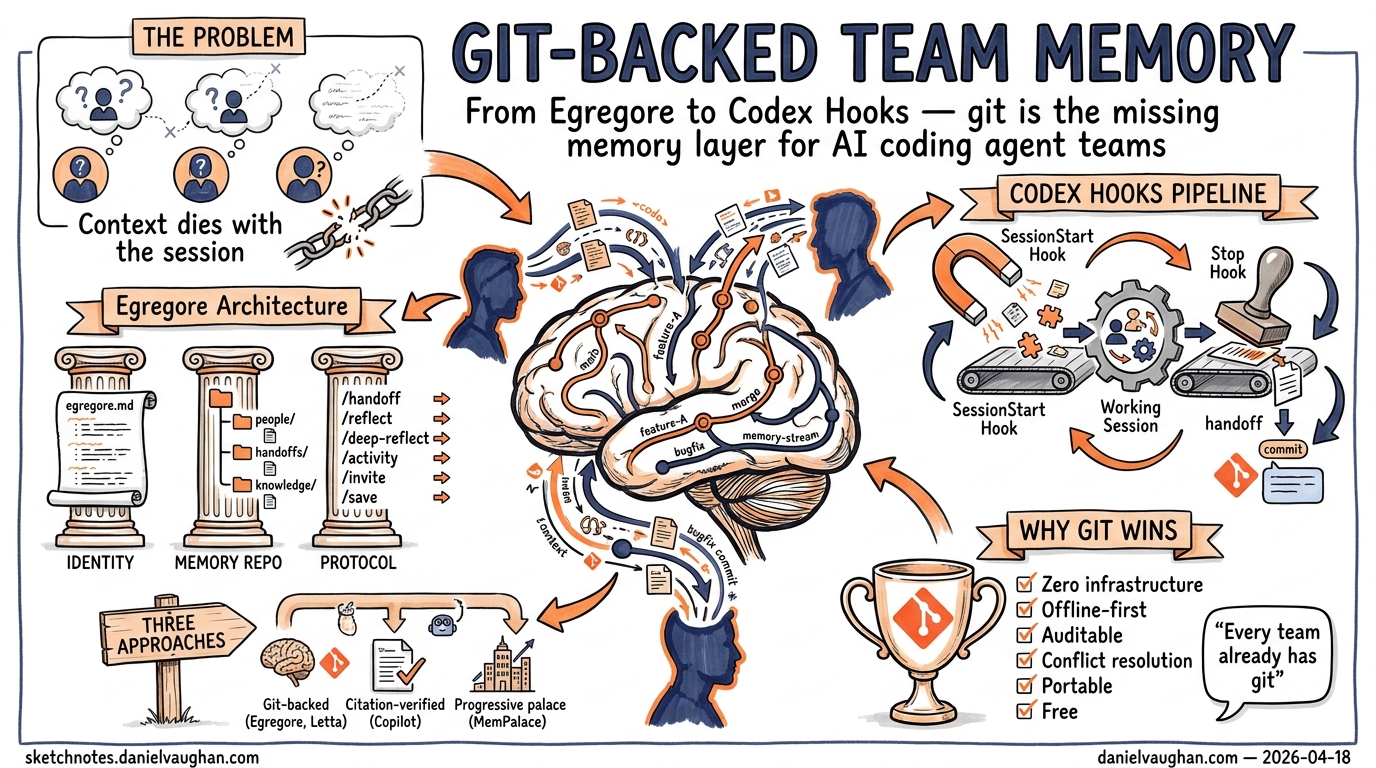
Every developer team already has a shared, versioned, conflict-resolving knowledge store: git. Yet most AI coding agents treat memory as a single-user concern — personal context that evaporates when the session ends or a different team member picks up the work. Egregore, an open-source shared cognition layer for Claude Code that launched on Show HN on 18 April 20261, demonstrates that git-backed team memory is not only viable but remarkably practical. This article maps Egregore’s three-pillar architecture to Codex CLI equivalents, showing how to build cross-session, cross-developer team memory using hooks, AGENTS.md composition, and the built-in memory system.
The Problem: Context Fragmentation Across Sessions and Developers
When three developers and their agents work on the same codebase, each agent accumulates session-specific knowledge — architectural decisions, debugging insights, API quirks — that dies with the session. The next developer starts cold. Manual handoff documents help, but they’re rarely written and never structured consistently enough for an agent to consume programmatically.
Egregore’s insight is that the coordination primitives already exist in git: branching for isolation, merging for reconciliation, commit history for provenance, and pull requests for review2. The missing piece is a protocol layer that structures what gets written and when it gets read.
Egregore’s Three-Pillar Architecture
Egregore transforms Claude Code into a multiplayer environment through three interlocking components12:
graph TB
    subgraph "Pillar 1: Identity"
        ED[egregore.md<br/>Team values, norms, principles]
    end

    subgraph "Pillar 2: Memory Repo"
        MR[memory/ git repo]
        MR --> P[people/]
        MR --> H[handoffs/]
        MR --> K[knowledge/<br/>decisions/ + patterns/]
        MR --> I[infrastructure/]
    end

    subgraph "Pillar 3: Protocol Commands"
        HC[/handoff — context transfer]
        RC[/reflect — knowledge capture]
        AC[/activity — team visibility]
        IC[/invite — onboarding]
        SC[/save — git workflows]
        DR[/deep-reflect — cross-referencing]
    end

    ED -->|loaded at session start| MR
    HC -->|writes to| H
    RC -->|writes to| K
    AC -->|reads from| MR

    style ED fill:#f9f,stroke:#333
    style MR fill:#bbf,stroke:#333
Pillar 1: The Identity Document
egregore.md is an evolving document that captures the team’s values, operational norms, and architectural principles2. It functions as a team-level AGENTS.md — not instructions for a single project, but shared cognitive context for the entire group. Every session loads it, ensuring agents operate with consistent team identity regardless of which developer initiated the session.
Pillar 2: The Memory Repository
A separate git repository (symlinked into the working tree as memory/) stores versioned team knowledge3:
people/— Team member profiles and working styleshandoffs/— Structured session summaries with an indexknowledge/decisions/— Organisational choices with rationaleknowledge/patterns/— Emergent team patterns surfaced through reflectioninfrastructure/— Service registry and system topology
Every write is a git commit. Every read checks the latest state. The entire history is browsable, searchable, and auditable outside the agent3.
Pillar 3: Protocol Commands
Six slash commands provide the coordination protocol2:
| Command | Purpose | Memory Effect |
|---|---|---|
/handoff |
Transfer context between sessions | Writes structured summary to handoffs/ |
/reflect |
Capture decisions and insights | Writes to knowledge/ |
/deep-reflect |
Cross-reference across knowledge base | Reads and connects existing entries |
/activity |
Team-wide work visibility | Aggregates across all stored sessions |
/invite |
Onboard new team members | Grants access with full context inheritance |
/save |
Automated git stage, commit, PR | Enforces versioning best practices |
Mapping Egregore to Codex CLI
Egregore is built on Claude Code hooks1, but every pattern it implements has a direct Codex CLI equivalent. Here’s how to build the same capabilities.
Team-Level AGENTS.md via @include
Egregore’s identity document maps to a team-level AGENTS.md. Codex CLI’s proposed @include directive (issue #174014) enables composable instruction files:
# .codex/AGENTS.md (project-level)
@~/.codex/team/identity.md
@~/.codex/team/coding-standards.md
@docs/architecture-decisions.md

## Project-Specific Instructions
- Use the repository's existing error handling patterns
- All new endpoints require OpenAPI specs
The @include directive is a CLI-side text transformation during instruction assembly — no API changes required4. Until it ships, a SessionStart hook can achieve the same effect by injecting team context via additionalContext.
Session-Start Context Sync
Egregore pulls accumulated team context on every session start. In Codex CLI, a SessionStart hook does the same5:
{
  "hooks": {
    "SessionStart": [
      {
        "type": "command",
        "command": "bash .codex/hooks/team-sync.sh",
        "statusMessage": "Syncing team context...",
        "timeout": 15000
      }
    ]
  }
}
The hook script pulls the latest team memory and injects it:
#!/usr/bin/env bash
# .codex/hooks/team-sync.sh

TEAM_MEMORY_DIR="$HOME/.codex/team-memory"

# Pull latest team knowledge
if [ -d "$TEAM_MEMORY_DIR/.git" ]; then
    git -C "$TEAM_MEMORY_DIR" pull --rebase --quiet 2>/dev/null
fi

# Read recent decisions and active handoffs
RECENT_DECISIONS=$(find "$TEAM_MEMORY_DIR/knowledge/decisions" \
    -name "*.md" -mtime -7 -exec cat {} + 2>/dev/null | head -c 2000)

ACTIVE_HANDOFFS=$(cat "$TEAM_MEMORY_DIR/handoffs/index.md" 2>/dev/null \
    | head -c 1500)

# Inject as additional context
cat <<EOF
{
  "hookSpecificOutput": {
    "hookEventName": "SessionStart",
    "additionalContext": "## Team Context (auto-synced)\n\n### Recent Decisions\n${RECENT_DECISIONS}\n\n### Active Handoffs\n${ACTIVE_HANDOFFS}"
  }
}
EOF
The additionalContext field adds developer context that the model receives before the first prompt5, giving the agent immediate awareness of team state.
Structured Handoffs via Stop Hooks
When a session ends, a Stop hook captures the session’s knowledge and commits it to the team memory repo:
{
  "hooks": {
    "Stop": [
      {
        "type": "command",
        "command": "bash .codex/hooks/handoff-capture.sh",
        "statusMessage": "Capturing session handoff...",
        "timeout": 30000
      }
    ]
  }
}
#!/usr/bin/env bash
# .codex/hooks/handoff-capture.sh

# Read session context from stdin
SESSION_DATA=$(cat)
SESSION_ID=$(echo "$SESSION_DATA" | jq -r '.session_id')
TRANSCRIPT_PATH=$(echo "$SESSION_DATA" | jq -r '.transcript_path')

TEAM_MEMORY_DIR="$HOME/.codex/team-memory"
HANDOFF_FILE="$TEAM_MEMORY_DIR/handoffs/$(date +%Y-%m-%d)-${SESSION_ID:0:8}.md"

# Use codex exec to summarise the transcript
if [ -f "$TRANSCRIPT_PATH" ]; then
    SUMMARY=$(cat "$TRANSCRIPT_PATH" | codex exec \
        "Summarise this session: key decisions, files changed, \
         open threads, and gotchas for the next developer. \
         Output structured markdown." 2>/dev/null)

    mkdir -p "$TEAM_MEMORY_DIR/handoffs"
    echo "$SUMMARY" > "$HANDOFF_FILE"

    cd "$TEAM_MEMORY_DIR"
    git add handoffs/
    git commit -m "handoff: session $SESSION_ID" --quiet
    git push --quiet 2>/dev/null
fi
This mirrors Egregore’s /handoff command but runs automatically on every session close2.
The Reflect Loop: Knowledge Consolidation
Egregore’s /reflect captures insights; /deep-reflect cross-references them2. In Codex CLI, this maps to a periodic consolidation pattern — either triggered manually or via a scheduled automation:
sequenceDiagram
    participant Dev as Developer Session
    participant Stop as Stop Hook
    participant Repo as Team Memory Repo
    participant Sync as SessionStart Hook
    participant Next as Next Session

    Dev->>Stop: Session ends
    Stop->>Stop: Summarise transcript
    Stop->>Repo: Commit handoff + decisions
    Note over Repo: git push (async)

    Next->>Sync: New session starts
    Sync->>Repo: git pull latest
    Sync->>Next: Inject additionalContext
    Note over Next: Agent has full team context
The reflection step can use Codex CLI’s built-in two-phase memory pipeline (extract → integrate)6 extended to team scope: raw session transcripts feed into extraction, and the resulting insights merge into the shared knowledge repository rather than personal memory alone.
Comparison: Three Approaches to Agent Memory
The ecosystem has converged on three distinct strategies789:
| Approach | Example | Storage | Verification | Team Support |
|---|---|---|---|---|
| Git-backed files | Egregore, Letta Context Repos | Git repository | Version history | Native (merge/branch) |
| Citation-verified | GitHub Copilot Memory | Repository-scoped DB | Real-time code citation checks | Per-repository |
| Progressive palace | MemPalace | ChromaDB + SQLite | Vector similarity | Single-user |
Git-backed memory has a structural advantage for teams: conflict resolution, branching, and access control are solved problems7. Letta’s Context Repositories independently arrived at the same architecture, using git worktrees to enable concurrent subagent memory writes that merge back through standard git operations7.
GitHub Copilot’s agentic memory takes a different approach — storing memories with code citations that are verified in real-time before use8. This provides accuracy guarantees (3% precision increase, 4% recall increase in evaluation8) but is repository-scoped and platform-locked.
MemPalace achieves impressive benchmark scores (96.6% on LongMemEval9) through its progressive-disclosure architecture, but operates as a single-user system with no native team coordination.
Why Git Beats Cloud Memory Services for Small Teams
The argument for git-as-memory-substrate over centralised services is pragmatic37:
- Zero new infrastructure — Every team already has git hosting, CI, and access controls
- Offline-first — Memory works without network connectivity; sync happens on push/pull
- Auditable —
git logandgit blameprovide complete provenance - Conflict resolution — Concurrent writes from multiple agents resolve through standard merge strategies
- Portable — No vendor lock-in; memory is plain markdown files in a repository
- Cost — Free, versus per-seat pricing for managed memory services
The trade-off is query sophistication. Vector-search-backed systems like MemPalace can retrieve semantically similar memories without exact keyword matches9. Git-backed systems rely on file organisation and grep — effective for structured knowledge, less so for fuzzy recall. For teams writing structured decisions and handoffs, this trade-off favours git.
Practical Implementation Checklist
To implement git-backed team memory in Codex CLI today:
- Create a team memory repository with the directory structure:
knowledge/decisions/,knowledge/patterns/,handoffs/,people/ - Add a
SessionStarthook that pulls the repo and injects recent context viaadditionalContext - Add a
Stophook that summarises the session transcript and commits a handoff document - Add team-level AGENTS.md content — either via
@include(when available) or injected through theSessionStarthook - Set up periodic consolidation — a scheduled
codex execjob that deduplicates and cross-references accumulated knowledge - Configure access — use the same branch protection and code review rules you’d use for production code
The entire system requires no custom infrastructure beyond what’s already in your development workflow. Git is the memory layer. Hooks are the sync mechanism. AGENTS.md is the identity document.
Citations
-
Egregore — Shared Cognition for Teams and Agents and Show HN discussion, April 18, 2026 ↩ ↩2 ↩3
-
Egregore Shared Memory Documentation, Egregore Docs, 2026 ↩ ↩2 ↩3 ↩4 ↩5 ↩6
-
Daniel Vaughan, internal notes: egregore-shared-cognition-patterns.md, 2026-04-18 ↩ ↩2 ↩3
-
feat: @include directive for composable AGENTS.md files · Issue #17401, openai/codex, April 11, 2026 ↩ ↩2
-
[Hooks – Codex OpenAI Developers](https://developers.openai.com/codex/hooks), OpenAI, 2026 -
[Features – Codex CLI OpenAI Developers](https://developers.openai.com/codex/cli/features), OpenAI, 2026 -
Introducing Context Repositories: Git-based Memory for Coding Agents, Letta, 2026 ↩ ↩2 ↩3 ↩4
-
Building an agentic memory system for GitHub Copilot, GitHub Blog, 2026 ↩ ↩2 ↩3
-
MemPalace: 170 Tokens to Recall Everything, recca0120, April 8, 2026 ↩ ↩2 ↩3