Formal Architecture Descriptors: Cutting Codex CLI Navigation Overhead by a Third
Formal Architecture Descriptors: Cutting Codex CLI Navigation Overhead by a Third
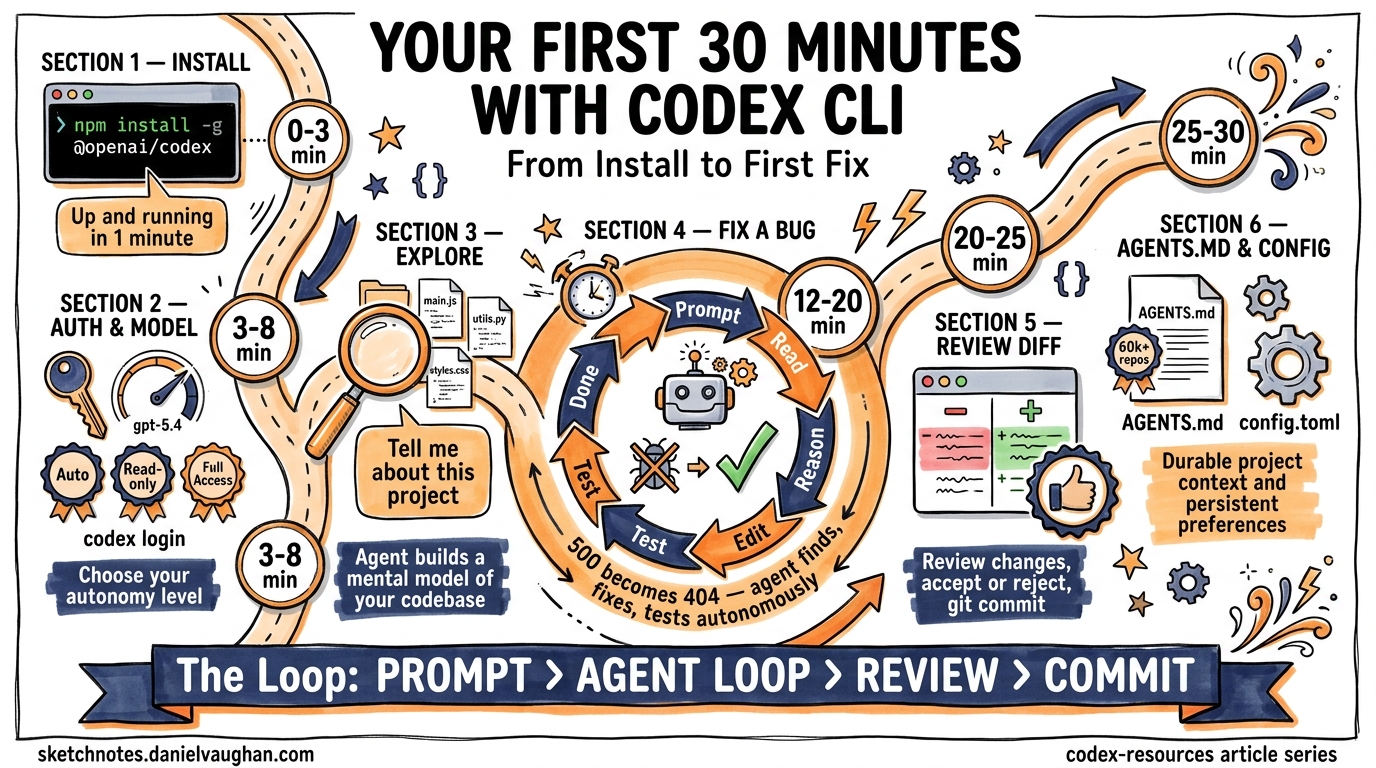
Your AGENTS.md file tells your coding agent what to do. But does it tell the agent where things are in a way that actually reduces navigational overhead? A controlled study published in April 2026 found that formal architecture descriptors — structured declarations of module boundaries, symbol signatures, and data flows — reduce Codex CLI navigation steps by 33–44%, with a large effect size (Cohen’s d = 0.92)1. A companion field study across 7,012 Claude Code sessions showed a 52% reduction in behavioural variance when formal descriptors were present1. This article explains the research, introduces the intent.lisp format, and shows how to integrate architecture descriptors into your Codex CLI workflow.
The Navigation Paradox
Context windows have grown from 128K to 1M tokens in the past year2, yet coding agents still spend a disproportionate fraction of their tool calls on undirected exploration — grepping, globbing, and reading modules speculatively1. This is the Navigation Paradox: the bottleneck has shifted from retrieval capacity to navigational salience1.
Research consistently confirms this. The Amazing Agent Race benchmark found navigation errors account for 27–52% of all trial failures, whilst tool-use errors stay below 17%3. AGENTS.md file maps help4, but natural-language descriptions lack structural guarantees — there is nothing preventing an agent from misinterpreting an ambiguous module description or missing a critical dependency relationship.
graph TD
    A[Agent receives task] --> B{Has architecture descriptor?}
    B -->|No| C[Speculative exploration]
    C --> D[grep / glob / read cycles]
    D --> E[33-44% more navigation steps]
    E --> F[Higher token cost]
    B -->|Yes| G[Targeted navigation]
    G --> H[Direct module lookup]
    H --> I[Reduced exploration overhead]
    I --> J[Lower token cost]
What Are Formal Architecture Descriptors?
A formal architecture descriptor is a structured document declaring four things about your codebase1:
- Module boundaries — which directories and files constitute each logical component
- Symbol signatures — function names, types, and their call signatures
- Constraints and invariants — rules that must hold within each module
- Data flows — how data moves between components
Unlike free-form AGENTS.md documentation, formal descriptors use a parseable syntax that enforces structural hierarchy. The research paper proposes intent.lisp, an S-expression format, but the controlled experiments found no statistically significant difference between S-expression, JSON, YAML, and Markdown formats for reader comprehension (p > 0.07 across all pairwise comparisons)1.
The advantage of S-expressions emerges in error resilience, not comprehension. More on that below.
The Evidence: Four Experiments
Experiment 1: Code Localisation (Controlled)
Jin ran 24 code localisation tasks on a ~22K-line Rust project using Claude Sonnet 4.6 at temperature 0 with a maximum of 20 steps1.
| Condition | Navigation Steps (median) | Accuracy |
|---|---|---|
| Blind (no context) | Baseline | 54% |
| S-expression | –33% | 58% |
| JSON | –38% | 58% |
| Markdown | –44% | 63% |
The navigation reduction was statistically significant (Wilcoxon p = 0.009, Cohen’s d = 0.92)1. Format differences were not (p > 0.07)1. The implication: any structured architecture context helps; the specific format matters far less than having one at all.
Experiment 2: Auto-Generated vs. Hand-Curated
Fifteen tasks on a 43K-line Rust project tested three conditions1:
- Blind: 80% accuracy
- AutoGen (170-line auto-generated descriptor): 100% accuracy
- Curated (698-line hand-refined descriptor): 87% accuracy
The auto-generated descriptor outperformed the curated one — a counter-intuitive result explained by token budget constraints. Longer descriptors consume context window capacity that could be used for actual code1. The practical takeaway: auto-generate your descriptors first; refine only when governance demands it.
Experiment 3: Error Resilience
Ninety-six error injections across four formats revealed dramatically different failure modes1:
| Format | Structural Error Detection | Silent Corruption Rate |
|---|---|---|
| S-expression | 100% | 50% |
| JSON | Atomic failure | 21% |
| YAML | 50% | 50% |
| Markdown | 0% | 100% |
JSON fails loudly (atomic parse failure on structural errors), which is either a virtue or a disaster depending on your error-handling strategy. S-expressions detect all structural completeness errors. YAML silently corrupts half the time, and Markdown provides zero error detection1. If your descriptor will be auto-generated or frequently updated, JSON or S-expressions are the safer choices.
Experiment 4: Field Study (7,012 Sessions)
An observational study across 7,012 Claude Code sessions spanning November 2025 to April 2026 measured the per-session explore/edit ratio1:
- Pre-descriptor IQR: 2.24
- Post-descriptor IQR: 1.08
- Reduction: 52%
Interestingly, sessions that directly read the intent.lisp file showed no advantage over those that did not (ratio 1.65 vs. 1.65)1. This suggests the act of formalising architecture may itself improve code organisation, producing benefits even when the agent does not directly consume the descriptor.
The intent.lisp Format
The proposed S-expression format declares architecture as nested lists1:
(intent my-project
  (design-constraints
    "All database access goes through the repository layer"
    "HTTP handlers must not import domain logic directly")

  (pillar api-gateway
    (component routes
      (role "HTTP request routing and middleware chain")
      (invariants "No business logic in route handlers")
      (data-flow "request → middleware → handler → service")
      (symbols
        (function handle_create_user
          (sig "(req: Request) -> Result<Response, ApiError>"))
        (function validate_auth_token
          (sig "(token: &str) -> Result<Claims, AuthError>")))))

  (pillar domain
    (component user-service
      (role "User lifecycle management")
      (invariants "Email uniqueness enforced at service layer")
      (data-flow "handler → service → repository → database")
      (symbols
        (function create_user
          (sig "(cmd: CreateUserCmd) -> Result<User, DomainError>"))
        (function find_by_email
          (sig "(email: &str) -> Option<User>"))))))
Compression Ratios
The format achieves substantial compression across production codebases1:
| Project | Source Lines | Descriptor Lines | Ratio |
|---|---|---|---|
| xiaojinpro-backend | 469,594 | 7,877 | 60:1 |
| jarvis-forge | 44,321 | 698 | 64:1 |
| missiond | 107,986 | 5,846 | 18:1 |
| Weighted average | 34:1 |
A 34:1 compression ratio means a 100K-line codebase reduces to roughly 3,000 lines of architectural description — well within context window budgets even for smaller models1.
Integrating with Codex CLI
Step 1: Generate Your Descriptor
You can use Codex CLI itself to generate an initial architecture descriptor. Create a prompt that asks for a structured survey:
codex exec "Survey this codebase and produce an intent.lisp file \
  declaring all top-level modules, their roles, key function \
  signatures, invariants, and data flows. Use S-expression format." \
  > intent.lisp
Based on the research, this auto-generated descriptor will already deliver the full navigation benefit without manual refinement1.
Step 2: Place the Descriptor
Add intent.lisp to your project root alongside AGENTS.md. Reference it from your AGENTS.md so the agent knows it exists:
## Architecture

This project uses a formal architecture descriptor.
See `intent.lisp` for module boundaries, symbol signatures,
and data flow declarations.
Step 3: Configure AGENTS.md to Complement, Not Duplicate
With a formal descriptor handling navigation, your AGENTS.md can focus on what it does best — behavioural instructions5:
- Code style preferences and conventions
- Testing requirements and approval modes
- Files that should never be modified
- Domain-specific terminology
This separation of concerns keeps both files shorter and more effective. Research shows AGENTS.md files beyond 150 lines deliver diminishing returns and can increase inference costs by 20–23%6.
Step 4: Keep Descriptors Current
Architecture descriptors drift as code evolves. Use a Codex CLI hook to regenerate on significant changes:
# codex.toml
[hooks.post-commit]
command = "codex exec 'Update intent.lisp to reflect the current codebase structure. Preserve existing design-constraints and invariants. Only update module boundaries and symbol signatures that have changed.' > intent.lisp"
⚠️ Hook-based auto-regeneration is an emerging pattern — monitor for drift between the descriptor and actual code structure, particularly in rapidly evolving projects.
flowchart LR
    A[AGENTS.md] -->|Behavioural rules| B[Agent Context Window]
    C[intent.lisp] -->|Structural navigation| B
    B --> D[Reduced exploration]
    B --> E[Consistent behaviour]
    D --> F[33-44% fewer nav steps]
    E --> G[52% less variance]
Choosing Your Format
The research tested four formats and found equivalent comprehension across all of them1. Your choice should depend on downstream tooling and error tolerance:
| Criterion | S-expression | JSON | YAML | Markdown |
|---|---|---|---|---|
| LLM comprehension | ✅ 95% | ✅ 95% | ✅ 95% | ✅ 95% |
| Generation reliability | 95.8% | 100% | 91.7% | — |
| Error detection | High | Atomic | Low | None |
| Silent corruption | 50% | 21% | 50% | 100% |
| Compression vs. JSON | 22% smaller | Baseline | Similar | Larger |
| Tooling ecosystem | Niche | Ubiquitous | Common | Universal |
For most teams, JSON is the pragmatic choice — perfect generation reliability, lowest silent corruption, and universal tooling support. Choose S-expressions if you want structural error detection and maximum compression. Avoid YAML for auto-generated descriptors given its 50% silent corruption rate1.
Limitations and Caveats
The research has important constraints to keep in mind:
- Model specificity: All controlled experiments used Claude Sonnet 4.6. Results may differ with other models, though weaker models showed even larger benefits (d = 1.70)1.
- Task scope: Only code localisation was tested. Multi-file modification, refactoring, and generation tasks remain untested1.
- Codebase size: The controlled experiments used 22K–44K line projects. The compression ratios suggest scaling to 100K+ line projects should work, but this is not yet empirically validated under controlled conditions1.
- Self-clarification confound: The field study cannot fully separate the benefit of the descriptor artefact from the benefit of the developer thinking through their architecture to write it1.
Key Takeaways
- Any structured architecture context reduces navigation by a third — the format barely matters for comprehension1.
- Auto-generated descriptors work as well as hand-curated ones — start with
codex execand refine only if needed1. - Separate navigation from behaviour — let
intent.lisp(orarchitecture.json) handle structure whilstAGENTS.mdhandles conventions5. - Watch your error resilience — if the descriptor is auto-generated or frequently updated, avoid YAML and Markdown1.
- The 34:1 compression ratio means even large codebases fit comfortably within context budgets1.
The Navigation Paradox is solvable. Formal architecture descriptors give your coding agent a map instead of a compass — and the empirical evidence shows that map cuts a third of the wandering.
Citations
-
Jin, R. (2026). “Formal Architecture Descriptors as Navigation Primitives for AI Coding Agents.” arXiv:2604.13108. https://arxiv.org/abs/2604.13108 ↩ ↩2 ↩3 ↩4 ↩5 ↩6 ↩7 ↩8 ↩9 ↩10 ↩11 ↩12 ↩13 ↩14 ↩15 ↩16 ↩17 ↩18 ↩19 ↩20 ↩21 ↩22 ↩23 ↩24 ↩25 ↩26 ↩27 ↩28 ↩29
-
Farajijobehdar, V., Köseoğlu Sarı, İ., Üre, N. K., & Zeydan, E. (2026). “Tokalator: A Context Engineering Toolkit for Artificial Intelligence Coding Assistants.” arXiv:2604.08290. https://arxiv.org/abs/2604.08290 ↩
-
Kim, J. et al. (2026). “The Amazing Agent Race.” arXiv:2604.10261. https://arxiv.org/abs/2604.10261 ↩
-
Jin, R. et al. (2026). “On the Impact of AGENTS.md Files on the Efficiency of AI Coding Agents.” arXiv:2601.20404. https://arxiv.org/abs/2601.20404 ↩
-
OpenAI. (2026). “Custom instructions with AGENTS.md.” Codex Developer Documentation. https://developers.openai.com/codex/guides/agents-md ↩ ↩2
-
Augment Code. (2026). “How to Build Your AGENTS.md (2026).” https://www.augmentcode.com/guides/how-to-build-agents-md ↩