Codex CLI for C and C++ Teams: CMake, Clangd MCP, Sanitisers, and Memory-Safe Agent Workflows
Codex CLI for C and C++ Teams: CMake, Clangd MCP, Sanitisers, and Memory-Safe Agent Workflows
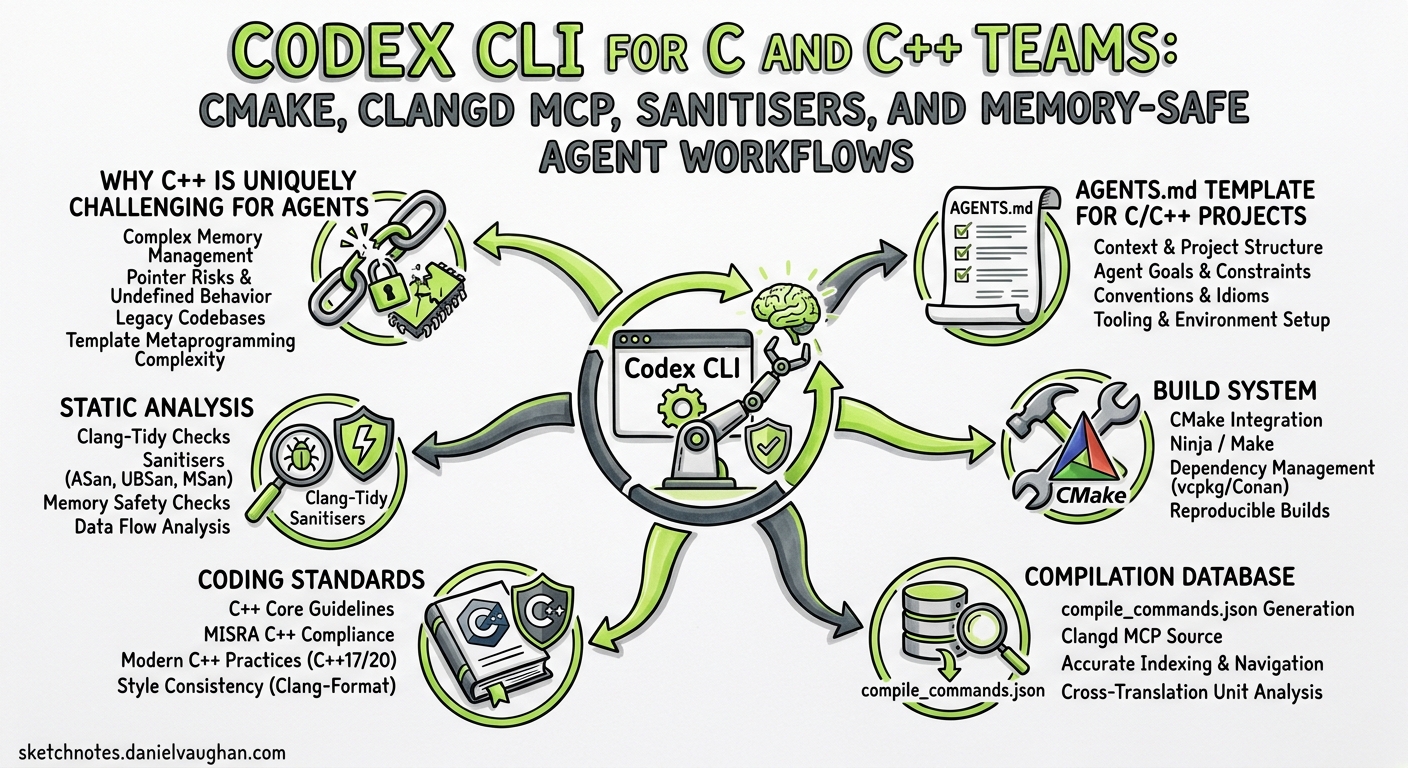
C and C++ remain the backbone of systems programming — from kernels and game engines to embedded firmware and high-frequency trading platforms. Yet most AI coding agent guides focus on managed-language ecosystems where compilation is trivial and memory management is invisible. C++ developers face a different reality: header resolution across translation units, build-system complexity, undefined behaviour lurking behind every raw pointer, and compile times measured in minutes rather than seconds.
This article shows how to configure Codex CLI as a productive partner for C and C++ projects, covering AGENTS.md conventions, sandbox and build-tool configuration, Clangd MCP integration for semantic code intelligence, PostToolUse hooks for compiler and sanitiser feedback, and model selection for different C++ task profiles.
Why C++ Is Uniquely Challenging for Agents
Before diving into configuration, it is worth understanding why C++ demands more harness work than most languages:
- No single entry point for builds. Projects may use CMake, Meson, Bazel, Make, or Ninja — often in combination 1. The agent must know the exact incantation.
- Header-only visibility. Without a compilation database (
compile_commands.json), the agent cannot resolve includes, macros, or template instantiations accurately 2. - Undefined behaviour. Correct-looking code can silently corrupt memory. Agents need sanitiser feedback in the loop, not just “it compiled” 3.
- Long compile times. A full rebuild can take minutes on large codebases. The agent must be guided towards incremental builds and ccache.
- C++26 evolution. The recently shipped C++26 standard introduces reflection, contracts, and hardened memory-safety defaults 4 — the agent needs up-to-date knowledge of modern idioms.
AGENTS.md Template for C/C++ Projects
A well-structured AGENTS.md encodes the build commands, coding standards, and safety expectations that the agent cannot infer from source alone.
# AGENTS.md — C++ Project Conventions

## Build System
- Build tool: CMake 4.1+ with Ninja generator
- Configure: `cmake -B build -G Ninja -DCMAKE_EXPORT_COMPILE_COMMANDS=ON -DCMAKE_BUILD_TYPE=Debug`
- Build: `cmake --build build -j$(nproc)`
- Test: `ctest --test-dir build --output-on-failure`
- Clean: `cmake --build build --target clean`

## Compilation Database
- Always generate `compile_commands.json` via `-DCMAKE_EXPORT_COMPILE_COMMANDS=ON`
- Symlink to project root: `ln -sf build/compile_commands.json .`
- The Clangd MCP server depends on this file

## Coding Standards
- C++23 minimum; use C++26 features (contracts, reflection) where compiler support exists
- Smart pointers (std::unique_ptr, std::shared_ptr) — no raw owning pointers
- RAII for all resource management
- Use std::span and std::string_view over raw pointers and const char*
- Prefer std::expected or std::optional over error codes
- No `using namespace std;` in headers

## Static Analysis
- clang-tidy checks: modernize-*, bugprone-*, cppcoreguidelines-*, performance-*
- Run: `clang-tidy -p build src/**/*.cpp`

## Sanitisers
- Debug builds enable ASan + UBSan: `-DCMAKE_CXX_FLAGS="-fsanitize=address,undefined -fno-omit-frame-pointer"`
- Thread-safety builds: `-DCMAKE_CXX_FLAGS="-fsanitize=thread"`
- Always run tests under sanitisers before marking work complete

## File Layout
- Headers: `include/<project>/`
- Sources: `src/`
- Tests: `tests/` (Google Test framework)
- Benchmarks: `bench/` (Google Benchmark)
For monorepo layouts with multiple libraries, place a root-level AGENTS.md with shared conventions, then add per-library overrides in each subdirectory 5.
config.toml: Sandbox and Build Configuration
C++ builds require write access beyond the workspace (e.g., /tmp for intermediate objects) and read access to system headers and toolchain binaries. The default workspace-write sandbox mode works for most projects, but you may need writable roots for out-of-tree build directories.
# ~/.codex/config.toml — C++ profile

model = "gpt-5.5"
model_reasoning_effort = "high"

[features]
codex_hooks = true

[profiles.cpp]
model = "gpt-5.5"
model_reasoning_effort = "high"
sandbox_mode = "workspace-write"
approval_policy = "on-request"

[profiles.cpp-fast]
model = "GPT-5.3-Codex-Spark"
model_reasoning_effort = "medium"
sandbox_mode = "workspace-write"
Launch Codex with a profile:
codex --profile cpp
# Or for quick refactors:
codex --profile cpp-fast
For projects that place the build directory outside the workspace (e.g., a sibling ../build-release), extend writable roots in a project-level .codex/config.toml 6:
# .codex/config.toml
sandbox_mode = "workspace-write"
Clangd MCP: Semantic Code Intelligence
Raw text search is insufficient for C++ — templates, overloaded functions, and macro expansions demand semantic understanding. Two MCP servers bridge this gap.
Option 1: clangd-mcp-server
The clangd-mcp-server exposes nine tools backed by the Clangd language server 7:
| Tool | Purpose |
|---|---|
find_definition |
Jump to symbol definitions |
find_references |
All references to a symbol |
get_hover |
Type information and documentation |
workspace_symbol_search |
Search symbols across the workspace |
find_implementations |
Virtual method / interface implementations |
get_document_symbols |
Hierarchical symbol tree for a file |
get_diagnostics |
Compiler errors, warnings, and notes |
get_call_hierarchy |
Function callers and callees |
get_type_hierarchy |
Base and derived classes |
Prerequisites: Node.js >= 18, clangd installed, and a compile_commands.json at the project root 7.
Configure in .codex/config.toml:
[mcp_servers.clangd]
command = "clangd-mcp-server"
[mcp_servers.clangd.env]
PROJECT_ROOT = "."
Option 2: Clangaroo
Clangaroo combines Tree-sitter’s parsing speed with Clangd’s LSP accuracy 8. It offers the same core navigation tools plus AI-powered architectural analysis via an optional Gemini Flash backend. Useful for very large codebases where you want fast symbol lookup with accurate fallback.
graph LR
    A[Codex CLI] -->|MCP protocol| B[Clangd MCP Server]
    B --> C[clangd LSP]
    C --> D[compile_commands.json]
    D --> E[CMake / Ninja build]
    A -->|PostToolUse hook| F[clang-tidy]
    A -->|PostToolUse hook| G[ASan / UBSan]
PostToolUse Hooks: Compiler and Sanitiser Feedback
Hooks inject deterministic checks into the agent loop 9. For C++ projects, two hooks are essential: one to run the build after file edits (catching compile errors immediately) and another to run sanitisers after test execution.
Hook 1: Build After Edit
Create .codex/hooks/build-after-edit.py:
#!/usr/bin/env python3
"""PostToolUse hook: rebuild after file edits."""
import json, subprocess, sys

event = json.loads(sys.stdin.read())
tool = event.get("tool_name", "")

if tool not in ("apply_patch", "Edit", "Write"):
    json.dump({"decision": "approve"}, sys.stdout)
    sys.exit(0)

# Check if edited file is C/C++
tool_input = event.get("tool_input", {})
path = tool_input.get("file_path", "")
if not any(path.endswith(ext) for ext in (".cpp", ".cc", ".cxx", ".c", ".h", ".hpp")):
    json.dump({"decision": "approve"}, sys.stdout)
    sys.exit(0)

result = subprocess.run(
    ["cmake", "--build", "build", "-j4"],
    capture_output=True, text=True, timeout=120
)

if result.returncode != 0:
    json.dump({
        "decision": "block",
        "reason": f"Build failed:\n{result.stderr[-2000:]}",
        "hookSpecificOutput": {
            "hookEventName": "PostToolUse",
            "additionalContext": result.stdout[-1000:]
        }
    }, sys.stdout)
    sys.exit(2)

json.dump({"decision": "approve"}, sys.stdout)
Hook 2: Sanitiser Check After Tests
Create .codex/hooks/sanitiser-check.py:
#!/usr/bin/env python3
"""PostToolUse hook: run tests under ASan/UBSan after Bash commands."""
import json, subprocess, sys

event = json.loads(sys.stdin.read())
tool = event.get("tool_name", "")
tool_input = event.get("tool_input", {})

if tool != "Bash":
    json.dump({"decision": "approve"}, sys.stdout)
    sys.exit(0)

command = tool_input.get("command", "")
if "ctest" not in command and "test" not in command:
    json.dump({"decision": "approve"}, sys.stdout)
    sys.exit(0)

# Re-run tests with sanitiser output captured
env_vars = {"ASAN_OPTIONS": "detect_leaks=1:halt_on_error=0"}
result = subprocess.run(
    ["ctest", "--test-dir", "build", "--output-on-failure"],
    capture_output=True, text=True, timeout=300,
    env={**__import__("os").environ, **env_vars}
)

if result.returncode != 0:
    json.dump({
        "decision": "block",
        "reason": f"Sanitiser or test failure:\n{result.stderr[-2000:]}"
    }, sys.stdout)
    sys.exit(2)

json.dump({"decision": "approve"}, sys.stdout)
Register both hooks in .codex/config.toml:
[[hooks.PostToolUse]]
matcher = "^(apply_patch|Edit|Write)$"

[[hooks.PostToolUse.hooks]]
type = "command"
command = '/usr/bin/python3 ".codex/hooks/build-after-edit.py"'
timeout = 120
statusMessage = "Rebuilding..."

[[hooks.PostToolUse]]
matcher = "^Bash$"

[[hooks.PostToolUse.hooks]]
type = "command"
command = '/usr/bin/python3 ".codex/hooks/sanitiser-check.py"'
timeout = 300
statusMessage = "Running sanitiser checks..."
Agent-Driven Feature Development Workflow
The following sequence illustrates adding a new feature to a C++ project with full compiler and sanitiser feedback:
sequenceDiagram
    participant Dev as Developer
    participant Codex as Codex CLI
    participant MCP as Clangd MCP
    participant Build as CMake/Ninja
    participant San as ASan/UBSan

    Dev->>Codex: "Add a thread-safe LRU cache to core/cache.hpp"
    Codex->>MCP: get_document_symbols("core/cache.hpp")
    MCP-->>Codex: Existing symbols, includes, class hierarchy
    Codex->>MCP: find_references("CacheBase")
    MCP-->>Codex: 12 call sites across 4 translation units
    Codex->>Codex: Write cache.hpp + cache.cpp + cache_test.cpp
    Codex->>Build: cmake --build build (PostToolUse hook)
    Build-->>Codex: ✅ Build succeeded
    Codex->>Codex: Run ctest
    Codex->>San: PostToolUse sanitiser hook
    San-->>Codex: ⚠️ Data race in cache eviction
    Codex->>Codex: Fix: add std::shared_mutex
    Codex->>Build: Rebuild (PostToolUse hook)
    Build-->>Codex: ✅ Build succeeded
    Codex->>San: Re-run sanitiser check
    San-->>Codex: ✅ Clean
    Codex-->>Dev: Feature complete, all tests passing under ASan + UBSan
Model Selection by C++ Task
| Task | Recommended Model | Reasoning Effort | Rationale |
|---|---|---|---|
| Complex template metaprogramming | gpt-5.5 | high | Deep type-system reasoning [^10] |
| New feature implementation | gpt-5.5 | high | Architecture + safety awareness |
| Bug fix with sanitiser output | gpt-5.5 | medium | Focused analysis of error trace |
| Refactoring (rename, extract) | GPT-5.3-Codex-Spark | medium | Mechanical, speed matters 10 |
| Boilerplate (getters, operators) | GPT-5.3-Codex-Spark | low | Pattern-based, minimal reasoning |
| CMakeLists.txt maintenance | gpt-5.5 | medium | CMake’s DSL has subtle pitfalls |
Code review (/review) |
gpt-5.5 | high | Catch UB and ownership issues |
C++26 Awareness
C++26 was finalised by WG21 on 28 March 2026 and is now in ISO Draft International Standard phase 4. Key features the agent should understand:
- Contracts (
pre,post,assert): Language-level preconditions and postconditions that replace ad-hocassert()macros 4. - Static reflection (
^and[: :]): Compile-time introspection eliminating entire categories of boilerplate 4. - Hardened standard library:
std::vector,std::span,std::string, andstd::string_viewnow perform bounds checking by default in hardened mode, treating precondition violations as contract violations rather than silent undefined behaviour 11. - Erased uninitialized UB: Reading an uninitialized local variable is no longer undefined behaviour in C++26 11.
Encode C++26 awareness in your AGENTS.md:
## C++26 Features (where supported)
- Prefer contracts (`pre`, `post`) over assert macros
- Use `std::hardened` mode for container bounds checking
- Leverage reflection for serialisation and logging boilerplate
⚠️ Compiler support for C++26 contracts and reflection varies across GCC, Clang, and MSVC as of April 2026. Check your toolchain’s feature status before relying on these in production.
Common Pitfalls
| Pitfall | Symptom | Fix |
|---|---|---|
Missing compile_commands.json |
Clangd MCP returns empty results | Add -DCMAKE_EXPORT_COMPILE_COMMANDS=ON to CMake configure |
Agent uses raw new/delete |
Memory leaks under sanitiser | Add “No raw owning pointers” to AGENTS.md |
| Full rebuild on every edit | Hook timeouts | Use incremental builds; ensure Ninja (not Make) as generator |
| Agent ignores sanitiser warnings | UB persists | PostToolUse hook blocks on non-zero sanitiser exit code |
| Template errors consume context window | Agent loops on SFINAE failures | Use gpt-5.5 with high effort; provide error excerpts in AGENTS.md tips |
Agent writes using namespace std; in headers |
Name collisions in downstream code | Explicit prohibition in AGENTS.md coding standards |
Headless CI Pipeline
For automated pipelines, chain codex exec with build verification:
#!/usr/bin/env bash
set -euo pipefail

# Phase 1: Generate code
codex exec \
  --model gpt-5.5 \
  --approval-policy on-request \
  --profile cpp \
  "Implement the LRU cache described in TODO.md with thread safety"

# Phase 2: Build and test with sanitisers
cmake --build build -j"$(nproc)"
ASAN_OPTIONS="detect_leaks=1" ctest --test-dir build --output-on-failure

# Phase 3: Static analysis
clang-tidy -p build src/**/*.cpp --warnings-as-errors='*'
Citations
| [^10]: [Features — Codex CLI | OpenAI Developers](https://developers.openai.com/codex/cli/features) — GPT-5.5 is recommended for complex coding and knowledge work; GPT-5.3-Codex-Spark for fast tasks at 1000+ tokens/sec. |
-
CMake Documentation — cmake-toolchains(7) — CMake 4.x supports Ninja, Make, and other generators for cross-platform C++ builds. ↩
-
clangd-mcp-server — GitHub — Requires
compile_commands.jsongenerated via CMake, GN, or Bear for accurate code intelligence. ↩ -
AddressSanitizer — Google Sanitizers Wiki — ASan detects heap/stack buffer overflows, use-after-free, and memory leaks at approximately 2x runtime overhead. ↩
-
C++26: Reflection, Memory Safety, Contracts, and a New Async Model — InfoQ, April 2026 — WG21 finalised C++26 on 28 March 2026 with reflection, contracts, and hardened standard library. ↩ ↩2 ↩3 ↩4
-
Custom instructions with AGENTS.md — OpenAI Developers — Codex discovers and concatenates AGENTS.md files from root to current directory. ↩
-
Config basics — OpenAI Developers — Configuration precedence: CLI flags → profiles → project config → user config → defaults. ↩
-
clangd-mcp-server — GitHub — MCP server exposing nine clangd LSP tools including find_definition, get_diagnostics, and get_call_hierarchy. ↩ ↩2
-
Clangaroo — GitHub — Hybrid Tree-sitter + Clangd MCP server for fast C++ code navigation in AI agent workflows. ↩
-
Hooks — OpenAI Developers ��� PostToolUse hooks execute after Bash, apply_patch, and MCP calls; configurable in config.toml with regex matchers. ↩
-
Codex Changelog — OpenAI Developers — v0.124.0 introduced TUI quick reasoning controls (Alt+, and Alt+.) for on-the-fly effort tuning. ↩
-
C++26 Memory Safety Is the First Serious Answer to the Rewrite Fantasy — John Farrier — C++26 eliminates UB from uninitialized reads and adds bounds checking to standard containers. ↩ ↩2