Codex CLI for Microservices: Cross-Service Development, Multi-Repo Patterns, and Distributed Workflows
Codex CLI for Microservices: Cross-Service Development, Multi-Repo Patterns, and Distributed Workflows
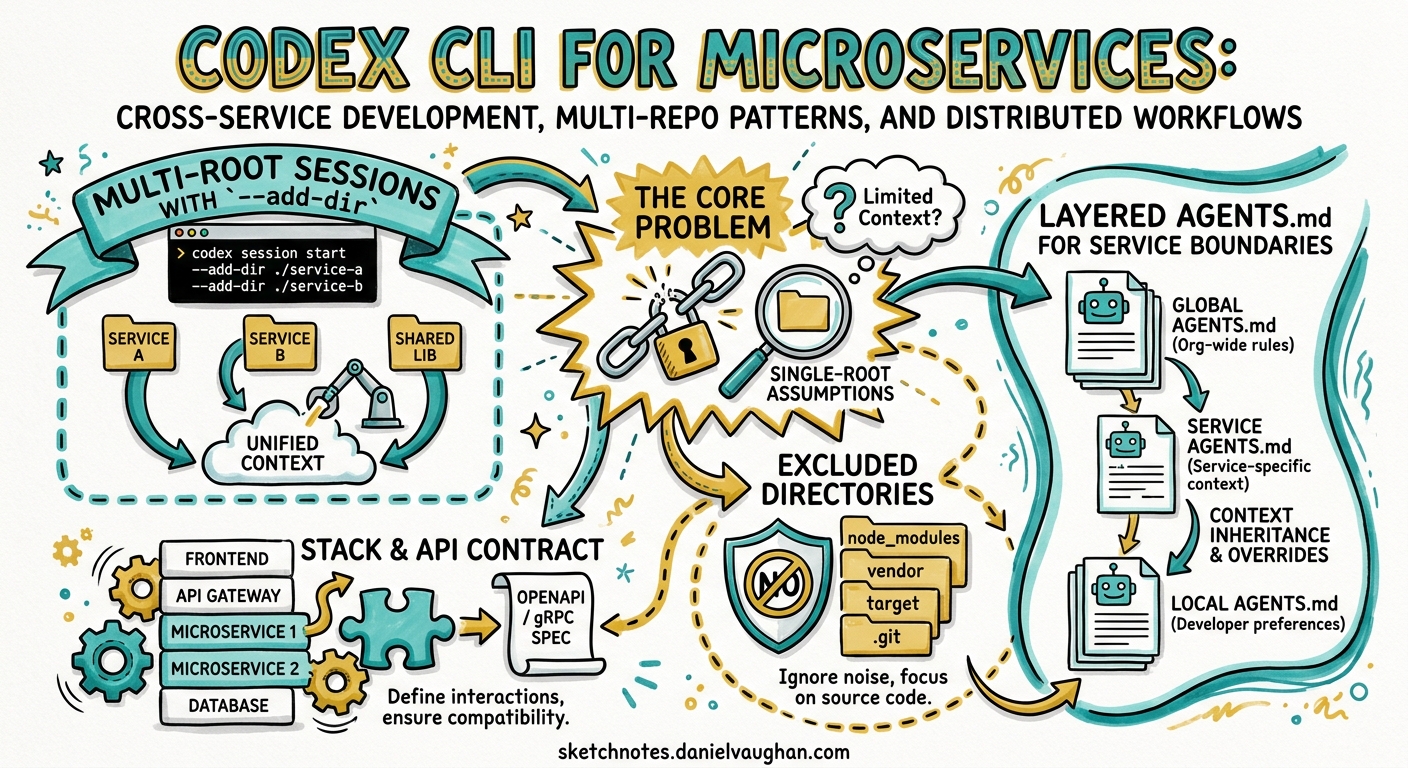
Microservices architectures pose a unique challenge for AI coding agents: the work you need done rarely fits inside a single repository. A typical change — say, adding a field to a shared protobuf definition — cascades across an API gateway, two backend services, a shared library, and a set of integration tests. Codex CLI, as of v0.125, has the primitives to handle these workflows, but you need to assemble them deliberately. This article covers the patterns that work.
The Core Problem: Single-Root Assumptions
Most coding agents, Codex included, default to a single working directory rooted at your Git checkout 1. That assumption breaks immediately when your microservice stack spans multiple repositories. Until recently, the main workaround was running separate Codex sessions per repo and manually coordinating changes — precisely the kind of toil an agent should eliminate.
The community has been vocal about this. GitHub issue #11956 has accumulated significant support from developers who cite multi-repo context as a primary reason for switching between tools 2. Codex CLI’s answer comes in two parts: the --add-dir flag for multi-root sessions, and subagents for parallel cross-service orchestration.
Multi-Root Sessions with --add-dir
The --add-dir flag exposes additional writable roots to a single Codex session 3. This is the foundational primitive for cross-service work:
codex --cd services/api-gateway \
      --add-dir ../user-service \
      --add-dir ../order-service \
      --add-dir ../shared-types
With this invocation, Codex can read and write files across all four directories within a single conversation context. The active path displays in the terminal header, and you can reference files from any root using the @ fuzzy search 3.
Practical Constraints
The --add-dir approach works best when your services live in a monorepo or are checked out as siblings in a parent directory. For genuinely separate repositories, you need to clone them into adjacent paths first:
mkdir -p ~/work/platform && cd ~/work/platform
git clone git@github.com:acme/api-gateway.git
git clone git@github.com:acme/user-service.git
git clone git@github.com:acme/order-service.git
git clone git@github.com:acme/shared-types.git

codex --cd api-gateway \
      --add-dir ../user-service \
      --add-dir ../order-service \
      --add-dir ../shared-types
Be mindful of context window budget. GPT-5.5 offers roughly a million tokens of context 4, but four large services with node_modules or build artefacts can still overwhelm it. Exclude irrelevant paths via AGENTS.md:
## Excluded Directories
Do NOT read or index:
- `node_modules/`, `dist/`, `build/`, `.next/`
- `vendor/`, `target/`, `__pycache__/`
Layered AGENTS.md for Service Boundaries
Codex discovers AGENTS.md files hierarchically, concatenating from the repository root downward 5. In a microservices context, this hierarchy becomes your service contract with the agent:
~/work/platform/
├── AGENTS.md                          # Cross-cutting standards
├── api-gateway/
│   └── AGENTS.md                      # Gateway-specific rules
├── user-service/
│   ├── AGENTS.md                      # Service conventions
│   └── services/auth/
│       └── AGENTS.override.md         # Auth module overrides
├── order-service/
│   └── AGENTS.md
└── shared-types/
    └── AGENTS.md
The root-level AGENTS.md should encode cross-cutting concerns — naming conventions, API versioning rules, shared error handling patterns. Each service-level file narrows the context:
# User Service — AGENTS.md

## Stack
- Runtime: Node.js 22 LTS, TypeScript 5.7
- Framework: Fastify 5.x
- Database: PostgreSQL 16 via Drizzle ORM
- Testing: Vitest + Testcontainers

## API Contract
- All endpoints defined in ../shared-types/proto/user.proto
- gRPC for inter-service, REST for external consumers
- Breaking changes require proto field deprecation, never removal

## Sandbox Rules
- Database migrations must be reversible
- Never modify files in ../shared-types without explicit instruction
The project_doc_max_bytes setting defaults to 32 KiB 5. With four services, you will hit this limit quickly if your AGENTS.md files are verbose. Keep them terse and factual.
Subagent Patterns for Cross-Service Changes
For changes that genuinely need to touch multiple services in parallel, Codex subagents provide structured delegation 6. The system supports up to six concurrent threads by default (max_threads: 6), with a nesting depth of one.
flowchart TD
    A[Orchestrator Agent] --> B[Explorer: Map shared-types impact]
    A --> C[Worker: Update user-service handlers]
    A --> D[Worker: Update order-service handlers]
    A --> E[Worker: Update api-gateway routing]
    B --> F[Consolidated change plan]
    C --> F
    D --> F
    E --> F
    F --> G[Orchestrator: Cross-service integration tests]
Configuring Subagents for Service Specialisation
Create service-specific agent definitions in ~/.codex/agents/:
# ~/.codex/agents/user-svc-worker.toml
name = "user-service-worker"
description = "Implements changes in the user-service, follows Fastify/Drizzle conventions"
developer_instructions = """
You work exclusively in the user-service directory.
Follow the AGENTS.md in that directory.
Run `pnpm test` before reporting completion.
Never modify files outside user-service/ unless explicitly told.
"""
model = "gpt-5.5"
sandbox_mode = "standard"
The built-in agent types — default, worker, and explorer — cover most needs 6. The explorer agent is particularly useful as a first step: send it to map the dependency graph across services before dispatching workers.
Token Budget Awareness
Subagent workflows consume significantly more tokens than single-agent runs 6. For a four-service change, expect roughly 3-4x the token usage of modifying a single service. Use the codex exec --json flag to monitor reasoning token consumption 7, and set job_max_runtime_seconds (default: 1800) to prevent runaway sessions:
[agents]
max_threads = 4
max_depth = 1
job_max_runtime_seconds = 900
The Contract-First Workflow
The most reliable pattern for cross-service changes follows a contract-first approach that minimises coordination failures:
sequenceDiagram
    participant Dev as Developer
    participant Codex as Codex CLI
    participant Proto as shared-types
    participant Svc as Service Workers

    Dev->>Codex: "Add email_verified field to User"
    Codex->>Proto: Update user.proto with new field
    Codex->>Codex: Generate language bindings
    Codex->>Svc: Dispatch workers per service
    Svc->>Svc: Implement handlers + tests
    Svc->>Codex: Report completion
    Codex->>Dev: Consolidated diff for review
In practice, this translates to a prompt like:
Add an email_verified boolean field to the User entity.
1. Update shared-types/proto/user.proto first
2. Regenerate TypeScript and Go bindings
3. Update user-service to populate the field during OAuth callback
4. Update order-service to read the field for fraud checks
5. Update api-gateway to expose it in the REST response
6. Run tests in each service
The explicit ordering matters. Without it, Codex may attempt parallel modifications to shared-types while simultaneously updating consumers, leading to compilation failures against stale definitions.
Integration Testing Across Services
After individual service changes, you need cross-service validation. Codex can orchestrate Docker Compose-based integration tests:
codex exec "Run docker compose up -d for the integration test stack, \
  execute the cross-service test suite in tests/integration/, \
  and report any failures with root cause analysis"
For teams using Testcontainers, add guidance to your root AGENTS.md:
## Integration Testing
- Cross-service tests live in tests/integration/
- Use docker compose -f docker-compose.test.yml up
- Each service exposes health checks on /healthz
- Wait for all health checks before running tests
Current Limitations and Workarounds
Multi-repo support in Codex CLI is functional but evolving. Key limitations to be aware of:
| Limitation | Workaround |
|---|---|
--add-dir requires local filesystem paths |
Clone repos as siblings before starting session |
| No native multi-repo Git operations | Use hooks or post-session scripts for coordinated commits |
| Subagent nesting capped at depth 1 6 | Flatten orchestration; avoid agent-spawns-agent chains |
| IDE extension visibility for subagents is limited 6 | Use CLI with --json for full observability |
| No atomic cross-repo commits | Create PRs per repo, link them in descriptions |
For coordinated commits across repositories, a post-session script works well:
#!/usr/bin/env bash
CHANGE_ID=$(date +%s)
for svc in api-gateway user-service order-service shared-types; do
  cd ~/work/platform/$svc
  git add -A
  git commit -m "feat: add email_verified field [change:${CHANGE_ID}]"
  git push origin HEAD
done
When to Use What
Not every microservices task needs the full multi-root, subagent treatment. A decision framework:
| Scenario | Approach |
|---|---|
| Single-service feature | Standard single-root codex session |
| Shared type change + 1 consumer | --add-dir with two roots |
| Cross-cutting change across 3+ services | Subagents with service-specific workers |
| Read-only cross-service investigation | Explorer subagent across --add-dir roots |
| CI pipeline validation | codex exec with Docker Compose integration tests |