Codex for Open Source: What the Programme Offers Maintainers and How to Make the Most of It
Codex for Open Source: What the Programme Offers Maintainers and How to Make the Most of It
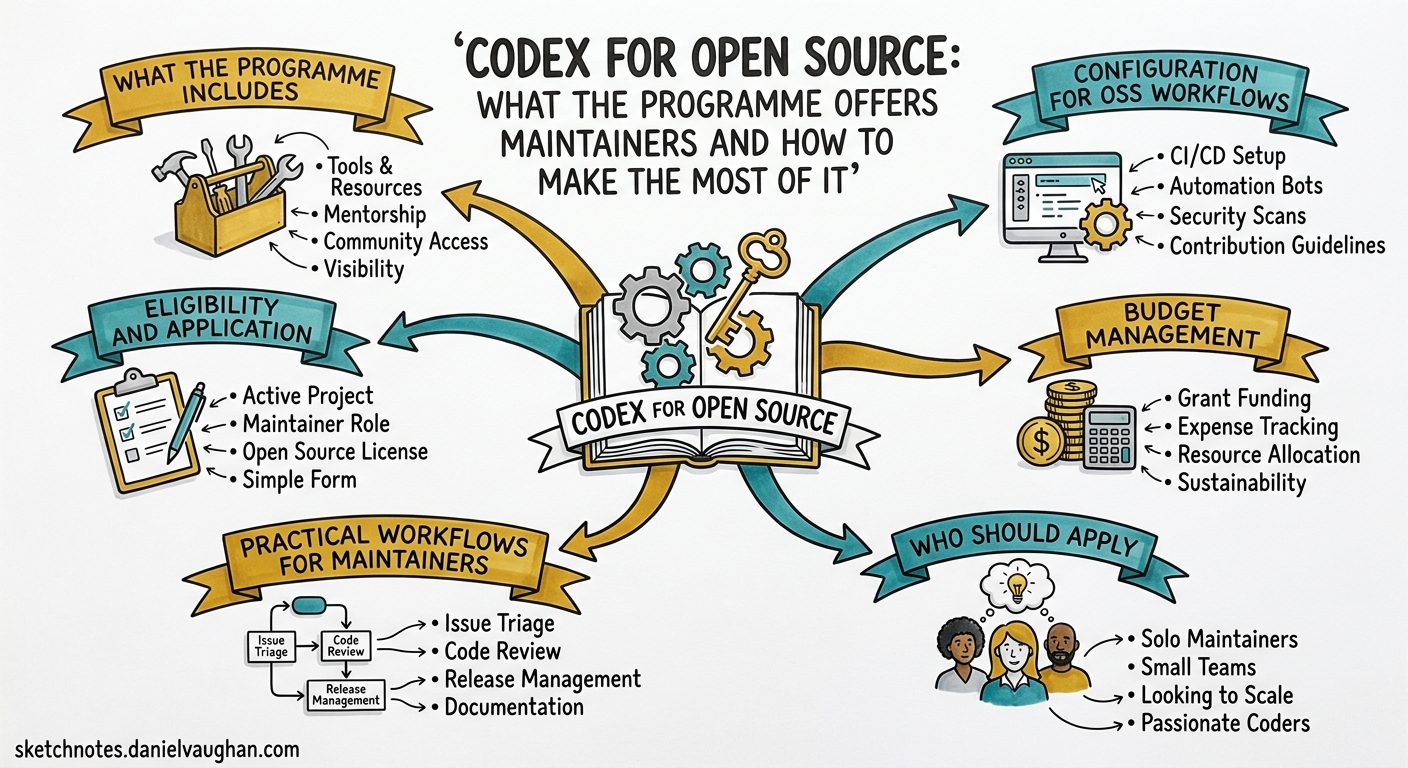
Open-source maintainers do critical infrastructure work — triaging issues, reviewing pull requests, cutting releases, keeping dependencies current — often unpaid and under-tooled. On 7 March 2026 OpenAI announced Codex for Open Source, a programme that bundles six months of ChatGPT Pro (with Codex), up to $25,000 in API credits, and conditional access to Codex Security into a single package aimed squarely at the people who keep the software ecosystem running 12. This article explains what the programme includes, who qualifies, and — most importantly — how to integrate these resources into real maintainer workflows using Codex CLI.
What the Programme Includes
The Codex for Open Source programme delivers three tiers of support 13:
| Benefit | Details |
|---|---|
| ChatGPT Pro with Codex | Six months of full Pro access for day-to-day coding, triage, review, and maintainer workflows |
| API Credits | Grants up to $25,000 from the $1 million Codex Open Source Fund, for projects using Codex in PR review, maintainer automation, or release workflows |
| Codex Security | Conditional access to OpenAI’s vulnerability-scanning agent for repositories that need deeper security coverage |
ChatGPT Pro access is the immediate, lowest-friction benefit: every accepted maintainer gets the interactive Codex agent in the web UI, the desktop app, and the CLI 1. The API credits unlock programmatic use via codex exec, the TypeScript SDK, or the Responses API — essential for CI/CD automation and batch workflows 4. Codex Security access is reviewed case-by-case, reflecting the additional diligence required for security-sensitive scanning 1.
Eligibility and Application
Who Qualifies
The primary criterion is straightforward: core maintainers of public GitHub-hosted projects with at least 1,000 stars 25. OpenAI verifies identity through a GitHub partnership, so you authenticate with your GitHub account during the application process.
However, the programme explicitly welcomes edge cases. The official guidance states: “If your project doesn’t fit the criteria but it plays an important role in the ecosystem, apply anyway and explain why” 1. This means maintainers of critical-but-niche infrastructure (package registries, build tools, specification implementations) should still apply.
Application Process
- Visit the application page at openai.com/form/codex-for-oss 1
- Authenticate via your GitHub account
- Provide project details and describe how you intend to use Codex
- Accept the Codex for Open Source Programme Terms
Applications are reviewed on a rolling basis — there is no fixed deadline, but the fund is capped at $1 million total, so earlier applications are advisable 4. Successful applicants receive immediate access upon approval 5.
Practical Workflows for Maintainers
Having the tools is one thing; wiring them into your daily workflow is another. The sections below cover the three most valuable patterns for open-source maintainers.
Automated PR Review with codex exec
High-volume projects often struggle with PR review throughput. Codex CLI’s non-interactive mode slots directly into a GitHub Actions workflow:
# .github/workflows/codex-review.yml
name: Codex PR Review
on:
  pull_request:
    types: [opened, synchronize]

jobs:
  review:
    runs-on: ubuntu-latest
    steps:
      - uses: actions/checkout@v4
        with:
          fetch-depth: 0

      - name: Install Codex CLI
        run: npm install -g @openai/codex

      - name: Run Codex review
        env:
          CODEX_API_KEY: ${{ secrets.CODEX_API_KEY }}
        run: |
          git diff origin/main...HEAD > /tmp/diff.txt
          cat /tmp/diff.txt | codex exec \
            --full-auto \
            --sandbox read-only \
            --ephemeral \
            "Review this diff for bugs, security issues, and style violations. \
             Output a markdown summary with severity ratings." \
            -o /tmp/review.md

      - name: Post review comment
        uses: marocchino/sticky-pull-request-comment@v2
        with:
          path: /tmp/review.md
The --sandbox read-only flag ensures Codex cannot modify your repository during review, whilst --ephemeral avoids persisting session files to the CI runner 67.
Triage and Issue Classification
For projects receiving dozens of issues per day, Codex can classify and label incoming issues using the API credits:
#!/usr/bin/env bash
# triage-issue.sh — called by a GitHub webhook or scheduled action
ISSUE_BODY="$1"
ISSUE_NUMBER="$2"

LABEL=$(echo "$ISSUE_BODY" | codex exec \
  --full-auto \
  --sandbox read-only \
  --ephemeral \
  --output-schema ./triage-schema.json \
  "Classify this GitHub issue. Categories: bug, feature-request, \
   question, documentation, security. Output JSON with 'category' \
   and 'priority' (P0-P3) fields." \
  -o /dev/stdout | jq -r '.category')

gh issue edit "$ISSUE_NUMBER" --add-label "$LABEL"
The --output-schema flag enforces structured JSON output, making downstream parsing reliable 6.
Security Scanning with Codex Security
For maintainers granted Codex Security access, the agent scans repositories in three phases 8:
flowchart LR
    A[Configure Scan] --> B[Threat Modelling]
    B --> C[Vulnerability Discovery]
    C --> D[Sandboxed Validation]
    D --> E[Patch Generation]
    E --> F[Maintainer Review]
Codex Security operates more like a security researcher than a traditional static analyser: it reads code, generates a project-specific threat model, explores realistic attack paths, and produces minimal patches for validated findings 8. In its research preview, it has scanned over 1.2 million commits across beta repositories, identifying 792 critical findings and more than 10,000 high-severity issues, with false-positive rates falling by over 50% during the beta period 9.
Maintainers integrate findings into their existing workflow — Codex Security surfaces results as reviewable items, not automated commits, keeping humans firmly in the approval loop.
Configuration for OSS Workflows
Once accepted into the programme, configure your Codex CLI installation for maintainer-centric work:
# ~/.codex/config.toml — maintainer profile

[profiles.review]
model = "gpt-5.5"
model_reasoning_effort = "high"
sandbox = "read-only"

[profiles.triage]
model = "o4-mini"
model_reasoning_effort = "medium"
sandbox = "read-only"

[profiles.autofix]
model = "gpt-5.5"
model_reasoning_effort = "high"
sandbox = "workspace-write"
Switch profiles on the fly:
# Deep review of a complex PR
codex --profile review

# Quick issue triage
codex --profile triage

# Automated dependency update
codex --profile autofix "Update all outdated npm dependencies and run tests"
Profiles keep token spend predictable. Use o4-mini with medium reasoning for high-volume, low-complexity triage; reserve gpt-5.5 with high reasoning for security-sensitive reviews or complex refactoring 1011.
Budget Management
The $25,000 API credit grant sounds generous, but sustained CI automation can consume tokens rapidly. Key strategies:
- Gate on diff size — skip Codex review for trivial changes (dependency bumps under 10 lines, documentation-only PRs)
- Use
--ephemeral— avoids writing session rollout files, reducing storage and cleanup overhead 6 - Prefer
o4-minifor classification and triage tasks — it is significantly cheaper per token thangpt-5.510 - Cache structured outputs — if multiple workflows consume the same analysis, write the JSON output to an artefact and share it across jobs
- Monitor with
codex exec --json— the JSONL stream now includes reasoning-token usage, enabling precise per-run cost tracking 12
Who Should Apply
If you maintain a project with 1,000+ GitHub stars, the application is a straightforward value proposition: six months of free tooling with no strings beyond the programme terms. But even if your project falls below the star threshold, consider applying if:
- Your project is a transitive dependency of many larger projects (build tools, linters, serialisation libraries)
- You maintain critical ecosystem infrastructure (package registries, CI tooling, specification implementations)
- Your project handles security-sensitive workloads where Codex Security access would be particularly valuable
The programme is designed to support the maintainers who keep the broader ecosystem healthy — and OpenAI has explicitly stated that edge cases are welcome 1.
Current Limitations
- ⚠️ The $1 million fund is finite and first-come-first-served; there is no public dashboard showing remaining capacity
- ⚠️ Codex Security access is not guaranteed — it is assessed case-by-case based on the repository’s security needs 1
- ⚠️ ChatGPT Pro access is for six months; there has been no announcement regarding renewal or extension
- ⚠️ The programme requires GitHub authentication; projects hosted on GitLab, Codeberg, or other forges are not currently eligible
Citations
-
OpenAI, “Codex for Open Source,” OpenAI Developers, 2026. https://developers.openai.com/community/codex-for-oss ↩ ↩2 ↩3 ↩4 ↩5 ↩6 ↩7 ↩8
-
OpenAI, “Codex for Open Source Application,” OpenAI, 2026. https://openai.com/form/codex-for-oss/ ↩ ↩2
-
MLQ AI, “OpenAI Rolls Out Free ChatGPT Pro and Codex Access for Open Source Maintainers,” MLQ AI News, March 2026. https://mlq.ai/news/openai-rolls-out-free-chatgpt-pro-and-codex-access-for-open-source-maintainers/ ↩
-
OpenAI, “Codex Open Source Fund,” openai/codex GitHub repository, 2026. https://github.com/openai/codex/blob/main/docs/open-source-fund.md ↩ ↩2
-
WinBuzzer, “OpenAI Launches Codex for Open Source With Free ChatGPT Pro,” WinBuzzer, March 2026. https://winbuzzer.com/2026/03/09/openai-codex-open-source-maintainers-free-chatgpt-pro-xcxwbn/ ↩ ↩2
-
OpenAI, “Non-interactive mode,” OpenAI Developers, 2026. https://developers.openai.com/codex/noninteractive ↩ ↩2 ↩3
-
OpenAI, “Agent approvals & security,” OpenAI Developers, 2026. https://developers.openai.com/codex/agent-approvals-security ↩
-
OpenAI, “Codex Security: now in research preview,” OpenAI Blog, March 2026. https://openai.com/index/codex-security-now-in-research-preview/ ↩ ↩2
-
The Hacker News, “OpenAI Codex Security Scanned 1.2 Million Commits and Found 10,561 High-Severity Issues,” The Hacker News, March 2026. https://thehackernews.com/2026/03/openai-codex-security-scanned-12.html ↩
-
OpenAI, “Models,” OpenAI Developers, 2026. https://developers.openai.com/codex/models ↩ ↩2
-
OpenAI, “Config basics,” OpenAI Developers, 2026. https://developers.openai.com/codex/config-basic ↩
-
OpenAI, “Changelog,” OpenAI Developers, 2026. https://developers.openai.com/codex/changelog ↩