GitHub Copilot's Usage-Based Billing Shift: What It Means for Codex CLI Teams
GitHub Copilot’s Usage-Based Billing Shift: What It Means for Codex CLI Teams
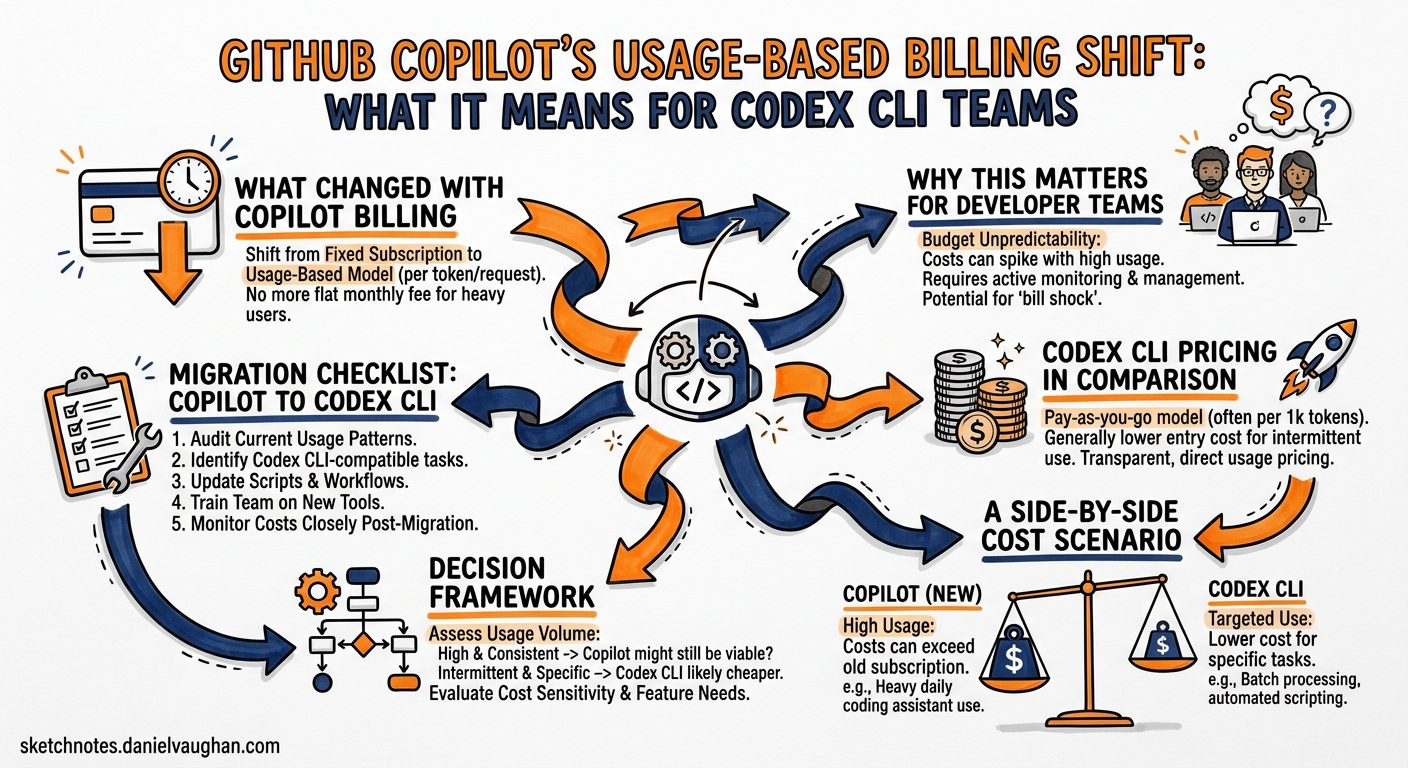
On 27 April 2026, GitHub announced that every Copilot plan will move from premium request units to usage-based billing with GitHub AI Credits on 1 June 2026 1. Two days earlier, Copilot code review was confirmed to start consuming GitHub Actions minutes on the same date 2. For teams already running Codex CLI — or evaluating it — these changes reshape the cost calculus. This article unpacks what changed, compares the two billing models head-to-head, and provides a decision framework for teams weighing their options.
What Changed with Copilot Billing
The Core Shift
Until June 2026, Copilot charged a flat per-seat fee that bundled a monthly allotment of premium request units (PRUs). Under the new model, each plan includes a fixed dollar amount of GitHub AI Credits instead 1:
| Plan | Monthly Price | Included AI Credits |
|---|---|---|
| Copilot Pro | $10/user | $10 |
| Copilot Pro+ | $39/user | $39 |
| Copilot Business | $19/user | $19 |
| Copilot Enterprise | $39/user | $39 |
One AI Credit equals $0.01 USD. Credits are consumed based on token usage — input, output, and cached tokens — at published API rates for each model 1. Code completions and Next Edit suggestions remain free and do not consume credits 1.
Promotional Buffer
Business plans receive $30/month and Enterprise plans $70/month in credits during the June–August 2026 promotional period 1, giving teams a runway to instrument usage before the standard allocations apply.
Code Review Hits Actions Minutes
Starting 1 June, every Copilot code review on a private repository will also draw from your GitHub Actions minutes entitlement, billed at standard runner rates 2. Public repositories remain unaffected. This is an entirely new cost vector that did not exist under the PRU model.
New Sign-Ups Paused
Since 20 April 2026, new individual sign-ups for Copilot Pro, Pro+, and student plans have been temporarily paused, and annual plans are being retired 3. Existing annual subscribers stay on PRUs until their current billing cycle ends.
Why This Matters for Developer Teams
The shift from predictable flat-rate billing to token-metered billing introduces two concerns that developers have been vocal about 4 5:
-
Cost unpredictability. A quick inline completion and a multi-hour agentic coding session can now produce wildly different bills. GitHub acknowledged this directly: “A quick chat question and a multi-hour autonomous coding session can cost the user the same amount, which is unsustainable” 1.
-
Behavioural changes. When credits are finite, developers self-censor. Heavy Chat users, agentic coding session users, and teams relying on automated code review are most likely to feel the squeeze 5.
Codex CLI Pricing in Comparison
Codex CLI’s billing model differs in structure. Here is how the two compare for a team evaluating costs:
Individual Plans
| Feature | Copilot Pro ($10/mo) | Codex CLI via Plus ($20/mo) |
|---|---|---|
| Billing model | Token-metered AI Credits | Message-based rolling window |
| Code completions | Included (free) | N/A (terminal agent, not IDE) |
| Agentic sessions | Credits consumed per token | 15–80 GPT-5.5 messages per 5h window 6 |
| Code review | Credits + Actions minutes | Via codex exec or GitHub Action 7 |
| Predictability | Variable | Capped per window |
Business and Enterprise
| Feature | Copilot Business ($19/user) | Codex Business ($25/user) 6 |
|---|---|---|
| Included credits | $19 AI Credits/mo | Token-based credit pool |
| Credit rates (GPT-5.5, per 1M tokens) | ~$2.50 input / $15 output 8 | 125 input / 12.50 cached / 750 output credits 6 |
| SSO/SCIM | Yes | Yes (SAML, MFA) |
| Admin controls | Org-level spending limits | Managed configuration, requirements.toml 9 |
| Audit logging | Limited | Compliance API, OTEL integration 6 |
The Hidden Cost: Actions Minutes
For teams running Copilot code review on private repositories, the new Actions minutes consumption is an additive cost that Codex CLI does not impose. Codex CLI’s codex exec and codex-action@v1 run on your own CI infrastructure without a separate minutes tax 7.
A Side-by-Side Cost Scenario
Consider a five-person team running 20 code reviews per day on a private monorepo:
Copilot Business (post-June):
  Seats: 5 × $19 = $95/mo
  AI Credits for reviews: variable (token-dependent)
  Actions minutes: ~600 min/mo at $0.008/min = ~$4.80/mo
  Chat/agentic usage: variable
  Total: $95 + variable

Codex CLI Business:
  Seats: 5 × $25 = $125/mo
  Code review via codex-action: runs on your GHA runners
  Agentic usage: included in token credit pool
  Total: $125 (predictable within credit pool)
The break-even point depends on how aggressively the team uses Chat, agentic sessions, and code review. Light users save with Copilot; heavy agentic users may find Codex CLI’s rolling-window model more predictable.
Decision Framework
flowchart TD
    A[Team evaluating AI coding tools] --> B{Primary use case?}
    B -->|IDE completions + light Chat| C[Copilot Pro/Business]
    B -->|Terminal-first agentic workflows| D[Codex CLI]
    B -->|Both IDE + terminal| E{Budget priority?}
    E -->|Predictable monthly cost| F[Codex CLI + IDE completions via Copilot Free]
    E -->|Lowest possible cost for light use| G[Copilot Business]
    C --> H{Heavy code review on private repos?}
    H -->|Yes| I[Factor in Actions minutes cost]
    H -->|No| J[Copilot remains cost-effective]
    D --> K{Need IDE completions?}
    K -->|Yes| L[Pair with Copilot Free or Supermaven]
    K -->|No| M[Codex CLI standalone]
When to Stay on Copilot
- Your team primarily uses inline completions and light Chat — these remain free under the new model 1.
- You are on an annual plan that has not yet expired — PRU billing continues until renewal.
- Your organisation already has GitHub Enterprise with bundled Actions minutes to absorb the code review cost.
When to Evaluate Codex CLI
- Your team runs heavy agentic coding sessions that would consume credits rapidly under token-metered billing.
- You need terminal-first workflows:
codex execfor CI pipelines, non-interactive automation, structured output via--output-schema7. - You want automated code review without an Actions minutes surcharge.
- You are already on ChatGPT Plus or Pro and Codex CLI is included at no additional cost 6.
The Hybrid Approach
Many teams are converging on a split stack 10:
- Copilot Free for IDE completions (zero cost, remains available).
- Codex CLI for agentic terminal workflows, CI automation, and code review.
- This avoids the usage-based billing entirely for completions whilst retaining full agentic capability through Codex.
Migration Checklist: Copilot to Codex CLI
For teams deciding to shift agentic work from Copilot to Codex CLI, here is a practical checklist:
1. Install and Authenticate
# Install via npm
npm install -g @openai/codex

# Authenticate with ChatGPT account (draws from plan limits)
codex auth login

# Or use API key (pay-per-token)
export OPENAI_API_KEY="sk-..."
2. Set Up Project Configuration
# .codex/config.toml
model = "gpt-5.5"
approval_mode = "auto-edit"

[sandbox]
mode = "full"

[profiles.review]
model = "gpt-5.4"
approval_mode = "suggest"
3. Replace Copilot Code Review
# .github/workflows/codex-review.yml
name: Codex PR Review
on:
  pull_request:
    types: [opened, synchronize]

jobs:
  review:
    runs-on: ubuntu-latest
    steps:
      - uses: actions/checkout@v4
      - uses: openai/codex-action@v1
        with:
          task: |
            Review this PR for correctness, security,
            and maintainability. Flag only actionable issues.
          model: gpt-5.5
This runs on your own Actions runners without any separate minutes tax 7.
4. Create an AGENTS.md
# AGENTS.md

## Code Review Standards
- Flag security issues, performance regressions, and API misuse
- Ignore formatting (handled by CI linters)
- Reference team style guide at docs/STYLE.md

## Testing Requirements
- All new functions require unit tests
- Integration tests for API endpoints
- 80% coverage minimum
5. Monitor Token Usage
# Install ccusage for cross-agent token monitoring
pip install ccusage

# Track session costs
ccusage report --last 7d
What to Watch
- June 1 2026: Copilot billing transition takes effect. Monitor actual credit consumption against the promotional allotments 1.
- Copilot Free tier expansion: GitHub may expand the free tier to retain developers migrating away from paid plans.
- Codex CLI rate limit resets: OpenAI reset Codex rate limits for all paid plans on 28 April 2026 11, and the 25x Pro multiplier is honoured through 31 May 2026 6.
- GPT-5.2-Codex API access: Currently available in Codex surfaces for paid ChatGPT users, with API access coming in the following weeks 12. This may further shift the cost equation for teams using API-key billing.
Key Takeaway
GitHub’s shift to usage-based billing is an acknowledgement that flat-rate pricing cannot sustain heavy agentic workloads. For teams whose workflow centres on terminal-based AI agents, CI automation, and non-interactive code review, Codex CLI’s rolling-window model offers more predictable costs. For teams that primarily value IDE completions and light Chat, Copilot remains the simpler choice. The emerging pattern is a hybrid stack: free completions from Copilot, heavy agentic lifting from Codex CLI.
Citations
-
GitHub Blog, “GitHub Copilot is moving to usage-based billing,” 27 April 2026. https://github.blog/news-insights/company-news/github-copilot-is-moving-to-usage-based-billing/ ↩ ↩2 ↩3 ↩4 ↩5 ↩6 ↩7 ↩8
-
GitHub Changelog, “GitHub Copilot code review will start consuming GitHub Actions minutes on June 1, 2026,” 27 April 2026. https://github.blog/changelog/2026-04-27-github-copilot-code-review-will-start-consuming-github-actions-minutes-on-june-1-2026/ ↩ ↩2
-
GitHub Community, “Announcement & FAQ: Changes to GitHub Copilot Individual Plans,” April 2026. https://github.com/orgs/community/discussions/192963 ↩
-
Visual Studio Magazine, “Devs Sound Off on Usage-Based Copilot Pricing Change,” April 2026. https://visualstudiomagazine.com/articles/2026/04/27/devs-sound-off-on-usage-based-copilot-pricing-change-you-will-get-less-but-pay-the-same-price.aspx ↩
-
The New Stack, “GitHub moves Copilot to usage-based billing as AI coding costs climb,” April 2026. https://thenewstack.io/github-copilot-usage-billing/ ↩ ↩2
-
OpenAI, “Codex Pricing,” April 2026. https://developers.openai.com/codex/pricing ↩ ↩2 ↩3 ↩4 ↩5 ↩6
-
OpenAI, “GitHub Action – Codex,” 2026. https://developers.openai.com/codex/github-action ↩ ↩2 ↩3 ↩4
-
GitHub Docs, “Models and pricing for GitHub Copilot,” April 2026. https://docs.github.com/en/copilot/reference/copilot-billing/models-and-pricing ↩
-
OpenAI, “Managed configuration – Codex,” 2026. https://developers.openai.com/codex/enterprise/managed-configuration ↩
-
Slashdot, “GitHub Copilot Is Moving To Usage-Based Billing,” April 2026. https://developers.slashdot.org/story/26/04/27/1717232/github-copilot-is-moving-to-usage-based-billing ↩
-
OpenAI Developer Community, “Codex Rate limits reset for all paid plans April 28, 2026,” April 2026. https://community.openai.com/t/codex-rate-limits-reset-for-all-paid-plans-april-28-2026/1379921 ↩
-
OpenAI, “Introducing GPT-5.2-Codex,” April 2026. https://openai.com/index/introducing-gpt-5-2-codex/ ↩