Interaction Smells in Codex CLI Sessions: Recognising and Fixing Multi-Turn Prompt Anti-Patterns
Interaction Smells in Codex CLI Sessions: Recognising and Fixing Multi-Turn Prompt Anti-Patterns
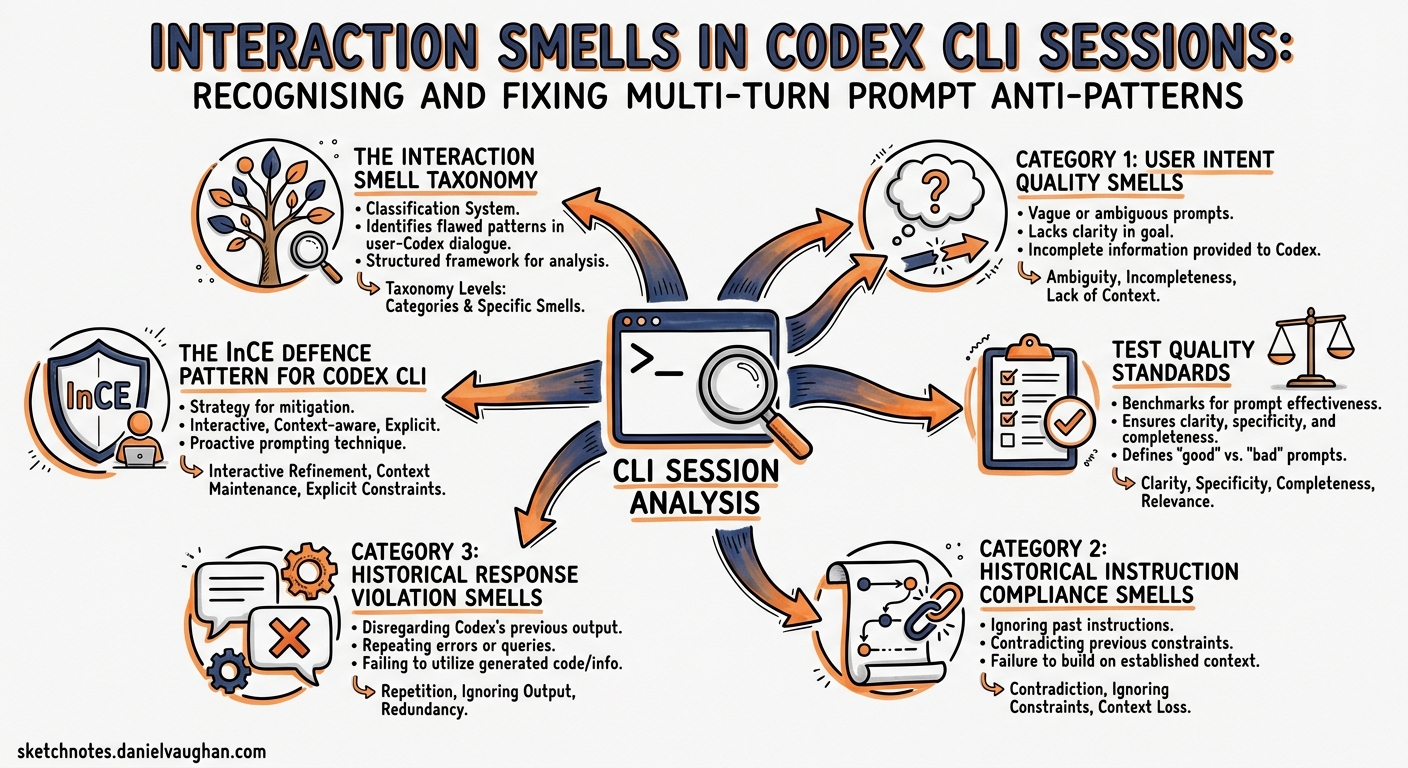
Every senior developer knows about code smells — structural patterns that hint at deeper problems. A March 2026 empirical study from Zhang et al. introduces an analogous concept for AI-assisted coding: interaction smells, the recurring anti-patterns in multi-turn human-LLM conversations that silently degrade output quality over the course of a session1. For Codex CLI users running long agentic sessions — sometimes spanning hours of iterative development — recognising and mitigating these smells is the difference between productive collaboration and context-poisoned drift.
This article maps the research taxonomy onto practical Codex CLI workflows and shows how to use the CLI’s built-in features to defend against each smell category.
The Interaction Smell Taxonomy
The study analysed real-world multi-turn coding conversations across six LLMs (GPT-4o, DeepSeek-Chat, Gemini 2.5, Qwen2.5-32B, Qwen2.5-72B, and Qwen3-235B-a22b) and identified three primary categories of interaction smell, comprising nine subcategories1:
graph TD
    IS[Interaction Smells] --> UIQ[User Intent Quality]
    IS --> HIC[Historical Instruction Compliance]
    IS --> HRV[Historical Response Violation]

    UIQ --> VI[Vague Requirements]
    UIQ --> IS2[Incomplete Specifications]
    UIQ --> AI[Ambiguous Instructions]

    HIC --> MDO[Must-Do Omit]
    HIC --> CC[Constraint Contradiction]
    HIC --> IF[Inconsistent Feedback]

    HRV --> PFB[Partial Functionality Breakdown]
    HRV --> CV[Constraint Violation]
    HRV --> CG[Communication Gap]

    style IS fill:#1a1a2e,stroke:#e94560,color:#fff
    style UIQ fill:#16213e,stroke:#0f3460,color:#fff
    style HIC fill:#16213e,stroke:#0f3460,color:#fff
    style HRV fill:#16213e,stroke:#0f3460,color:#fff
The study found that Must-Do Omit and Partial Functionality Breakdown were the most pervasive smells across all models tested, whilst Ambiguous Instruction appeared less frequently in coding-specific tasks1. The critical insight: these smells compound over turns. A vague requirement in turn 3 interacts with constraint contradiction in turn 7 to produce functionally broken code by turn 12.
Category 1: User Intent Quality Smells
These originate from how the developer frames requests. In Codex CLI sessions, they manifest as prompts that lack the four components OpenAI’s own best-practices guide recommends: objective, context, constraints, and verification criteria2.
Vague Requirements
The smell: “Fix the authentication” instead of “The JWT refresh flow in src/auth/refresh.ts silently swallows 401 responses when the refresh token has expired — make it redirect to /login and clear the stored token.”
Codex CLI defence: Use the @ mention syntax to attach specific files before prompting. The official prompting guide states that “Codex produces higher-quality outputs when it can verify its work”3 — vague prompts make verification impossible.
# Bad: leaves Codex guessing which auth system
codex "fix the auth bug"

# Good: anchors the request with files and verification
codex "The JWT refresh in @src/auth/refresh.ts swallows 401s. \
  Make it redirect to /login and clear localStorage. \
  Run the existing tests in @src/auth/__tests__ to verify."
Incomplete Specifications
The smell: Asking Codex to “add pagination” without specifying cursor vs offset, page size defaults, or whether the API already has pagination headers.
Codex CLI defence: Use /plan mode first. OpenAI recommends toggling Plan mode with /plan or Shift+Tab for complex or ambiguous work2. Plan mode forces Codex to gather information and propose a step-by-step approach before writing code, surfacing the specification gaps early.
Ambiguous Instructions
The smell: “Make the tests better” — better could mean faster, more comprehensive, or more readable.
Codex CLI defence: Use AGENTS.md to encode your team’s definition of quality. As the best-practices guide notes, “a short, accurate AGENTS.md is more useful than a long file full of vague rules”2. Scaffold one with /init and include explicit verification criteria:
<!-- .codex/AGENTS.md -->
## Test quality standards
- Every new function gets at least one happy-path and one error-path test
- Use `vitest` with `--coverage` — minimum 80% branch coverage
- Prefer `describe`/`it` blocks; avoid `test()` for consistency
Category 2: Historical Instruction Compliance Smells
These are the most insidious category for long Codex CLI sessions. They arise when the LLM forgets or contradicts instructions given earlier in the conversation.
Must-Do Omit
The smell: You told Codex to “always run npm test after every change” in turn 2, but by turn 15 it silently stops running tests.
Codex CLI defence: Move durable instructions out of prompts and into AGENTS.md or PostToolUse hooks. The best-practices guide explicitly warns against “embedding durable rules in prompts instead of AGENTS.md”2. Hooks enforce compliance mechanically:
# .codex/config.toml
[[hooks]]
event = "PostToolUse"
tool = "shell"
command = "npm test --silent 2>&1 | tail -5"
timeout_ms = 30000
This hook runs the test suite after every shell command Codex executes — the agent cannot omit it regardless of how long the session runs4.
Constraint Contradiction
The smell: In turn 4 you say “use functional patterns, no classes.” In turn 9, reviewing a module, you say “wrap this in a service class.” The model now holds contradictory constraints and picks whichever it deems more recent.
Codex CLI defence: Use /compact when you catch yourself contradicting earlier instructions. Compaction summarises the conversation history, and you can follow up with a clarifying prompt that resolves the contradiction. For persistent constraints, codify them in AGENTS.md where they cannot drift between turns2.
Inconsistent Feedback
The smell: Approving a code pattern in turn 6, then rejecting the identical pattern in turn 11. This trains the agent towards confusion rather than quality.
Codex CLI defence: Use /fork to explore alternative approaches without polluting the main conversation thread. The fork creates a separate context where you can evaluate a different style without sending mixed signals in the primary session5.
Category 3: Historical Response Violation Smells
These occur when the model itself violates patterns it established earlier, independent of user contradictions.
Partial Functionality Breakdown
The smell: Codex refactors a module and silently drops error handling that was present in the original code.
Codex CLI defence: The SlopCodeBench research (March 2026) found that agent-generated code exhibits an 80% increase in erosion markers and 89.8% increase in verbosity during long-horizon tasks6. The defence is structural: use PostToolUse hooks to run linters and type checkers after every file edit, and configure /review presets that check for behaviour changes:
/review # Uses the built-in review preset to check working tree changes
Constraint Violation
The smell: AGENTS.md says “never modify files in src/generated/” but Codex edits them anyway during a large refactor.
Codex CLI defence: Use deny-read glob policies in config.toml to make protected directories literally invisible to the agent:
# .codex/config.toml
[sandbox]
deny_read = ["src/generated/**", "vendor/**"]
This is a runtime-enforced boundary, not a prompt-level suggestion4.
Communication Gap
The smell: Codex produces code that works but deviates from your architectural intent without explaining why.
Codex CLI defence: Set the /personality to pragmatic for maximum information density, and configure reasoning effort to medium or high for architectural tasks. The prompting guide recommends adjusting reasoning effort to match task complexity — low for quick fixes, high for complex changes3. Higher reasoning effort produces more explicit decision rationale, though the “Reasoning Trap” research cautions that xhigh effort can paradoxically increase tool hallucination7.
The InCE Defence Pattern for Codex CLI
The interaction smells paper proposes Invariant-aware Constraint Evolution (InCE), a multi-agent framework that extracts global invariants from the conversation and runs pre-generation quality audits1. You can approximate this pattern in Codex CLI using three built-in mechanisms:
flowchart LR
    A[AGENTS.md<br/>Global Invariants] --> B[PostToolUse Hooks<br/>Pre-generation Audit]
    B --> C[/compact + /review<br/>Periodic Reconciliation]
    C --> D[Clean Context<br/>Smell-Free Output]

    style A fill:#0f3460,stroke:#e94560,color:#fff
    style B fill:#0f3460,stroke:#e94560,color:#fff
    style C fill:#0f3460,stroke:#e94560,color:#fff
    style D fill:#1a1a2e,stroke:#53d769,color:#fff
- AGENTS.md as invariant store — Encode non-negotiable constraints once; they persist across all turns without drift2.
- Hooks as automated auditors — PostToolUse hooks enforce invariants at the tool level, catching violations before they compound4.
- Periodic compaction and review — Run
/compactevery 20-30 turns to prune accumulated context noise, then/reviewto verify the working tree matches intent5.
Session Hygiene Checklist
| Smell Category | Signal | Codex CLI Mitigation |
|---|---|---|
| Vague Requirements | Agent asks many clarifying questions | Use @ file mentions; write explicit objectives |
| Incomplete Specifications | Output misses edge cases | Use /plan mode first |
| Must-Do Omit | Agent stops following earlier rules | Move rules to AGENTS.md or hooks |
| Constraint Contradiction | Output quality fluctuates wildly | Use /compact; resolve contradictions explicitly |
| Partial Functionality Breakdown | Regressions after refactoring | PostToolUse hooks running tests/linters |
| Constraint Violation | Protected files modified | deny_read policies in config.toml |
| Communication Gap | Code works but deviates from intent | Raise reasoning effort; use /review |
When to Start a New Session
The compounding nature of interaction smells means there is a point of diminishing returns for any conversation thread. OpenAI’s best-practices guide recommends keeping “one thread per coherent unit of work” and warns against “using one thread per project” which causes bloated context2. The research supports this: smell density increases non-linearly with turn count1.
Practical threshold: if you have run /compact more than twice and are still seeing constraint violations or must-do omissions, start a fresh session with /new. Transfer the relevant context through AGENTS.md and file mentions rather than carrying forward a polluted conversation history.
Citations
-
Zhang, B., Zhang, L., Shi, L., Wang, S., Qian, Y., Zhao, L., Liu, F., Fu, A., & Ye, Y. (2026). “An Empirical Study of Interaction Smells in Multi-Turn Human-LLM Collaborative Code Generation.” arXiv:2603.09701v2, March 2026. https://arxiv.org/abs/2603.09701 ↩ ↩2 ↩3 ↩4 ↩5
-
OpenAI. “Best practices — Codex.” OpenAI Developers, April 2026. https://developers.openai.com/codex/learn/best-practices ↩ ↩2 ↩3 ↩4 ↩5 ↩6 ↩7
-
OpenAI. “Codex Prompting Guide.” OpenAI Cookbook, April 2026. https://developers.openai.com/cookbook/examples/gpt-5/codex_prompting_guide ↩ ↩2
-
OpenAI. “Advanced Configuration — Codex.” OpenAI Developers, April 2026. https://developers.openai.com/codex/config-advanced ↩ ↩2 ↩3
-
OpenAI. “Features — Codex CLI.” OpenAI Developers, April 2026. https://developers.openai.com/codex/cli/features ↩ ↩2
-
Orlanski, G., et al. (2026). “SlopCodeBench: Benchmarking How Coding Agents Degrade Over Long-Horizon Iterative Tasks.” arXiv:2603.24755, March 2026. https://arxiv.org/abs/2603.24755 ↩
-
Zhuang, Y., et al. (2026). “The Reasoning Trap: Why Higher Reasoning Effort Increases Tool Hallucination.” arXiv:2510.22977, ICLR 2026. https://arxiv.org/abs/2510.22977 ↩