Agent Interoperability Protocols and Codex CLI: MCP, ACP, and A2A in Practice
Agent Interoperability Protocols and Codex CLI: MCP, ACP, and A2A in Practice
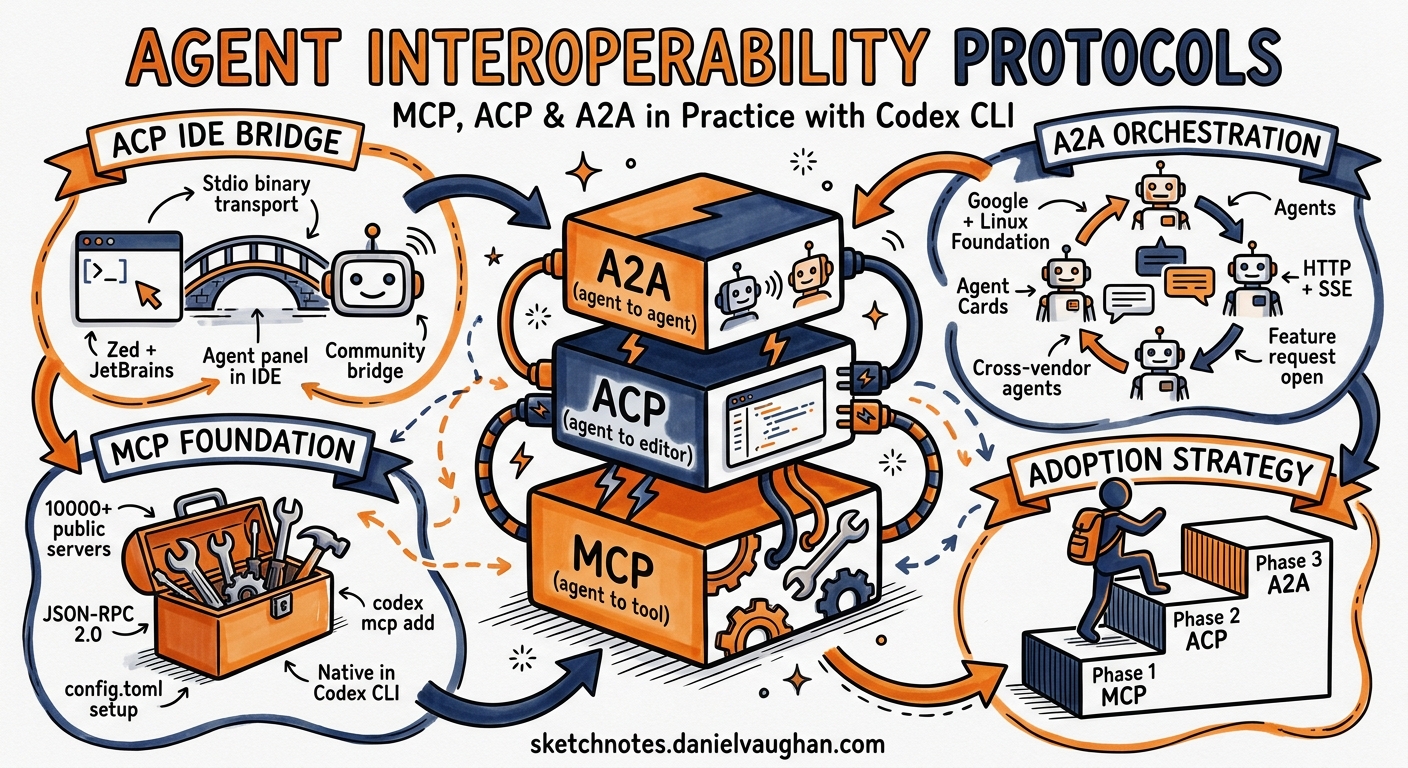
Three agent interoperability protocols now compete for the plumbing underneath every coding agent workflow: the Model Context Protocol (MCP) for tool integration, the Agent Client Protocol (ACP) for IDE integration, and the Agent-to-Agent Protocol (A2A) for inter-agent orchestration1. Codex CLI supports MCP natively, has a mature community bridge for ACP, and is tracking A2A through an open feature request. This article maps each protocol to concrete Codex CLI configuration, explains when you need each one, and provides a phased adoption strategy.
The Three-Protocol Stack
A recent academic survey formalises the relationship between these protocols as complementary layers rather than competitors1:
graph TB
    subgraph "Agent Interoperability Stack"
        A2A["A2A — Agent-to-Agent\n(Horizontal: agent ↔ agent)"]
        ACP["ACP — Agent Client Protocol\n(Diagonal: agent ↔ editor)"]
        MCP["MCP — Model Context Protocol\n(Vertical: agent ↔ tool)"]
    end
    A2A --> ACP
    ACP --> MCP
    style MCP fill:#2d6a4f,color:#fff
    style ACP fill:#1d3557,color:#fff
    style A2A fill:#6a040f,color:#fff
| Protocol | Maintained By | Transport | Primary Use Case |
|---|---|---|---|
| MCP | Anthropic / Linux Foundation AAIF | JSON-RPC 2.0 over stdio, HTTP+SSE | Agent ↔ tool communication2 |
| ACP | Zed Industries + JetBrains | Stdio (binary) | Agent ↔ IDE integration3 |
| A2A | Google / Linux Foundation AAIF | HTTP + SSE, Agent Cards | Agent ↔ agent orchestration4 |
MCP: The Foundation Layer
MCP is the only protocol Codex CLI supports natively. Every MCP server configured in config.toml exposes its tools alongside Codex’s built-in shell and file tools5. With over 10,000 public MCP servers indexed by May 2026, this is the protocol with critical mass6.
Configuration
Add an MCP server to ~/.codex/config.toml:
[mcp_servers.github]
command = "npx"
args = ["-y", "@modelcontextprotocol/server-github"]
env = { GITHUB_TOKEN = "env:GITHUB_TOKEN" }

[mcp_servers.postgres]
command = "npx"
args = ["-y", "@modelcontextprotocol/server-postgres"]
env = { DATABASE_URL = "env:DATABASE_URL" }
Or use the CLI to add servers directly5:
codex mcp add github -- npx -y @modelcontextprotocol/server-github
Running Codex as an MCP Server
Codex can also expose itself as an MCP server, enabling orchestration by external systems like the OpenAI Agents SDK7:
codex mcp-server
This exposes two tools: codex (start a new session) and codex-reply (continue an existing session via thread ID). External agents can then invoke Codex programmatically:
from agents.mcp import MCPServerStdio

async with MCPServerStdio(
    name="Codex CLI",
    params={
        "command": "npx",
        "args": ["-y", "codex", "mcp-server"]
    },
    client_session_timeout_seconds=360000,
) as codex_mcp_server:
    agent = Agent(mcp_servers=[codex_mcp_server])
Hardening MCP in Production
Limit the tools an MCP server can expose using enabled_tools5:
[mcp_servers.github]
command = "npx"
args = ["-y", "@modelcontextprotocol/server-github"]
enabled_tools = ["get_file_contents", "search_code", "list_issues"]
This prevents the agent from invoking destructive operations — critical when running in CI pipelines or with elevated sandbox permissions.
ACP: The IDE Bridge
The Agent Client Protocol, co-developed by Zed Industries and JetBrains, standardises how coding agents integrate with editors3. Where MCP connects agents to tools, ACP connects agents to editing environments — exposing multi-file editing, terminal execution, and real-time feedback loops through a single protocol8.
Why ACP Matters for Codex CLI Users
Since January 2026, the ACP Agent Registry has been live inside both JetBrains IDEs and Zed9. Codex CLI is listed alongside Claude Code, Gemini CLI, and GitHub Copilot CLI. Installing Codex through the registry gives IDE users a graphical interface backed by the same Codex harness that powers the terminal.
The codex-acp Bridge
The community-maintained codex-acp project provides a Rust-based ACP adapter that bridges the Codex runtime to any ACP-compatible client10:
# Build from source
git clone https://github.com/cola-io/codex-acp.git
cd codex-acp
make release
The bridge exposes Codex’s capabilities through ACP’s standardised interface, including:
- Session management with three modes: read-only, auto, and full-access
- Slash commands advertised dynamically:
/init,/status,/compact,/review - Filesystem tools via an embedded MCP server (
acp_fs) withread_text_file,write_text_file,edit_text_file, andmulti_edit_text_file - Custom provider support with model switching using the
{provider_id}@{model_name}format10
Zed Configuration
Configure Codex as an ACP agent in Zed’s settings.json10:
{
  "agent_servers": {
    "Codex": {
      "command": "/path/to/codex-acp",
      "args": [],
      "env": {
        "RUST_LOG": "info",
        "CODEX_LOG_DIR": "./logs"
      }
    }
  }
}
JetBrains Configuration
In JetBrains IDEs (2025.3+), Codex appears in the AI chat agent picker11. The registry handles installation — no manual binary management required. Select Codex from the agent list and it connects through ACP automatically.
A2A: The Orchestration Layer
Google’s Agent-to-Agent protocol, now at version 1.2 under the Linux Foundation’s Agentic AI Foundation, enables agents to discover each other’s capabilities via HTTP-hosted Agent Cards and delegate tasks through structured artifact exchanges412.
Current Codex CLI Status
A2A support for Codex CLI is not yet merged. GitHub issue #11980 tracks a working implementation spanning eight files in codex-rs/a2a and codex-rs/mcp-server that would add13:
- ACP session lifecycle management within the A2A handler
- Token usage tracking via event handling
- Unified tool discovery across MCP and A2A surfaces
- Session-aware HTTP transport routing
The implementation passes cargo check and maintains backward compatibility, but remains open as of May 2026.
What A2A Would Enable
Once landed, A2A support would let Codex CLI participate in multi-vendor agent orchestration. A concrete example: a Symphony-orchestrated workflow where a Codex agent handles code generation, a Claude Code agent handles security review, and a Gemini agent handles documentation — all coordinated through A2A’s task delegation protocol.
sequenceDiagram
    participant O as Orchestrator
    participant C as Codex Agent
    participant S as Security Agent
    participant D as Docs Agent
    O->>C: A2A Task: Implement feature
    C->>C: Code generation (MCP tools)
    C-->>O: Artifact: PR branch
    O->>S: A2A Task: Review security
    S->>S: Static analysis
    S-->>O: Artifact: Security report
    O->>D: A2A Task: Update docs
    D->>D: Doc generation
    D-->>O: Artifact: Updated docs
    O->>O: Merge all artifacts
Working Around the Gap Today
Until native A2A lands, you can achieve cross-agent orchestration using two existing mechanisms:
- Codex as MCP server — external orchestrators (Agents SDK, Kata, Bernstein) invoke Codex through its MCP server interface7
- Symphony — OpenAI’s open-source orchestrator connects Linear tickets to Codex sessions. Since v1.1.0, Symphony also supports the Kata CLI runtime, enabling Claude Code and Gemini alongside Codex14
Protocol Decision Framework
flowchart TD
    A[What do you need?] --> B{Agent needs external tools?}
    B -->|Yes| C[MCP — configure in config.toml]
    B -->|No| D{Agent needs IDE integration?}
    D -->|Yes| E[ACP — install codex-acp or use registry]
    D -->|No| F{Agents need to talk to each other?}
    F -->|Yes| G{Native A2A available?}
    G -->|Yes| H[A2A — configure Agent Card]
    G -->|No| I[Use Codex MCP server + external orchestrator]
    F -->|No| J[Codex CLI standalone is sufficient]
| Scenario | Protocol | Codex CLI Support |
|---|---|---|
| Connect a database, GitHub, or Sentry | MCP | Native — config.toml |
| Use Codex inside Zed or JetBrains | ACP | Community — codex-acp binary |
| Orchestrate Codex with other agents | A2A | Pending — use MCP server as workaround |
| Expose Codex to the Agents SDK | MCP (server mode) | Native — codex mcp-server |
| Run Codex in CI/CD pipelines | None needed | Native — codex exec |
Phased Adoption Strategy
The academic survey recommends sequential adoption1, and this maps cleanly onto Codex CLI maturity:
Phase 1: MCP Foundation (Start Here)
Configure two to three MCP servers that remove your most frequent manual loops. GitHub, your database, and your observability stack are good starting points.
# ~/.codex/config.toml — starter MCP stack
[mcp_servers.github]
command = "npx"
args = ["-y", "@modelcontextprotocol/server-github"]
env = { GITHUB_TOKEN = "env:GITHUB_TOKEN" }

[mcp_servers.context7]
command = "npx"
args = ["-y", "@upstash/context7-mcp"]
Phase 2: ACP for IDE Integration (When Needed)
If your team splits time between terminal and IDE, add ACP. The JetBrains registry makes this zero-configuration for IntelliJ, WebStorm, and Rider users. For Zed, build codex-acp and point settings.json at the binary.
Phase 3: A2A for Multi-Agent Orchestration (When Available)
Monitor GitHub issue #11980 for the A2A merge13. In the interim, use codex mcp-server as the integration point for external orchestrators. Symphony provides a production-ready reference implementation14.
Security Considerations
Each protocol introduces a distinct trust boundary:
- MCP servers run as child processes under Codex’s sandbox. Use
enabled_toolsto restrict the attack surface, anddeny_read_pathsto protect credentials5. - ACP connections run over local stdio — nothing traverses the network by default. The
codex-acpbridge respects Codex’s approval policy and sandbox settings10. - A2A Agent Cards are served over HTTP and can be discovered by any agent on the network. When A2A lands, configure cards behind authentication and restrict which agents can invoke Codex capabilities.
For enterprise environments, managed_config.toml can enforce MCP server allowlists and block unapproved protocol endpoints15.
What Comes Next
The protocol landscape is consolidating. The Linux Foundation’s Agentic AI Foundation now governs both MCP and A2A12, and ACP’s backing from JetBrains and Zed ensures IDE-side longevity. For Codex CLI practitioners, the practical advice is straightforward: invest in MCP configuration now, adopt ACP when your IDE workflow demands it, and prepare for A2A by structuring your orchestration around codex mcp-server so the transition is a protocol swap rather than an architecture change.
Citations
-
Taha, M. et al. (2026). “A Survey of Agent Interoperability Protocols: Model Context Protocol (MCP), Agent Communication Protocol (ACP), Agent-to-Agent Protocol (A2A), and Agent Network Protocol (ANP).” arXiv:2505.02279. https://arxiv.org/html/2505.02279v1 ↩ ↩2 ↩3
-
Anthropic. “Model Context Protocol — Specification.” https://spec.modelcontextprotocol.io/ ↩
-
Zed Industries. “Agent Client Protocol.” https://zed.dev/acp ↩ ↩2
-
Google. “Agent2Agent Protocol.” GitHub repository. https://github.com/a2aproject/A2A ↩ ↩2
-
OpenAI. “Model Context Protocol — Codex CLI.” OpenAI Developers. https://developers.openai.com/codex/mcp ↩ ↩2 ↩3 ↩4
-
GetStream. “Top AI Agent Protocols in 2026 — MCP, A2A, ACP & More.” https://getstream.io/blog/ai-agent-protocols/ ↩
-
OpenAI. “Use Codex with the Agents SDK.” OpenAI Developers. https://developers.openai.com/codex/guides/agents-sdk ↩ ↩2
-
Natarajan, T. (2026). “Agent Client Protocol (ACP): The LSP Moment for AI Coding Agents.” Medium. https://thamizhelango.medium.com/agent-client-protocol-acp-the-lsp-moment-for-ai-coding-agents-and-how-jetbrains-and-zed-nailed-e2a42f5defb0 ↩
-
JetBrains. “ACP Agent Registry Is Live.” The JetBrains AI Blog. https://blog.jetbrains.com/ai/2026/01/acp-agent-registry/ ↩
-
Cola.io. “codex-acp — Agent Client Protocol bridge for Codex CLI.” GitHub repository. https://github.com/cola-io/codex-acp ↩ ↩2 ↩3 ↩4
-
JetBrains. “Codex Is Now Integrated Into JetBrains IDEs.” The JetBrains AI Blog. https://blog.jetbrains.com/ai/2026/01/codex-in-jetbrains-ides/ ↩
-
Linux Foundation. “Agentic AI Foundation (AAIF).” Governs A2A and MCP specifications. https://www.linuxfoundation.org/ ↩ ↩2
-
OpenAI/Codex. “feat(a2a): add ACP session management and token usage tracking to A2A server.” GitHub Issue #11980. https://github.com/openai/codex/issues/11980 ↩ ↩2
-
OpenAI. “An open-source spec for Codex orchestration: Symphony.” https://openai.com/index/open-source-codex-orchestration-symphony/ ↩ ↩2
-
OpenAI. “Managed Configuration — Codex.” OpenAI Developers. https://developers.openai.com/codex/managed-configuration ↩