Do Agent-Written Tests Actually Help? What Six LLMs on SWE-bench Reveal and How to Rethink Your Codex CLI Testing Strategy
Do Agent-Written Tests Actually Help? What Six LLMs on SWE-bench Reveal and How to Rethink Your Codex CLI Testing Strategy
Introduction
The instinct to make coding agents write tests is strong — and understandable. Test-driven development has been a pillar of professional software engineering for decades, and encoding that discipline into your AGENTS.md feels like the obvious move. But a February 2026 study by Chen et al. challenges this assumption head-on: across six frontier LLMs on SWE-bench Verified, agent-written tests reshaped process and cost far more than they changed outcomes 1.
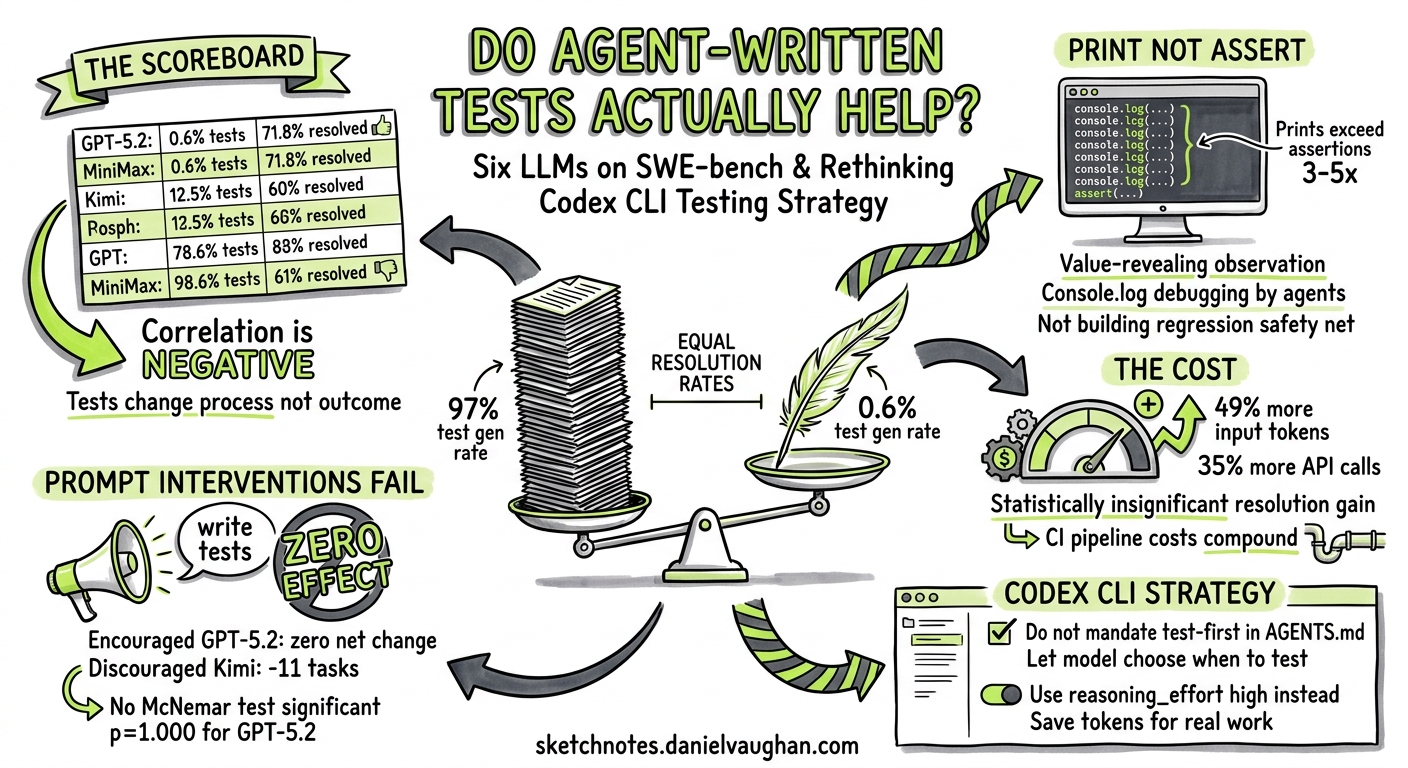
The finding is striking. GPT-5.2 wrote new tests in just 0.6% of tasks yet resolved 71.8% — comparable to models that generated tests in over 97% of tasks 1. This article unpacks the research, cross-references it with a complementary March 2026 empirical study of real-world agent test generation 2, and translates both into actionable Codex CLI configuration guidance.
The Core Finding: Tests as Process, Not Outcome
Chen et al. analysed trajectories from six strong LLMs on SWE-bench Verified 1:
| Model | Test Gen Rate | Resolution Rate |
|---|---|---|
| MiniMax M2 | 98.6% | 61.0% |
| Kimi K2 Thinking | 97.4% | 63.4% |
| DeepSeek v3.2 Reasoner | 89.2% | 60.0% |
| Claude Opus 4.5 | 83.0% | 74.4% |
| Gemini 3 Pro | 61.6% | 74.2% |
| GPT-5.2 | 0.6% | 71.8% |
The correlation between test generation rate and resolution rate is, if anything, negative. The three highest test generators (MiniMax, Kimi, DeepSeek) all resolved fewer tasks than the three lowest generators (Claude, Gemini, GPT-5.2).
What Agents Actually Write
When agents do write tests, they overwhelmingly use print statements rather than assertions as their primary feedback mechanism 1. Across all models, value-revealing prints exceeded assertions by a factor of 3–5×:
- Claude Opus 4.5: 5.16 assertions vs 25.00 prints per task
- MiniMax M2: 7.37 assertions vs 34.06 prints per task
- Kimi K2 Thinking: 2.86 assertions vs 20.72 prints per task
The print statements serve as observational feedback — the agent is essentially console.log-debugging rather than building a regression safety net 1. Of those prints, 70–77% were categorised as value/content inspection (P1), with only 3–7% being structural summaries (P2) 1.
Prompt Interventions Don’t Change Outcomes
The study’s most provocative finding comes from the prompt-intervention experiment. When prompts were modified to encourage or discourage test writing across four models 1:
- GPT-5.2 (encouraged to write tests): 64.4% of tasks gained tests, but zero net change in resolved tasks (p=1.000)
- Gemini 3 Pro (encouraged): 37.0% shift, net −1 resolved task (p=0.522)
- Kimi K2 Thinking (discouraged): 68.4% shift, net −11 resolved tasks (p=0.228)
- DeepSeek v3.2 Reasoner (discouraged): 75.2% shift, net −20 resolved tasks (p=0.435)
No McNemar test reached statistical significance. Tests changed the process but not the bottom line.
The Cost of Testing Theatre
Where the impact does show up is in token consumption. When Kimi K2 Thinking was discouraged from writing tests 1:
- API calls dropped 35.4% (−16.57 calls per task)
- Input tokens dropped 49.0% (−327,760 tokens per task)
- Output tokens dropped 43.1% (−6,427 tokens per task)
- Resolution dropped just 2.6% (statistically insignificant)
DeepSeek v3.2 Reasoner showed similar patterns: 32.9% fewer input tokens and 24.5% fewer API calls when discouraged from testing, with a non-significant 1.8% resolution drop 1.
This is not a small overhead. At current Codex CLI pricing, a 49% input token reduction translates directly to lower session costs — and in a CI pipeline running codex exec on hundreds of issues, the savings compound rapidly.
graph LR
    A[Agent starts task] --> B{Write tests?}
    B -->|Yes - 97% of tasks| C[Write test file]
    C --> D[Run tests - avg 5-7 executions]
    D --> E[Debug with print statements]
    E --> D
    D --> F[Edit source code]
    F --> G[Resolution: ~62%]
    B -->|No - skip tests| F2[Edit source code directly]
    F2 --> G2[Resolution: ~72%]

    style G fill:#f9f,stroke:#333
    style G2 fill:#9f9,stroke:#333
Complementary Evidence: Real-World Test Quality
A March 2026 study by Yoshimoto et al. provides the other side of the coin 2. Analysing 2,232 commits from real-world repositories via the AIDev dataset, they found:
- AI authored 16.4% of all commits adding tests
- AI-generated tests featured higher assertion density and longer code
- AI-generated tests maintained lower cyclomatic complexity (linear, sequential logic)
- Code coverage from AI tests was comparable to human-written tests 2
This paints a more nuanced picture: when agents write tests that persist in the codebase (as opposed to throwaway debugging tests during issue resolution), those tests are structurally sound and contribute meaningfully to coverage.
The reconciliation is straightforward: agent-written tests are valuable as durable artefacts but wasteful as ephemeral debugging scaffolding. The problem isn’t that agents can’t write good tests — it’s that during autonomous issue resolution, they default to using tests as printf debugging rather than building lasting regression protection.
Reconfiguring Your Codex CLI Testing Strategy
1. Separate Test-Writing from Bug-Fixing
Rather than asking Codex to write tests while fixing a bug, treat testing as a distinct phase. Use the plan-execute pattern 3:
<!-- AGENTS.md -->
## Bug Fix Protocol
1. Diagnose the root cause
2. Implement the minimal fix
3. Run existing tests to verify the fix
4. ONLY write new tests if the bug reveals a coverage gap
5. Do NOT write throwaway diagnostic scripts
This mirrors GPT-5.2’s approach — minimal test generation, maximum resolution — while preserving the option for genuine coverage expansion.
2. Use Reasoning Effort to Control Test Behaviour
Higher reasoning effort correlates with more deliberate tool use 4. For bug-fix tasks where you want focused resolution without test proliferation, lower effort keeps the agent on target:
# ~/.codex/config.toml

[profile.fix]
model = "gpt-5.5"
model_reasoning_effort = "medium"
# Medium effort: focused problem-solving, less process overhead

[profile.test]
model = "gpt-5.5"
model_reasoning_effort = "high"
# High effort for dedicated test-writing sessions
Invoke with codex -p fix for repairs and codex -p test for coverage expansion.
3. Dedicated Test-Writing Subagent
Codex CLI’s custom agent definitions let you create a specialised test writer that runs after the fix is verified 5:
# .codex/agents/test-writer.toml

model = "gpt-5.5"
model_reasoning_effort = "high"

[instructions]
content = """
You are a test engineer. Your sole job is to write durable regression tests.

Rules:
- Never modify production code
- Every test must use proper assertions, never print-based verification
- Each test must have a clear docstring explaining what regression it prevents
- Target the specific behaviour that was just fixed or added
- Prefer integration tests over unit tests for cross-module changes
"""
4. PostToolUse Hooks for Test Quality
Rather than preventing test writing entirely, enforce quality when it happens 6:
# ~/.codex/config.toml

[[hooks]]
event = "PostToolUse"
tool = "apply_patch"
command = """
python3 -c "
import sys, re
patch = open(sys.argv[1]).read() if len(sys.argv) > 1 else ''
if 'test' in patch.lower():
    prints = len(re.findall(r'print\(', patch))
    asserts = len(re.findall(r'assert|self\.assert|expect\(', patch))
    if prints > asserts and prints > 3:
        print('WARNING: Test has more print statements than assertions.')
        print(f'Prints: {prints}, Assertions: {asserts}')
        print('Consider using proper assertions for durable regression coverage.')
        sys.exit(1)
"
"""
5. Structured CI Testing with codex exec
For CI pipelines, split the workflow into two explicit phases to avoid the test-writing overhead during resolution 7:
#!/bin/bash
# Phase 1: Fix the issue (discourage throwaway tests)
codex exec -p fix \
  --ignore-rules \
  "Fix issue #${ISSUE_NUMBER}. Do NOT write diagnostic test scripts. \
   Run existing tests to verify your fix passes."

# Phase 2: Add regression test (dedicated test-writing pass)
codex exec -p test \
  "Write a regression test for the fix applied to issue #${ISSUE_NUMBER}. \
   The test must use assertions, not print statements. \
   It must fail if the fix is reverted."
This two-pass approach captures both the efficiency of skipping throwaway tests and the durability of proper regression coverage.
When Agent-Written Tests ARE Worth the Cost
The research does not say “never write tests”. It says the current default behaviour — where agents reflexively generate ephemeral tests as a debugging mechanism — costs tokens without improving outcomes 1. Tests remain valuable when:
- You are building coverage, not fixing bugs — dedicated test-writing sessions with high reasoning effort produce structurally sound, high-assertion-density tests 2
- The test will persist — if the test goes into the repository and protects against regression, the token cost is amortised across every future CI run
- You need verification, not exploration — TDD workflows where the test defines the requirement (red-green-refactor) are fundamentally different from agents writing tests to debug their own work 8
- Existing coverage is thin — when there are no existing tests to validate against, generating them becomes a genuine necessity rather than a habit
Decision Framework
flowchart TD
    A[Task Type] --> B{Bug fix with existing tests?}
    B -->|Yes| C[Skip test generation<br/>Run existing tests<br/>Profile: fix]
    B -->|No| D{Coverage gap identified?}
    D -->|Yes| E[Write targeted regression test<br/>Use test-writer subagent<br/>Profile: test]
    D -->|No| F{New feature?}
    F -->|Yes| G[TDD: write test first<br/>Then implement<br/>Profile: test then fix]
    F -->|No| H[Fix directly<br/>Verify with existing suite]

    style C fill:#e8f5e9
    style E fill:#fff3e0
    style G fill:#e3f2fd
    style H fill:#e8f5e9
Practical Takeaways
-
Mandate test quality, not test quantity — AGENTS.md policies that say “always write tests” encourage the very pattern the research shows is wasteful. Say “write durable regression tests when coverage gaps exist” instead.
-
Measure assertion-to-print ratio — if your agent’s test files contain more
print()calls than assertions, it is debugging, not testing. PostToolUse hooks can catch this automatically. -
Use two-pass CI workflows — separate fix and test phases in
codex execpipelines. The fix pass runs 35–49% cheaper without throwaway test overhead. -
Match the approach to the model — GPT-5.2 and GPT-5.5 naturally favour direct resolution. Other models (particularly Kimi K2 and MiniMax) default to heavy test generation. Your AGENTS.md should account for the model’s tendencies.
-
Test-writing is a first-class task, not a side effect — treat test creation with the same intentionality as feature development. Dedicated subagents, dedicated profiles, dedicated sessions.
Citations
-
Chen, Z., Sun, Z., Shi, Y., Peng, C., Gu, X., Lo, D., & Jiang, L. (2026). “Rethinking the Value of Agent-Generated Tests for LLM-Based Software Engineering Agents.” arXiv:2602.07900v2. https://arxiv.org/abs/2602.07900 ↩ ↩2 ↩3 ↩4 ↩5 ↩6 ↩7 ↩8 ↩9 ↩10
-
Yoshimoto, S., Fujita, S., Horikawa, K., Feitosa, D., Kashiwa, Y., & Iida, H. (2026). “Testing with AI Agents: An Empirical Study of Test Generation Frequency, Quality, and Coverage.” arXiv:2603.13724. https://arxiv.org/abs/2603.13724 ↩ ↩2 ↩3 ↩4
-
OpenAI. “Best practices — Codex.” https://developers.openai.com/codex/learn/best-practices ↩
-
OpenAI. “Configuration Reference — Codex.” https://developers.openai.com/codex/config-reference ↩
-
OpenAI. “Subagents — Codex.” https://developers.openai.com/codex/concepts/subagents ↩
-
OpenAI. “Hooks — Codex CLI.” https://developers.openai.com/codex/cli/hooks ↩
-
OpenAI. “Non-interactive mode — Codex CLI.” https://developers.openai.com/codex/cli/non-interactive ↩
-
OpenAI. “Codex Prompting Guide.” https://developers.openai.com/cookbook/examples/gpt-5/codex_prompting_guide ↩