Coder Agents vs Codex CLI: Self-Hosted, Model-Agnostic Agent Infrastructure and What It Means for Enterprise AI Coding
Coder Agents vs Codex CLI: Self-Hosted, Model-Agnostic Agent Infrastructure and What It Means for Enterprise AI Coding
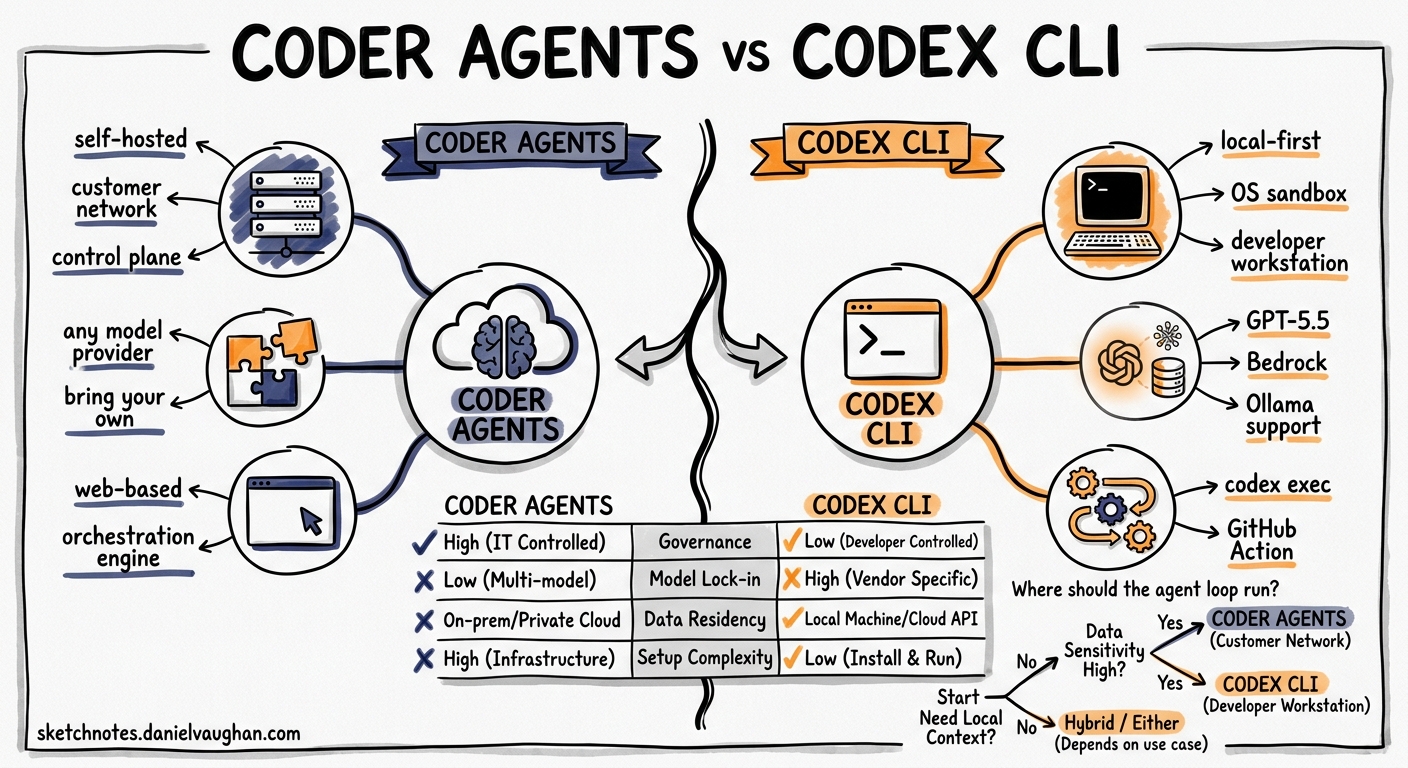
On 6 May 2026, Coder Technologies released Coder Agents to public beta — a native AI coding agent that runs entirely on customer-owned infrastructure and supports any model provider1. Two days later, the Codex CLI ecosystem sits at v0.129 with its own multi-provider story, including Amazon Bedrock, Ollama, LM Studio, and custom provider endpoints2. For engineering leaders evaluating their agent strategy, these two products represent fundamentally different architectural bets. This article compares them honestly and maps out the decision points.
Two Philosophies of Agent Infrastructure
The core divergence is where the agent loop runs and who controls the model.
Codex CLI is a local-first terminal agent. The CLI binary runs on your workstation (or in CI via codex exec), authenticates through OpenAI’s API or a ChatGPT subscription, and executes commands inside an OS-level sandbox (Seatbelt on macOS, Bubblewrap on Linux, restricted tokens on Windows)3. The model inference always calls an external provider — OpenAI by default, though v0.129 supports Amazon Bedrock, Ollama, LM Studio, and fully custom provider endpoints2.
Coder Agents takes a different approach. The entire system — control plane, orchestration engine, and execution environment — runs inside the customer’s network perimeter1. Coder provides the agent runtime; you bring your own models from Anthropic, OpenAI, Google, AWS Bedrock, or self-hosted inference servers. Source code and prompts never leave your infrastructure4.
flowchart LR
    subgraph "Codex CLI Architecture"
        DEV1[Developer Workstation] --> SANDBOX[OS Sandbox]
        SANDBOX --> API[OpenAI API / Bedrock / Custom Provider]
        API --> MODEL1[GPT-5.5 / Claude / Local]
    end

    subgraph "Coder Agents Architecture"
        DEV2[Developer Browser / API] --> CP[Coder Control Plane]
        CP --> ORCH[Orchestration Engine]
        ORCH --> EXEC[Coder Workspace]
        ORCH --> MODEL2[Any Model Provider]
    end

    style API fill:#f9f,stroke:#333
    style CP fill:#bbf,stroke:#333
Where Codex CLI Excels
Model Quality and Ecosystem Depth
Codex CLI’s tight coupling with OpenAI models is a constraint, but it is also a strength. The GPT-5.x Codex model family has been specifically trained on the V4A patch format that apply_patch uses5, and features like --output-schema, reasoning-effort controls (Alt+, / Alt+.), and the Guardian auto_review agent are tuned for these models6. Third-party models work — Bedrock and Ollama support shipped in recent releases — but the first-party experience remains the tightest.
Developer-Centric Workflow
Codex CLI is a single npm install -g codex away from a working agent. The TUI offers session resume, /fork, /diff, /review, Vim modal editing, and configurable keymaps7. The plugin marketplace, skill definitions, and AGENTS.md hierarchy give individual developers fine-grained control over agent behaviour without waiting for an infrastructure team to provision anything.
Sandboxing Without Infrastructure
The OS-level sandbox runs on every developer’s laptop with zero infrastructure overhead. Bubblewrap namespaces on Linux provide network isolation and filesystem boundaries that approximate container-level security without a container runtime3.
CI and Automation
codex exec powers non-interactive pipelines, including structured JSON output via --output-schema, JSONL event streams via --json, and the codex-action GitHub Action for PR-triggered agent workflows8. The agent runs wherever Node.js runs — no orchestration platform required.
Where Coder Agents Excels
True Air-Gap Capability
Coder Agents supports fully air-gapped deployments where no traffic leaves the network perimeter1. Codex CLI, even with a custom provider endpoint, still needs outbound connectivity to reach the model API — unless you run a local inference server, which limits you to open-weight models rather than frontier models like GPT-5.5.
Model Agnosticism as a First-Class Feature
Platform teams can centrally control which models are available, and developers choose from approved options4. Switching from Anthropic to OpenAI to a self-hosted Llama variant requires no client-side reconfiguration. Codex CLI’s model_providers table supports custom endpoints, but the tooling (apply_patch, Guardian, structured output) is optimised for OpenAI models.
Centralised Governance
Coder Agents provides organisation-wide visibility into agent usage, output quality, and policy compliance from a single control plane1. Codex CLI’s governance story relies on requirements.toml pushed to repositories, OTEL trace export, and hook-based audit trails — powerful but distributed across repositories rather than centralised9.
Workspace Isolation
Each agent task runs in a dedicated Coder workspace — an ephemeral cloud development environment with its own filesystem, network policy, and resource limits10. Codex CLI’s sandbox is process-level rather than machine-level, which is lighter but offers a smaller blast radius.
The Overlap: Complementary Rather Than Competing
These tools are not mutually exclusive. Coder has supported running Codex CLI inside Coder workspaces since 202510, and the pattern still works with Coder Agents:
- Coder Agents for batch orchestration — trigger repository-scale tasks (test generation, dependency upgrades, security scans) from the Coder control plane using a centrally governed model.
- Codex CLI for interactive development — individual developers run Codex CLI locally or inside a Coder workspace for real-time pair-programming, using the TUI’s rich session management.
flowchart TB
    subgraph "Enterprise Hybrid Pattern"
        PLATFORM[Platform Team] --> CA[Coder Agents Control Plane]
        CA -->|batch tasks| WS1[Coder Workspace 1]
        CA -->|batch tasks| WS2[Coder Workspace 2]

        DEV[Developer] -->|interactive| CLI[Codex CLI in Workspace]
        DEV -->|interactive| LOCAL[Codex CLI Local]

        CA --> GOV[Governance Dashboard]
        CLI -->|OTEL traces| GOV
        LOCAL -->|OTEL traces| GOV
    end
Decision Framework
| Criterion | Codex CLI | Coder Agents |
|---|---|---|
| Deployment | Local binary, zero infrastructure | Control plane + workspace fleet |
| Model lock-in | OpenAI-optimised, multi-provider capable | Fully model-agnostic by design |
| Air-gap support | Partial (local models only) | Full (self-hosted models + inference) |
| Governance | Distributed (OTEL, hooks, requirements.toml) | Centralised control plane |
| Developer UX | Rich TUI, plugins, skills, session resume | Browser-based, API-driven |
| Setup time | Minutes (npm install) | Hours to days (infrastructure provisioning) |
| Cost model | Per-token (OpenAI API / ChatGPT subscription) | Infrastructure + model inference costs |
| Sandbox | OS-level (Seatbelt/Bubblewrap/DACL) | Workspace-level (container/VM) |
| Maturity | GA, v0.129, 4M+ users11 | Public beta, free through September 20261 |
Practical Considerations
For Regulated Industries
If your compliance regime requires that source code and prompts never leave your network — common in financial services, defence, and healthcare — Coder Agents’ architecture is purpose-built for this constraint4. Codex CLI can approximate it with Ollama and local models, but you sacrifice access to frontier model capabilities.
For Startup and Mid-Market Teams
Codex CLI’s zero-infrastructure model is hard to beat. A team of five can be productive within an hour. The ChatGPT Pro subscription at $200/month per seat gives unlimited access to GPT-5.5 for coding12. Coder Agents requires provisioning infrastructure — worthwhile at scale, but overhead for smaller teams.
For Platform Engineering Teams
If you already run Coder for cloud development environments, Coder Agents is a natural extension of your existing investment. If your developers primarily work locally, Codex CLI with OTEL export to a centralised observability stack may provide sufficient governance without a new control plane.
What to Watch
Coder Agents is in beta with no usage-based limits through September 20261. The key question is whether its native agent can match the quality of purpose-built agents like Codex CLI that have been trained alongside their model family. Conversely, Codex CLI’s multi-provider support continues to mature — if future releases close the UX gap for non-OpenAI models, the architectural distinction narrows.
The broader trend is clear: enterprises want agent infrastructure that separates the agent runtime from the model provider, and both Coder and OpenAI are converging on this pattern from opposite starting points.
Citations
-
Coder, “Coder Sets a New Standard for AI Coding with Self-Hosted, AI Model Agnostic Coder Agents,” GlobeNewsWire, 6 May 2026. https://www.globenewswire.com/news-release/2026/05/06/3288916/0/en/Coder-Sets-a-New-Standard-for-AI-Coding-with-Self-Hosted-AI-Model-Agnostic-Coder-Agents.html ↩ ↩2 ↩3 ↩4 ↩5 ↩6
-
OpenAI, “Configuration Reference – Codex CLI,” OpenAI Developers, accessed 8 May 2026. https://developers.openai.com/codex/config-reference ↩ ↩2
-
OpenAI, “Sandbox – Codex,” OpenAI Developers, accessed 8 May 2026. https://developers.openai.com/codex/concepts/sandboxing ↩ ↩2
-
Coder, “Self-Hosted AI Model Agnostic Coder Agents,” Coder Blog, 6 May 2026. https://coder.com/blog/self-hosted-ai-model-agnostic-coder-agents ↩ ↩2 ↩3
-
OpenAI, “Apply Patch,” OpenAI API Docs, accessed 8 May 2026. https://developers.openai.com/api/docs/guides/tools-apply-patch ↩
-
OpenAI, “Agent Approvals & Security – Codex,” OpenAI Developers, accessed 8 May 2026. https://developers.openai.com/codex/agent-approvals-security ↩
-
OpenAI, “Features – Codex CLI,” OpenAI Developers, accessed 8 May 2026. https://developers.openai.com/codex/cli/features ↩
-
OpenAI, “Non-interactive Mode – Codex,” OpenAI Developers, accessed 8 May 2026. https://developers.openai.com/codex/noninteractive ↩
-
OpenAI, “Advanced Configuration – Codex,” OpenAI Developers, accessed 8 May 2026. https://developers.openai.com/codex/config-advanced ↩
-
Coder, “Cloud Development Environments,” Coder Documentation, accessed 8 May 2026. https://coder.com/docs ↩ ↩2
-
SD Times, “May 8, 2026: AI updates from the past week,” 8 May 2026. https://sdtimes.com/ai/may-8-2026-ai-updates-from-the-past-week-coder-agents-launch-snyk-claude-partnership-opsera-cursor-partnership-and-more/ ↩
-
OpenAI, “Pricing – Codex,” OpenAI Developers, accessed 8 May 2026. https://developers.openai.com/codex/pricing ↩