Codex CLI Context Compaction Under GPT-5.5: Diagnosing Failures, Configuring Fallbacks, and Keeping Long Sessions Alive
Codex CLI Context Compaction Under GPT-5.5: Diagnosing Failures, Configuring Fallbacks, and Keeping Long Sessions Alive
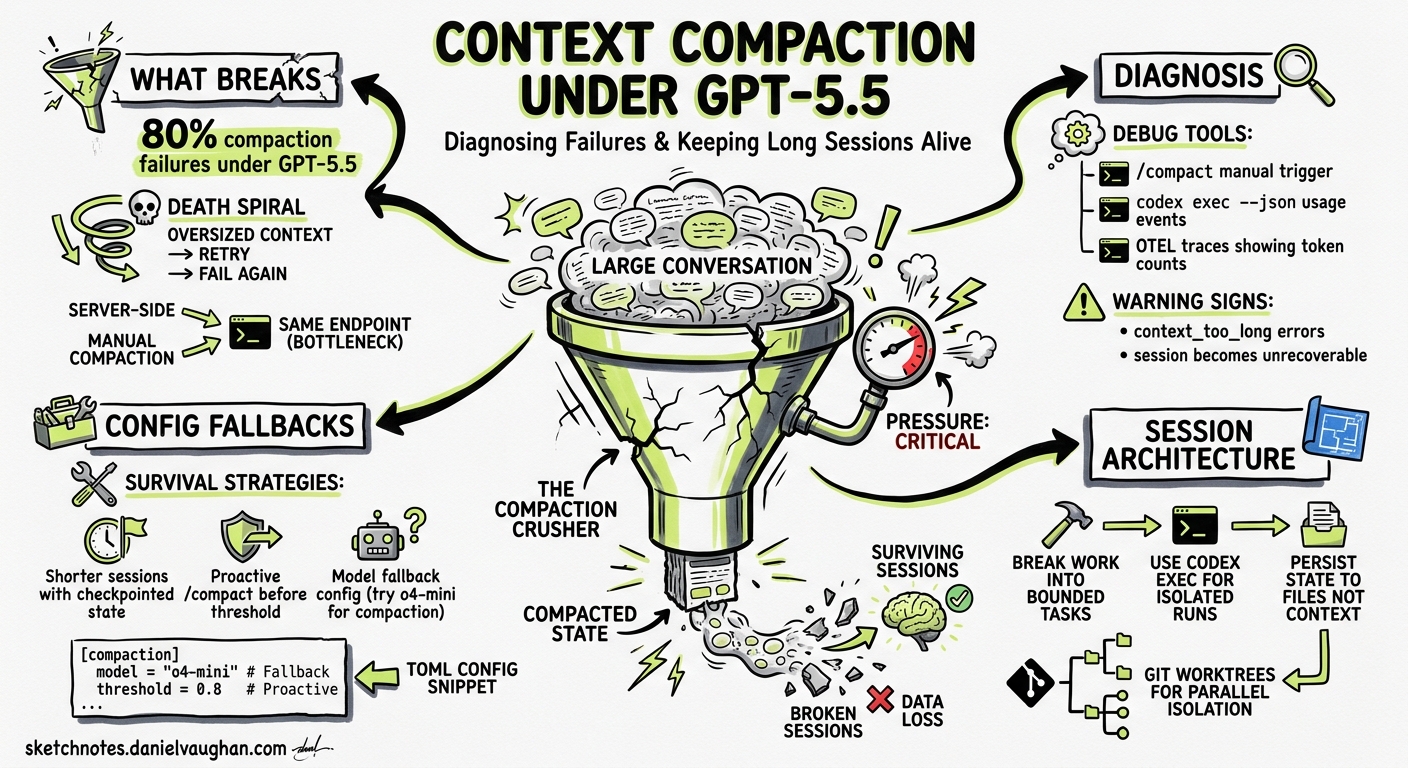
Since GPT-5.5 became the default model in Codex CLI, a wave of compaction failures has disrupted long-running sessions for practitioners worldwide. GitHub issues report roughly 80% of compaction operations failing under GPT-5.51, with sessions becoming unrecoverable once the context window fills. This article examines what is going wrong, what configuration levers exist today, and how to build session workflows that survive compaction failures.
What Compaction Does — and Why It Breaks
Codex CLI manages growing conversation context through compaction — a process that summarises prior turns into a compressed representation, discarding raw history while preserving essential state2. Two mechanisms exist:
- Server-side (remote) compaction — triggered automatically when rendered tokens cross a threshold, handled by the
/responses/compactendpoint on OpenAI’s infrastructure3. - Manual compaction — invoked via the
/compactslash command in the TUI.
Both call the same upstream endpoint. When compaction succeeds, the session continues with a smaller context footprint. When it fails, the oversized conversation history is retried against the same endpoint — and fails again, creating a death spiral4.
flowchart TD
    A[Session grows toward token limit] --> B{Auto-compact threshold reached?}
    B -- Yes --> C[Codex calls /responses/compact]
    C --> D{Compaction succeeds?}
    D -- Yes --> E[Session continues with compressed context]
    D -- No --> F[Error: stream disconnected / 503]
    F --> G[Retry with same oversized context]
    G --> F
    B -- No --> H[Session continues normally]
The GPT-5.5 Problem
Three interrelated issues make GPT-5.5 compaction unreliable as of May 2026:
1. Endpoint Incompatibility
The /responses/compact endpoint does not yet fully support GPT-5.5 as a compaction model5. When Codex sends the active model slug (gpt-5.5) to the compact endpoint, the request fails with invalid_request_error or 503 Service Unavailable. Codex falls back to gpt-5.4 for compaction in some configurations, but this fallback is inconsistent.
2. Context Window Mismatch
GPT-5.5 advertises 400K tokens (or 1M for some tiers), but sessions report an effective context window of approximately 258,400 tokens6. Auto-compaction triggers based on the advertised window size, meaning it fires too late — the context is already larger than the compact endpoint can process.
3. Compaction State Lock
Once a compaction attempt fails, the session enters a broken compaction state. Subsequent turns push the context further over the limit, and the session becomes unrecoverable. Restarting the application does not recover the lost session1.
Diagnosing Compaction Failures
When compaction fails, the TUI displays:
Error running remote compact task: stream disconnected before completion
To get more detail, check the session log:
# Find the active session directory
ls -lt ~/.codex/sessions/ | head -5

# Search for compaction errors
grep -i "compact" ~/.codex/sessions/<session-id>/log.jsonl | tail -20
The /debug-config slash command reveals the effective context window and auto-compact threshold:
/debug-config
Look for model_auto_compact_token_limit and model_context_window — if the former is unset or close to the latter, compaction fires too late.
Configuration Defences
Lower the Auto-Compact Threshold
The single most effective mitigation is triggering compaction well before the context window fills. Set model_auto_compact_token_limit to roughly 60% of the effective window7:
# ~/.codex/config.toml or .codex/config.toml
model = "gpt-5.5"
model_context_window = 258400
model_auto_compact_token_limit = 150000
This gives the compact endpoint a smaller payload to process, reducing the chance of stream disconnection.
Override the Compaction Prompt
The default compaction prompt can lose critical context. Override it with a file that enforces cumulative summary preservation8:
experimental_compact_prompt_file = ".codex/compact_prompt.md"
A minimal compact_prompt.md should include:
## Compaction Rules

1. Preserve ALL previous compaction summaries cumulatively — never overwrite prior summaries.
2. Capture decision reasoning (why) alongside outcomes (what).
3. Maintain a structured list of: current branch, recent commits, active files, and blocking issues.
4. Document any tool state, MCP server connections, or running processes.
5. Include a "Next Steps" section with the immediate work queue.
Use a Compaction-Safe Model Profile
Create a named profile that routes compaction through a model known to work reliably with the compact endpoint:
[profiles.long-session]
model = "gpt-5.5"
model_auto_compact_token_limit = 150000
model_reasoning_effort = "high"
model_reasoning_summary = "concise"
⚠️ There is currently no dedicated compaction_model configuration key — Codex uses the active session model for compaction. The workaround of switching models mid-session (described below) is the only way to route compaction through a different model.
Session Survival Strategies
The Model-Switch Workaround
When compaction fails, switch to a model with reliable compaction support before the context fills completely4:
/model gpt-5.4
/compact
/model gpt-5.5
This routes the single compaction call through GPT-5.4’s compact endpoint, then switches back for subsequent work. It is manual and inelegant, but it works.
Subagent Scoping
Rather than running a single long session, delegate discrete work units to subagents9. Each subagent starts with a fresh context window:
[agents.refactor]
model = "gpt-5.4-mini"
prompt = "Refactor the authentication module. Run tests after each change."

[agents.tests]
model = "gpt-5.4-mini"
prompt = "Write integration tests for the payment service."
The parent session stays small — it only coordinates — while subagents handle the token-intensive work.
The Brain Dump Pattern
Before context reaches the danger zone, manually extract session state into a file that survives compaction8:
- Ask Codex to write a
SESSION_STATE.mdcapturing: current progress, decisions made, files changed, tests passing, and next steps. - Compact the session.
- On the next turn, reference
SESSION_STATE.mdto rehydrate context.
This is the manual equivalent of compaction hooks. When hooks land as stable features, this pattern will be automatable via pre_compact and post_compact lifecycle events10.
Pre-Emptive Forking
If you anticipate a long session, fork proactively before compaction territory:
/fork
The fork preserves the full transcript in the original session whilst giving you a fresh context window to continue. You lose nothing and gain a clean runway.
What Is Coming
Two developments should improve the situation:
- Compaction endpoint support for GPT-5.5 — the most likely near-term fix. Once
/responses/compacthandles GPT-5.5 natively, the stream disconnection errors should resolve5. - Stable compaction lifecycle hooks —
pre_compactandpost_compactevents are requested (GitHub issues #16098 and #19061)10 and partially implemented in v0.129’s hook system. When stable, they will enable deterministic memory reinjection and pre-compaction state snapshots without manual intervention.
Decision Framework
| Session length | Strategy |
|---|---|
| < 30 minutes | No action needed — unlikely to hit compaction |
| 30 min – 2 hours | Set model_auto_compact_token_limit = 150000; use compact_prompt override |
| 2 – 6 hours | Add subagent delegation; write SESSION_STATE.md at milestones |
| 6+ hours | Use /goal with subagents; fork at compaction boundaries; consider /model gpt-5.4 for the main session |
Summary
GPT-5.5 compaction failures are a known, unresolved issue as of May 2026. The root cause is an endpoint compatibility gap that OpenAI is expected to address. In the meantime, lowering the auto-compact threshold, overriding the compaction prompt, and using the model-switch workaround provide the most reliable mitigation. For genuinely long-horizon work, subagent delegation and pre-emptive forking remain the safest patterns regardless of compaction reliability.
Citations
-
Context compact error — GitHub Issue #21343 — Reports of ~80% compaction failure rate since GPT-5.5 release, May 2026. ↩ ↩2
-
Compaction Guide — OpenAI API Documentation — Server-side compaction architecture and
/responses/compactendpoint reference. ↩ -
[Configuration Reference — Codex OpenAI Developers](https://developers.openai.com/codex/config-reference) — compact_prompt,model_auto_compact_token_limit, andmodel_context_windowconfiguration keys. -
GPT-5.5 Codex session hits unrecoverable compaction failure around ~220k tokens — GitHub Issue #19386 — Model-switch workaround and subagent scoping suggestions. ↩ ↩2
-
Remote compaction fails when using gpt-5.5 — GitHub Issue #19400 — Confirmation that
/responses/compactdoes not support GPT-5.5 model slug. ↩ ↩2 -
GPT-5.5 context catalog mismatch — GitHub Issue #19409 — Effective context window of 258,400 tokens vs advertised 400K/1M. ↩
-
[Advanced Configuration — Codex OpenAI Developers](https://developers.openai.com/codex/config-advanced) — Context management and auto-compact trigger configuration. -
Compaction Memory: How to Stop AI Agents From Losing Context Across Compressions — GitHub Gist by sigalovskinick — Four-component compaction memory system: extended prompt, pre-compact hook, post-compact hook, and brain dump skill. ↩ ↩2
-
[Subagents — Codex OpenAI Developers](https://developers.openai.com/codex/subagents) — Subagent delegation for parallel task execution with isolated context windows. -
Add pre_compact and post_compact hooks for context compaction — GitHub Issue #16098 — Feature request for compaction lifecycle hooks. ↩ ↩2