Codex CLI for Automated Error Handling Strategy: Auditing, Generating, and Enforcing Consistent Error Patterns
Codex CLI for Automated Error Handling Strategy: Auditing, Generating, and Enforcing Consistent Error Patterns
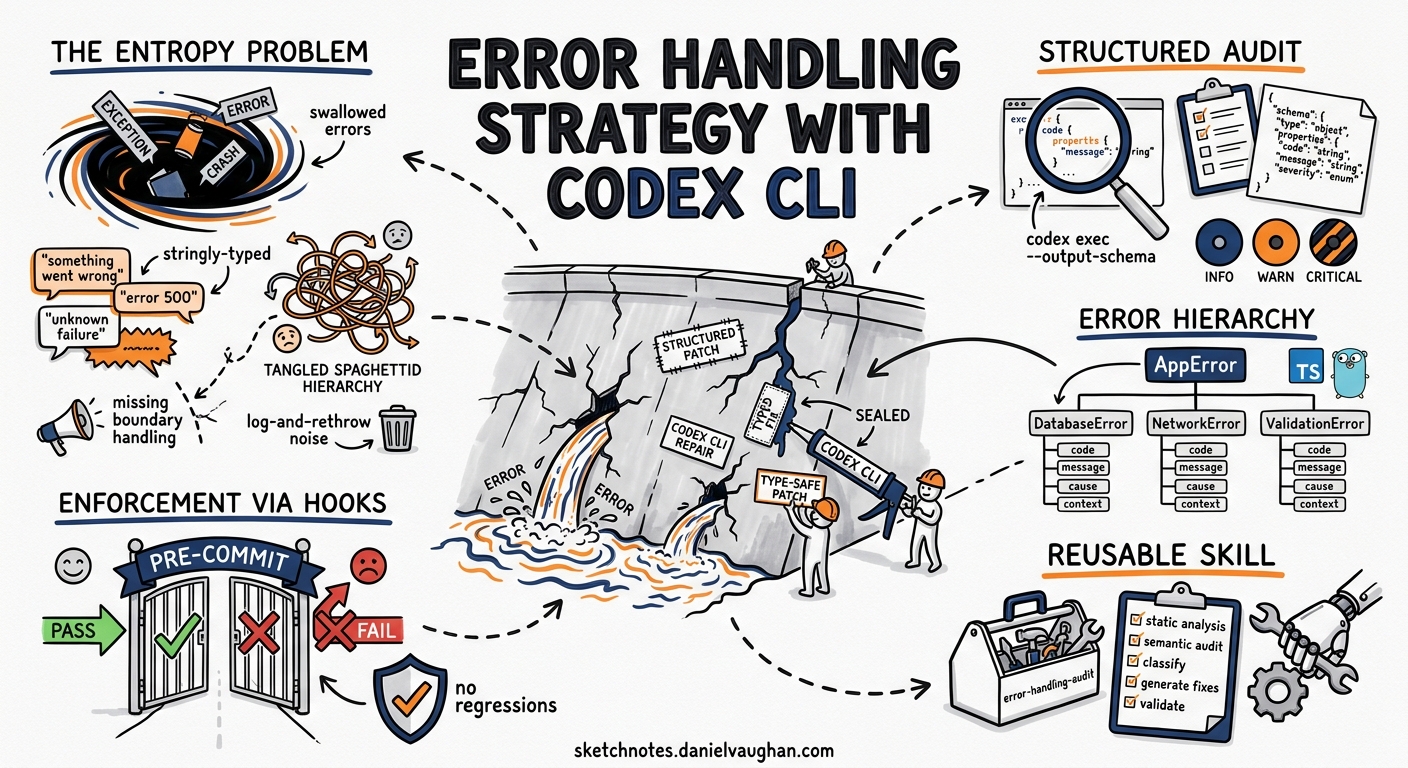
Error handling is the seam where production systems fracture. Inconsistent patterns — bare catch blocks swallowing context, untyped error strings propagating through call stacks, missing retry logic around I/O boundaries — create silent failure modes that only surface under load. Yet error handling audits rarely make it onto sprint boards. Codex CLI transforms this from a tedious manual review into an automated, repeatable pipeline: audit the current state, generate idiomatic fixes, and enforce standards via hooks so regressions never land.
The Problem: Error Handling Entropy
Every codebase accumulates error handling debt. Common patterns include:
- Catch-all suppression —
catch (e) {}orexcept Exception: passthat silently swallows failures - Stringly-typed errors — bare string messages with no structured context for observability tools
- Inconsistent hierarchies — each module inventing its own error taxonomy rather than deriving from a shared base
- Missing boundary handling — network calls, file I/O, and database queries lacking timeout, retry, or circuit-breaker logic
- Log-and-rethrow noise — errors logged at every layer creating duplicate alerts
Static analysis tools catch some of these (ESLint’s no-empty rule1, Go’s errcheck2, Python’s flake8-bugbear B0013), but they lack the semantic understanding to propose idiomatic fixes or design cohesive error hierarchies. This is where Codex CLI’s reasoning capabilities complement traditional linting.
Phase 1: Structured Error Handling Audit with codex exec
The first step is establishing a baseline. Use codex exec with --output-schema to produce a machine-readable audit report4:
{
  "$schema": "https://json-schema.org/draft/2020-12/schema",
  "type": "object",
  "properties": {
    "findings": {
      "type": "array",
      "items": {
        "type": "object",
        "properties": {
          "file": { "type": "string" },
          "line": { "type": "integer" },
          "category": {
            "type": "string",
            "enum": ["swallowed_error", "untyped_error", "missing_boundary_handling", "log_and_rethrow", "inconsistent_hierarchy", "missing_context"]
          },
          "severity": { "type": "string", "enum": ["critical", "high", "medium", "low"] },
          "description": { "type": "string" },
          "suggested_pattern": { "type": "string" }
        },
        "required": ["file", "line", "category", "severity", "description"]
      }
    },
    "summary": {
      "type": "object",
      "properties": {
        "total_findings": { "type": "integer" },
        "critical_count": { "type": "integer" },
        "files_scanned": { "type": "integer" }
      }
    }
  }
}
Run the audit in read-only sandbox mode:
codex exec \
  "Audit all error handling in src/. Identify: swallowed errors, \
   untyped error strings, missing boundary handling around I/O, \
   log-and-rethrow anti-patterns, and inconsistent error hierarchies. \
   Classify severity: critical if it can cause silent data loss, \
   high if it masks production failures, medium if it reduces \
   observability, low if it's a style inconsistency." \
  --sandbox read-only \
  --output-schema ./error-audit-schema.json \
  -o ./error-audit-report.json
The structured output feeds downstream tooling — Jira ticket creation, Slack notifications, or dashboard metrics5.
Phase 2: Error Hierarchy Generation
Once the audit identifies patterns, Codex can generate a typed error hierarchy tailored to your domain. Define the requirements in AGENTS.md:
## Error Handling Standards

- All application errors MUST extend a base `AppError` class/type
- Errors MUST carry: code (string enum), message (human-readable),
  cause (wrapped original error), context (structured metadata)
- HTTP boundary errors map to status codes via error code
- Database errors wrap driver errors with operation context
- External service errors include: service name, endpoint, latency
- Never throw raw strings or generic Error instances
Then generate the hierarchy:
codex exec \
  "Based on the error patterns found in src/, generate a typed error \
   hierarchy following the standards in AGENTS.md. Create: \
   1. Base error class with code, message, cause, context \
   2. Domain-specific error subclasses for each module \
   3. Error factory functions for common patterns \
   4. Type guards / type predicates for error narrowing" \
  --sandbox workspace-write
TypeScript Example Output
// src/errors/base.ts
export abstract class AppError extends Error {
  abstract readonly code: ErrorCode;
  readonly cause?: Error;
  readonly context: Record<string, unknown>;
  readonly timestamp: string;

  constructor(message: string, opts?: { cause?: Error; context?: Record<string, unknown> }) {
    super(message);
    this.name = this.constructor.name;
    this.cause = opts?.cause;
    this.context = opts?.context ?? {};
    this.timestamp = new Date().toISOString();
  }

  toJSON(): Record<string, unknown> {
    return {
      code: this.code,
      message: this.message,
      name: this.name,
      context: this.context,
      timestamp: this.timestamp,
      ...(this.cause && { cause: this.cause.message }),
    };
  }
}

// src/errors/database.ts
export class DatabaseError extends AppError {
  readonly code = 'DATABASE_ERROR' as const;
  constructor(
    operation: string,
    opts: { cause?: Error; table?: string; query?: string }
  ) {
    super(`Database operation failed: ${operation}`, {
      cause: opts.cause,
      context: { operation, table: opts.table, query: opts.query },
    });
  }
}
Go Example Output
// pkg/errors/errors.go
package errors

import "fmt"

type Code string

const (
    CodeDatabase    Code = "DATABASE_ERROR"
    CodeNetwork     Code = "NETWORK_ERROR"
    CodeValidation  Code = "VALIDATION_ERROR"
)

type AppError struct {
    Code    Code
    Message string
    Cause   error
    Context map[string]any
}

func (e *AppError) Error() string {
    if e.Cause != nil {
        return fmt.Sprintf("[%s] %s: %v", e.Code, e.Message, e.Cause)
    }
    return fmt.Sprintf("[%s] %s", e.Code, e.Message)
}

func (e *AppError) Unwrap() error { return e.Cause }

func NewDatabaseError(op string, cause error, ctx map[string]any) *AppError {
    return &AppError{
        Code:    CodeDatabase,
        Message: fmt.Sprintf("database operation failed: %s", op),
        Cause:   cause,
        Context: ctx,
    }
}
Phase 3: Reusable Error Handling Skill
Encode the audit-and-fix workflow as a reusable skill:
---
name: error-handling-audit
description: Audit and fix error handling patterns across the codebase
triggers:
  - "audit error handling"
  - "fix error patterns"
  - "error handling review"
---

# Error Handling Audit Skill

## Steps

1. Run static analysis first (`eslint --rule 'no-empty: error'` for TS,
   `errcheck ./...` for Go, `flake8 --select=B001,E722` for Python)
2. Feed linter output as context to the semantic audit
3. Classify findings by severity using the output schema
4. For critical/high findings, generate fixes following AGENTS.md standards
5. Validate fixes compile and pass existing tests
6. Present a summary diff for human review

## Constraints

- Never auto-merge fixes for critical error handling changes
- Preserve existing error messages that are referenced in monitoring dashboards
- Wrap, never replace, third-party library errors
- Generated error codes must be unique across the codebase
Install it:
codex skills install ./skills/error-handling-audit/SKILL.md
Phase 4: Enforcement via Hooks
Prevent regressions with a Codex hook that validates error handling on every commit6:
# .codex/config.toml
[[hooks]]
name = "error-handling-gate"
event = "pre-commit"
command = """
codex exec \
  "Check the staged diff for error handling violations: \
   bare catch blocks, untyped throw statements, missing error \
   wrapping at I/O boundaries, and raw string errors. \
   Return PASS if clean, FAIL with locations if violations found." \
  --sandbox read-only \
  --output-schema .codex/error-gate-schema.json \
  -o /tmp/error-gate-result.json
"""
pass_condition = "jq -r '.verdict' /tmp/error-gate-result.json | grep -q PASS"
The hook schema is minimal:
{
  "type": "object",
  "properties": {
    "verdict": { "type": "string", "enum": ["PASS", "FAIL"] },
    "violations": {
      "type": "array",
      "items": {
        "type": "object",
        "properties": {
          "file": { "type": "string" },
          "line": { "type": "integer" },
          "violation": { "type": "string" }
        }
      }
    }
  }
}
Pipeline Architecture
flowchart TD
    A[Developer commits code] --> B{Pre-commit hook}
    B -->|PASS| C[Commit proceeds]
    B -->|FAIL| D[Violations reported]
    D --> E[Developer fixes or<br/>runs error-handling-audit skill]
    E --> A

    F[Scheduled CI job] --> G[Full codebase audit<br/>codex exec --output-schema]
    G --> H[Structured JSON report]
    H --> I[Dashboard metrics]
    H --> J[Jira ticket creation<br/>for critical findings]
    H --> K[Slack notification<br/>to owning team]
Model Selection Matrix
| Task | Recommended Model | Rationale |
|---|---|---|
| Structured audit (schema output) | GPT-5.4-mini | Mechanical classification, schema compliance7 |
| Error hierarchy design | GPT-5.5 | Requires understanding domain semantics and relationships |
| Fix generation | GPT-5.4 | Balanced reasoning for idiomatic code generation |
| Hook validation (pass/fail) | GPT-5.4-mini | Binary decision, minimal reasoning needed |
Configure model routing in config.toml:
[models]
default = "gpt-5.4"

[models.overrides]
audit = "gpt-5.4-mini"
design = "gpt-5.5"
Anti-Patterns to Avoid
-
Over-wrapping — Adding error context at every call frame creates noise. Wrap at boundaries (HTTP handlers, service interfaces, repository layers), not at every function call.
-
Generating without validating — Always run the test suite after error handling changes. New error types can break
instanceofchecks, pattern matches, or serialisation logic. -
Ignoring observability — Generated error hierarchies must integrate with your existing logging and tracing setup. Include structured fields that your log aggregator (Datadog, Grafana, SigNoz) indexes8.
-
Blanket enforcement — Not every function needs custom error types. Reserve structured errors for boundaries and domain events; utility functions can use simpler patterns.
-
Trusting without reviewing — Use
--sandbox read-onlyfor audits and always review generated fixes before merging. Error handling changes can silently alter control flow.
Known Limitations
--output-schemaandexec resumeare mutually exclusive — you cannot resume a structured audit session with additional schema constraints9- Sandbox network isolation — hooks running in sandboxed mode cannot reach external services (monitoring APIs, ticket systems) directly; pipe results to a post-hook script
- Context window limits — for monorepos with thousands of files, scope audits to specific modules or use differential analysis on changed files only
- False positives in framework code — frameworks like Express.js intentionally use middleware error patterns that may trigger audit findings; configure exclusions in AGENTS.md
Putting It Together: A Weekly Error Health Report
Combine all phases in a scheduled automation:
#!/usr/bin/env bash
# scripts/weekly-error-audit.sh

set -euo pipefail

# Phase 1: Audit
codex exec \
  "Perform a comprehensive error handling audit of src/. \
   Focus on changes since last Monday. Compare against our \
   error handling standards in AGENTS.md." \
  --sandbox read-only \
  --output-schema ./error-audit-schema.json \
  -o ./reports/error-audit-$(date +%Y-%m-%d).json

# Phase 2: Metrics extraction
CRITICAL=$(jq '.summary.critical_count' ./reports/error-audit-$(date +%Y-%m-%d).json)
TOTAL=$(jq '.summary.total_findings' ./reports/error-audit-$(date +%Y-%m-%d).json)

echo "Error handling health: ${CRITICAL} critical, ${TOTAL} total findings"

# Phase 3: Alert on regression
if [ "$CRITICAL" -gt 0 ]; then
  # Send to Slack/PagerDuty
  curl -X POST "$SLACK_WEBHOOK" \
    -d "{\"text\": \"Error handling audit: ${CRITICAL} critical findings detected\"}"
fi
Schedule via cron or GitHub Actions to maintain continuous error handling hygiene without manual intervention10.
Citations
-
ESLint. “no-empty - Rules.” ESLint Documentation, 2026. https://eslint.org/docs/latest/rules/no-empty ↩
-
kisielk. “errcheck - checks for unchecked errors in Go.” GitHub, 2026. https://github.com/kisielk/errcheck ↩
-
Cooper Ry Lees et al. “flake8-bugbear - Opinionated linting for Python.” GitHub, 2026. https://github.com/PyCQA/flake8-bugbear ↩
-
OpenAI. “Non-interactive mode - Codex CLI.” OpenAI Developers, 2026. https://developers.openai.com/codex/noninteractive ↩
-
OpenAI. “Build Code Review with the Codex SDK.” OpenAI Cookbook, 2026. https://developers.openai.com/cookbook/examples/codex/build_code_review_with_codex_sdk ↩
-
OpenAI. “Customization - Codex CLI.” OpenAI Developers, 2026. https://developers.openai.com/codex/concepts/customization ↩
-
OpenAI. “Models - Codex CLI.” OpenAI Developers, 2026. https://developers.openai.com/codex/models ↩
-
OpenAI. “Best practices - Codex CLI.” OpenAI Developers, 2026. https://developers.openai.com/codex/learn/best-practices ↩
-
GitHub. “Add –output-schema support to codex exec resume - Issue #14343.” openai/codex, 2026. https://github.com/openai/codex/issues/14343 ↩
-
OpenAI. “Workflows - Codex CLI.” OpenAI Developers, 2026. https://developers.openai.com/codex/workflows ↩