Codex CLI for Static Analysis: Agent-Driven Semgrep Rule Authoring, CodeQL Query Generation, and Security Scanning Pipelines
Codex CLI for Static Analysis: Agent-Driven Semgrep Rule Authoring, CodeQL Query Generation, and Security Scanning Pipelines
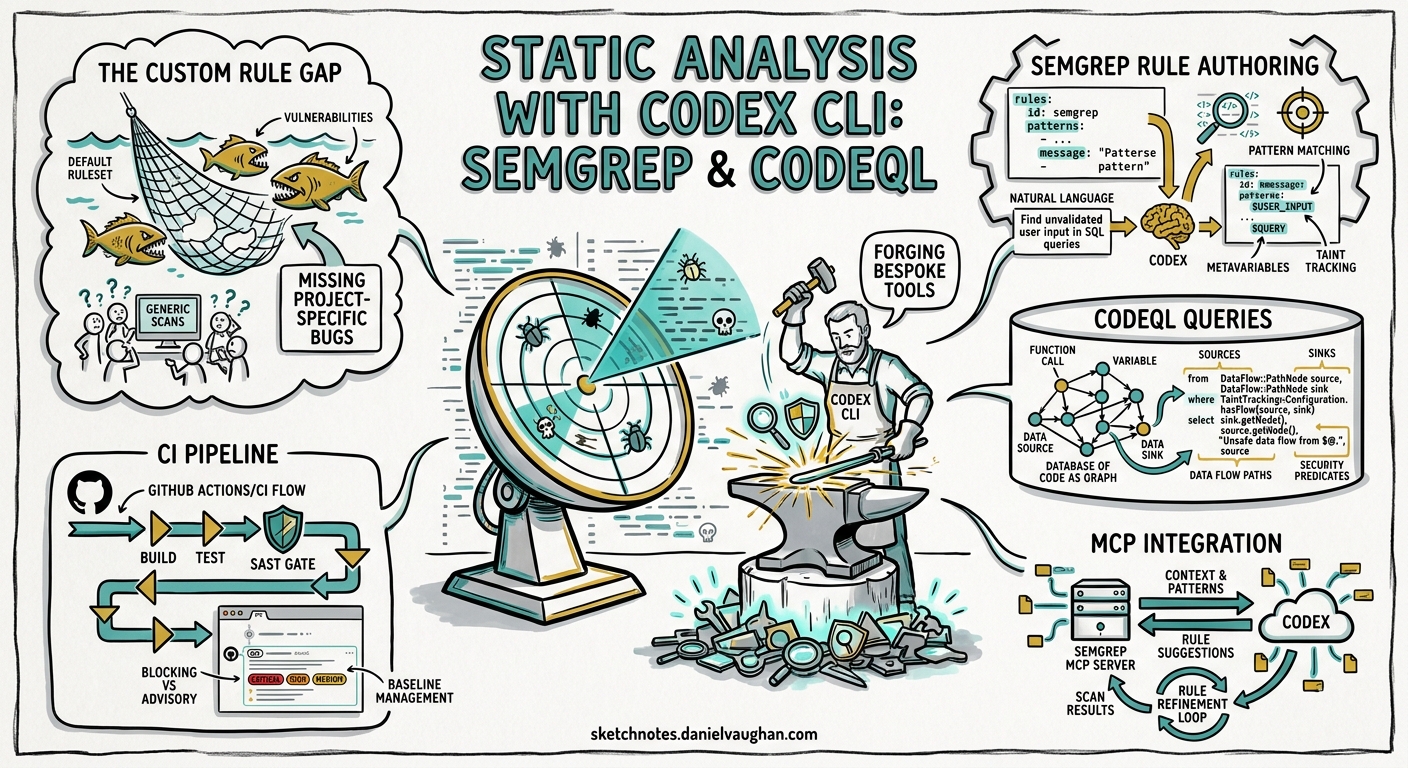
Static analysis tools catch bugs before they reach production, but writing custom rules is tedious enough that most teams never do it. Semgrep rules require YAML pattern syntax; CodeQL queries demand a Datalog-derived query language with a steep learning curve 1. The result: organisations run the default rulesets and miss project-specific vulnerability classes entirely.
Codex CLI changes this calculus. By combining the Semgrep MCP server for real-time scanning, codex exec for batch rule generation, and AGENTS.md guardrails for rule quality, you can build a pipeline that turns ad-hoc security knowledge into tested, enforceable static analysis rules — without becoming a QL expert.
The Semgrep MCP Server in Codex CLI
Semgrep ships an official MCP server that exposes its scanning engine as tools callable by any MCP-compatible agent 2. The server bundles three Semgrep products — Code (SAST), Supply Chain (SCA), and Secrets detection — into a single integration 3.
Configuration
Add the server to your Codex configuration:
# ~/.codex/config.toml
[mcp_servers.semgrep]
command = "semgrep"
args = ["mcp"]
Prerequisites: Python 3.10+, semgrep installed via Homebrew or pipx, and semgrep login && semgrep install-semgrep-pro for the Pro engine 3.
Once configured, Codex sessions gain access to several MCP tools 2:
| Tool | Purpose |
|---|---|
security_check |
Rapid vulnerability scan on code snippets |
scan_code |
Full scan using standard rulesets |
scan_with_custom_rule |
Scan using a user-defined YAML rule |
get_rule_schema |
JSON schema for custom rule development |
get_ast |
Abstract syntax tree for structural analysis |
Unlike Claude Code’s hook-based Semgrep integration, Codex invokes Semgrep tools through MCP — the agent calls them explicitly rather than triggering on file writes 3.
Encoding Rule-Authoring Standards in AGENTS.md
Before generating rules, encode your organisation’s static analysis conventions:
# AGENTS.md — Static Analysis Standards

## Semgrep Rule Authoring
- Every rule MUST include a `fix` field with an auto-fix pattern where feasible
- Rules MUST use `severity: ERROR` for exploitable vulnerabilities, `WARNING` for
  code-quality issues, `INFO` for style enforcement
- Every rule MUST have at least two `test_cases` — one true positive, one true negative
- Taint-mode rules MUST specify explicit `sources`, `sinks`, and `sanitizers`
- Rule IDs follow the pattern: `<org>.<language>.<category>.<description>`
  e.g. `acme.python.injection.sqlalchemy-raw-text`

## CodeQL Query Authoring
- Queries MUST include `@kind problem` or `@kind path-problem` metadata
- Every query MUST have a companion `.qlref` test file
- Prefer `DataFlow::PathGraph` over manual recursion for taint tracking
- Query IDs follow: `<org>/<language>/<category>/<description>`
This gives the agent concrete constraints rather than vague instructions. The Semgrep team’s own guidance confirms that “agents learn far more from seeing a vulnerable code snippet next to its fixed version” than from descriptive paragraphs 4.
Generating Custom Semgrep Rules with Codex
Interactive Rule Authoring
In an interactive session with the Semgrep MCP server active, prompt Codex to author rules contextually:
Scan src/ for SQL injection patterns, then write a custom Semgrep rule
that catches any use of f-strings or string concatenation inside
SQLAlchemy execute() calls. Include an auto-fix using text() with
bound parameters.
The agent can call get_rule_schema to understand the correct YAML structure, draft the rule, then immediately validate it with scan_with_custom_rule against your codebase 2. This feedback loop — draft, scan, refine — compresses what was previously hours of trial-and-error into minutes.
Batch Rule Generation with codex exec
For systematic rule creation, use non-interactive mode with structured output:
codex exec \
  --model o4-mini \
  --approval-mode full-auto \
  --output-schema semgrep-rules-schema.json \
  "Analyse the top 10 most common vulnerability patterns in src/ using
   the Semgrep MCP tools. For each pattern, generate a custom Semgrep
   rule with test cases. Output the rules as a JSON array conforming
   to the provided schema."
The --output-schema flag ensures structured, parseable output 5. A suitable schema:
{
  "type": "object",
  "properties": {
    "rules": {
      "type": "array",
      "items": {
        "type": "object",
        "properties": {
          "id": { "type": "string" },
          "severity": { "enum": ["ERROR", "WARNING", "INFO"] },
          "language": { "type": "string" },
          "pattern": { "type": "string" },
          "message": { "type": "string" },
          "fix": { "type": "string" },
          "test_positive": { "type": "string" },
          "test_negative": { "type": "string" }
        },
        "required": ["id", "severity", "language", "pattern", "message"]
      }
    }
  },
  "required": ["rules"]
}
Example Generated Rule
A Codex-generated rule for detecting insecure deserialisation in Python:
rules:
  - id: acme.python.security.pickle-untrusted-load
    severity: ERROR
    languages: [python]
    message: >
      Deserialising untrusted data with pickle can lead to arbitrary
      code execution (CWE-502). Use json.loads() or a safe
      deserialisation library instead.
    patterns:
      - pattern: pickle.loads($DATA)
      - pattern-not-inside: |
          $DATA = pickle.dumps(...)
    fix: json.loads($DATA)
    metadata:
      cwe: ["CWE-502"]
      owasp: ["A08:2021"]
      confidence: HIGH
CodeQL Query Generation
CodeQL’s QL language is substantially more complex than Semgrep’s YAML patterns — a comparison study notes that “CodeQL queries use a SQL-like QL language requiring days of study to write effectively” 1. This makes it an ideal candidate for agent assistance.
Prompting for CodeQL Queries
Write a CodeQL query for JavaScript that finds cases where user input
from Express req.query or req.body reaches a child_process.exec() call
without sanitisation. Use DataFlow::PathGraph for taint tracking.
Include @kind path-problem metadata and a .qlref test file.
Codex generates both the query and its test harness:
/**
 * @name Command injection from HTTP parameters
 * @description User input from Express reaches child_process.exec
 *              without sanitisation.
 * @kind path-problem
 * @problem.severity error
 * @security-severity 9.8
 * @precision high
 * @id acme/javascript/injection/express-command-injection
 * @tags security
 *       external/cwe/cwe-078
 */

import javascript
import DataFlow::PathGraph

class HttpSource extends DataFlow::Node {
  HttpSource() {
    exists(Express::RouteHandler rh |
      this = rh.getARequestSource()
    )
  }
}

class ExecSink extends DataFlow::Node {
  ExecSink() {
    exists(DataFlow::CallNode call |
      call = DataFlow::moduleMember("child_process", "exec").getACall() and
      this = call.getArgument(0)
    )
  }
}

class CommandInjectionConfig extends TaintTracking::Configuration {
  CommandInjectionConfig() { this = "CommandInjectionConfig" }
  override predicate isSource(DataFlow::Node node) { node instanceof HttpSource }
  override predicate isSink(DataFlow::Node node) { node instanceof ExecSink }
}

from CommandInjectionConfig cfg, DataFlow::PathNode source, DataFlow::PathNode sink
where cfg.hasFlowPath(source, sink)
select sink.getNode(), source, sink,
  "Command injection: user input from $@ reaches exec() call.",
  source.getNode(), "HTTP parameter"
⚠️ CodeQL queries generated by the agent should always be validated with codeql test run against a known-vulnerable test case before deployment. The agent cannot execute CodeQL inside the Codex sandbox due to database construction requirements.
Building a Reusable Rule-Authoring Skill
Encode the full workflow as a SKILL.md:
# static-analysis-rule-author

## Trigger
When asked to create custom static analysis rules, security scanning
rules, or SAST custom patterns.

## Workflow
1. Use the Semgrep MCP `scan_code` tool to identify existing findings
   in the target directory
2. Analyse the findings to identify patterns not covered by default rules
3. For each gap, generate a custom rule:
   - Semgrep: YAML rule with pattern, message, severity, fix, and tests
   - CodeQL: QL query with metadata, taint config, and .qlref test file
4. Validate Semgrep rules using `scan_with_custom_rule` against the codebase
5. Output rules to `.semgrep/` and `.codeql/` directories respectively

## Constraints
- Follow AGENTS.md static analysis standards
- Every rule must have test cases (true positive + true negative)
- Prefer Semgrep for pattern-matching rules (faster, simpler)
- Use CodeQL only for inter-procedural taint tracking that Semgrep
  cannot express
- Never generate rules that suppress or weaken existing coverage
CI/CD Integration: The Security Gate
Wire the generated rules into your pipeline:
# .github/workflows/security-gate.yml
name: Custom SAST Gate
on: [pull_request]

jobs:
  semgrep-custom:
    runs-on: ubuntu-latest
    steps:
      - uses: actions/checkout@v4
      - name: Run custom Semgrep rules
        uses: semgrep/semgrep-action@v1
        with:
          config: .semgrep/
        env:
          SEMGREP_APP_TOKEN: ${{ secrets.SEMGREP_APP_TOKEN }}

  codeql-custom:
    runs-on: ubuntu-latest
    steps:
      - uses: actions/checkout@v4
      - uses: github/codeql-action/init@v3
        with:
          queries: .codeql/
          languages: javascript
      - uses: github/codeql-action/analyze@v3

  rule-freshness:
    runs-on: ubuntu-latest
    steps:
      - uses: actions/checkout@v4
      - name: Check rule freshness
        run: |
          codex exec \
            --model o4-mini \
            --approval-mode full-auto \
            "Review .semgrep/ rules against current Semgrep best
             practices. Flag any rules using deprecated patterns or
             missing required metadata fields. Output a pass/fail
             summary."
flowchart LR
    A[Pull Request] --> B[Semgrep Custom Rules]
    A --> C[CodeQL Custom Queries]
    A --> D[Rule Freshness Check]
    B --> E{Findings?}
    C --> E
    D --> F{Rules Current?}
    E -->|Yes| G[Block Merge]
    E -->|No| H[Pass]
    F -->|No| G
    F -->|Yes| H
Model Selection Matrix
| Task | Recommended Model | Rationale |
|---|---|---|
| Scanning with Semgrep MCP | Any (tool call) | MCP tools run locally |
| Simple pattern rules | o4-mini | Mechanical YAML generation |
| Taint-mode Semgrep rules | o3 | Requires reasoning about data flow |
| CodeQL query authoring | o3 | Complex QL syntax and type system |
| Rule review and freshness | o4-mini | Structural comparison task |
GPT-5.5 is available in Codex as the newest frontier model 6, but for rule generation the reasoning models (o3, o4-mini) typically produce better results due to the logical precision required.
Running Both Tools: Practical Guidance
Many teams run Semgrep and CodeQL in tandem: “Semgrep in CI for fast PR-level gates and CodeQL in nightly builds for deeper dataflow and taint tracking analysis” 1. The performance difference is stark — Semgrep scans in roughly 10 seconds using ~150 MB of memory, whilst CodeQL takes minutes to 30+ minutes and uses ~450 MB due to database construction 1.
Use Codex to enforce this division of labour. Your AGENTS.md should specify:
- Semgrep: pattern matching, string detection, simple data flow, auto-fixes
- CodeQL: inter-procedural taint tracking, type-state analysis, complex control-flow queries
Anti-Patterns
- Generating without validating — Always test rules with
scan_with_custom_rulebefore committing. Untested rules produce false positives that erode developer trust. - Duplicating default coverage — Check existing rulesets before writing custom rules. Semgrep’s registry contains over 20,000 Pro rules 1.
- Over-scoping rules — Semgrep Skills guidance confirms that rules “work best when narrowly focused” 4. A rule targeting “SQL injection in SQLAlchemy” outperforms one targeting “all injection vulnerabilities”.
- Ignoring auto-fixes — Rules without
fixfields create work; rules with fixes create value. - Trusting agent output without review — Static analysis rules are security-critical. Every generated rule should undergo human review, particularly CodeQL queries where the QL type system can produce subtle logical errors.
Known Limitations
--output-schemaand--resumeare mutually exclusive — you cannot resume a structured-output session 7- Sandbox network isolation — the Semgrep MCP server runs locally but
semgrep loginrequires network access, so authenticate before entering the sandbox - CodeQL database construction — CodeQL requires building a database from source, which cannot run inside the Codex sandbox; generate queries with Codex, validate them externally
- Context window limits — large monorepos may exceed context when scanning for patterns; scope scans to specific directories
Citations
-
Semgrep vs CodeQL: Lightweight Patterns vs Semantic Analysis for SAST (2026) ↩ ↩2 ↩3 ↩4 ↩5
-
The AI Engineer’s Deep Dive into the Official Semgrep MCP Server ↩ ↩2 ↩3
-
How-to Write Skills That Make Your AI-Generated Code Secure — Semgrep Blog ↩ ↩2
-
[Non-interactive mode — Codex CLI OpenAI Developers](https://developers.openai.com/codex/noninteractive) -
Add –output-schema support to codex exec resume — GitHub Issue #14343 ↩