Codex CLI for GitOps Workflows: ArgoCD Application Generation, Kustomize Overlay Management, and Environment Promotion Pipelines
Codex CLI for GitOps Workflows: ArgoCD Application Generation, Kustomize Overlay Management, and Environment Promotion Pipelines
Introduction
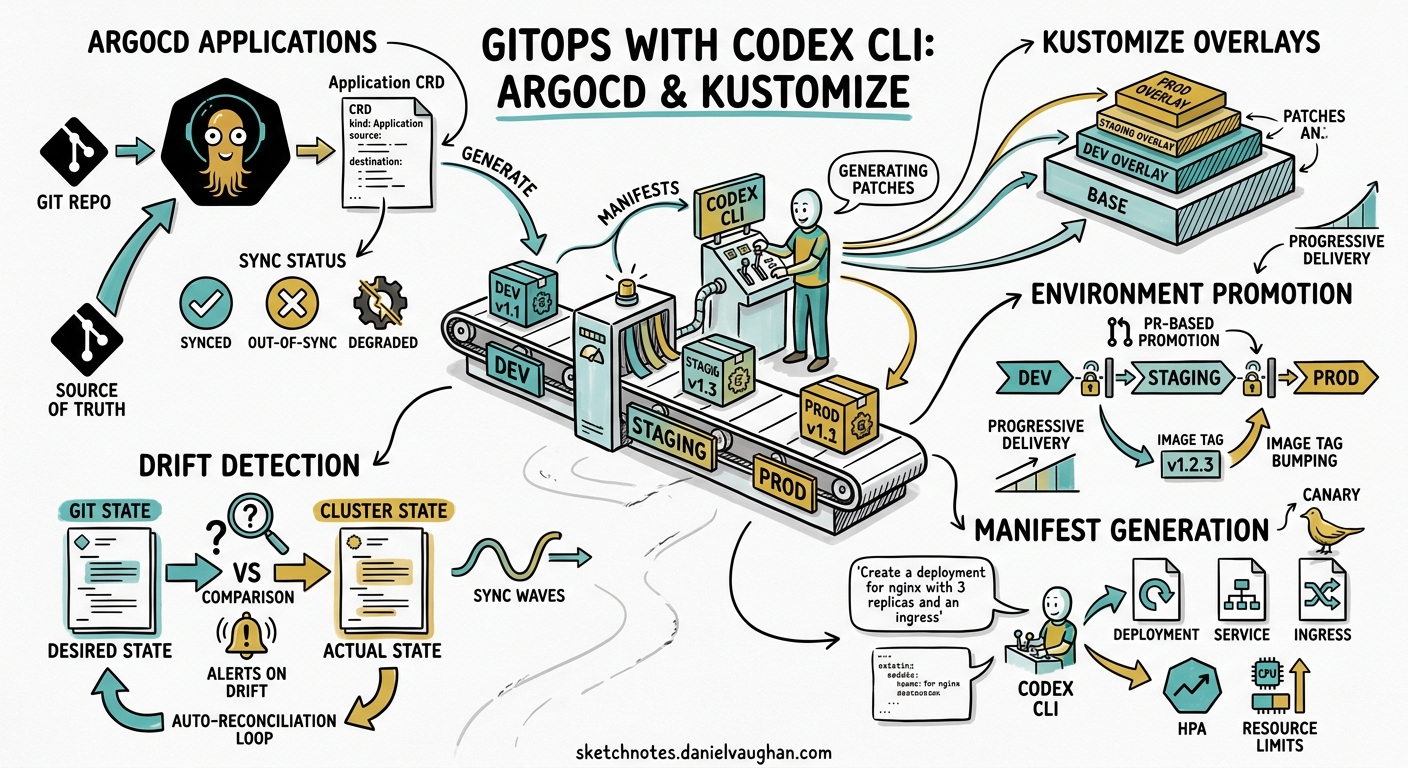
GitOps treats Git as the single source of truth for declarative infrastructure and application state1. ArgoCD v3.4 and Flux v2.x are the dominant CNCF-graduated reconciliation controllers2, yet maintaining sprawling manifest repositories — with per-environment Kustomize overlays, ArgoCD Application CRDs, and promotion gates — remains tedious manual toil. Codex CLI transforms this: using codex exec with --output-schema, interactive sessions with the Kubernetes MCP server, and PostToolUse hooks for manifest validation, you can generate, validate, and promote GitOps configurations with agent-driven precision.
This article covers three complementary workflows: generating ArgoCD Application manifests from service metadata, managing Kustomize overlay hierarchies, and building automated environment promotion pipelines — all orchestrated through Codex CLI.
Prerequisites
| Component | Version | Purpose |
|---|---|---|
| Codex CLI | ≥ 0.130.0 | Agent runtime3 |
| ArgoCD | ≥ 3.3 | GitOps reconciliation4 |
| Kustomize | ≥ 5.6 | Overlay composition |
| Kubernetes MCP Server | latest | Cluster interaction5 |
Configure the Kubernetes MCP server in ~/.codex/config.toml:
[mcp_servers.kubernetes]
command = "kubernetes-mcp-server"
args = ["--kubeconfig", "~/.kube/config"]
startup_timeout_sec = 10
tool_timeout_sec = 30
Encoding GitOps Standards in AGENTS.md
Before generating any manifests, encode your organisation’s GitOps conventions:
# AGENTS.md — GitOps Standards

## ArgoCD Applications
- Use `apiVersion: argoproj.io/v1alpha1` for all Application CRDs
- Target namespace: `argocd` for Application resources
- Always set `spec.syncPolicy.automated.prune: true` for non-production
- Production applications require `spec.syncPolicy.automated.selfHeal: true` but NOT auto-prune
- Use `spec.source.kustomize` for all Kustomize-based deployments

## Kustomize Structure
- Base manifests in `base/`
- Environment overlays in `overlays/{dev,staging,production}/`
- Never duplicate resources across overlays — patch only
- All images must use digest pinning in production overlays

## Environment Promotion
- Promotion order: dev → staging → production
- Each promotion requires a passing health check from the previous environment
- Use Git tags with semver for release tracking
This ensures Codex respects your deployment topology regardless of session type6.
Generating ArgoCD Application Manifests
Interactive Generation
For a new microservice requiring ArgoCD onboarding:
> Generate an ArgoCD Application manifest for the payment-service.
  It lives in github.com/acme/platform-manifests under services/payment-service.
  Target cluster: in-cluster. Namespace: payments.
  Use Kustomize with overlays/dev as the initial environment.
Codex produces:
apiVersion: argoproj.io/v1alpha1
kind: Application
metadata:
  name: payment-service-dev
  namespace: argocd
  labels:
    app.kubernetes.io/part-of: platform
    environment: dev
  finalizers:
    - resources-finalizer.argocd.argoproj.io
spec:
  project: default
  source:
    repoURL: https://github.com/acme/platform-manifests.git
    targetRevision: HEAD
    path: services/payment-service/overlays/dev
  destination:
    server: https://kubernetes.default.svc
    namespace: payments
  syncPolicy:
    automated:
      prune: true
      selfHeal: true
    syncOptions:
      - CreateNamespace=true
      - ServerSideApply=true
    retry:
      limit: 5
      backoff:
        duration: 5s
        factor: 2
        maxDuration: 3m
Batch Generation with codex exec
For onboarding multiple services at once, define an output schema:
{
  "type": "object",
  "properties": {
    "applications": {
      "type": "array",
      "items": {
        "type": "object",
        "properties": {
          "filename": { "type": "string" },
          "content": { "type": "string" }
        },
        "required": ["filename", "content"]
      }
    }
  },
  "required": ["applications"]
}
Execute:
codex exec \
  --sandbox workspace-write \
  --output-schema argocd-apps-schema.json \
  "Read services.yaml which lists all microservices with their repos, \
   namespaces, and target clusters. Generate an ArgoCD Application \
   manifest for each service across dev, staging, and production \
   environments following our AGENTS.md GitOps standards."
This produces structured JSON that your CI pipeline can parse to write individual YAML files and commit them to the GitOps repository7.
Kustomize Overlay Management
Generating Base and Overlay Hierarchies
graph TD
    A[Service Source Code] --> B[codex exec: Analyse Deployment Requirements]
    B --> C[Generate base/ Manifests]
    C --> D[Generate overlays/dev/]
    C --> E[Generate overlays/staging/]
    C --> F[Generate overlays/production/]
    D --> G[kustomize build --enable-helm overlays/dev]
    E --> G
    F --> G
    G --> H{Validation Pass?}
    H -->|Yes| I[Commit to GitOps Repo]
    H -->|No| J[Agent Fix Loop]
    J --> C
The Overlay Generation Skill
Create a reusable skill at .codex/skills/kustomize-overlay-generator.md:
# Kustomize Overlay Generator

## Purpose
Generate environment-specific Kustomize overlays from base manifests.

## Inputs
- Base manifest directory path
- Target environment (dev/staging/production)
- Environment-specific overrides (replicas, resource limits, image tags)

## Constraints
- Production overlays MUST pin images by digest
- Staging replicas = production replicas (for realistic load testing)
- Dev overlays may use `:latest` tags
- All overlays must include namespace transformer
- Never duplicate base resources — use patches only

## Validation
Run `kustomize build` on the generated overlay and verify valid YAML output.
Environment-Specific Patches
Codex generates strategic merge patches for each environment:
# overlays/production/kustomization.yaml
apiVersion: kustomize.config.k8s.io/v1beta1
kind: Kustomization

namespace: payments

resources:
  - ../../base

patches:
  - path: replica-patch.yaml
  - path: resource-limits-patch.yaml

images:
  - name: acme/payment-service
    digest: sha256:a1b2c3d4e5f6...
# overlays/production/replica-patch.yaml
apiVersion: apps/v1
kind: Deployment
metadata:
  name: payment-service
spec:
  replicas: 5
  template:
    spec:
      containers:
        - name: payment-service
          resources:
            requests:
              cpu: "500m"
              memory: "512Mi"
            limits:
              cpu: "2000m"
              memory: "2Gi"
Environment Promotion Pipelines
The Promotion Workflow
sequenceDiagram
    participant Dev as Dev Environment
    participant Agent as Codex CLI
    participant Staging as Staging Overlay
    participant Prod as Production Overlay
    participant ArgoCD as ArgoCD Controller

    Dev->>Agent: Health check passes
    Agent->>Agent: codex exec --output-schema promotion.json
    Agent->>Staging: Update image tag/digest
    Staging->>ArgoCD: Sync triggered
    ArgoCD->>Staging: Reconcile
    Note over Staging: Smoke tests pass
    Agent->>Prod: Update image digest
    Prod->>ArgoCD: Manual sync required
    ArgoCD->>Prod: Reconcile after approval
CI-Driven Promotion with codex exec
#!/usr/bin/env bash
# promote.sh — Agent-driven environment promotion

set -euo pipefail

SERVICE="$1"
SOURCE_ENV="$2"
TARGET_ENV="$3"
IMAGE_DIGEST="$4"

codex exec \
  --sandbox workspace-write \
  --ephemeral \
  "Promote ${SERVICE} from ${SOURCE_ENV} to ${TARGET_ENV}. \
   Update the image digest to ${IMAGE_DIGEST} in \
   services/${SERVICE}/overlays/${TARGET_ENV}/kustomization.yaml. \
   If the target is production, ensure digest pinning is used \
   (never a mutable tag). Run kustomize build to validate. \
   Commit with message: 'promote(${SERVICE}): ${SOURCE_ENV} → ${TARGET_ENV} [${IMAGE_DIGEST:0:12}]'"
Drift Detection as a Scheduled Task
Use codex exec with a cron schedule to detect configuration drift:
# Run hourly via cron or GitHub Actions schedule
codex exec \
  --sandbox read-only \
  --output-schema drift-report-schema.json \
  "Compare the rendered manifests from kustomize build for all \
   overlays against what ArgoCD reports as the live state via \
   the Kubernetes MCP server. Report any resources where the \
   desired state in Git differs from the live cluster state, \
   excluding expected transient fields (status, metadata.resourceVersion)."
PostToolUse Hooks for Manifest Validation
Enforce manifest correctness before any file write reaches the GitOps repository:
# config.toml — GitOps validation hooks

[[hooks]]
event = "PostToolUse"
match_tool = "write_file"
match_path = "overlays/**/*.yaml"
command = "kustomize build $(dirname $CODEX_TOOL_ARG_PATH)/../ | kubectl apply --dry-run=server -f - 2>&1"
on_failure = "block"
description = "Validate Kustomize overlay renders and passes server-side dry-run"

[[hooks]]
event = "PostToolUse"
match_tool = "write_file"
match_path = "applications/**/*.yaml"
command = "kubectl apply --dry-run=client -f $CODEX_TOOL_ARG_PATH 2>&1"
on_failure = "block"
description = "Validate ArgoCD Application CRD syntax"
This ensures Codex cannot commit invalid manifests regardless of model hallucination8.
Model Selection Matrix
| Task | Recommended Model | Reasoning Effort | Rationale |
|---|---|---|---|
| Single Application CRD | o4-mini | medium | Structured, low-complexity YAML |
| Batch overlay generation | o3 | high | Cross-environment consistency |
| Drift analysis | o4-mini | low | Comparison logic, fast turnaround |
| Promotion pipeline design | o3 | high | Multi-step workflow reasoning |
Configure per-task profiles:
[profiles.gitops-batch]
model = "o3"
model_reasoning_effort = "high"
sandbox = "workspace-write"

[profiles.gitops-quick]
model = "o4-mini"
model_reasoning_effort = "medium"
sandbox = "workspace-write"
Anti-Patterns
-
Generating manifests without validation hooks — Models hallucinate invalid API versions, non-existent fields, or deprecated sync options. Always enforce
kustomize buildandkubectl --dry-runvia PostToolUse hooks. -
Using mutable image tags in production overlays — Never allow
:latestor branch-based tags in production. Enforce digest pinning through AGENTS.md constraints and hook validation. -
Bypassing the promotion order — Deploying directly to production without traversing dev → staging violates GitOps auditability. Encode the promotion DAG in AGENTS.md.
-
Over-generating ApplicationSets — For simple per-environment deployments, individual Application CRDs are more debuggable than complex ApplicationSet generators with matrix combinatorics.
-
Ignoring ArgoCD sync waves — When generating multi-resource Applications, ensure Codex respects
argocd.argoproj.io/sync-waveannotations for dependency ordering.
Known Limitations
- Sandbox network isolation:
codex execinworkspace-writemode cannot reach the Kubernetes API directly. Use the Kubernetes MCP server or pre-fetch cluster state before execution9. --output-schemaand MCP mutual exclusion: As of v0.130.0,--output-schemacannot be combined with--resumein the same invocation10.- Context window for large repositories: Manifest repos with hundreds of services may exceed context limits. Use subagents scoped to individual services or service groups.
- ArgoCD Application CRD validation: The agent validates YAML syntax but cannot verify ArgoCD-specific semantics (e.g., whether the target project permits the specified destination) without cluster access.