Codex CLI for Kubernetes Operator Development: Scaffolding CRDs, Writing Reconciliation Loops, and Testing with envtest
Codex CLI for Kubernetes Operator Development: Scaffolding CRDs, Writing Reconciliation Loops, and Testing with envtest
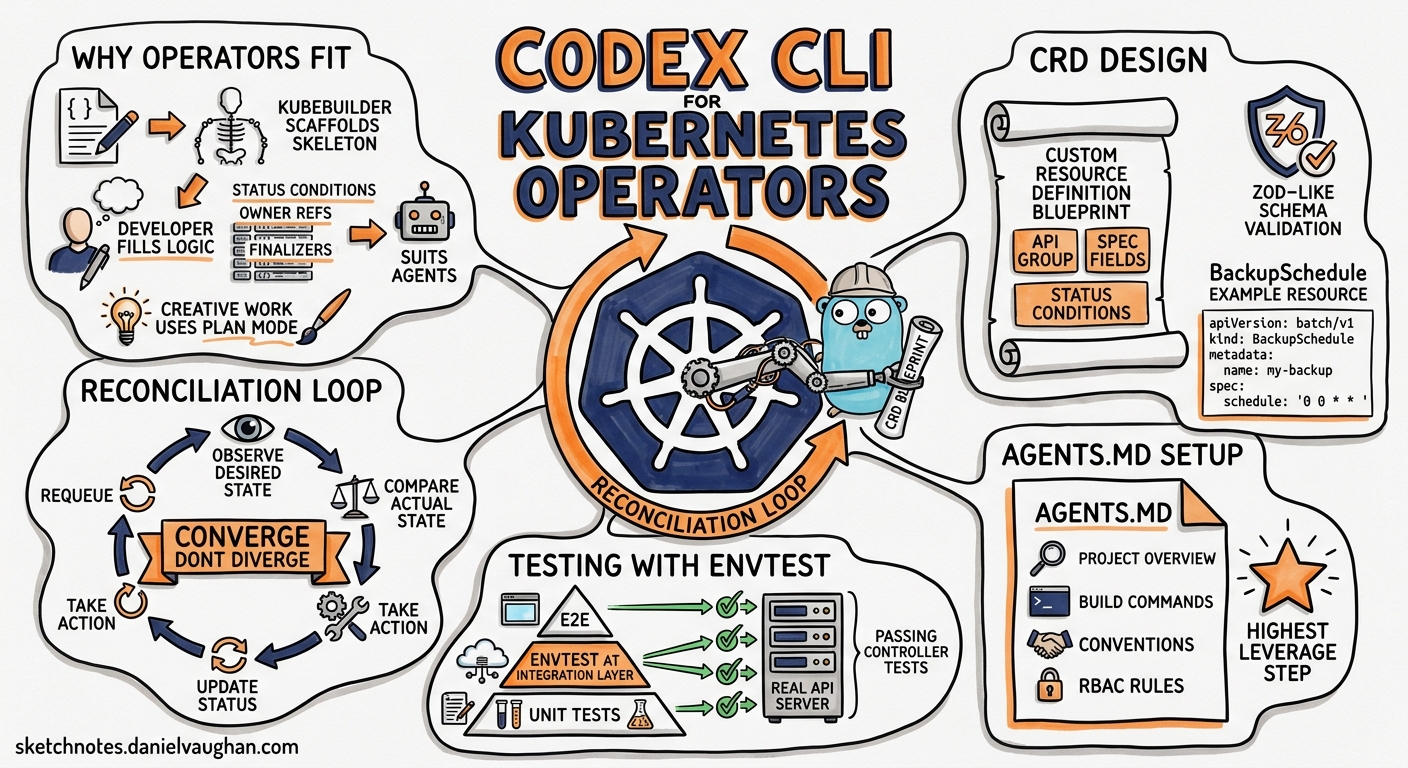
Building a Kubernetes operator is one of the most structurally demanding tasks in cloud-native Go development. You need a Custom Resource Definition that models your domain, a controller whose reconciliation loop converges actual state toward desired state, RBAC manifests scoped to exactly the right verbs, and integration tests that exercise the full loop against a real API server — all before you think about webhooks, finalizers, or status subresources. Codex CLI turns out to be remarkably well-suited to this workflow, provided you tell it what it needs to know.
This article covers the end-to-end operator development cycle with Codex CLI: from Kubebuilder scaffolding through reconciliation logic, envtest integration testing, and deployment manifest generation. The patterns here assume Kubebuilder v4.13.01, controller-runtime v0.23.x2, and Kubernetes 1.363.
Why Operators Are a Good Fit for Codex CLI
Operator development is heavily template-driven. Kubebuilder generates a project skeleton with Makefile, config/ manifests, and stub files — then the developer fills in domain-specific logic. The repetitive structural code (status conditions, event recording, owner references, finalizer management) follows well-documented patterns that a coding agent can reproduce reliably. The genuinely creative work — deciding what your CRD should model and how the reconciliation loop should converge — benefits from plan mode and the interview pattern.
Codex CLI’s sandbox also helps here. Operator code typically needs make generate and make manifests to run controller-gen, but does not need network access or cluster connectivity during development. A workspace-write sandbox with targeted command rules keeps the agent productive without exposing your kubeconfig.
Setting Up the Project
AGENTS.md for Operator Projects
The single highest-leverage step is writing an AGENTS.md that captures operator conventions Codex cannot infer from the scaffolding alone4:
# AGENTS.md

## Project Overview
Kubernetes operator built with Kubebuilder v4.13.0 and Go 1.24.
Manages `BackupSchedule` custom resources in the `data.example.com` API group.

## Build & Test Commands
- `make generate` — regenerate deepcopy and CRD manifests (run after any type change)
- `make manifests` — regenerate RBAC, CRD YAML, and webhook configs
- `make test` — run envtest suite (requires KUBEBUILDER_ASSETS)
- `make lint` — run golangci-lint with the project config

## Conventions
- Every reconciliation must be idempotent; never assume prior state
- Use `controllerutil.CreateOrUpdate` for owned resources
- Record events via `ctrl.EventRecorder` for every state transition
- Status conditions follow `metav1.Condition` with reason codes in PascalCase
- Finalizers use the pattern `data.example.com/cleanup`
- RBAC markers live on the Reconcile method, not in separate files
- Errors that indicate transient failures return `ctrl.Result{RequeueAfter: 30 * time.Second}`
- Permanent failures set a `Degraded` condition and return `ctrl.Result{}`

## Testing
- Integration tests use controller-runtime envtest with Ginkgo/Gomega
- Every reconciliation path must have a corresponding envtest case
- Do NOT mock the Kubernetes client; use the envtest API server
- Test fixtures live in `internal/controller/testdata/`

## Forbidden
- Do not use `client-go` informers directly; use controller-runtime caches
- Do not add cluster-admin RBAC; scope to the minimum required verbs
- Do not shell out to kubectl from the operator binary
This file prevents the three most common agent mistakes in operator projects: generating overly broad RBAC, mocking the Kubernetes client instead of using envtest, and forgetting to run make generate after modifying types.
Scaffolding with Kubebuilder
Start the project with Kubebuilder, then let Codex fill in the domain logic:
kubebuilder init --domain example.com --repo github.com/example/backup-operator
kubebuilder create api --group data --version v1alpha1 --kind BackupSchedule --resource --controller
This produces the canonical layout1:
├── api/v1alpha1/
│   ├── backupschedule_types.go    # CRD spec and status structs
│   └── zz_generated.deepcopy.go   # auto-generated
├── internal/controller/
│   ├── backupschedule_controller.go
│   └── suite_test.go
├── config/
│   ├── crd/
│   ├── rbac/
│   └── manager/
├── Makefile
└── AGENTS.md
Designing the CRD with Plan Mode
CRD design benefits from Codex’s plan mode. The spec and status structs define the operator’s API contract — get them wrong and every downstream component breaks.
/plan Design the BackupSchedule CRD. The spec should let users define:
a cron schedule, a target PVC name, a retention policy (count and age),
and an optional S3 destination. The status should track the last
successful backup time, the next scheduled time, and a conditions array.
Codex will propose the type definitions, ask clarifying questions about validation (minimum retention count? required vs optional S3 fields?), and produce a plan you can review before any code is written. Once approved, it generates the types:
// api/v1alpha1/backupschedule_types.go
type BackupScheduleSpec struct {
    // Schedule in Cron format (e.g. "0 2 * * *")
    // +kubebuilder:validation:MinLength=1
    Schedule string `json:"schedule"`

    // TargetPVC is the PersistentVolumeClaim to back up
    TargetPVC string `json:"targetPVC"`

    // Retention defines how long backups are kept
    Retention RetentionPolicy `json:"retention"`

    // S3Destination is the optional remote storage target
    // +optional
    S3Destination *S3Destination `json:"s3Destination,omitempty"`
}

type BackupScheduleStatus struct {
    // LastSuccessfulBackup is the timestamp of the most recent successful run
    // +optional
    LastSuccessfulBackup *metav1.Time `json:"lastSuccessfulBackup,omitempty"`

    // NextScheduledBackup is the computed next run time
    // +optional
    NextScheduledBackup *metav1.Time `json:"nextScheduledBackup,omitempty"`

    // Conditions represent the latest observations of the resource's state
    Conditions []metav1.Condition `json:"conditions,omitempty"`
}
After the types are written, Codex should run make generate && make manifests — the AGENTS.md instruction ensures it does this automatically after any type change.
Writing the Reconciliation Loop
The reconciliation loop is where most operator complexity lives. A well-structured prompt gives Codex enough context to generate idempotent, production-grade logic:
Implement the Reconcile method for BackupScheduleReconciler.
The loop should:
1. Fetch the BackupSchedule CR; return if not found (deleted)
2. Handle finalizer addition/removal for cleanup
3. Parse the cron schedule and compute the next run time
4. If the next run time has passed, create a batch/v1 Job owned by the CR
5. Update status.lastSuccessfulBackup when the Job succeeds
6. Set status conditions: Ready, Progressing, or Degraded
7. Requeue at the next scheduled time

Follow the conventions in AGENTS.md. Use controllerutil for owned resources.
The resulting reconciliation loop follows a standard pattern:
flowchart TD
    A[Reconcile called] --> B{CR exists?}
    B -- No --> C[Return: nothing to do]
    B -- Yes --> D{Being deleted?}
    D -- Yes --> E[Run finalizer cleanup]
    E --> F[Remove finalizer]
    F --> C
    D -- No --> G{Finalizer present?}
    G -- No --> H[Add finalizer]
    H --> I[Requeue]
    G -- Yes --> J[Parse cron schedule]
    J --> K{Time to run?}
    K -- No --> L["Requeue at next run time"]
    K -- Yes --> M["Create/update owned Job"]
    M --> N{Job succeeded?}
    N -- Yes --> O[Update status + Ready condition]
    N -- No --> P[Set Progressing condition]
    O --> L
    P --> L
Key patterns Codex should apply (and the AGENTS.md enforces):
- Idempotency:
controllerutil.CreateOrUpdateensures the Job is created if missing or updated if the spec has drifted5. - Owner references:
ctrl.SetControllerReferenceon every owned resource ensures garbage collection when the CR is deleted5. - Status conditions: Use
meta.SetStatusConditionfromapimachinery/pkg/api/metato avoid duplicate conditions6. - Event recording:
recorder.Eventf(cr, corev1.EventTypeNormal, "BackupStarted", ...)provides an audit trail visible viakubectl describe.
RBAC Markers
Codex generates RBAC markers directly on the Reconcile method. Verify they are scoped tightly:
//+kubebuilder:rbac:groups=data.example.com,resources=backupschedules,verbs=get;list;watch;update;patch
//+kubebuilder:rbac:groups=data.example.com,resources=backupschedules/status,verbs=get;update;patch
//+kubebuilder:rbac:groups=data.example.com,resources=backupschedules/finalizers,verbs=update
//+kubebuilder:rbac:groups=batch,resources=jobs,verbs=get;list;watch;create;update;patch;delete
//+kubebuilder:rbac:groups="",resources=events,verbs=create;patch
A common agent mistake is generating cluster-admin-level RBAC or adding wildcard verbs. The AGENTS.md constraint prevents this, but always review the generated config/rbac/role.yaml after running make manifests.
Testing with envtest
The envtest framework from controller-runtime provides a lightweight test environment with real etcd and API server components, enabling fast operator testing without deploying to a full cluster7. This is where Codex CLI adds the most value — writing envtest cases is tedious but structurally predictable.
Suite Setup
Kubebuilder scaffolds internal/controller/suite_test.go with the envtest bootstrap. The key components:
var (
    cfg       *rest.Config
    k8sClient client.Client
    testEnv   *envtest.Environment
    ctx       context.Context
    cancel    context.CancelFunc
)

var _ = BeforeSuite(func() {
    testEnv = &envtest.Environment{
        CRDDirectoryPaths:     []string{filepath.Join("..", "..", "config", "crd", "bases")},
        ErrorIfCRDPathMissing: true,
    }
    cfg, err := testEnv.Start()
    Expect(err).NotTo(HaveOccurred())

    // Register the CRD scheme
    err = datav1alpha1.AddToScheme(scheme.Scheme)
    Expect(err).NotTo(HaveOccurred())

    k8sClient, err = client.New(cfg, client.Options{Scheme: scheme.Scheme})
    Expect(err).NotTo(HaveOccurred())
})
Writing Reconciliation Tests
Prompt Codex to generate envtest cases for every reconciliation path:
Write envtest integration tests for BackupScheduleReconciler covering:
1. Creating a BackupSchedule CR triggers Job creation
2. Deleting the CR runs the finalizer and cleans up Jobs
3. A completed Job updates status.lastSuccessfulBackup
4. An invalid cron schedule sets the Degraded condition
5. Retention policy deletes Jobs older than the retention age

Use Ginkgo/Gomega. Follow the testing conventions in AGENTS.md.
A well-generated test case for the happy path:
It("should create a Job when the schedule fires", func() {
    cr := &datav1alpha1.BackupSchedule{
        ObjectMeta: metav1.ObjectMeta{
            Name:      "test-backup",
            Namespace: "default",
        },
        Spec: datav1alpha1.BackupScheduleSpec{
            Schedule:  "* * * * *", // every minute for testing
            TargetPVC: "data-pvc",
            Retention: datav1alpha1.RetentionPolicy{Count: 3},
        },
    }
    Expect(k8sClient.Create(ctx, cr)).To(Succeed())

    // Wait for the controller to create a Job
    Eventually(func() bool {
        var jobs batchv1.JobList
        err := k8sClient.List(ctx, &jobs,
            client.InNamespace("default"),
            client.MatchingLabels{"app.kubernetes.io/managed-by": "backup-operator"},
        )
        return err == nil && len(jobs.Items) > 0
    }, timeout, interval).Should(BeTrue())
})
Running Tests in the Sandbox
Codex CLI’s sandbox needs access to the setup-envtest binary and the downloaded Kubernetes API server binaries. Configure your project’s .codex/config.toml to enable this:
# .codex/config.toml — operator project overrides
sandbox_mode = "workspace-write"

[shell_environment_policy]
inherit = "core"
set = { KUBEBUILDER_ASSETS = "/usr/local/kubebuilder/bin" }
With workspace-write and the KUBEBUILDER_ASSETS path set, make test works inside the sandbox. Network access is not required — envtest runs etcd and kube-apiserver as local processes7.
Deployment Manifest Generation
Once the operator logic and tests pass, Codex can generate the deployment manifests. The standard Kubebuilder approach uses Kustomize overlays in config/:
Generate production Kustomize overlays for the backup-operator:
- config/production/ with namespace, resource limits, replica count 2
- config/production/manager_patch.yaml with memory limit 128Mi, CPU limit 100m
- Update config/default/kustomization.yaml to include the production overlay
Codex also generates the Dockerfile for the manager binary. Verify it uses a distroless base image and a non-root user — both are Kubebuilder defaults, but agents occasionally rewrite Dockerfiles with ubuntu:latest8.
Common Pitfalls and Agent-Specific Guidance
1. Forgetting make generate After Type Changes
The AGENTS.md convention handles this, but if you are prompting without it, explicitly instruct: “After modifying any types in api/, run make generate && make manifests before writing tests.”
2. Overly Broad RBAC
Codex sometimes generates verbs=* or adds permissions for resource types the operator never touches. Review config/rbac/role.yaml after every generation cycle.
3. Non-Idempotent Reconciliation
The most subtle bug: a reconciliation loop that creates duplicate resources on requeue. Enforce controllerutil.CreateOrUpdate in AGENTS.md and verify in envtest that calling Reconcile twice produces the same cluster state.
4. Mocking the Kubernetes Client
Codex may default to generating unit tests with a fake client. The AGENTS.md directive “Do NOT mock the Kubernetes client; use the envtest API server” prevents this. envtest catches real-world issues — validation, defaulting, RBAC — that mocks silently hide7.
5. Context Window Pressure on Large Operators
Operators with many types and controllers can exhaust Codex’s context window. Use subagents for independent controllers and the /compact command between phases (CRD design → controller logic → tests → deployment manifests).
The Recommended Workflow
sequenceDiagram
    participant Dev as Developer
    participant Codex as Codex CLI
    participant KB as Kubebuilder

    Dev->>KB: kubebuilder init + create api
    Dev->>Dev: Write AGENTS.md
    Dev->>Codex: /plan Design CRD types
    Codex->>Dev: Proposed types + questions
    Dev->>Codex: Approved — implement types
    Codex->>KB: make generate && make manifests
    Dev->>Codex: Implement reconciliation loop
    Codex->>Dev: Controller with RBAC markers
    Codex->>KB: make manifests
    Dev->>Codex: Write envtest integration tests
    Codex->>KB: make test
    Dev->>Codex: Generate deployment manifests
    Codex->>KB: make build && make docker-build
The cycle takes advantage of Codex’s strengths — template-heavy code generation, test case proliferation, and manifest management — whilst keeping the developer in control of the domain-specific design decisions that require human judgement.
Citations
-
Kubebuilder v4.13.0 Release Notes, kubernetes-sigs/kubebuilder, February 2026 — https://github.com/kubernetes-sigs/kubebuilder/releases ↩ ↩2
-
controller-runtime v0.23.x, kubernetes-sigs/controller-runtime — https://pkg.go.dev/sigs.k8s.io/controller-runtime ↩
-
Kubernetes v1.36 Release, April 2026 — https://kubernetes.io/blog/2026/04/22/kubernetes-v1-36-release/ ↩
-
Custom Instructions with AGENTS.md, OpenAI Codex Docs — https://developers.openai.com/codex/guides/agents-md ↩
-
controllerutil Package Reference, controller-runtime — https://pkg.go.dev/sigs.k8s.io/controller-runtime/pkg/controller/controllerutil ↩ ↩2
-
Kubebuilder Book: Writing Controllers — https://book.kubebuilder.io/cronjob-tutorial/controller-implementation ↩
-
envtest Package Reference, controller-runtime — https://pkg.go.dev/sigs.k8s.io/controller-runtime/pkg/envtest ↩ ↩2 ↩3
-
Kubebuilder Book: Quick Start — https://book.kubebuilder.io/quick-start ↩