Managed Agents in the Gemini API vs Codex Cloud Tasks: Agent-as-a-Service Showdown
Managed Agents in the Gemini API vs Codex Cloud Tasks: Agent-as-a-Service Showdown
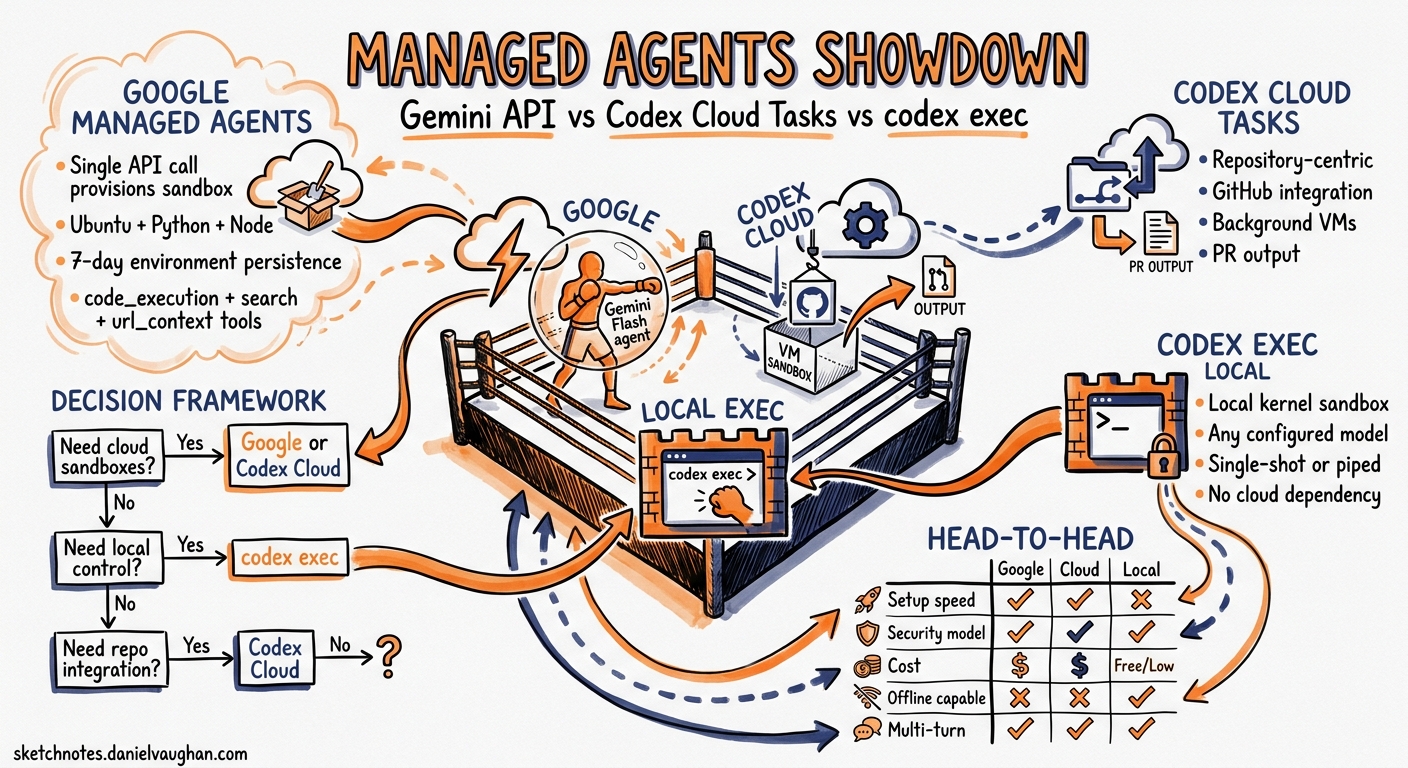
At Google I/O 2026, Ali Çevik introduced Managed Agents in the Gemini API — a single API call that provisions an ephemeral Linux sandbox, drops in an agent powered by Gemini 3.5 Flash, and lets it reason, execute code, manage files, and browse the web autonomously 1. It is the most direct competitive response yet to OpenAI’s Codex Cloud tasks and the local codex exec command, both of which let developers fire off agentic coding work without an interactive session.
This article compares the three surfaces head-to-head: Google’s Managed Agents, Codex Cloud tasks, and codex exec. If your team is building agentic automation into CI/CD pipelines, internal tooling, or batch workflows, this is the decision framework you need.
Architecture at a Glance
graph LR
    subgraph Google
        A[Gemini API Call] --> B[Interactions API]
        B --> C[Ephemeral Linux Sandbox]
        C --> D[Antigravity Agent<br/>Gemini 3.5 Flash]
    end
    subgraph OpenAI Cloud
        E[codex cloud exec] --> F[Cloud VM]
        F --> G[Repository Sandbox]
        G --> H[GPT-5.5 / codex-mini]
    end
    subgraph OpenAI Local
        I[codex exec] --> J[Local Kernel Sandbox]
        J --> K[Any configured model]
    end
Google Managed Agents
A Managed Agent is an ephemeral, sandboxed execution unit provisioned via the Interactions API 2. Each call creates an isolated Ubuntu-based environment with Python 3.12 and Node.js 22 pre-installed 3. The agent has three default tools — code_execution, google_search, and url_context — with filesystem operations activated automatically when an environment is specified 4. Environments persist for seven days of inactivity, allowing multi-turn sessions by passing back the environment ID 4.
The basic invocation is remarkably terse:
interaction = client.interactions.create(
    agent="antigravity-preview-05-2026",
    input="Refactor the auth module to use JWT",
    environment="remote",
)
Custom agents are defined through AGENTS.md (instructions) and SKILL.md files (capabilities) mounted under .agents/skills/ in the sandbox, or passed inline at interaction time 5. This filesystem-native configuration approach mirrors Codex CLI’s own AGENTS.md convention, though the two implementations are not interchangeable.
Codex Cloud Tasks
Codex Cloud takes a repository-centric approach 6. You connect a GitHub account at chatgpt.com/codex, configure cloud environments with repository selection, setup steps, and tool choices, then submit tasks that run in background VMs pre-loaded with your codebase. Output is typically a pull request or a diff applied via the IDE extension.
From the terminal:
codex cloud exec --env ENV_ID "Summarise open bugs and propose fixes"
Tasks support --attempts 1-4 for best-of-N runs, and the codex cloud list subcommand returns recent tasks for scripting 7. Internet access is configurable per environment, and @codex mentions on GitHub issues and PRs can trigger tasks directly 6.
codex exec (Local)
The local codex exec (alias codex e) runs non-interactively in a kernel-level sandbox on your own machine 8. It is the lightest-weight option — no cloud provisioning, no network round-trip for the sandbox itself.
codex exec \
  --sandbox workspace-write \
  --model gpt-5.5 \
  --output-schema schema.json \
  "Generate the API client from openapi.yaml"
Key flags include --output-schema for structured JSON output validated against a schema, --json for newline-delimited event streaming, and --output-last-message for capturing the final response 8. The --sandbox flag offers three levels: read-only, workspace-write, and danger-full-access.
Comparison Matrix
| Dimension | Google Managed Agents | Codex Cloud Tasks | codex exec (Local) |
|---|---|---|---|
| Execution | Ephemeral cloud sandbox | Persistent cloud VM | Local kernel sandbox |
| Model | Gemini 3.5 Flash 1 | GPT-5.5 / codex-mini 9 | Any configured model |
| Invocation | Single API call | CLI or GitHub mention | CLI command |
| Output | Interaction result + files | Pull request / diff | stdout / JSON / file |
| Repo integration | Mount sources at creation | Pre-loaded from GitHub | Local working directory |
| Multi-turn | Environment ID reuse 4 | Task threads | resume subcommand 8 |
| Sandbox lifetime | 7 days idle 3 | Per-environment config | Session duration |
| Structured output | Not yet supported 4 | Via PR structure | --output-schema 8 |
| MCP support | Provisioned per sandbox 10 | Via plugins | Via plugins 11 |
| Network | Unrestricted (configurable allowlist) 3 | Configurable per env 6 | Host network |
| Billing | Token-based pay-as-you-go 3 | Plan-inclusive 6 | API token costs only |
Sandbox Security Models
The security posture differs fundamentally.
Google uses OS-level isolation for each agent instance with an egress proxy for credential injection — credentials are never exposed inside the sandbox 3. Network access defaults to unrestricted outbound with optional domain allowlisting.
Codex Cloud runs each task in its own cloud VM with repository-scoped access. Enterprise workspaces require admin setup before access is granted 6, giving organisations a governance gate.
codex exec relies on kernel-level sandboxing (seccomp-bpf on Linux, Seatbelt on macOS) with three configurable levels 8. The --dangerously-bypass-approvals-and-sandbox flag exists for isolated CI runners but should never appear outside ephemeral build environments.
For regulated industries, Codex CLI’s local execution keeps code and credentials on-premises entirely — a compliance advantage that neither cloud-based alternative can match.
When to Use Which
Google Managed Agents
Best for fire-and-forget tasks where you want agent execution without managing infrastructure. The single API call model suits teams already invested in the Google Cloud ecosystem, particularly those using the Gemini Enterprise Agent Platform 12. The Interactions API integrates with LangChain, LlamaIndex, CrewAI, and Google ADK 3, making it a natural fit for multi-framework agent orchestration.
However, Managed Agents are in preview with notable limitations: no structured output, no temperature control, no file_search or computer_use tools, and no audio/video input 4. MCP server support is provisioned per sandbox but the broader MCP ecosystem integration is still maturing 10.
Codex Cloud Tasks
Best for repository-centric automation — feature branches, bug fixes, PR generation. The GitHub-native integration (including @codex mentions) makes it the most natural choice for teams whose workflow revolves around pull requests 6. The --attempts flag for best-of-N is unique to Codex Cloud and valuable for non-deterministic tasks like test generation.
The trade-off is platform lock-in: you need a Plus, Pro, Business, Edu, or Enterprise plan 6, and the execution environment is OpenAI’s cloud, not yours.
codex exec
Best for CI/CD pipelines, structured queries, and air-gapped environments. The --output-schema flag turns Codex into a structured data extraction tool 8, and --json event streaming enables real-time progress monitoring in build systems. Local execution means zero data leaves your network.
The v0.131.0 release added codex doctor for diagnostics 11, and the Python SDK (openai-codex) now supports concurrent turn routing and approval modes 11, making programmatic integration increasingly robust.
The Programmatic Layer: SDK Comparison
Both platforms offer SDKs for embedding agent execution in applications.
The Gemini Interactions API follows a request-response pattern with environment reuse for multi-turn flows 2. Framework adapters (LangChain, ADK) provide higher-level abstractions. Agent-to-Agent (A2A) protocol support is announced but not yet generally available 12.
The openai-codex Python SDK uses JSON-RPC to communicate with the local app-server 13. It supports thread-based conversation management with thread_start() and sequential thread.run() calls, plus an AsyncCodex class for asynchronous workflows. This is lower-level than the Gemini approach but offers finer-grained control over the execution lifecycle.
# OpenAI Codex Python SDK
from openai_codex import Codex

codex = Codex()
thread = codex.thread_start(model="gpt-5.5")
result = thread.run("Analyse the auth module for security issues")
print(result.final_response)
Pricing Considerations
Google’s Managed Agents use a pay-as-you-go model based on Gemini token consumption and tool usage, with typical interactions consuming 100k to 3M tokens 3. The Gemini Enterprise Agent Platform adds compute billing (vCPU-hours and GiB-hours) with a free tier of 50 vCPU-hours and 100 GiB-hours of RAM per month 14. During preview, sandbox compute is not charged.
Codex Cloud tasks are included with OpenAI subscription plans (Plus, Pro, Business, Edu, Enterprise) 6, making them effectively unlimited within plan constraints. codex exec costs only the API tokens consumed by the chosen model.
For teams running hundreds of automated agent tasks per month, the pricing model difference is material: Google’s per-invocation billing can spike with heavy use, whilst OpenAI’s plan-inclusive model offers more predictable costs — provided you are already paying for a subscription.
Decision Flowchart
flowchart TD
    A[Need agentic automation] --> B{Code stays on-premises?}
    B -->|Yes| C[codex exec]
    B -->|No| D{Primary output?}
    D -->|Pull requests| E[Codex Cloud Tasks]
    D -->|Structured data / API response| F{Existing cloud platform?}
    F -->|Google Cloud| G[Managed Agents]
    F -->|OpenAI / other| H[codex exec + --output-schema]
    D -->|Fire-and-forget task| I{Subscription?}
    I -->|OpenAI plan| E
    I -->|Google / pay-as-you-go| G
What Comes Next
Google’s Managed Agents are in preview — expect file_search, computer_use, structured outputs, and full A2A governance to land in the coming months 4 12. OpenAI’s v0.131.0 release signals continued investment in the local-first model with remote environment management now supporting daemon-managed codex remote-control and registry-backed environments 11.
The convergence is clear: both platforms are building towards “agent-as-a-service” where developers define intent and the platform handles provisioning, execution, and output. The question is not whether to adopt agentic automation, but which execution model — ephemeral sandbox, persistent cloud VM, or local kernel sandbox — fits your team’s security posture, workflow, and billing preferences.
Citations
-
Çevik, A. (2026, May 19). “Introducing Managed Agents in the Gemini API.” Google Blog. https://blog.google/innovation-and-ai/technology/developers-tools/managed-agents-gemini-api/ ↩ ↩2
-
Google AI for Developers. “Agents Overview — Gemini API.” https://ai.google.dev/gemini-api/docs/agents ↩ ↩2
-
Google AI for Developers. “Agents Overview — Sandbox Environment and Pricing.” https://ai.google.dev/gemini-api/docs/agents ↩ ↩2 ↩3 ↩4 ↩5 ↩6 ↩7
-
Google AI for Developers. “Antigravity Agent — Gemini API.” https://ai.google.dev/gemini-api/docs/antigravity-agent ↩ ↩2 ↩3 ↩4 ↩5 ↩6
-
Google AI for Developers. “Set up your coding assistant with Gemini MCP and Skills.” https://ai.google.dev/gemini-api/docs/coding-agents ↩
-
OpenAI Developers. “Web — Codex (Cloud).” https://developers.openai.com/codex/cloud ↩ ↩2 ↩3 ↩4 ↩5 ↩6 ↩7 ↩8
-
OpenAI Developers. “Command line options — Codex CLI.” https://developers.openai.com/codex/cli/reference ↩
-
OpenAI Developers. “Command line options — codex exec.” https://developers.openai.com/codex/cli/reference ↩ ↩2 ↩3 ↩4 ↩5 ↩6
-
OpenAI Developers. “Models — Codex.” https://developers.openai.com/codex/models ↩
-
“Google I/O ‘26 Fills Out Enterprise Agent Stack with Managed Agents, ADK 2.0.” Virtualization Review, 19 May 2026. https://virtualizationreview.com/articles/2026/05/19/google-io-26-fills-out-enterprise-agent-stack-with-managed-agents-adk-2,-d-,0.aspx ↩ ↩2
-
OpenAI Developers. “Changelog — Codex v0.131.0.” https://developers.openai.com/codex/changelog ↩ ↩2 ↩3 ↩4
-
Google Cloud. “Agent Platform overview — Gemini Enterprise Agent Platform.” https://docs.cloud.google.com/gemini-enterprise-agent-platform/overview ↩ ↩2 ↩3
-
OpenAI Developers. “SDK — Codex.” https://developers.openai.com/codex/sdk ↩
-
Google Cloud. “Gemini Enterprise Agent Platform pricing.” https://cloud.google.com/products/gemini-enterprise-agent-platform/pricing ↩