The Post-Google I/O Coding Agent Landscape: Codex CLI vs Antigravity 2.0 vs Jules V2 vs Claude Code vs Grok Build
The Post-Google I/O Coding Agent Landscape: Codex CLI vs Antigravity 2.0 vs Jules V2 vs Claude Code vs Grok Build
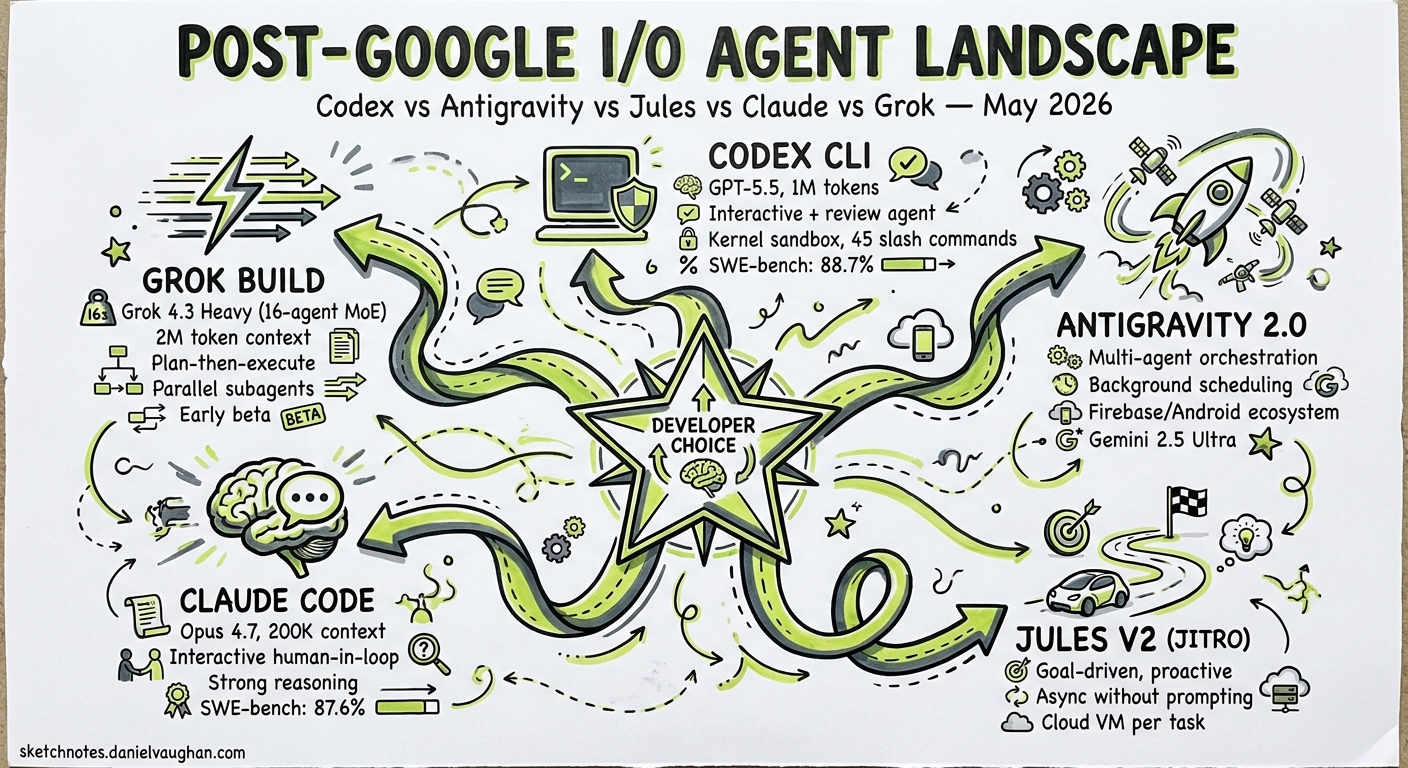
Google I/O 2026 landed on 19 May and reshaped the terminal coding agent market overnight. Antigravity 2.0 replaced Gemini CLI1, Jules V2 (Project Jitro) introduced goal-driven development2, and xAI’s Grok Build entered early beta the same week3. Combined with OpenAI’s Codex CLI v0.1314 and Anthropic’s Claude Code running Opus 4.75, senior engineers now face a genuine five-way choice. This article provides a structured comparison as of 20 May 2026.
Architecture at a Glance
graph TD
    subgraph "Local Terminal Agents"
        A[Codex CLI] --> |GPT-5.5| M1[OpenAI API]
        B[Claude Code] --> |Opus 4.7| M2[Anthropic API]
        C[Grok Build] --> |Grok 4.3 Heavy| M3[xAI API]
        D[Antigravity CLI] --> |Gemini 2.5 Ultra| M4[Google AI API]
    end
    subgraph "Cloud/Async Agents"
        E[Codex Cloud] --> M1
        F[Jules V2 / Jitro] --> M4
    end
All five tools run in a local terminal, but they differ fundamentally in execution model: Codex CLI and Claude Code are interactive (human-in-the-loop per action), Grok Build uses plan-then-execute with parallel subagents, Antigravity 2.0 offers multi-agent orchestration with background scheduling, and Jules V2 operates as a proactive, goal-driven agent that can work asynchronously without prompting2.
Model Foundations
| Agent | Primary Model | Context Window | SWE-bench Verified |
|---|---|---|---|
| Codex CLI | GPT-5.5 | 1M tokens | 88.7%6 |
| Claude Code | Opus 4.7 | 200K tokens | 87.6%6 |
| Grok Build | Grok 4.3 Heavy (16-agent MoE) | 2M tokens | Not yet submitted |
| Antigravity 2.0 | Gemini 2.5 Ultra | 2M tokens | 82.1%6 |
| Jules V2 | Gemini 2.5 Ultra | 2M tokens | Shared with Antigravity |
On Terminal-Bench 2.0, which tests realistic shell tasks, Codex CLI + GPT-5.5 leads at 82.0%, with Claude Code (Opus 4.7) reporting 69.4%7. Grok Build and Antigravity have not yet appeared on the public leaderboard.
Execution Models Compared
Codex CLI: Interactive with Review Agent
Codex CLI v0.131 introduced a built-in review agent that critiques diffs before commit4. The workflow is prompt-execute-review, with the developer approving each action. Its 45 slash commands give fine-grained control over session state8.
# Codex CLI typical workflow
codex "refactor the auth module to use dependency injection"
# Agent executes, review agent validates, developer approves commit
Claude Code: Deep Reasoning with Self-Verification
Claude Code’s differentiator is Opus 4.7’s visible thought process — developers can watch reasoning chains unfold5. Task budgets (new in 4.7) let the model self-allocate tokens across an agentic loop9. Background mode enables fire-and-forget for longer tasks.
Antigravity 2.0: Multi-Agent Orchestration
The headline feature is native multi-agent orchestration with subagent spawning1. The OS-in-12-hours demo at I/O launched 93 subagents simultaneously10. The built-in Chromium browser and cross-platform terminal sandboxing are unique differentiators. The new Antigravity SDK provides programmatic control for custom deployments1.
Grok Build: Parallel Subagents by Default
Grok Build spawns up to 8 concurrent subagents by default3. Plan Mode is always-on — the agent generates a step-by-step plan that developers approve, modify, or reject before execution begins. It claims local-first operation with no source code transmission to xAI servers3.
Jules V2 (Project Jitro): Goal-Driven Development
Jules V2 represents a paradigm shift. Rather than task-based prompting, developers define outcomes: “Reduce authentication errors by 15% this sprint” or “Get test coverage to 85%”2. The agent autonomously identifies codebase changes to achieve the goal. A persistent workspace tracks goals, insights, and tool integrations11.
flowchart LR
    A[Developer sets goal] --> B[Jules analyses codebase]
    B --> C[Identifies changes needed]
    C --> D[Proposes implementation plan]
    D --> E{Developer approves?}
    E -->|Yes| F[Executes autonomously]
    E -->|No| G[Revises approach]
    G --> D
    F --> H[Reports outcome metrics]
Security and Sandboxing
| Feature | Codex CLI | Claude Code | Grok Build | Antigravity 2.0 | Jules V2 |
|---|---|---|---|---|---|
| Local execution | Yes | Yes | Yes | Yes | Cloud |
| Terminal sandbox | toml-configured | Permission prompts | Claimed local-first | Cross-platform sandbox | Cloud sandbox |
| Source code leaves machine | Via API calls | Via API calls | Claimed no3 | Via API calls | Yes (cloud) |
| Credential masking | Hooks | Manual | Unknown | Built-in1 | Cloud-managed |
| Git policy enforcement | Hooks | Manual | Plan approval | Hardened policies1 | PR-based |
Pricing Comparison (May 2026)
| Agent | Entry Tier | Mid Tier | Premium Tier |
|---|---|---|---|
| Codex CLI | $20/mo (Plus)12 | $100/mo (Pro) | $200/mo (Pro 20x) |
| Claude Code | $20/mo (Pro)13 | $100/mo (Max 5x) | $200/mo (Max 20x) |
| Grok Build | $99/mo intro ($299 standard)3 | — | SuperGrok Heavy |
| Antigravity 2.0 | $20/mo (AI Pro)14 | $100/mo (AI Ultra) | $200/mo (AI Ultra 20x) |
| Jules V2 | Included with AI Ultra14 | — | — |
The three major platforms (OpenAI, Anthropic, Google) have converged on identical tier structures: $20/$100/$200. Grok Build is the outlier at $99/mo introductory, making it the most expensive entry point for a beta product.
Enterprise Considerations
Codex CLI offers enterprise governance through config layering (user/project/enterprise TOML files), hook-based policy enforcement, and the codex doctor diagnostics command4. The Python SDK (openai-codex) supports programmatic integration.
Claude Code provides Team plans at $100/seat/month with centralised billing13. Opus 4.7 is available on AWS Bedrock, Google Vertex AI, and Microsoft Foundry9.
Antigravity 2.0 launched the Gemini Enterprise Agent Platform alongside managed agents in the Gemini API1. A single API call provisions a fully sandboxed agent with remote execution.
Grok Build supports ACP (Agent Coordination Protocol) and is compatible with existing MCP servers and Anthropic skills3, positioning it as a multi-ecosystem tool despite being single-vendor for its model.
Decision Flowchart
flowchart TD
    A[Choosing a coding agent] --> B{Primary need?}
    B -->|Interactive terminal dev| C{Budget?}
    B -->|Async/background tasks| D{Scale?}
    B -->|Goal-driven outcomes| E[Jules V2]
    C -->|Entry $20/mo| F{Prefer reasoning visibility?}
    C -->|Premium performance| G{Benchmark priority?}
    F -->|Yes| H[Claude Code]
    F -->|No| I[Codex CLI]
    G -->|SWE-bench / code quality| J[Codex CLI]
    G -->|Deepest reasoning on hard tasks| K[Claude Code]
    D -->|Single repo| L[Codex Cloud / Claude Background]
    D -->|Multi-agent orchestration| M[Antigravity 2.0]
    A --> N{Want parallel subagents + large context?}
    N -->|Yes + 2M context| O[Grok Build]
What Changed Since the Terminal Agent Showdown (4 May)
The earlier three-way comparison15 covered Codex CLI, Claude Code, and Gemini CLI. Since then:
- Gemini CLI is deprecated — replaced by Antigravity CLI with a migration deadline of 18 June 20261
- Grok Build entered the market — adding a fourth local terminal agent with unique parallel subagent architecture3
- Jules V2 introduced goal-driven development — a fundamentally different interaction paradigm2
- Codex CLI v0.131 shipped the review agent, 45 slash commands, plugin marketplace, and remote workflows4
- Claude Opus 4.7 brought task budgets, background mode, and high-resolution vision9
Honest Trade-offs
- Codex CLI wins on benchmarks and ecosystem maturity but requires OpenAI lock-in and has the smallest context window (1M vs 2M)
- Claude Code has the deepest reasoning and most stable production track record but trails on Terminal-Bench and has the smallest context window (200K)
- Antigravity 2.0 offers the most ambitious multi-agent architecture but is brand new, unproven at scale, and forces a migration from Gemini CLI
- Grok Build has the largest context and parallel subagents but is early beta, expensive, and benchmarks are unverified
- Jules V2 is genuinely novel in its goal-driven approach but is waitlist-only and requires trusting a cloud agent with full repo access
Recommendation
For teams choosing in June 2026: Claude Code remains the safest default for interactive development — Opus 4.7’s self-verification reduces the worst agentic failure modes, the $20 Pro entry point is accessible, and multi-cloud availability (Bedrock, Vertex, Foundry) avoids vendor lock-in. Codex CLI is the performance pick if you prioritise benchmark scores and terminal ergonomics. Antigravity 2.0 is worth evaluating if you need multi-agent orchestration or are already in Google’s ecosystem. Grok Build is interesting for large-context monorepo work but too early to recommend for production. Jules V2 is one to watch — goal-driven development may be the future, but it is not yet the present.
Citations
-
Google Developers Blog, “All the news from the Google I/O 2026 Developer keynote”, 19 May 2026. https://developers.googleblog.com/all-the-news-from-the-google-io-2026-developer-keynote/ ↩ ↩2 ↩3 ↩4 ↩5 ↩6 ↩7
-
DevOps.com, “Google’s Next Coding Agent Could Change How Developers Think About Their Work”, May 2026. https://devops.com/googles-next-coding-agent-could-change-how-developers-think-about-their-work/ ↩ ↩2 ↩3 ↩4
-
xAI, “Introducing Grok Build”, May 2026. https://x.ai/news/grok-build-cli ↩ ↩2 ↩3 ↩4 ↩5 ↩6 ↩7
-
OpenAI, “Codex CLI Changelog”, May 2026. https://developers.openai.com/codex/changelog ↩ ↩2 ↩3 ↩4
-
Anthropic, “Introducing Claude Opus 4.7”, April 2026. https://www.anthropic.com/news/claude-opus-4-7 ↩ ↩2
-
SWE-bench Verified Leaderboard, May 2026. https://www.swebench.com/verified.html ↩ ↩2 ↩3
-
Terminal-Bench 2.0 Leaderboard, May 2026. https://www.tbench.ai/leaderboard/terminal-bench/2.0 ↩
-
OpenAI, “Codex CLI Slash Commands”, 2026. https://developers.openai.com/codex/cli ↩
-
GitHub Changelog, “Claude Opus 4.7 is generally available”, 16 April 2026. https://github.blog/changelog/2026-04-16-claude-opus-4-7-is-generally-available/ ↩ ↩2 ↩3
-
Digit.in, “Google I/O 2026: Google claims Antigravity 2.0 created an operating system in 12 hours”, 19 May 2026. https://www.digit.in/news/general/google-io-2026-google-claims-antigravity-20-created-an-operating-system-in-12-hours-brings-vibe-coding-to-android.html ↩
-
ByteIota, “Google Project Jitro: Jules V2 Moves from Prompts to Goals”, 2026. https://byteiota.com/google-project-jitro-jules-v2-goal-driven-coding-agent/ ↩
-
OpenAI, “Codex Pricing”, 2026. https://developers.openai.com/codex/pricing ↩
-
Anthropic, “Plans & Pricing”, 2026. https://claude.com/pricing ↩ ↩2
-
Google, “Everything new in our Google AI subscriptions, fresh from I/O 2026”, May 2026. https://blog.google/products-and-platforms/products/google-one/google-ai-subscriptions/ ↩ ↩2
-
Daniel Vaughan, “Terminal Agent Showdown”, 4 May 2026. Previously published in this knowledge base. ↩