Codex CLI's SDK Maturation Arc: How v0.130–v0.132 Turned a Terminal Tool into a Programmable Agent Platform
Codex CLI’s SDK Maturation Arc: How v0.130–v0.132 Turned a Terminal Tool into a Programmable Agent Platform
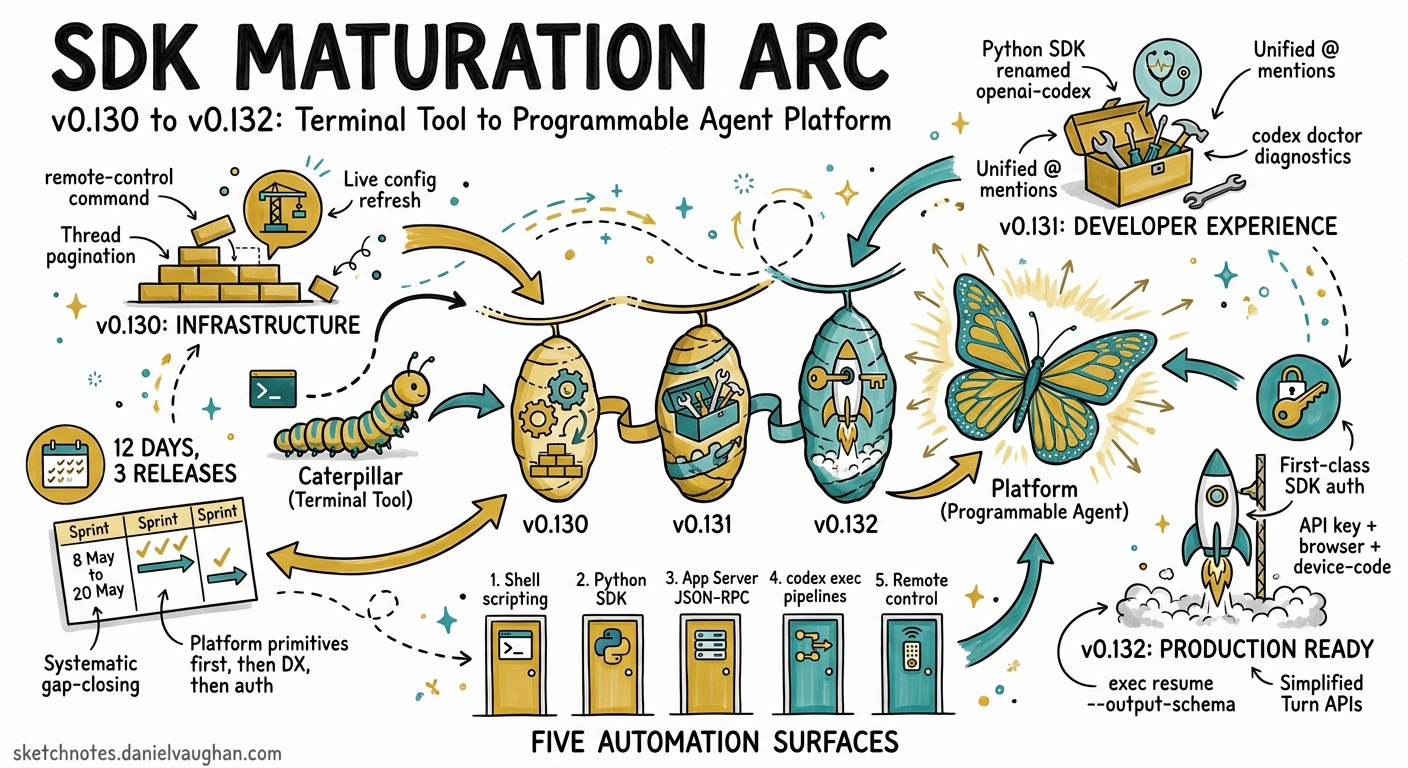
Three releases in twelve days. Between 8 May and 20 May 2026, Codex CLI shipped v0.130, v0.131, and v0.132 — and each one quietly pushed the project further from “terminal tool with a good TUI” towards “programmable agent platform with five distinct automation surfaces”123. Most coverage has focused on individual features: remote-control here, unified mentions there, Python SDK auth over there. This article traces the arc across all three releases, maps the five automation surfaces that now exist, and provides a decision framework for choosing which one to use.
The Problem the Arc Solves
Before May 2026, building production automation with Codex CLI meant one of two things: shell-scripting around codex exec or wiring up the app-server’s undocumented JSON-RPC protocol yourself4. The first was adequate for one-shot CI tasks but clumsy for multi-turn workflows. The second was powerful but fragile — types changed between releases, authentication required manual token juggling, and there was no official client library to absorb breaking changes.
The v0.130–v0.132 sprint addressed this gap systematically.
Release-by-Release: What Changed
v0.130 (8 May 2026): The Infrastructure Layer
v0.130 laid the groundwork with three infrastructure changes1:
-
codex remote-control— a single command that starts a headless app-server with remote-control support enabled, replacing the previous multi-flag incantation (codex --headless --enable-remote --daemon). This gave managed environments a clean entry point for running Codex as a background service. -
App-server thread pagination — clients can now page large threads with
unloaded,summary, orfullturn item views, preventing memory exhaustion in long-running sessions1. -
Live configuration refresh — app-server threads pick up
config.tomlchanges without requiring a restart, enabling runtime tuning of model selection, reasoning effort, and approval policies1.
These were not user-facing features. They were platform primitives: a stable daemon, efficient data access, and hot-reloadable configuration.
v0.131 (18 May 2026): The SDK and Diagnostics Layer
v0.131 delivered the developer experience improvements that make a platform usable2:
-
Python SDK rename to
openai-codex— the package moved from an internal naming convention to a public identity, with pinned runtime-generated types, concurrent turn routing, and approval mode controls2. This was a signal: the SDK is no longer experimental. -
codex doctor— a first-class diagnostics command covering runtime, authentication, terminal, network, configuration, and local state25. Before this, debugging a broken installation required manual log archaeology. Now a single command produces a structured, redacted JSON report suitable for support tooling. -
Unified
@mentions — the mention picker now searches files, directories, plugins, and skills in a single interface2, which matters for automation because it means the app-server’s metadata API exposes a unified resource namespace that custom clients can query.
v0.132 (20 May 2026): The Authentication and Output Layer
v0.132 closed the final gaps that prevented the Python SDK from being production-ready3:
-
First-class SDK authentication — the Python SDK now supports API key login, ChatGPT browser-based PKCE flow, and device-code flow for headless environments3. Previously, SDK users had to manage tokens manually or shell out to
codex login. -
Simplified Turn APIs — text-only workflows accept plain string inputs and return enriched
TurnResultobjects containing collected items, timing data, and usage statistics36. No more parsing JSON-RPC responses by hand. -
codex exec resume --output-schema— theresumesubcommand now accepts--output-schema, enabling multi-step pipelines where each step preserves full session context whilst outputting structured JSON37. This was a long-requested feature (GitHub Issue #14343) that removes the last barrier to chained agent workflows in CI/CD.
timeline
    title SDK Maturation Arc: v0.130–v0.132
    section v0.130 (8 May)
        Infrastructure : remote-control daemon
                       : Thread pagination
                       : Live config refresh
    section v0.131 (18 May)
        Developer Experience : Python SDK rename
                             : codex doctor diagnostics
                             : Unified mentions API
    section v0.132 (20 May)
        Production Readiness : First-class SDK auth
                             : TurnResult APIs
                             : resume + output-schema
The Five Automation Surfaces
As of v0.132, Codex CLI exposes five distinct surfaces for programmatic use. Each targets a different integration pattern468:
1. codex exec — The Unix Primitive
Best for one-shot tasks in shell scripts and CI pipelines. Accepts a prompt via argument or --prompt-file, streams progress to stderr, prints the final response to stdout. Add --output-schema for JSON Schema–validated output and --json for full JSONL event streaming4.
codex exec "Analyse src/ for type safety issues" \
  --output-schema ./schemas/type-report.json \
  -o ./reports/types.json \
  --ephemeral
2. Python SDK (openai-codex) — The Embedding Surface
Best for multi-turn automation, custom agent harnesses, and services that need programmatic control over thread lifecycle. As of v0.132, supports native authentication, sync and async clients, and typed TurnResult responses36.
from codex_app_server import Codex

with Codex() as codex:
    codex.login_api_key(api_key)
    thread = codex.thread_start(model="gpt-5.5")
    result = thread.run("Review the PR diff for security issues")
    print(result.final_response)
    print(f"Tokens used: {result.usage.total_tokens}")
3. TypeScript SDK (@openai/codex-sdk) — The Node Integration
Mirrors the Python SDK for Node.js environments. Thread-based API with startThread(), run(), and resumeThread()6.
import { Codex } from "@openai/codex-sdk";

const codex = new Codex();
const thread = codex.startThread();
const result = await thread.run("Generate release notes from the last 10 commits");
4. MCP Server — The Inter-Agent Bridge
Exposes Codex CLI as a Model Context Protocol server that other agents or orchestrators can call. Combined with the OpenAI Agents SDK, this enables multi-agent pipelines where a coordinator delegates coding tasks to Codex89.
5. GitHub Action (openai/codex-action@v1) — The CI Wrapper
Installs the CLI, configures the Responses API proxy, runs codex exec under specified permissions, and emits the final message as a GitHub Actions output10. Handles authentication, safety strategy, and user/bot allowlisting declaratively.
flowchart TD
    A[Shell Script] -->|codex exec| B[One-shot task]
    C[Python App] -->|openai-codex SDK| D[Multi-turn threads]
    E[Node.js App] -->|@openai/codex-sdk| D
    F[Agent Orchestrator] -->|MCP Server| G[Delegated coding]
    H[GitHub Actions] -->|codex-action| B
    D --> I[App-Server Process]
    B --> I
    G --> I
    I --> J[Codex Runtime + Sandbox]
Decision Framework: Which Surface to Choose
| Scenario | Recommended Surface | Rationale |
|---|---|---|
| One-shot CI quality gate | codex exec |
Stateless, composable, exit-code driven |
| Multi-step pipeline with context | codex exec resume |
Preserves thread state across steps |
| Custom Python service embedding Codex | Python SDK | Native auth, typed results, thread lifecycle |
| Multi-agent orchestration | MCP Server + Agents SDK | Protocol-level delegation with tracing |
| GitHub PR review automation | GitHub Action | Declarative YAML, built-in safety controls |
| Headless background service | codex remote-control |
Daemon mode with WebSocket management |
What Is Still Missing
The maturation arc is impressive but incomplete. Three gaps remain as of v0.132:
-
PyPI distribution — the Python SDK still requires a local Codex repository checkout and
pip install -e .fromsdk/python/6. There is nopip install openai-codexfrom PyPI yet. This limits adoption in environments where cloning the full repository is impractical. ⚠️ -
Streaming in the SDK — both
codex exec --jsonand the app-server’s JSON-RPC protocol support event streaming, but the Python and TypeScript SDKs expose only blockingrun()calls that return complete results6. Real-time progress callbacks would enable richer integrations. ⚠️ -
SDK feature parity — the Python SDK does not yet expose all app-server capabilities. Goal management, plugin lifecycle, and MCP server control are accessible only through the raw JSON-RPC protocol or the TUI6. ⚠️
Practical Implications
The v0.130–v0.132 arc matters because it changes how teams should think about Codex CLI. It is no longer just a terminal tool you ssh into; it is a platform with multiple integration points, each designed for a different architectural pattern.
For teams currently using codex exec in CI: consider whether the Python SDK’s multi-turn threading would simplify complex pipelines. For teams building custom developer platforms: the SDK’s first-class authentication means you can embed Codex without managing OAuth tokens yourself. For teams evaluating Codex against competitors: the five-surface architecture is Codex CLI’s structural advantage — no other coding agent offers this range of programmatic integration points in a single open-source package11.
The sprint from v0.130 to v0.132 was quiet — no blog posts, no keynote demos. But it may be the most consequential twelve days in Codex CLI’s history: the twelve days it stopped being a tool and started being a platform.
Citations
-
OpenAI, “Changelog – Codex: v0.130.0 (8 May 2026),” OpenAI Developers, 2026. https://developers.openai.com/codex/changelog ↩ ↩2 ↩3 ↩4
-
OpenAI, “Changelog – Codex: v0.131.0 (18 May 2026),” OpenAI Developers, 2026. https://developers.openai.com/codex/changelog ↩ ↩2 ↩3 ↩4 ↩5
-
OpenAI, “Changelog – Codex: v0.132.0 (20 May 2026),” OpenAI Developers, 2026. https://developers.openai.com/codex/changelog ↩ ↩2 ↩3 ↩4 ↩5 ↩6
-
OpenAI, “Non-interactive mode – Codex,” OpenAI Developers, 2026. https://developers.openai.com/codex/noninteractive ↩ ↩2 ↩3
-
GitHub Pull Request #22336, “feat(cli): add codex doctor diagnostics,” openai/codex, May 2026. https://github.com/openai/codex/pull/22336 ↩
-
OpenAI, “SDK – Codex,” OpenAI Developers, 2026. https://developers.openai.com/codex/sdk ↩ ↩2 ↩3 ↩4 ↩5 ↩6 ↩7
-
GitHub Pull Request #23123, “Resume automations now support –output-schema,” openai/codex, May 2026. https://github.com/openai/codex/pull/23123 ↩
-
OpenAI, “Use Codex with the Agents SDK,” OpenAI Developers, 2026. https://developers.openai.com/codex/guides/agents-sdk ↩ ↩2
-
OpenAI, “Building Consistent Workflows with Codex CLI & Agents SDK,” OpenAI Cookbook, 2025. https://developers.openai.com/cookbook/examples/codex/codex_mcp_agents_sdk/building_consistent_workflows_codex_cli_agents_sdk ↩
-
OpenAI, “GitHub Action – Codex,” OpenAI Developers, 2026. https://developers.openai.com/codex/github-action ↩
-
Blake Crosley, “Codex CLI v0.130 Reference,” blakecrosley.com, May 2026. https://blakecrosley.com/guides/codex ↩