Codex CLI v0.133.0 Release Guide: Goals Enabled by Default, Permission Profile Inheritance, and Extension Lifecycle Events
Codex CLI v0.133.0 Release Guide: Goals Enabled by Default, Permission Profile Inheritance, and Extension Lifecycle Events
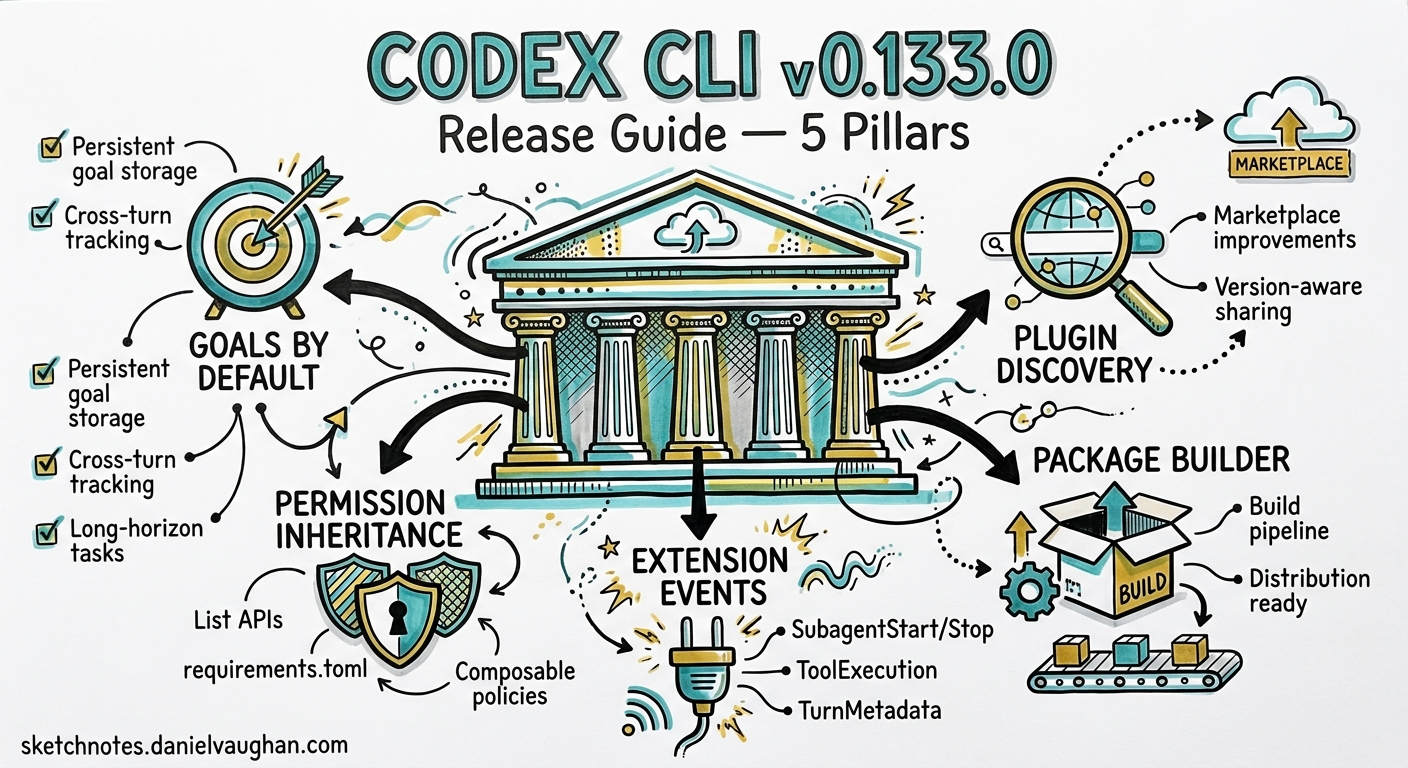
Codex CLI v0.133.0 landed on 21 May 2026 with over 80 merged pull requests 1. The headline change is deceptively simple — goals are now on by default — but the full release reshapes three critical surfaces: long-horizon task persistence, enterprise permission governance, and the extension observation API. This guide covers what shipped, what changed in configuration, and how to migrate from v0.132.
What Shipped: The Five Pillars of v0.133.0
graph TD
    A[v0.133.0 Stable] --> B[Goals Enabled<br/>by Default]
    A --> C[Permission Profile<br/>Inheritance]
    A --> D[Extension Lifecycle<br/>Events]
    A --> E[Plugin Discovery<br/>Improvements]
    A --> F[Package Builder<br/>Pipeline]
    B --> B1[Dedicated goal<br/>storage]
    B --> B2[Cross-turn progress<br/>tracking]
    C --> C1[List APIs]
    C --> C2[requirements.toml<br/>integration]
    D --> D1[SubagentStart/Stop]
    D --> D2[Tool execution<br/>observation]
    D --> D3[Turn metadata]
    E --> E1[Marketplace-aware<br/>output]
    E --> E2[Installed version<br/>visibility]
    F --> F1[Canonical archive<br/>format]
    F --> F2[DotSlash zstd<br/>handling]
1. Goals Enabled by Default with Dedicated Storage
In v0.132 and earlier, goal mode required an explicit feature flag in ~/.codex/config.toml 2:
# v0.132: opt-in
[features]
goals = true
That flag is no longer necessary. v0.133.0 enables goals by default across CLI, IDE extension, and Codex App 3. Goals now persist in a dedicated storage layer rather than ephemeral session state, meaning progress tracking survives session restarts, context compaction, and terminal crashes 4.
The practical difference: when you set a goal with /goal "Migrate the auth module from JWT to PASETO", the objective, its sub-tasks, and their completion status are now written to a purpose-built database within the app-server rather than embedded in the conversation context. This eliminates the failure mode where context compaction silently drops goal state mid-session.
Migration note: If you previously set features.goals = true, the key is now ignored. You can safely remove it. If you want to disable goals (uncommon, but useful in constrained CI environments), set features.goals = false explicitly.
2. Permission Profile Inheritance and List APIs
Permission profiles — the named bundles controlling filesystem access, network policy, and workspace roots — gain three capabilities in v0.133.0 5:
Inheritance. Profiles can now extend a parent profile, reducing duplication across team configurations:
[permissions.ci-deploy]
extends = ":workspace"

[permissions.ci-deploy.network]
enabled = true

[permissions.ci-deploy.network.domains]
"registry.npmjs.org" = "allow"
"api.github.com" = "allow"
The extends key accepts any built-in profile (:read-only, :workspace, :danger-full-access) or a custom profile defined in the same configuration scope. Child profiles override parent settings at the key level — a child’s network.enabled = true overrides a parent’s network.enabled = false, but unspecified keys fall through to the parent 6.
List APIs. The app-server now exposes JSON-RPC methods for programmatic profile discovery: listing available profiles, querying their effective permissions after inheritance resolution, and reading the currently active profile 7. This enables external tooling — CI pipelines, fleet management scripts, compliance dashboards — to inspect what a given Codex session is permitted to do without parsing TOML.
Managed requirements.toml integration. Enterprise administrators can now push permission profile constraints through the managed requirements.toml channel 8. Combined with inheritance, this allows a central security team to define a restrictive base profile while individual teams extend it with the specific domains and paths their projects require.
3. Extension Lifecycle Events
The extension observation API — the system through which plugins and external tooling observe Codex session behaviour — gains five new event types 9:
| Event | Fires When | Typical Use |
|---|---|---|
SubagentStart |
A subagent is about to spawn | Spawn-time governance gates |
SubagentStop |
A subagent completes or is terminated | Cost tracking, cleanup triggers |
ToolExecution |
Any tool (MCP or built-in) executes | Audit logging, security monitoring |
TurnMetadata |
A turn completes with timing and token data | Usage dashboards, budget alerts |
AsyncApproval |
An approval request is submitted or resolved | Compliance workflow integration |
These events complement the existing SessionStart, PreToolUse, PostToolUse, PermissionRequest, UserPromptSubmit, and Stop events 10. The key architectural change is that extensions can now observe the full agent lifecycle rather than just the outer session boundary and tool-call boundaries.
For plugin authors, observing these events requires declaring the lifecycle_events capability in the plugin manifest:
{
  "name": "my-observability-plugin",
  "version": "1.0.0",
  "capabilities": ["lifecycle_events"],
  "hooks": {
    "SubagentStart": { "type": "command", "command": "scripts/log-spawn.sh" },
    "SubagentStop": { "type": "command", "command": "scripts/log-complete.sh" }
  }
}
4. Plugin Discovery Improvements
The codex plugin list command now returns marketplace-aware output showing whether each installed plugin has a newer version available, the plugin’s marketplace source, and its installation root 11. The codex plugin inspect command surfaces bundled hooks and their enablement state.
For teams managing shared plugin sets, the remote collection support means a URL or registry reference in requirements.toml can point to a curated plugin bundle that Codex resolves at startup 12.
5. Canonical Package Builder Pipeline
The infrastructure story is less visible to end users but significant for distribution. v0.133.0 introduces a canonical package archive format that unifies how Codex binaries, npm packages, DotSlash entries, and SDK runtimes are built, signed, and distributed 13. The immediate benefits include faster installer downloads (zstd compression replaces gzip in DotSlash archives), platform-sharded CI reducing release build times, and a foundation for enterprise air-gapped distribution.
Upgrading from v0.132
Self-Update
The simplest path:
codex update
Or via npm:
npm install -g @openai/codex@latest
Verify the version:
codex --version
# Expected: 0.133.0
Configuration Changes
flowchart LR
    A[v0.132 config.toml] --> B{features.goals = true?}
    B -->|Yes| C[Remove line —<br/>now default]
    B -->|No| D[No change needed]
    A --> E{Custom permission<br/>profiles?}
    E -->|Yes| F[Consider adding<br/>extends for DRY]
    E -->|No| G[No change needed]
    A --> H{Plugin hooks?}
    H -->|Yes| I[Review new<br/>lifecycle events]
    H -->|No| J[No change needed]
Breaking changes: None. v0.133.0 is backwards-compatible with v0.132 configurations. The features.goals = true key is now a no-op but does not cause errors.
Deprecated keys: The undocumented goals.experimental_storage key from early alpha builds has been removed. If present in your configuration, Codex prints a startup warning and ignores it.
Bug Fixes Worth Noting
Several fixes in v0.133.0 address longstanding pain points:
- TUI startup directory selection (#23538): The TUI now correctly respects the
--cdflag and project-scoped working directory configuration, fixing a regression where some sessions launched in the wrong directory 14. - Plan-mode Enter key with modifiers (#23536): Pressing Shift+Enter in plan mode no longer accidentally submits the plan; it inserts a newline as expected 14.
- Stale background terminal events (#23231): Background terminal poll events from terminated processes are now cleaned up, preventing ghost entries in
/psoutput 14. - AGENTS.md loading reliability (#23343, #23232): Instruction files with certain Unicode characters or deeply nested directory structures are now loaded correctly 14.
- App-server startup races (#23516, #23578): Race conditions during rapid session creation (common in multi-agent workflows) have been resolved, fixing intermittent “connection refused” errors when spawning subagents 14.
Practical Patterns for v0.133.0 Features
Pattern 1: Goal-Driven Migration with Progress Persistence
With goals enabled by default, long-horizon migrations become more reliable:
codex
> /goal "Migrate all 47 API handlers from Express to Hono, updating tests and OpenAPI specs for each"
The agent creates trackable sub-tasks, and you can check progress at any time with /goal status. If your session crashes or you close the terminal, codex resume picks up with full goal awareness — the sub-task completion state persists independently of the conversation context.
Pattern 2: Inherited Permission Profiles for Team Governance
Define a restrictive base profile at the organisation level, then extend per-team:
# In managed requirements.toml (pushed by admin)
[permissions.org-base]
[permissions.org-base.filesystem]
":workspace_roots"."**" = "write"
[permissions.org-base.filesystem.deny]
"../.env*" = "read"
"../**/*credentials*" = "read"
[permissions.org-base.network]
enabled = false

# In team's .codex/config.toml
[permissions.frontend-team]
extends = "org-base"
[permissions.frontend-team.network]
enabled = true
[permissions.frontend-team.network.domains]
"registry.npmjs.org" = "allow"
"cdn.jsdelivr.net" = "allow"
The frontend team inherits the filesystem restrictions and credential protections from org-base while gaining the network access their build tooling requires 15.
Pattern 3: Extension-Driven Cost Monitoring
The new SubagentStop and TurnMetadata events enable real-time cost tracking without parsing JSONL transcripts after the fact:
#!/bin/bash
# scripts/track-cost.sh — called by SubagentStop hook
EVENT=$(cat)
TOKENS=$(echo "$EVENT" | jq '.usage.total_tokens // 0')
MODEL=$(echo "$EVENT" | jq -r '.model // "unknown"')
echo "$(date -u +%Y-%m-%dT%H:%M:%SZ) model=$MODEL tokens=$TOKENS" >> ~/.codex/cost-log.tsv
Wire it in via config.toml:
[hooks.SubagentStop]
[[hooks.SubagentStop.hooks]]
type = "command"
command = "scripts/track-cost.sh"
timeout = 3000
Version Comparison: v0.131 → v0.132 → v0.133
| Capability | v0.131 | v0.132 | v0.133 |
|---|---|---|---|
| Goals | Feature flag, session-scoped | Feature flag, session-scoped | Default on, dedicated DB |
| Permission profiles | Static, per-config | Static, per-config | Inheritance, list APIs |
| Extension events | 7 event types | 7 event types | 12 event types |
| Plugin discovery | Basic list | Marketplace install | Version-aware, remote collections |
| Package format | npm + DotSlash | npm + DotSlash | Canonical archive, zstd |
| Python SDK | openai-codex migration |
First-class auth, TurnResult | Stable, no changes |
codex doctor |
New | Stable | Stable |
codex remote-control |
New | Enhanced | Foreground mode, status reporting |
Who Should Upgrade Immediately
- Teams using goals: The migration from session-scoped to dedicated storage is the single largest reliability improvement for long-horizon workflows. Upgrade and remove the feature flag.
- Enterprise administrators: Permission profile inheritance and managed
requirements.tomlintegration significantly reduce the configuration burden for multi-team deployments. - Plugin authors: The five new lifecycle events open up observability use cases that were previously impossible without parsing raw JSONL transcripts.
- CI pipelines: The
codex remote-controlimprovements (foreground mode, readiness waiting, machine status) make headless agent management more predictable.
Known Limitations
- Goal storage migration from older alpha builds may require a one-time
codex goals migratecommand if you were running v0.133.0-alpha.1 through alpha.3 1. Stable-to-stable upgrades (v0.132 → v0.133) handle this automatically. - Permission profile inheritance is limited to single-parent chains — there is no multiple-inheritance or mixin support 6.
- Extension lifecycle events are delivered best-effort; if a hook script times out, the event is dropped rather than blocking the agent loop 9.
- The canonical package builder is an internal infrastructure improvement — end users interact with it only through faster downloads and the existing
codex update/npm installpaths 13.