Codex CLI for Clojure Development Teams: ClojureMCP, REPL-Driven Agent Workflows, and Structural Editing
Codex CLI for Clojure Development Teams: ClojureMCP, REPL-Driven Agent Workflows, and Structural Editing
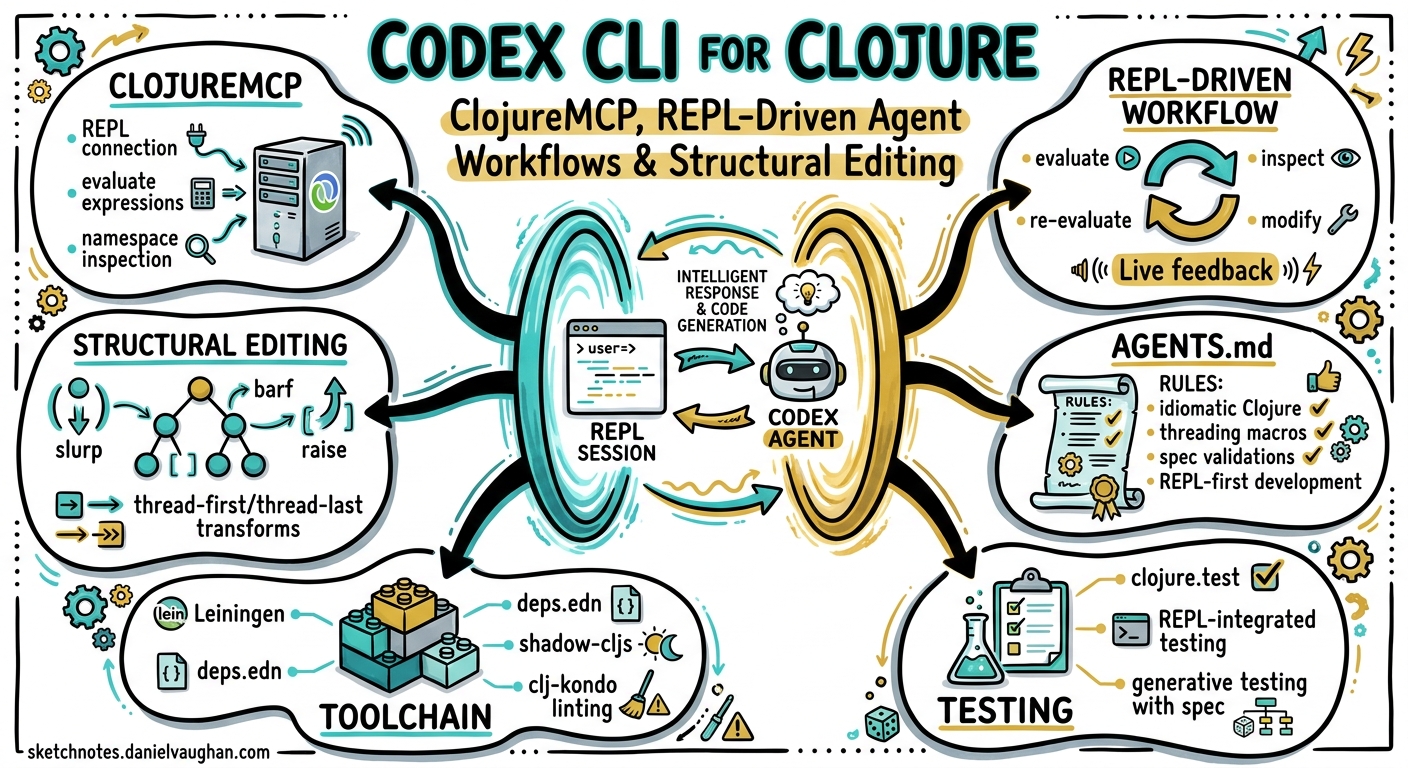
Clojure’s parenthesised syntax and REPL-driven development culture create a distinctive set of challenges — and opportunities — for AI coding agents. Where most language ecosystems treat the editor as the primary surface and the terminal as secondary, Clojure teams live inside a running REPL, growing systems incrementally through evaluated forms. Codex CLI can participate in this workflow directly, but only when properly equipped with Clojure-aware MCP servers, structural editing tools, and AGENTS.md conventions that encode the idioms a competent Clojurist expects.
This article covers the MCP server landscape for Clojure, AGENTS.md templates for functional codebases, practical REPL-driven agent patterns, and the pitfalls that trip up general-purpose agents in Lisp-family languages.
The Paren Edit Death Loop
Every team that has pointed a coding agent at Clojure code encounters the same failure mode within minutes: the agent introduces a mismatched delimiter, attempts a fix, introduces another mismatch, and spirals until context is exhausted 1. Bruce Hauman — creator of Figwheel and one of the most prolific contributors to Clojure tooling — coined the term “Paren Edit Death Loop” and built two tools to break it 1.
The root cause is that LLMs treat Clojure source as flat text. A missing closing parenthesis on line 47 cascades through every subsequent form, and a naive find-and-replace edit can shift delimiter boundaries in ways the model cannot predict from its diff-based output.
MCP Server Landscape for Clojure
Three MCP-compatible tools serve Clojure development in 2026, each targeting a different point on the complexity spectrum.
ClojureMCP (Full)
ClojureMCP 2 is a comprehensive MCP server that connects to a running nREPL and exposes Clojure-aware tooling across four categories:
| Category | Tools | Purpose |
|---|---|---|
| Read | LS, read_file, grep, glob_files |
Project introspection |
| REPL | clojure_eval, list_nrepl_ports |
Live evaluation with delimiter repair |
| Edit | clojure_edit, clojure_edit_replace_sexp, file_edit, file_write |
Structure-aware S-expression manipulation |
| Agent | dispatch_agent, architect |
Sub-agent orchestration (requires API key) |
The editing tools use parinfer, cljfmt, and clj-rewrite internally to guarantee well-formed output 2. When the model’s requested edit introduces a delimiter error, ClojureMCP repairs it before writing to disc — silently, without consuming additional turns.
Install via Clojure tools:
clojure -Ttools install-latest :lib io.github.bhauman/clojure-mcp :as mcp
For Codex CLI, configure the :cli-assist profile in ~/.codex/config.toml to avoid redundant tools:
[mcp_servers.clojure-mcp]
command = "bash"
args = ["-c", "clojure -Tmcp start :config-profile :cli-assist :port 7888"]
The :cli-assist profile disables ClojureMCP’s built-in file reading and shell tools — which would duplicate Codex CLI’s native capabilities — and retains REPL evaluation, structural editing, and delimiter repair 2.
clojure-mcp-light
For teams that prefer minimal tooling, clojure-mcp-light 1 provides three standalone CLI commands rather than a full MCP server:
clj-nrepl-eval— nREPL evaluation with auto-discovery of ports and delimiter repair before every evaluationclj-paren-repair— standalone delimiter repair invocable as a shell commandclj-paren-repair-claude-hook— a hook that intercepts Write/Edit operations and repairs delimiters before files hit disc
Install via bbin (Babashka package manager):
bbin install https://github.com/bhauman/clojure-mcp-light.git --tag v0.2.2
For Codex CLI, register clj-nrepl-eval and clj-paren-repair as shell tools in your AGENTS.md rather than as MCP servers. This approach preserves Codex CLI’s native diff display whilst adding REPL access.
clj-kondo MCP
The clj-kondo MCP server 3 wraps the clj-kondo static analyser (v2026.04.15) 4 in a single lint_clojure tool. It reports unused namespaces, private variable access violations, and style warnings without requiring a running REPL.
[mcp_servers.clj-kondo]
command = "npx"
args = ["-y", "clj-kondo-mcp"]
Compose this with ClojureMCP for a two-layer feedback loop: clj-kondo catches static issues pre-evaluation, and the REPL catches runtime errors post-evaluation.
Bridging clojure-lsp via LSP-MCP
clojure-lsp (v2026.05.05) 5 provides go-to-definition, find-references, rename, and the new cyclic-dependencies linter 5. The LSP-MCP bridge 6 exposes these capabilities as MCP tools.
[mcp_servers.clojure-lsp]
command = "npx"
args = ["-y", "lsp-mcp", "--", "clojure-lsp"]
This gives Codex CLI access to project-wide refactoring operations — renaming a function across 200 namespaces, for instance — that neither ClojureMCP nor clj-kondo can perform alone.
AGENTS.md for Clojure Projects
Clojure’s conventions diverge sharply from imperative languages. An AGENTS.md that doesn’t encode these conventions produces code that compiles but violates community norms. Here is a battle-tested template:
# AGENTS.md — Clojure Project

## Build & Run
- `clojure -M:dev` to start REPL with dev profile
- `clojure -M:test` to run test suite (kaocha)
- `clojure -T:build uber` to build uberjar

## REPL-First Development
- ALWAYS evaluate code in the REPL before modifying files
- Use `clojure_eval` or `clj-nrepl-eval` — never guess at runtime behaviour
- Develop solutions incrementally: small forms first, compose later
- Use `(comment ...)` rich comment blocks for exploratory code

## Code Conventions
- Pure functions: accept arguments, return results, no side effects
- Separate pure logic from stateful operations (atoms, I/O, channels)
- Prefer `map`, `filter`, `reduce` over manual recursion
- Use destructuring instead of manual data extraction
- Namespaced keywords for domain entities (`:order/id`, `:order/total`)
- Keep data structures flat — avoid deep nesting
- Thread-last (`->>`) for collection pipelines, thread-first (`->`) for transforms

## Structural Integrity
- NEVER attempt manual delimiter repair — use `clj-paren-repair` or ClojureMCP
- Run `clj-kondo` lint after every file modification
- Zero warnings policy: all linting errors must be resolved before commit

## Testing
- Tests live in `test/` mirroring `src/` namespace structure
- Use `clojure.test` with `deftest` and `is` assertions
- Test pure functions with example-based tests
- Test stateful components with `with-redefs` or component test fixtures

## Dependencies
- deps.edn for dependency management (no Leiningen)
- Pin all dependency versions — no RELEASE or LATEST
- Document new dependencies in commit messages
Practical Patterns
Pattern 1: REPL-Driven Bug Fix
The canonical Clojure debugging workflow — reproduce in the REPL, fix, verify — maps directly onto Codex CLI’s interactive mode.
sequenceDiagram
    participant Dev as Developer
    participant Codex as Codex CLI
    participant MCP as ClojureMCP
    participant REPL as nREPL

    Dev->>Codex: "Fix the NPE in orders/calculate-total"
    Codex->>MCP: read_file orders.clj
    MCP-->>Codex: Source code
    Codex->>MCP: clojure_eval (calculate-total sample-data)
    MCP->>REPL: Evaluate with delimiter repair
    REPL-->>MCP: NullPointerException at line 34
    Codex->>Codex: Identify nil guard needed
    Codex->>MCP: clojure_edit (add nil check)
    MCP-->>Codex: Structurally valid edit applied
    Codex->>MCP: clojure_eval (calculate-total sample-data)
    REPL-->>MCP: {:total 42.50}
    Codex-->>Dev: Fixed — nil guard added, verified in REPL
The key insight is that Codex CLI never modifies the file without first verifying behaviour in the REPL. The AGENTS.md enforces this sequence.
Pattern 2: ClojureScript Cross-Compilation with shadow-cljs
ClojureMCP’s list_nrepl_ports tool discovers both Clojure and shadow-cljs nREPL instances 2. For full-stack Clojure/ClojureScript projects:
# Terminal 1: Start Clojure REPL
clojure -M:dev

# Terminal 2: Start shadow-cljs watch
npx shadow-cljs watch app
Both REPLs register .nrepl-port files. Codex CLI can then evaluate server-side code on one port and client-side ClojureScript on another by specifying the :port parameter in clojure_eval:
Evaluate (js/console.log "hello") on the shadow-cljs REPL at port 9000
This enables full-stack feature development in a single Codex CLI session — backend logic verified against the JVM REPL, frontend behaviour verified against the browser REPL.
Pattern 3: Namespace Refactoring with clojure-lsp
Large Clojure projects accumulate namespace coupling. The new cyclic-dependencies linter in clojure-lsp v2026.05.05 5 flags circular require chains. Combined with the LSP-MCP bridge:
- Ask Codex CLI to run the cyclic-dependencies diagnostic
- Review the dependency graph
- Use LSP rename and move-form refactorings to break cycles
- Verify with
clojure_evalthat the refactored code loads cleanly
Pattern 4: Batch Linting with codex exec
For CI pipelines, combine clj-kondo with Codex CLI’s non-interactive mode to produce structured lint reports:
codex exec "Lint the entire src/ directory using clj-kondo. \
  Report every warning with file, line, and suggested fix." \
  --output-schema ./lint-schema.json \
  -o lint-report.json
The --output-schema flag 7 constrains the output to a machine-parseable format that downstream tools can consume.
Model Selection for Clojure
Clojure’s homoiconic syntax and macro system demand strong reasoning capabilities. Model selection matters more here than in most language ecosystems.
| Task | Recommended Model | Rationale |
|---|---|---|
| Macro authoring | GPT-5.5 | Requires understanding of compile-time vs runtime evaluation 8 |
| Pure function development | GPT-5.4-mini | Sufficient for data transformation pipelines |
| Spec/Schema validation | GPT-5.5 | Complex predicate composition benefits from deeper reasoning |
| deps.edn dependency management | GPT-5.4-mini | Declarative configuration, lower complexity |
| ClojureScript interop | GPT-5.5 | Cross-compilation and JS interop require broader context |
Switch models mid-session with Alt+M or the /model slash command 9.
Composing the MCP Stack
A production-ready Codex CLI configuration for Clojure combines all three servers:
# ~/.codex/config.toml

[mcp_servers.clojure-mcp]
command = "bash"
args = ["-c", "clojure -Tmcp start :config-profile :cli-assist :port 7888"]

[mcp_servers.clj-kondo]
command = "npx"
args = ["-y", "clj-kondo-mcp"]

[mcp_servers.clojure-lsp]
command = "npx"
args = ["-y", "lsp-mcp", "--", "clojure-lsp"]
This gives Codex CLI three complementary feedback channels: static analysis (clj-kondo), live evaluation (ClojureMCP), and project-wide navigation and refactoring (clojure-lsp).
Sandbox Configuration
Clojure development requires network access for dependency resolution (Maven Central, Clojars) and local process communication for nREPL:
[sandbox_workspace_write]
network_access = true
⚠️ The network_access = true setting is necessary for clojure -P dependency downloads and nREPL socket connections, but it does reduce sandbox isolation. For tighter control, consider pre-fetching dependencies and using network_access = false during coding sessions.
Limitations
- Training data lag for recent libraries: GPT-5.5’s training data may not include libraries published after its cutoff. Clojure’s smaller ecosystem means niche libraries receive less coverage than mainstream equivalents 8.
- Macro debugging: Codex CLI cannot step through
macroexpandinteractively. Useclojure_evalwith(macroexpand-1 '(your-macro ...))as a workaround. - No persistent REPL state across sessions: Each Codex CLI session starts with a fresh nREPL connection. Long-running REPL state (loaded data, initialised components) must be recreated.
- spec/Schema inference: Generating comprehensive
clojure.specor Malli schemas from data requires extensive sampling that may exceed token budgets in a single turn. - ClojureMCP agent tools cost: The
dispatch_agentandarchitecttools in ClojureMCP make their own LLM API calls, incurring additional costs outside the Codex CLI billing surface 2.
Citations
-
Hauman, B. (2026). clojure-mcp-light: Simple CLI tools for LLM coding assistants working with Clojure. GitHub. https://github.com/bhauman/clojure-mcp-light ↩ ↩2 ↩3
-
Hauman, B. (2026). ClojureMCP: Clojure MCP server for REPL-driven AI development. GitHub. https://github.com/bhauman/clojure-mcp ↩ ↩2 ↩3 ↩4 ↩5
-
Bigsy. (2026). clj-kondo-MCP: MCP server for clj-kondo linting. GitHub. https://github.com/Bigsy/clj-kondo-MCP ↩
-
clj-kondo. (2026). clj-kondo 2026.04.15. Clojars. https://clojars.org/clj-kondo ↩
-
clojure-lsp. (2026). clojure-lsp v2026.05.05-12.58.26. GitHub. https://github.com/clojure-lsp/clojure-lsp/releases ↩ ↩2 ↩3
-
LSP-MCP. (2026). LSP MCP bridge extension. Open VSX. https://open-vsx.org/extension/CJL/lsp-mcp ↩
-
OpenAI. (2026). Non-interactive mode — Codex CLI. OpenAI Developers. https://developers.openai.com/codex/noninteractive ↩
-
OpenAI. (2026). Models — Codex. OpenAI Developers. https://developers.openai.com/codex/models ↩ ↩2
-
OpenAI. (2026). Slash commands in Codex CLI. OpenAI Developers. https://developers.openai.com/codex/cli/slash-commands ↩