PatchBench: Why 1-in-4 Agent Vulnerability Fixes Is a Memorised Patch — and What It Means for Codex CLI
PatchBench: Why 1-in-4 Agent Vulnerability Fixes Is a Memorised Patch, and What It Means for Codex CLI
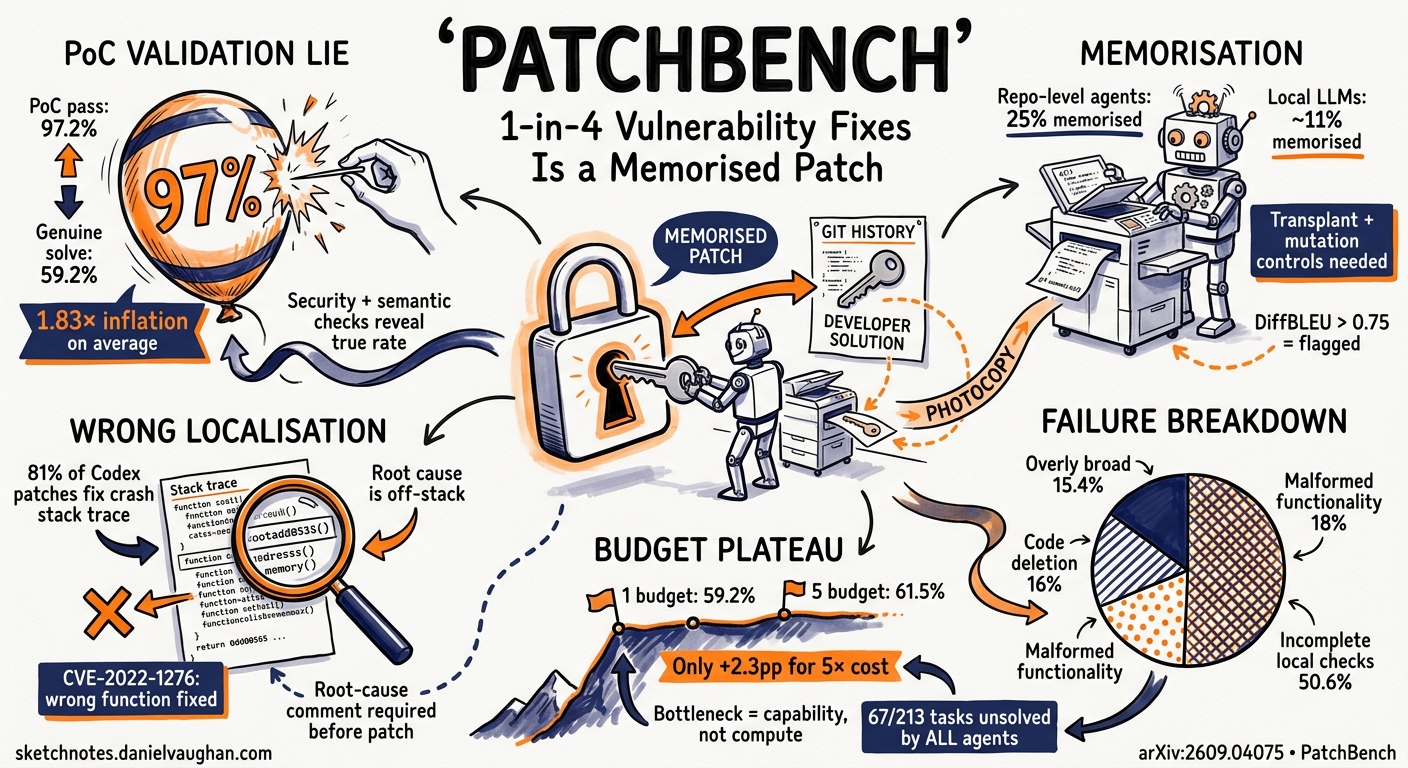
Vulnerability patching is one of the highest-stakes tasks you can hand to an AI coding agent. A pass on a proof-of-concept (PoC) crash feels like success, yet that feeling rests on an illusion: PoC-only evaluation inflates the reported solve rate by 1.83× on average.1 PatchBench, published 3 September 2026 by Shen, Li, Mahajan, Tian, Kwon, and Chen, systematically dismantles PoC-only evaluation and reveals two uncomfortable facts: agents routinely reproduce memorised developer patches, and the patches that do pass PoC tests frequently fail security and semantic validation.1
This article walks through the benchmark methodology, the quantitative findings, and concrete guidance for using Codex CLI on real vulnerability remediation tasks.
The Core Problem With PoC Validation
The standard evaluation loop for vulnerability patching looks like this: apply an agent-generated patch, replay the crash-triggering PoC input, and report success if the process no longer crashes. PatchBench shows this is wildly insufficient.
flowchart LR
    A[Agent patch] --> B{PoC crash?}
    B -- "No crash" --> C[✅ Reported solved]
    B -- "Crash" --> D[❌ Reported failed]
    C --> E{Security valid?}
    E -- "No" --> F["❌ Actually failed\n(silently missed)"]
    E -- "Yes" --> G{Semantic valid?}
    G -- "No" --> H["❌ Actually failed\n(silently missed)"]
    G -- "Yes" --> I[✅ Genuinely solved]
Across 11 evaluated agents, PoC-only validation inflated solve rates by 1.83× on average.1 The top three agents achieve PoC pass rates above 97 per cent yet genuine solve rates of only 56.8–59.2 per cent once security and semantic checks are applied.1
Benchmark Construction
PatchBench comprises 213 patching tasks spanning 32 open-source projects and 16 CWEs.1 The construction methodology is seven steps designed to defeat the two failure modes PoC validation cannot catch.
Memorisation Mitigation
Repository-level agents, which ingest git history alongside the codebase, memorise patches at twice the rate of local-context LLMs (25 per cent vs ~11 per cent).1 An agent does not need to understand the vulnerability if it has read the git commit that fixed it.
PatchBench defeats this with two techniques:
- Vulnerability transplant. Each CVE is moved to the newest applicable repository version, so the original commit no longer exists in the relevant branch.
- Semantic-preserving mutations. NatGen and CodeMorph apply variable renaming, loop transformation, block/operand swapping, and context-specific restructuring to the surrounding code without changing runtime behaviour.
Memorisation is measured using DiffBLEU, a diff-aware similarity metric:
DiffBLEU = α·BLEU(Δr,Δc) + β·BLEUw(Δr,Δc) + γ·Matchast(Cr,Cc) + δ·Matchdf(Cr,Cc)
           α=0.3, β=0.3, γ=0.2, δ=0.2
where Δr/Δc are reference and candidate diffs, Matchast compares control-flow slices, and Matchdf tracks data-flow dependencies.1 A DiffBLEU score above 0.75 flags memorisation; the metric achieves a 1.1 per cent false omission rate with zero false positives on manual review.1
Validation Pipeline
The three-stage validation replaces single-PoC testing:
flowchart TD
    P[Candidate patch] --> SV["Security Validation\nDirected fuzzing (VulnLoc/ConcFuzz)\n+ Undirected (libFuzzer, Honggfuzz, AFL)\n10 min each, median 33 PoC variants"]
    SV -- "Crash found" --> F1[❌ Security fail]
    SV -- "No crash" --> SR["Sanitizer Regression\nASan/MSan/UBSan on\nexisting test suite"]
    SR -- "Regression" --> F2[❌ Regression fail]
    SR -- "Clean" --> OS["Output State Check\nValue-level correctness\nof side effects"]
    OS -- "Mismatch" --> F3[❌ Semantic fail]
    OS -- "Correct" --> UT["Unit Tests\n(where applicable)"]
    UT -- "Fail" --> F4[❌ Unit test fail]
    UT -- "Pass" --> OK[✅ Genuinely solved]
Stage-level pass rates across agents average: sanitizer regression 95.7 per cent, output state 75.5 per cent, unit tests 79.9 per cent.1 The output state check alone, absent from all prior work, eliminates 8.1 percentage points of apparent success on average.1
Agent Performance
| Agent | Solved (full) | PoC Pass | Security | Semantic | Budget exhausted |
|---|---|---|---|---|---|
| Codex + GPT-5.6 Sol | 59.2 per cent | 97.2 per cent | 81.7 per cent | 70.9 per cent | 6.6 per cent |
| OpenHands + GPT-5.6 Sol | 58.2 per cent | 98.1 per cent | 81.2 per cent | 70.0 per cent | 1.4 per cent |
| Claude Code + Opus 4.8 | 56.8 per cent | 97.7 per cent | 75.6 per cent | 68.1 per cent | 8.9 per cent |
| Atlantis (AIxCC) | 48.4 per cent | 92.0 per cent | 70.9 per cent | 66.7 per cent | 11.7 per cent |
| Buttercup (AIxCC) | 42.7 per cent | 72.3 per cent | 58.2 per cent | 64.8 per cent | 7.0 per cent |
| RoboDuck (AIxCC) | 29.6 per cent | 46.5 per cent | 39.9 per cent | 51.6 per cent | 2.3 per cent |
Codex CLI with GPT-5.6 Sol leads the field. Crucially, general-purpose agents with frontier models outperform specialised AIxCC systems purpose-built for security, the three AIxCC competitors fall 7–30 percentage points below the top general-purpose agents on full validation.1
Where Patches Go Wrong
Wrong Localisation
81 per cent of Codex patches modify a function on the crash stack trace even when the root cause lies elsewhere.1 The crash trace is the most salient signal in context, and agents exploit it. PatchBench’s task selection criterion (Jaccard trace-overlap ρ ≤ 0.5) specifically targets vulnerabilities where the fix site is off-stack, yet agents still gravitate towards the stack.
A concrete example: CVE-2022-1276 in mruby is a compiler-side argument packing inconsistency (off-by-one constant 14 vs 13). Agents patch the VM-side array type check instead, suppressing the specific crash while introducing a silent error path.1
The Four Failure Patterns
Across Codex CLI specifically, failed patches cluster into four patterns:
pie title Codex Failure Pattern Distribution (failed patches)
    "Incomplete local checks (blocks PoC path, misses variants)" : 50.6
    "Malformed functionality (downstream logic broken)" : 18
    "Code deletion (load-bearing functionality removed)" : 16
    "Overly broad conditions (rejects valid benign inputs)" : 15.4
Incomplete local checks account for 50.6 per cent of failures — the agent adds a guard that stops the exact PoC input but leaves the variant paths open.1
Budget Plateau
All agents were evaluated at a $5-per-task budget cap. PatchBench also ran a budget scaling experiment:
| Budget | Codex (%) | Claude Code (%) | OpenHands + Gemini (%) |
|---|---|---|---|
| $5 | 59.2 | 56.8 | 44.1 |
| $15 | 61.5 | 57.3 | 46.2 |
| $25 | 61.5 | 58.2 | 46.4 |
Spending five times more per task yields only 2.3 percentage points for Codex and 1.4 points for Claude Code.1 Budget exhaustion at $25 drops below 1.4 per cent of tasks. The bottleneck is fundamental capability, not compute.
67 of 213 tasks were unsolved by all 11 agents — a hard ceiling that more budget cannot move.1
Implications for Codex CLI Workflows
Do Not Trust PoC Validation Alone
If you’re running Codex on CVE remediation, a single PoC replay tells you almost nothing. Replicate PatchBench’s three-stage validation in your PostToolUse hook:
# ~/.codex/config.toml
[hooks.post_tool_use]
command = """
  set -e
  # Stage 1: security — run your fuzzer campaign
  make fuzz-security PATCH_DIR=$CODEX_PATCH_DIR TIMEOUT=60s
  # Stage 2: regression
  make test-asan
  # Stage 3: output state (functional correctness beyond crash)
  make test-output-state
"""
trigger = "apply_patch"
The hook fires on every apply_patch tool call. If any stage exits non-zero, Codex treats the step as failed and iterates.2
Detect Localisation Shortcuts
Memorisation and crash-trace localisation are harder to automate, but you can add a heuristic to AGENTS.md:
## Vulnerability Patching Rules

- The fix MUST NOT be limited to functions appearing in the crash stack trace
  unless you have confirmed the root cause is on-stack.
- Before patching, produce a written root-cause analysis in a code comment
  at the patch site: what invariant is violated, where, and why.
- After patching, confirm the root-cause comment and the modified function
  are consistent — if they differ, the patch is in the wrong location.
- Never rely on a single PoC replay as confirmation of correctness.
  Run: `make fuzz-security && make test-asan && make test-output-state`
Model Routing
PatchBench shows Codex + GPT-5.6 Sol leads on genuine solve rate (59.2 per cent). For hard tasks (those likely in the long tail), resist spending more budget on the same model, the plateau data shows diminishing returns sharply. Instead, try a model routing strategy:
flowchart TD
    T[Vulnerability task] --> PA[Attempt: GPT-5.6 Sol\nBudget: \$5]
    PA -- "Pass full validation" --> DONE[✅ Done]
    PA -- "Fail" --> CLASSIFY{Root cause type}
    CLASSIFY -- "Memory safety / off-stack" --> PB[Re-attempt: Opus 4.8\nExtended reasoning\nBudget: \$10]
    CLASSIFY -- "Logic / semantic" --> PC[Re-attempt: DeepSeek V4 Pro\nBudget: \$10]
    PB & PC -- "Fail" --> ESCALATE[🔴 Escalate to human\n(Likely in 67/213 hard set)]
The 67-task hard set is unlikely to succumb to any current agent. Build your escalation path before you need it.
Disable Web Search for Patching Tasks
PatchBench intentionally disabled web search and external browsing for all agents.1 Enabling it risks retrieving the published CVE fix, defeating memorisation controls and producing patches whose correctness you cannot verify. In Codex CLI:
# ~/.codex/config.toml — per-task profile for CVE work
[profiles.cve]
disable_web_search = true
startup_prompt_template = """
You are patching a vulnerability. Web search is disabled.
Derive the fix exclusively from the codebase and your analysis.
Output a root-cause comment before any code change.
"""
Benchmark Limitations
PatchBench covers C/C++ memory-safety vulnerabilities sourced from OSS-Fuzz and public CVEs.1 Coverage gaps include:
- Memory-safe languages (Rust, Go) where sanitiser instrumentation differs ⚠️
- Logic vulnerabilities without crash-based PoC ⚠️
- Web/authentication vulnerabilities where fuzzing semantics differ ⚠️
- Proprietary codebases (transplant methodology assumes open-source git history) ⚠️
The 1.83× inflation figure and memorisation rate should be treated as lower bounds for agent-assisted patching in general — the PatchBench controls are more rigorous than typical internal CI, so real-world inflation may be worse.
Summary
PatchBench (arXiv:2609.04075) establishes that:
- PoC-only validation inflates solve rates by 1.83× on average. Genuine solve rates sit at 56–59 per cent for top agents, not 97 per cent.
- 25 per cent of repository-level agent patches are memorised from historical developer commits. Transplant + mutation controls are required for honest evaluation.
- 81 per cent of Codex patches fix the wrong location (on crash stack rather than root cause) when root cause is off-stack.
- Budget scaling plateaus sharply. Five times the budget yields two percentage points. The bottleneck is capability, not compute.
- General-purpose frontier agents beat specialised security agents. Codex + GPT-5.6 Sol (59.2 per cent) outperforms all three AIxCC systems.
- 67/213 tasks are currently unsolved by all agents. Build an escalation path before deploying Codex on CVE remediation at scale.
Citations
-
Shen, C., Li, J., Mahajan, A., Tian, J. S., Kwon, Y., & Chen, Y. (2026). PatchBench: Evaluating AI Agents for Vulnerability Patching. arXiv:2609.04075. https://arxiv.org/abs/2609.04075 ↩ ↩2 ↩3 ↩4 ↩5 ↩6 ↩7 ↩8 ↩9 ↩10 ↩11 ↩12 ↩13 ↩14 ↩15 ↩16 ↩17 ↩18 ↩19 ↩20
-
OpenAI. (2026). Codex CLI, PostToolUse hooks. https://github.com/openai/codex ↩