WebMCP Brings Model Context Protocol Into the Browser Itself
WebMCP Brings Model Context Protocol Into the Browser Itself
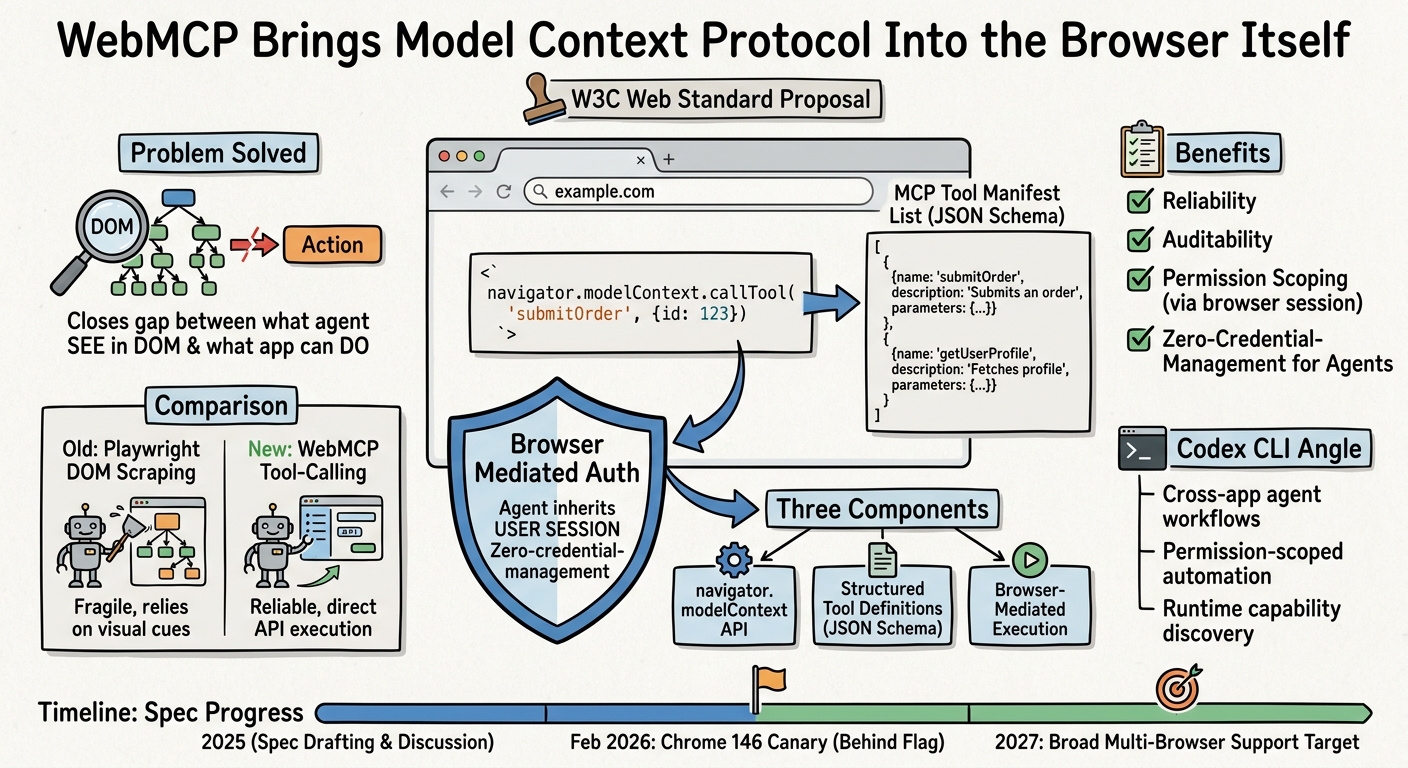
The gap that browser automation tools have been filling for the past two years — the gap between what an AI agent can see in a web interface and what the web application actually knows it can do — has a formal solution in progress. It is called WebMCP, and it exposes a website’s capabilities as structured MCP tools directly via a browser API.
The Problem WebMCP Solves
When Codex CLI or any agent runtime needs to interact with a web application today, it has two options. It can use a browser automation tool like Playwright, which interacts with the rendered DOM and is fragile to layout changes. Or it can call the application’s REST API directly, which requires knowing the API schema, managing authentication, and mapping the API surface to the agent’s intent.
Both approaches share a structural problem: the web application knows exactly what it can do and how, but there is no standard channel through which it can communicate that knowledge to an agent at runtime. The agent has to infer it from markup or documentation.
WebMCP is a proposed web standard that closes this gap. It introduces a browser-native API, navigator.modelContext, that allows websites to declare their agent-callable capabilities as structured MCP tools. The agent runtime queries navigator.modelContext and receives a manifest of what the site can do — not inferred from the DOM, but declared by the application itself.
The Architecture
The specification, published as a Draft Community Group Report in February 2026 and formally accepted by the W3C Web Machine Learning Community Group in September 2025, defines three components:
navigator.modelContext — the browser-side API that agents query to discover available tools. A web application registers its MCP tools with the browser at page load; the agent reads them via navigator.modelContext.tools().
Structured tool definitions — each tool exposed via WebMCP has a name, description, input schema (JSON Schema), and output schema. This mirrors the MCP tool definition format exactly, which means existing MCP-compatible agent runtimes can consume WebMCP tools without modification to the tool-calling layer.
Browser-mediated execution — when the agent calls a WebMCP tool, the call goes through the browser, which handles the site’s authentication context. The agent does not need to manage session tokens or cookies — the browser’s existing authenticated session is the credential.
This last point is architecturally significant. It means an agent can call WebMCP tools with the permissions of the logged-in user, without the user ever handing credentials to the agent directly.
Current Status
Chrome 146 Canary shipped the first WebMCP implementation in February 2026 as an early preview behind a flag. As of October 2026, it remains in Canary with no stable channel release date announced.
The W3C timeline for multi-vendor standardisation is measured in years, not months. The specification’s own explainer notes that “when all four major browser vendors are at the table, the spec usually ships across browsers within 12–18 months of the first implementation” — which puts broad stable availability somewhere between Q2 2027 and Q4 2027 at the optimistic end.
Safari and Firefox have not yet signalled public support, though Mozilla engineers have participated in the W3C discussions. Edge typically follows Chrome’s implementation timeline given the shared Chromium base.
What This Means for Agent-Web Integration
The practical implication of WebMCP is not immediate — it is directional. Here is the trajectory it sets:
Web applications become first-class MCP servers. Today, building an MCP server for a web application requires a separate service layer, separate authentication, and separate deployment. With WebMCP, a web developer adds a <script> block that registers MCP tools with the browser, and any WebMCP-capable agent runtime can immediately discover and call those tools. The marginal cost of MCP enablement for a web app collapses to near zero.
Agent-web interaction shifts from scraping to tool-calling. Current browser agents — including Codex CLI’s browser integration via Playwright — are fundamentally scraping: they observe rendered state and infer what actions are available. WebMCP tool-calling is declarative: the application tells the agent what it can do. This makes agent-web interactions more reliable, more auditable, and more composable.
Authentication stops being the hard problem. Credential management is one of the most significant engineering challenges in building agents that interact with web applications. WebMCP’s browser-mediated execution model delegates this to the browser’s existing session management. The agent inherits the user’s authenticated context without handling tokens directly.
The Codex CLI Angle
Codex CLI’s browser automation capabilities — currently implemented via Playwright — would benefit directly from WebMCP once stable browser support arrives. The shift from DOM-scraping to tool-calling for web interactions is exactly the kind of reliability improvement that makes the difference between demos and production deployments.
More specifically, WebMCP enables a class of Codex CLI workflows that are currently impractical:
Cross-application agent tasks. A Codex agent asked to prepare a quarterly update could call WebMCP tools on a project management application, a CRM, and a finance dashboard in sequence — each call authenticated via the browser’s existing sessions — and synthesise the results without custom API integration for each system.
Permission-scoped automation. Because WebMCP tool access is mediated by the browser’s authentication context, agents can only do what the logged-in user can do. This is a natural permission boundary that is much harder to enforce in direct API integrations.
Application-declared capability discovery. Rather than hardcoding what actions are available on a given website, Codex agents could query navigator.modelContext.tools() at runtime and adapt their behaviour to whatever the site currently exposes.
The Timeline Problem
The gap between the architectural promise and the practical availability is the central challenge with WebMCP. Chrome Canary support since February is promising; stable multi-browser support is two years away at best.
In the interim, the practical value of WebMCP is concentrated in Chrome-specific agentic deployments — enterprise intranet applications, internal tools running in controlled browser environments, and developer tooling that does not require cross-browser compatibility.
For production web automation at scale, Playwright-based approaches remain the practical path through at least 2027. WebMCP is the standard toward which the ecosystem is moving, not the standard it has arrived at.
The specification is worth watching closely. The pattern it establishes — websites declaring their agent-callable surface area through the browser, with authentication mediated by the browser session — is the right architecture for the problem. The question is only how quickly the browser vendors move to make it broadly available.
The WebMCP specification is maintained by the W3C Web Machine Learning Community Group. Chrome 146 Canary includes an early preview behind a flag. Broad stable browser support is targeted for 2027.