Workday's Agent-Ready Tools Turn Enterprise HR and Finance Data into MCP Resources
Workday’s Agent-Ready Tools Turn Enterprise HR and Finance Data into MCP Resources
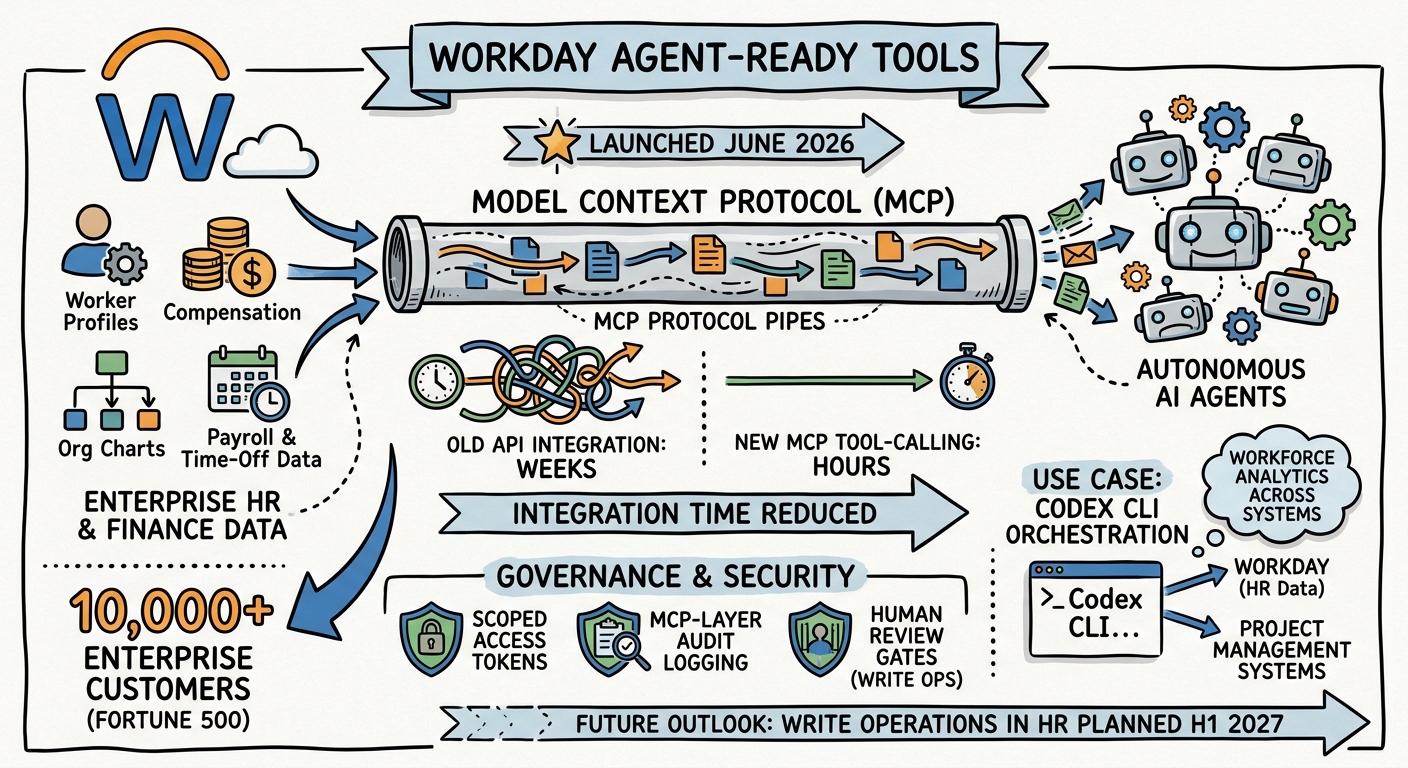
Workday’s Agent-Ready Tools, launched at Workday Rising in June 2026 and now broadly adopted across enterprise deployments, represent something more architecturally significant than another enterprise AI integration. They are a direct implementation of Model Context Protocol inside one of the world’s most data-dense enterprise systems — and that changes the gravity of MCP’s enterprise story considerably.
What Agent-Ready Tools Actually Are
Workday describes Agent-Ready Tools as “a new class of Workday connector built on the Model Context Protocol and purpose-built for autonomous AI consumption.” The distinction from previous Workday API access is precise: earlier integrations were designed for human-operated software that made API calls on behalf of users. Agent-Ready Tools are designed for AI agents that make decisions autonomously and need governed, real-time access to HR and finance data.
Practically, this means AI agents — whether Claude via Codex CLI, Copilot, Gemini, or any MCP-compatible agent runtime — can now:
- Retrieve worker profiles, compensation data, and org chart relationships
- Run payroll and time-off queries
- Surface headcount and hiring data in response to workforce planning queries
- Execute reports against Workday’s HCM data layer without a human in the loop for each operation
The MCP transport layer handles authentication, authorisation scoping, and audit logging. This is not a scraping integration or a webhook hack — it is structured tool exposure with governance built in from the protocol layer up.
Why This Matters Beyond Workday
The significance is not specific to Workday. It is what Workday’s participation in the MCP ecosystem signals about the trajectory of enterprise software more broadly.
Workday manages HR and finance data for over 10,000 organisations, including most of the Fortune 500. When a system at that scale exposes its data surface via MCP, it:
Creates a reference implementation for regulated data. Workday’s data is among the most sensitive in any enterprise — payroll records, performance reviews, equity grants, medical leave. Building Agent-Ready Tools required Workday to solve governance problems that every enterprise system will face: how do you scope agent access, log agent queries for audit, and enforce role-based limits when the requester is not a human? Their published architecture for doing this becomes a pattern other enterprise vendors will follow.
Accelerates MCP adoption at the enterprise procurement layer. Enterprise software procurement is not driven by developer enthusiasm — it is driven by what the incumbent system supports. If Workday supports MCP natively, and Salesforce, ServiceNow, and SAP follow (as their public roadmaps suggest), then MCP becomes a checklist item in enterprise AI procurement rather than a greenfield integration project.
Shifts integration from engineering to configuration. Workday claims their MCP integration reduces connection time from weeks of custom API work to hours of configuration. That claim deserves scrutiny, but the directional shift is real: when a protocol is standardised at both ends, the integration overhead collapses. The long tail of enterprise data — the systems that never get integrated because the engineering cost is too high — becomes accessible.
The Codex CLI Implication
For engineering teams using Codex CLI to orchestrate multi-agent workflows, Workday’s MCP exposure creates a concrete new capability: agents that can query HR and finance data as part of a broader workflow without requiring custom API integration work.
Consider a workforce analytics workflow:
- Codex CLI orchestrates a planning agent asked to evaluate headcount capacity across engineering teams
- The agent queries Workday’s Agent-Ready Tools via MCP to retrieve current headcount, open requisitions, and skills data
- The agent cross-references this with project pipeline data from a project management MCP server
- The agent surfaces a gap analysis without any human retrieving spreadsheets from multiple systems
This workflow was possible before Agent-Ready Tools, but it required custom API integration, credential management, and schema mapping for each data source. With standardised MCP exposure, the agent runtime handles protocol negotiation and the agent author writes tool calls rather than API clients.
The Governance Question
The more challenging question is not technical — it is governance. Enterprise agents with access to payroll data, compensation records, and HR systems create liability exposure that no enterprise legal team has fully worked through yet.
Workday’s Agent-Ready Tools include three governance mechanisms worth examining:
Scoped access tokens. Agents receive tokens scoped to specific data types and operations — a planning agent might get read access to headcount data but not to individual compensation records. The scope is defined at provisioning time, not inferred at query time.
Audit logging at the MCP layer. Every agent query against a Workday MCP tool is logged with the agent identity, timestamp, query parameters, and result metadata. This creates an audit trail that was absent from previous API-based integrations where authentication was often at the service account level.
Human review gates. For operations that write or modify Workday data, Agent-Ready Tools expose a review-required flag that pauses agent execution and surfaces a human approval request. This is the governance equivalent of a pull request — the agent prepares the change, a human approves it.
These mechanisms are a reasonable first pass. They do not address all the edge cases — what happens when an agent re-aggregates scoped data to infer information outside its scope, for instance — but they establish a governance baseline that the industry can iterate on.
What to Watch
The Workday Agent-Ready Tools implementation is early. The current release focuses on read operations against HCM data. The next phase, which Workday has signalled for H1 2027, extends to write operations in HR — initiating a hire, updating compensation, submitting a performance review on behalf of a manager.
Write access in HR systems via autonomous agents is where the governance architecture will be tested seriously. The scoped access and review gate mechanisms that look sufficient for read operations will face significantly harder challenges when agents are modifying records that affect people’s employment and pay.
The MCP layer provides the protocol. The governance layer is still being written.
Workday Agent-Ready Tools are available in Workday’s platform for enterprise customers. Developer documentation is at workday.com/en-us/ai-platform/agent-tools-mcp.html.