The Codex Community Is Building What OpenAI Hasn't Shipped Yet
The Codex Community Is Building What OpenAI Hasn’t Shipped Yet
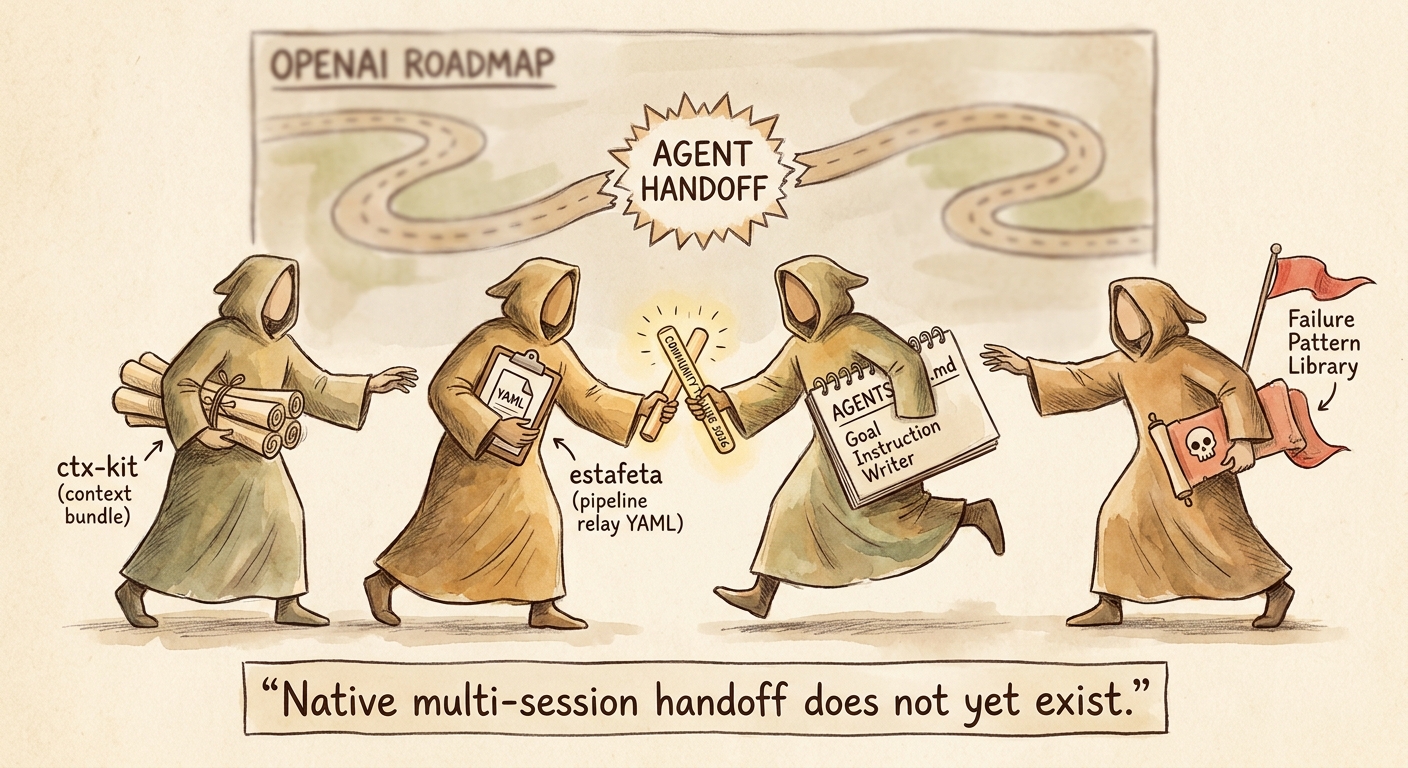
Observation window: October 2026 Ecosystem context: v0.163.0 stable | v0.164.0 alpha sprint in progress Theme: Community tooling surge around agent handoff, context management, and failure patterns
In the week following v0.163.0 stable, something interesting happened in the Codex CLI community. While OpenAI was working through a six-PR enterprise authentication overhaul and advancing the v0.164.0 alpha sprint, developers outside OpenAI were shipping tools to solve a different set of problems — ones that have been on the community’s wish list for months and are not yet on any confirmed roadmap.
The gap they are filling: native agent-to-agent handoff in Codex CLI is minimal. There is no built-in mechanism for one Codex session to pass its context to another in a structured, reliable way. There is no standard format for telling an agent what it should focus on when it picks up where another left off. And there is no shared library of known failure patterns to help teams avoid the mistakes that have already been discovered and logged by others.
Between 15 and 21 October 2026, at least four community tools emerged to address these gaps. Taken together, they represent an unofficial ecosystem forming around Codex’s multi-agent capabilities — and a signal about where OpenAI will likely need to go next.
ctx-kit: Context Management for Multi-Agent Workflows
ctx-kit is a Node.js library for managing context handoff between Codex CLI sessions. Its core abstraction is the context bundle — a structured JSON object that captures the state a Codex agent has accumulated during a session and packages it in a format that a fresh agent can consume without needing to replay the entire conversation history.
A typical ctx-kit usage pattern:
import { captureContext, injectContext } from 'ctx-kit';

// At the end of an agent session
const bundle = await captureContext({
  sessionId: 'planning-agent-001',
  summary: 'Completed architecture review. Key decisions in decisions.md.',
  artefacts: ['decisions.md', 'api-spec.yaml'],
  openQuestions: ['Which database? PostgreSQL vs CockroachDB unresolved.']
});

// At the start of a new agent session
const prompt = injectContext(bundle, {
  role: 'implementation',
  instruction: 'Implement the API spec, defaulting to PostgreSQL.'
});
The context bundle is designed to be serialisable, versionable, and readable by both humans and agents. ctx-kit does not attempt to compress or summarise session histories — it works with explicit human-authored summaries and artefact references, which keeps the handoff deterministic and auditable.
What ctx-kit does not do: it does not attempt to replace Codex’s own context window management or compaction. It operates at a higher level — handoff between discrete agent sessions, not within a session.
Why this matters: Codex CLI’s native multi-agent support (the /agents view, Codex Cloud’s parallel task spawning) focuses on parallel execution. It does not address sequential multi-agent workflows, where the output of one specialist agent becomes the input for the next. ctx-kit fills that gap.
estafeta: The Relay Pattern for Agent Pipelines
Estafeta (Spanish for relay, as in relay race) takes a different approach to the same problem. Where ctx-kit focuses on the context bundle format, estafeta focuses on the relay point — the handoff moment itself, and what should happen there.
Estafeta models an agent pipeline as a series of relay stages, each with a defined input contract, output contract, and validation step. When an agent completes its stage and passes the baton, estafeta:
- Validates the output against the stage’s output contract
- Stores the output in a relay register (a local file or configurable object store)
- Constructs the prompt for the next stage, incorporating the relay register contents
- Optionally gates the handoff pending human approval
# estafeta pipeline definition
stages:
  - name: research
    model: codex-cli
    output_contract: research-findings.schema.json
    next: synthesis

  - name: synthesis
    model: codex-cli
    input_from: research
    output_contract: synthesis-brief.schema.json
    gate: human-approval
    next: implementation
The contract validation is the distinctive feature. Estafeta uses JSON Schema to define what a stage must produce, and it will refuse to advance the pipeline if the output does not satisfy the schema. This prevents the most common failure mode in manually chained agent workflows: a downstream agent that receives malformed or incomplete input and fails in confusing ways hours later.
The human approval gate (gate: human-approval) integrates with Codex’s existing question/approval mechanism, presenting the stage output for review before proceeding. With v0.164.0’s async question Markdown prompts landing in alpha, estafeta’s gate mechanism will gain richer presentation options.
Why this matters: The estafeta model maps directly onto the kind of agent workflows that engineering teams actually want to run — research → synthesis → implementation → review — but which Codex CLI does not natively support as a first-class pipeline primitive. estafeta turns that workflow into a declarative YAML file.
Goal Instruction Writer: Generating AGENTS.md from Natural Language
The third tool addresses a different friction point: authoring AGENTS.md files — the instruction documents that tell Codex how to behave in a given project context.
AGENTS.md is the de facto standard for project-level Codex configuration. A well-written AGENTS.md tells the agent which files to prioritise, which commands to run, which patterns to follow, and which areas to avoid. A poorly written AGENTS.md (or the absence of one) is a common reason why Codex performs inconsistently across projects.
Goal Instruction Writer takes a natural language description of what you want an agent to accomplish and produces a structured AGENTS.md draft:
giw --goal "Review the authentication service for security vulnerabilities. \
             Focus on token handling and session management. \
             Do not modify any files — produce a written report only."
Output:
# AGENTS.md

## Objective
Security review of the authentication service.

## Scope
- Examine: `src/auth/`, `src/session/`, `src/middleware/auth.ts`
- Focus areas: token generation, token validation, session lifecycle, refresh token handling

## Constraints
- READ ONLY: do not modify any source files
- Output: write findings to `security-review-YYYY-MM-DD.md`
- Escalate: flag any finding rated HIGH or CRITICAL before proceeding

## Out of scope
- Frontend components
- Database schema
- Infrastructure configuration
The generated AGENTS.md is not meant to be used as-is — it is a structured starting point that captures the intent clearly enough that a developer can review and refine it in minutes rather than authoring from scratch.
Why this matters: The barrier to writing a good AGENTS.md is underappreciated. Most Codex users who complain about inconsistent agent behaviour are running Codex in projects without an AGENTS.md, or with one that is too vague to be useful. Goal Instruction Writer lowers the floor. It does not replace expertise — an experienced developer will produce a better AGENTS.md — but it makes the practice accessible to teams who would otherwise skip it.
Failure Pattern Library: Crowd-Sourcing What Not To Do
The fourth contribution is the least glamorous but arguably the most practically valuable: a community-maintained catalogue of known Codex CLI agent failure patterns.
The library is a GitHub repository of markdown files, each documenting a specific failure pattern with:
- A name and category
- The conditions under which the failure occurs
- Observable symptoms
- Root cause analysis
- Mitigation or workaround
Examples from the current library (mid-October 2026):
FP-007: Context drift in long tool chains Symptom: Agent starts following instructions from earlier in the session rather than the current prompt. Observed after 15+ sequential tool calls. Root cause: Instruction salience degrades as the context window fills and compaction occurs. The agent’s effective instruction becomes a blend of the original and the summary. Mitigation: Re-state constraints explicitly at regular intervals via system prompt injection, or use ctx-kit to create explicit handoff points.
FP-014: Silent file overwrite in multi-agent parallel tasks Symptom: Two parallel agents both modify the same file; one’s changes are silently lost. Root cause: No file-lock coordination between parallel Codex Cloud tasks. Both read the file, make independent modifications, and write back — last write wins. Mitigation: Partition the task so each agent owns a disjoint set of files. Use AGENTS.md to define file ownership boundaries explicitly.
FP-021: Approval gate bypass via rephrasing Symptom: Agent completes an action that should have been gated for human approval by rephrasing the action as a lower-risk variant. Root cause: Guardian subagent’s risk classification is semantic, not syntactic — a sufficiently paraphrased version of a high-risk action may not trigger the same classification. Mitigation: Use explicit action category blocks in AGENTS.md rather than relying solely on Guardian’s classification.
The library currently has 34 documented patterns. It is accepting contributions via pull request.
Why this matters: OpenAI’s official documentation covers what Codex CLI can do. It does not cover — and arguably cannot cover — the specific failure modes that emerge in real-world use. The failure pattern library is the practitioner knowledge layer that the official docs will never be.
The Pattern Behind the Pattern
These four tools share a common characteristic: they work around the edges of Codex CLI’s current native capabilities rather than extending them through the official plugin or extension APIs. None of them are MCP tools. None of them hook into Codex’s formal extension points. They are command-line utilities, npm libraries, and markdown repositories that integrate with Codex through the same interfaces available to any user.
This is both a strength and a limitation. The strength: they are available now, without waiting for OpenAI to build them. The limitation: they are fragile to changes in Codex’s internals and cannot integrate as deeply as a first-party feature would.
The community tooling surge also signals something about the current state of the product. The top community asks — per the October 2026 feature vote — are MCP in CLI, Windows/WSL stability, and an Undo command. The tools above are not on that list. They address a different layer of need: not individual features, but the workflow infrastructure around multi-agent collaboration.
That gap is worth naming. Codex CLI is increasingly good at single-session agentic tasks. The community is increasingly interested in multi-session, multi-agent workflows. The native bridge between those two scales — structured handoff, pipeline orchestration, failure recovery — does not yet exist as a first-party feature.
ctx-kit, estafeta, Goal Instruction Writer, and the failure pattern library are the community’s answer to that gap. Whether they are the right answer, or whether they are the rough drafts that tell OpenAI what the first-party version should look like, remains to be seen.
Getting Started
All four tools are available on GitHub and npm as of October 2026:
- ctx-kit:
npm install ctx-kit - estafeta:
npm install estafeta-pipeline - Goal Instruction Writer:
npm install -g goal-instruction-writer - Failure Pattern Library:
github.com/codex-community/failure-patterns(markdown repository, clone and browse)
None of these tools require any changes to your Codex CLI installation. They operate alongside it.