Filesystem-Aware Skill Loading and Unix Socket Sandbox Allowlists
Filesystem-Aware Skill Loading and Unix Socket Sandbox Allowlists
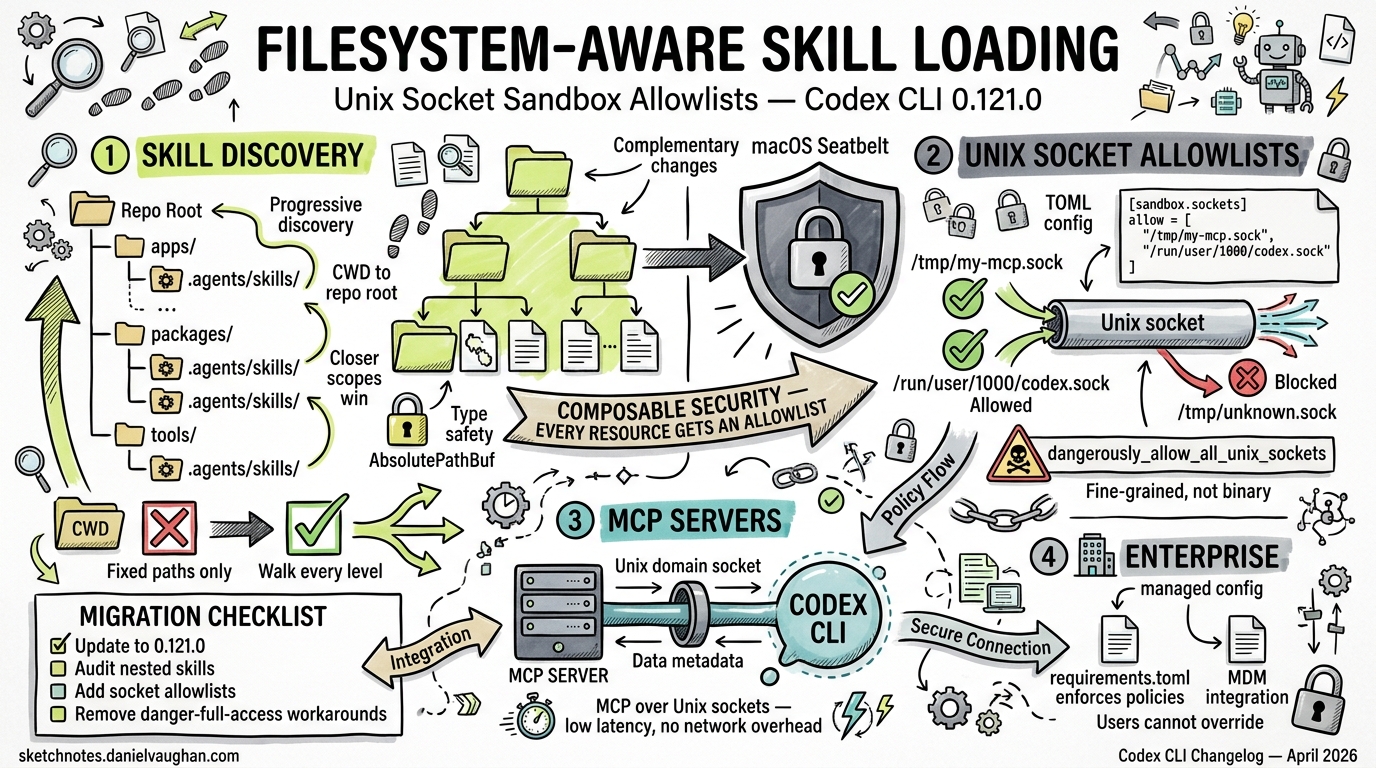
Version 0.121.0 of Codex CLI, released on 15 April 2026, shipped two complementary changes that significantly improve how skills are discovered and how sandboxed sessions interact with local services. PR #17720 introduced filesystem-aware skill loading1, whilst PR #17654 added Unix socket allowlists to the macOS Seatbelt sandbox2. Together, they resolve a class of problems that surfaced as teams began running MCP servers over Unix domain sockets inside sandboxed Codex sessions.
This article examines both changes, explains the architecture behind them, and shows how to configure your environment to take advantage of them.
The Problem: Skills That Vanish and Sockets That Block
Prior to 0.121.0, Codex CLI’s skill discovery was path-unaware. The scanner walked a fixed set of directories — $CODEX_HOME/skills, /etc/codex/skills, and the repository’s .agents/skills — but did not account for the filesystem context of the current session. If you launched Codex from a nested workspace inside a monorepo, skills defined at the repository root’s .agents/skills were found, but skills in an intermediate directory were silently skipped3.
Simultaneously, MCP servers communicating over Unix domain sockets were blocked by the macOS Seatbelt sandbox profile. The sandbox’s network policy treated all AF_UNIX connect attempts as network operations, denying them unless network_access was set to true — which defeated the purpose of sandboxing4. Linux users with Landlock + seccomp were partially affected too, though Issue #16910 tracked a separate fix for sandbox-local AF_UNIX sockets on that platform5.
flowchart TD
    A[Codex Session Starts] --> B{Discover Skills}
    B -->|Pre-0.121.0| C[Fixed paths only]
    B -->|0.121.0+| D[Walk CWD → repo root]
    D --> E[Load metadata progressively]
    A --> F{MCP Server Transport}
    F -->|stdio| G[Subprocess — always allowed]
    F -->|HTTP| H[Network proxy rules]
    F -->|Unix Socket| I{Sandbox policy}
    I -->|Pre-0.121.0| J[❌ Blocked by Seatbelt]
    I -->|0.121.0+| K[✅ Allowlist check]
Filesystem-Aware Skill Loading
How Discovery Now Works
PR #17720 changed the skill scanner to perform a bottom-up directory walk from the current working directory to the repository root (detected via .git), checking for .agents/skills at every level1. This mirrors how Codex already discovers AGENTS.md and AGENTS.override.md files — hierarchically, with closer scopes taking precedence6.
The full resolution order is now:
.agents/skillsin$CWD.agents/skillsin each parent directory up to the repository root.agents/skillsat the repository root$CODEX_HOME/skills(default~/.codex/skills), including.system/built-ins/etc/codex/skills(admin/system-wide)
At each level, Codex reads only frontmatter metadata — name, description, and optional agents/openai.yaml — deferring full instruction loading until the skill is actually invoked7. This progressive disclosure keeps context windows lean even in repositories with dozens of skills.
AbsolutePathBuf and Path Safety
A companion change in PR #17407 replaced bare PathBuf with AbsolutePathBuf throughout the skill-loading and codex_home modules1. This is a type-level guarantee that every path the skill loader handles has been canonicalised, eliminating a category of bugs where relative paths or symlink cycles could cause duplicate skill registrations or — in edge cases — path traversal outside the repository sandbox.
Practical Example: Monorepo Skill Organisation
Consider a monorepo with distinct skill sets per service:
my-monorepo/
├── .agents/skills/
│   └── shared-lint/
│       └── SKILL.md
├── services/
│   ├── api/
│   │   └── .agents/skills/
│   │       └── api-deploy/
│   │           └── SKILL.md
│   └── web/
│       └── .agents/skills/
│           └── web-test/
│               └── SKILL.md
When you run codex from services/api/, the scanner now finds both api-deploy (local) and shared-lint (root), but not web-test. Previously, api-deploy would have been invisible because only the root .agents/skills was checked.
Symlinked skill folders continue to work — Codex follows symlink targets during scanning7. This lets teams maintain a single canonical skill directory and symlink it into multiple service subtrees without duplication.
Disabling Unwanted Skills
If a parent directory exposes a skill you want to suppress locally, the existing config.toml mechanism still applies:
[[skills.config]]
path = "/absolute/path/to/unwanted-skill/SKILL.md"
enabled = false
This is evaluated after discovery, so the skill is found but never loaded into context7.
Unix Socket Sandbox Allowlists
The macOS Seatbelt Problem
Codex’s macOS sandbox uses Apple’s Seatbelt framework to enforce kernel-level restrictions on file and network access8. Before 0.121.0, the generated Seatbelt profile contained a blanket (deny network*) rule with exceptions only for TCP/UDP connections matching the managed proxy’s domain allowlist. Any AF_UNIX connect — even to a socket at a known, safe path — was denied.
This was particularly painful for MCP server operators. A common pattern is to run an MCP server as a local daemon listening on a Unix domain socket (e.g., /tmp/my-mcp.sock or /var/run/mcp-tools.sock), then point Codex at it. With the old sandbox profile, the only workaround was sandbox = "danger-full-access", which is unacceptable in enterprise environments9.
The Allowlist Solution
PR #17654 introduced a per-socket allowlist in the permissions configuration2. The new [permissions.<name>.network.unix_sockets] table lets you declare exactly which socket paths Codex may connect to:
[permissions.default.network]
enabled = true
mode = "limited"

[permissions.default.network.unix_sockets]
"/tmp/my-mcp.sock" = "allow"
"/var/run/docker.sock" = "allow"
"/tmp/dangerous.sock" = "none"
Each key is an absolute socket path; the value is either allow or none10. The Seatbelt profile generator reads this table and emits targeted (allow network-outbound (remote unix-socket (path-literal ...))) rules for each allowed path, keeping everything else denied.
The Nuclear Option
For development environments where enumerating every socket is impractical, a boolean escape hatch exists:
[permissions.default.network]
dangerously_allow_all_unix_sockets = true
This bypasses the per-path allowlist and permits AF_UNIX connect to any absolute socket path10. The dangerously_ prefix is intentional — this should never appear in managed enterprise configurations.
Sandbox State in MCP Tool Metadata
A related change in PR #17763 now sends sandbox state through MCP tool metadata1. This means MCP servers can introspect whether the calling Codex session is sandboxed and adjust their behaviour accordingly — for example, refusing destructive operations when running inside a restricted sandbox.
sequenceDiagram
    participant C as Codex CLI
    participant S as Seatbelt Sandbox
    participant M as MCP Server (Unix Socket)

    C->>S: Generate profile with unix_sockets allowlist
    S-->>C: Profile applied
    C->>M: AF_UNIX connect to /tmp/my-mcp.sock
    S->>S: Check path against allowlist
    S-->>C: ✅ Permitted
    C->>M: tool/call with sandbox metadata
    M-->>C: Tool result
Enterprise Managed Configuration
For organisations deploying Codex at scale, the Unix socket allowlist integrates with the managed configuration system. Administrators can enforce socket policies via /etc/codex/requirements.toml or macOS MDM profiles11:
# /etc/codex/requirements.toml
[permissions.enforced.network.unix_sockets]
"/var/run/approved-mcp.sock" = "allow"
When a requirement is set, users cannot override it with a less restrictive policy in their personal config.toml. The dangerously_allow_all_unix_sockets flag is also controllable via requirements, allowing admins to explicitly block the escape hatch.
Putting It All Together
The combination of filesystem-aware skills and socket allowlists unlocks a workflow that was previously impossible without disabling the sandbox entirely:
- Define per-service skills in nested
.agents/skillsdirectories — Codex now discovers them from any working directory within the repository. - Run MCP servers over Unix domain sockets for low-latency, no-network-overhead tool serving — the sandbox permits connections to declared socket paths.
- Ship managed configurations that enforce both skill discovery scopes and socket policies — enterprise teams get security without sacrificing functionality.
Quick Migration Checklist
- Update to Codex CLI ≥ 0.121.0 (
codex --versionto verify)1 - Audit existing skills: if you have skills in nested
.agents/skillsdirectories that weren’t being discovered, they will now appear automatically — check for naming collisions - Add socket allowlists: if you run MCP servers over Unix domain sockets on macOS, add their paths to
[permissions.default.network.unix_sockets] - Remove workarounds: if you set
sandbox = "danger-full-access"solely to enable socket-based MCP servers, you can now revert toworkspace-writewith explicit socket allowlists - Test in CI: run
codex --sandbox read-onlyin CI to verify that your skill discovery and MCP socket configuration work under the most restrictive sandbox
What’s Next
Issue #16910 tracks equivalent Unix socket support for the Linux Landlock + seccomp sandbox5, which is expected in a near-future release. The skill loading changes are platform-agnostic and already work on Linux, macOS, and WSL2.
The broader trajectory is clear: Codex CLI is moving towards fine-grained, composable security policies where every resource — filesystem paths, network domains, Unix sockets — has an explicit allowlist rather than a binary on/off switch. The skill system is evolving in parallel, with filesystem awareness being one step towards a future where skills can declare their own permission requirements and have them enforced automatically.
Citations
-
Codex CLI Changelog — v0.121.0 (2026-04-15) — PRs #17720, #17407, #17654, #17763 listed in April 2026 release notes. ↩ ↩2 ↩3 ↩4 ↩5
-
PR #17654 — Support Unix socket allowlists in macOS sandbox ↩ ↩2
-
Codex CLI Features — Agent Skills — pre-0.121.0 skill discovery behaviour. ↩
-
Codex Sandboxing Documentation — macOS Seatbelt sandbox architecture. ↩
-
Issue #16910 — Linux sandbox: support safe sandbox-local AF_UNIX sockets ↩ ↩2
-
Agent Skills Documentation — hierarchical skill resolution and progressive disclosure. ↩
-
Skills in OpenAI Codex — blog.fsck.com — skill structure, symlink support, and discovery mechanics. ↩ ↩2 ↩3
-
Codex Security Documentation — platform-native sandbox enforcement. ↩
-
Codex CLI Managed Configuration — enterprise sandbox policies. ↩
-
Codex Configuration Reference — permissions.network.unix_sockets — TOML syntax for socket allowlists. ↩ ↩2
-
Codex Enterprise Managed Configuration — requirements.toml enforcement and MDM integration. ↩