Stacked PRs Meet Coding Agents: GitHub gh stack, Sapling, and the codex-pr-body Skill Pattern
Stacked PRs Meet Coding Agents: GitHub gh stack, Sapling, and the codex-pr-body Skill Pattern
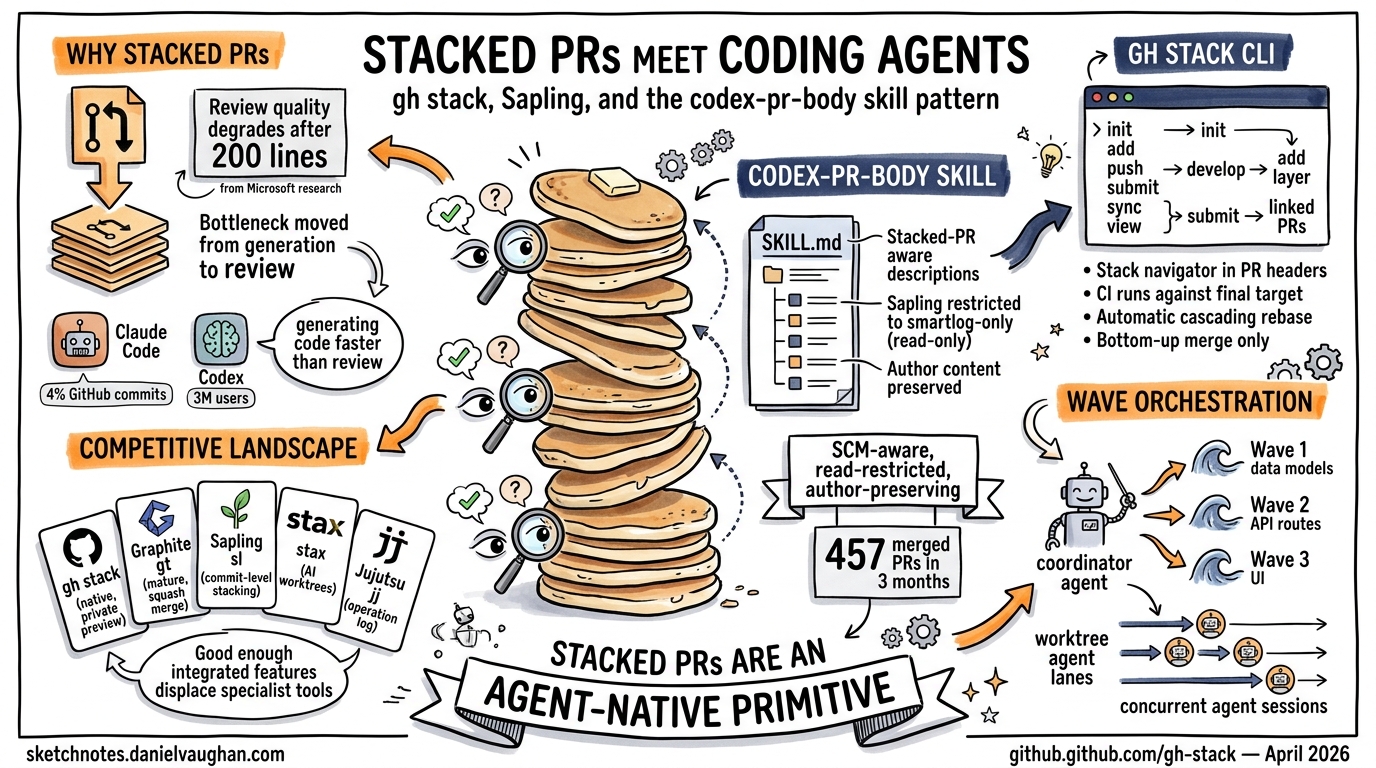
On 13 April 2026 GitHub shipped native stacked pull requests in private preview 12. The same week, OpenAI’s team merged a new project skill — codex-pr-body — that writes stacked-PR-aware descriptions and restricts Sapling operations to read-only for safety ⚠️3. Together these two events signal a shift: stacked PRs are no longer a power-user niche — they are becoming an agent-native primitive.
This article covers the gh stack CLI, how it compares with Graphite and Sapling, the enterprise skill pattern emerging from codex-pr-body, and what stacked PRs mean for multi-agent orchestration.
Why Stacked PRs, Why Now
Large pull requests are demonstrably harder to review. Microsoft’s internal research found that review quality degrades sharply once a PR exceeds roughly 200 lines of changed code 4. The traditional response — “please split your PR” — shifts mechanical toil onto the author with no tooling support.
Stacked PRs solve this by treating a chain of dependent branches as a first-class unit. Each layer in the stack targets the branch below it rather than main, forming an ordered chain that ultimately lands on the trunk 1. Reviewers see only the diff for their layer; CI runs against the final target; merging cascades automatically.
The timing is not coincidental. AI coding agents now produce code far faster than teams can review it. Claude Code accounts for roughly 4% of GitHub commits as of March 2026 5, and Codex CLI sits at 3 million weekly active users 6. The bottleneck has moved from generation to review — exactly the problem stacked PRs address.
GitHub’s gh stack CLI
GitHub’s implementation ships as a CLI extension with a companion web UI 17.
Installation
gh extension install github/gh-stack
Core Commands
| Command | Purpose |
|---|---|
gh stack init [name] |
Initialise a stack and create the first branch |
gh stack add [name] |
Add a new layer to the stack |
gh stack push |
Push all branches to remote |
gh stack submit |
Push branches and create/update linked PRs |
gh stack sync |
Fetch, rebase, push, and synchronise PR state |
gh stack view |
Display stack status with branch and PR links |
Workflow
flowchart TD
    A["gh stack init auth-layer"] --> B["Develop & commit"]
    B --> C["gh stack add api-routes"]
    C --> D["Develop & commit"]
    D --> E["gh stack add ui-components"]
    E --> F["gh stack submit"]
    F --> G["Three linked PRs created"]
    G --> H["Review each layer independently"]
    H --> I["Merge bottom-up"]
    I --> J["Automatic cascading rebase"]
Platform Integration
The gh stack CLI is entirely optional — stacks can be created via the GitHub UI, API, or standard Git workflow 8. What makes the native approach distinctive:
- Stack navigator: PR headers display a stack map so reviewers can navigate between layers 1.
- Branch protection: Rules enforce against the final target branch, not the immediate base 1.
- CI behaviour: Every PR runs CI as if targeting the final branch, eliminating false greens from stale bases 1.
- Merge cascading: Merging lower PRs automatically rebases the remaining stack onto
main9.
Stacks merge bottom-up — you can merge any contiguous group starting from the lowest unmerged PR, but you cannot skip layers 9.
Agent Skills Integration
GitHub ships an agent skill for stacked PRs:
npx skills add github/gh-stack
This teaches AI coding agents (Copilot, Cursor, Codex) to create, manage, and merge stacked PRs without human intervention 12. The skill follows the standard SKILL.md format — instructions, optional scripts, and references bundled into a .agents/skills/ directory 10.
The Competitive Landscape
GitHub’s entry validates the stacking category but poses existential risk to startups built on GitHub’s former lack of native support 211.
| Tool | Maturity | Agent Integration | Key Differentiator |
|---|---|---|---|
GitHub (gh stack) |
Private preview | npx skills add github/gh-stack |
Native platform integration |
Graphite (gt) |
Production | Claude Code skills exist | Advanced automation, squash merge support |
Sapling (sl) |
Production | codex-pr-body uses it ⚠️ |
Commit-level stacking, ReviewStack UI |
| stax | Active | AI worktree lanes | Rust CLI, st resolve AI conflict resolution |
| Aviator | Production | No agent skills yet | MergeQueue focus |
Jujutsu (jj) |
Active | No agent skills yet | Commit-level, operation log |
Graphite retains advantages in squash merge compatibility, conflict resolution UX, and stack visualisation maturity 11. However, the pattern is well-established: integrated features that are “good enough” tend to displace specialised external tools over time 2.
Sapling, Meta’s open-source SCM, takes a different approach — stacking at the commit level rather than the branch level. The sl pr submit --stack command creates one PR per commit in the stack 12. ReviewStack provides a purpose-built GitHub PR interface for stacked changes 12.
The codex-pr-body Skill Pattern
⚠️ The following details about codex-pr-body (reported as PR #18033) are sourced from internal project notes and could not be independently verified via public sources at the time of writing.
The codex-pr-body skill represents a notable pattern: the first team-authored project skill shipped alongside production code rather than as a community contribution 3. It encodes several design decisions worth examining:
-
Stacked-PR awareness: The skill writes descriptions covering only the net diff between base and head — not the full stack. Each PR body explains its layer, not the entire feature.
-
Sapling safety restrictions: The skill restricts Sapling CLI usage to
smartlog-only, preventing the agent from modifying the stack structure. This is a practical application of the principle of least privilege applied to SCM operations. -
Author content preservation: Existing content in PR bodies is preserved rather than overwritten, supporting human-agent collaboration on descriptions.
This pattern — SCM-aware, read-restricted, author-preserving — is likely to become the template for enterprise PR skills.
Enterprise Skill Architecture
The codex-pr-body skill follows the standard Codex skill structure 10:
.agents/skills/codex-pr-body/
├── SKILL.md          # Trigger conditions and instructions
├── scripts/          # PR body generation logic
├── references/       # Style guides, templates
└── agents/
    └── openai.yaml   # Metadata and policy
OpenAI’s own usage of skills for repository maintenance — achieving 457 merged PRs in three months, up from 316 in the prior quarter — demonstrates the throughput gains when skills encode team workflows 13.
Stacked PRs and Multi-Agent Orchestration
Stacked PRs map naturally onto wave-based orchestration, where a coordinating agent decomposes a task into ordered subtasks and dispatches them to worker agents.
flowchart LR
    subgraph Orchestrator
        O["Coordinator agent"]
    end

    subgraph Wave1["Wave 1"]
        A1["Agent: data models"]
    end

    subgraph Wave2["Wave 2"]
        A2["Agent: API routes"]
    end

    subgraph Wave3["Wave 3"]
        A3["Agent: UI components"]
    end

    subgraph Stack["PR Stack"]
        PR1["PR #1: data models → main"]
        PR2["PR #2: API routes → PR #1"]
        PR3["PR #3: UI → PR #2"]
    end

    O --> A1 --> PR1
    O --> A2 --> PR2
    O --> A3 --> PR3
Each wave produces one PR targeting the previous wave’s branch. The gh stack submit command creates the linked chain. A dedicated review agent can review each layer independently, seeing only that layer’s diff 14.
The AI Worktree Pattern
The stax tool extends this further with worktree lanes — isolated Git worktrees for concurrent agent sessions 14:
st wt c fix-tests --agent claude -- "fix flaky integration tests"
st wt c add-export --agent codex -- "add CSV export to /reports"
Each worktree runs an independent agent session while maintaining branch visibility and stackability. Combined with st submit --squash, this preserves clean one-commit-per-PR presentation upstream whilst allowing unconstrained local iteration 14.
Practical Adoption Guide
For teams already using Graphite
No immediate action required. Graphite remains more mature for production stacking workflows. Monitor gh stack as it exits private preview — the migration path will be straightforward given both tools operate on standard Git branches.
For teams new to stacking
- Join the waitlist at gh.io/stacksbeta for native GitHub support 1.
- Install the agent skill:
npx skills add github/gh-stack1. - Start small: Use two-layer stacks (refactor → feature) before attempting deep chains.
- Set merge strategy: Bottom-up merging is mandatory — design stack layers accordingly 9.
For Codex CLI users
The codex-pr-body skill pattern suggests a workflow:
- Use wave orchestration to decompose tasks into ordered subtasks.
- Each subtask agent creates one branch in the stack via
gh stack add. codex-pr-body(or a custom equivalent) writes per-layer descriptions.gh stack submitcreates the linked PR chain.- A review agent examines each layer’s focused diff independently.
Configuration Example
A minimal AGENTS.md encoding this workflow:
## PR Workflow

- When creating PRs for multi-step features, use `gh stack` to create stacked PRs.
- Use `$codex-pr-body` after code changes to generate stacked-PR-aware descriptions.
- Never modify the stack structure directly — use `gh stack` commands only.
- Each PR should represent one logical unit of work, reviewable independently.
What to Watch
- General availability timeline:
gh stackis private preview only — no public GA date yet 18. - Squash merge support: GitHub has not yet confirmed whether stacked PRs support squash merging, a critical requirement for many teams 11.
- Graphite response: Whether Graphite differentiates on advanced features or pivots to complement native stacking.
- Agent skill ecosystem: The
github/gh-stackskill is the first platform vendor to ship an agent skill for a core GitHub feature — expect Azure DevOps and GitLab to follow.
Citations
-
GitHub Stacked PRs — Official Documentation, GitHub, April 2026. ↩ ↩2 ↩3 ↩4 ↩5 ↩6 ↩7 ↩8 ↩9 ↩10
-
GitHub Ships Stacked PRs, Graphite Feels the Heat, Agent Wars, 13 April 2026. ↩ ↩2 ↩3 ↩4
-
Internal project notes —
codex-pr-body(PR #18033) details sourced fromnotes/github-stacked-prs-agent-skill-integration.md. ⚠️ Not independently verified via public sources. ↩ ↩2 -
GitHub recalls Phabricator with preview of Stacked PRs, The Register, 14 April 2026. ↩
-
The Composable AI Coding Stack, The New Stack / SemiAnalysis, March 2026. ↩
-
Codex CLI at One Year, codex-resources, April 2026. ↩
-
Quick Start — GitHub Stacked PRs, GitHub, April 2026. ↩
-
GitHub Stacked PRs Private Beta: Waitlist Required, byteiota, April 2026. ↩ ↩2
-
Working with Stacked PRs — GitHub Stacked PRs, GitHub, April 2026. ↩ ↩2 ↩3
-
Agent Skills — Codex, OpenAI Developers, April 2026. ↩ ↩2
-
GitHub adds Stacked PRs to speed complex code reviews, InfoWorld, April 2026. ↩ ↩2 ↩3
-
Sapling Stack Documentation, Sapling SCM. ↩ ↩2
-
Using skills to accelerate OSS maintenance, OpenAI Developers, 2026. ↩
-
Stacked PRs and AI Worktrees, Georg Heiler, 17 March 2026. ↩ ↩2 ↩3