Automated CI Failure Recovery with Codex CLI: Self-Healing Pipelines from GitHub Actions to GitLab CI
Automated CI Failure Recovery with Codex CLI: Self-Healing Pipelines from GitHub Actions to GitLab CI
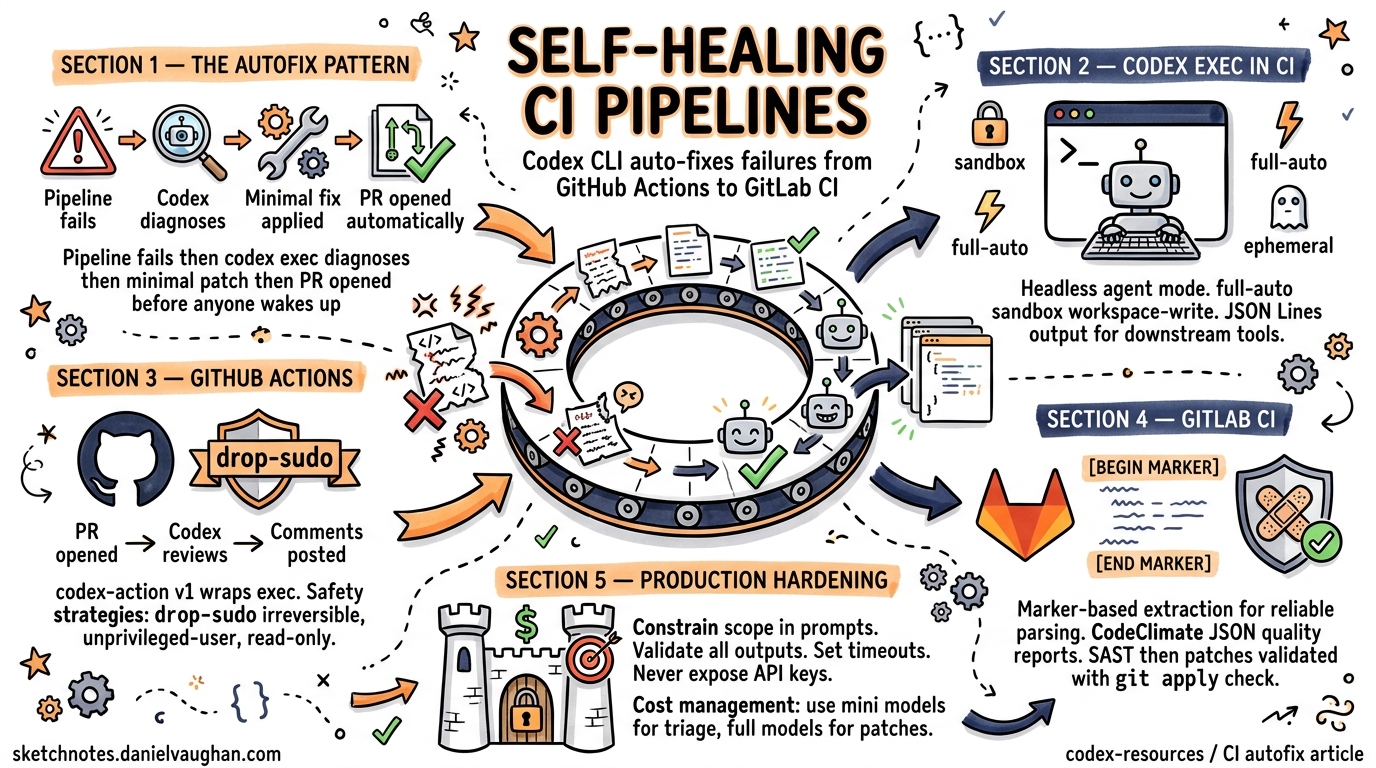
When a CI pipeline goes red at 2 a.m., the traditional response is a Slack notification followed by a bleary-eyed developer pushing a hotfix. Codex CLI offers a different pattern: the pipeline diagnoses its own failure, generates a minimal fix, validates it, and opens a pull request — all before anyone wakes up. This article covers the complete architecture for self-healing CI pipelines using codex exec, the official codex-action for GitHub Actions, and equivalent GitLab CI patterns including code quality reports and automated security patch generation.
The Autofix Pattern
The core idea is simple: when a CI workflow fails, a follow-up workflow triggers codex exec against the failing commit, generates a fix, re-runs the test suite to validate it, and opens a PR with the patch1. Codex runs headlessly — no TUI, no approval prompts — under whatever sandbox policy you configure.
sequenceDiagram
    participant CI as CI Pipeline
    participant CX as Codex CLI
    participant GH as GitHub / GitLab
    CI->>CI: Tests fail (exit 1)
    CI->>CX: codex exec --full-auto "Fix failing tests"
    CX->>CX: Read test output, diagnose root cause
    CX->>CX: Apply minimal patch
    CX->>CX: Re-run tests (validate fix)
    CX->>GH: Open PR with fix
    GH->>CI: Trigger standard CI on fix PR
The key constraint is minimality: the prompt must instruct Codex to make the smallest possible change that fixes the failure, not to refactor surrounding code2.
How codex exec Works in CI
The codex exec subcommand strips away the interactive TUI and runs a single agent session to completion3. Progress streams to stderr, the final agent message goes to stdout, and the process exits. Authentication uses the CODEX_API_KEY environment variable — store it as a CI secret, never inline3.
CODEX_API_KEY="${OPENAI_API_KEY}" \
  codex exec --full-auto --sandbox workspace-write \
  "Fix the failing tests with minimal changes. Do not refactor unrelated code."
Permission Flags
| Flag | Effect |
|---|---|
--full-auto |
Allows file edits without approval prompts3 |
--sandbox workspace-write |
Permits writes to the project directory only4 |
--sandbox read-only |
Default; no filesystem writes3 |
--sandbox danger-full-access |
Full system access — use only in disposable containers4 |
--ephemeral |
Prevents session persistence to disk3 |
--skip-git-repo-check |
Overrides the Git repository requirement3 |
Machine-Readable Output
For downstream processing, use JSON Lines output:
codex exec --json "analyse test failures" | jq '.type'
This produces a JSONL stream with event types including thread.started, turn.started, item.*, turn.completed, and turn.failed3. For structured results, pass an output schema:
codex exec "extract failure metadata" \
  --output-schema ./failure-schema.json \
  -o ./failure-report.json
GitHub Actions: The codex-action
The official openai/codex-action@v1 wraps codex exec for GitHub Actions, handling CLI installation, Responses API proxy startup, and permission management4.
Minimal Autofix Workflow
name: Codex auto-fix on CI failure

on:
  workflow_run:
    workflows: ["CI"]
    types: [completed]

jobs:
  auto-fix:
    if: ${{ github.event.workflow_run.conclusion == 'failure' }}
    runs-on: ubuntu-latest
    permissions:
      contents: write
      pull-requests: write
    steps:
      - uses: actions/checkout@v5
        with:
          ref: ${{ github.event.workflow_run.head_sha }}

      - name: Run Codex autofix
        uses: openai/codex-action@v1
        with:
          openai-api-key: ${{ secrets.OPENAI_API_KEY }}
          prompt: |
            The CI pipeline failed on this commit. Diagnose the failure
            from the test output and apply the minimal fix. Do not
            refactor unrelated code.
          sandbox: workspace-write
          safety-strategy: drop-sudo

      - name: Create fix PR
        uses: peter-evans/create-pull-request@v6
        with:
          title: "fix: auto-repair CI failure"
          body: "Automated fix generated by Codex CLI"
          branch: codex/autofix-${{ github.event.workflow_run.head_sha }}
The workflow triggers only when the main CI workflow completes with a failure, checks out the failing commit, runs Codex to generate a fix, and opens a PR14.
Safety Strategies
The safety-strategy input controls privilege isolation on the runner4:
| Strategy | Behaviour | Use Case |
|---|---|---|
drop-sudo |
Irreversibly removes sudo before Codex runs; protects secrets | Default; recommended for most pipelines |
unprivileged-user |
Runs as a specific non-root account | When you need user-level isolation |
read-only |
Prevents file and network changes | Analysis-only jobs (code review, triage) |
unsafe |
No privilege restriction | Windows runners only; avoid on Linux/macOS |
Critical: drop-sudo is irreversible within the job — once sudo is dropped, no subsequent step can reclaim it4. Run Codex as the final step to prevent inherited state leakage.
PR Review Workflow
Beyond autofix, the codex-action excels at automated code review:
name: Codex PR review

on:
  pull_request:
    types: [opened, synchronize, reopened]

jobs:
  review:
    runs-on: ubuntu-latest
    permissions:
      contents: read
      pull-requests: write
    steps:
      - uses: actions/checkout@v5
        with:
          ref: refs/pull/${{ github.event.pull_request.number }}/merge

      - name: Fetch base and head
        run: |
          git fetch --no-tags origin \
            ${{ github.event.pull_request.base.ref }} \
            +refs/pull/${{ github.event.pull_request.number }}/head

      - name: Run Codex review
        id: review
        uses: openai/codex-action@v1
        with:
          openai-api-key: ${{ secrets.OPENAI_API_KEY }}
          prompt-file: .github/codex/prompts/review.md
          output-file: codex-review.md
          safety-strategy: drop-sudo
          sandbox: read-only

      - name: Post review comment
        if: steps.review.outputs.final-message != ''
        uses: actions/github-script@v7
        with:
          script: |
            await github.rest.issues.createComment({
              owner: context.repo.owner,
              repo: context.repo.repo,
              issue_number: context.payload.pull_request.number,
              body: process.env.REVIEW,
            });
        env:
          REVIEW: ${{ steps.review.outputs.final-message }}
Note the prompt-file input — store review instructions as a committed file so the review criteria evolve with the codebase4.
GitLab CI: Code Quality and Security Remediation
GitLab does not have a direct equivalent to codex-action, but codex exec runs natively in GitLab CI/CD pipelines5. The OpenAI Cookbook provides two production patterns: CodeClimate-compliant quality reports and automated security patch generation6.
Marker-Based Output Extraction
Both patterns use a reliable extraction technique: instruct Codex to wrap its output between marker lines, then extract with awk6:
sed -E 's/\x1B\[[0-9;]*[A-Za-z]//g' "${RAW_LOG}" \
  | tr -d '\r' \
  | awk '
      /^\s*=== BEGIN_CODE_QUALITY_JSON ===\s*$/ {grab=1; next}
      /^\s*=== END_CODE_QUALITY_JSON ===\s*$/   {grab=0}
      grab
    ' > "${OUTPUT_FILE}"
The sed pass strips ANSI escape codes, tr removes carriage returns, and awk captures only the content between markers6. This avoids parsing prose, markdown, or code fences that Codex might generate despite instructions.
Code Quality Reports
Generate GitLab-native CodeClimate JSON that surfaces directly in merge request widgets:
codex_review:
  stage: codex
  image: node:24
  rules:
    - if: '$CI_PIPELINE_SOURCE == "merge_request_event"'
      when: on_success
  variables:
    CODEX_QA_PATH: "gl-code-quality-report.json"
  script:
    - npm -g i @openai/codex@latest
    - FILE_LIST="$(git ls-files | sed 's/^/- /')"
    - |
      codex exec --full-auto "
        Review this repository and output a GitLab Code Quality report
        in CodeClimate JSON format. Output ONLY a JSON array between
        === BEGIN_CODE_QUALITY_JSON === and === END_CODE_QUALITY_JSON ===
        markers. Use repo-relative paths from: ${FILE_LIST}
      " | tee raw.log >/dev/null
    - # Extract and validate JSON
    - |
      sed -E 's/\x1B\[[0-9;]*[A-Za-z]//g' raw.log | tr -d '\r' | awk '
        /BEGIN_CODE_QUALITY_JSON/ {grab=1; next}
        /END_CODE_QUALITY_JSON/  {grab=0}
        grab' > "${CODEX_QA_PATH}"
      node -e 'JSON.parse(require("fs").readFileSync(process.argv[1],"utf8"))' \
        "${CODEX_QA_PATH}" || echo "[]" > "${CODEX_QA_PATH}"
  artifacts:
    reports:
      codequality: gl-code-quality-report.json
The git ls-files allowlist prevents Codex from hallucinating file paths that do not exist in the repository6.
Automated Security Patch Generation
The most advanced pattern processes SAST scanner output, generates validated git apply-compatible patches for each High/Critical vulnerability, and stores them as pipeline artefacts6:
codex_remediation:
  stage: remediation
  image: node:24
  variables:
    SAST_REPORT: "gl-sast-report.json"
    PATCH_DIR: "codex_patches"
  script:
    - npm -g i @openai/codex@latest
    - mkdir -p "${PATCH_DIR}"
    - |
      jq -c '.vulnerabilities[]?
        | select((.severity|ascii_downcase)=="high"
             or (.severity|ascii_downcase)=="critical")' \
        "${SAST_REPORT}" | nl -ba > /tmp/vulns.txt
    - |
      while IFS=$'\t' read -r idx vuln; do
        codex exec --full-auto "
          Fix this vulnerability with a minimal, safe patch.
          Output a unified diff between === BEGIN_UNIFIED_DIFF ===
          and === END_UNIFIED_DIFF === markers.
          VULNERABILITY: ${vuln}
        " | tee /tmp/raw.log >/dev/null

        sed -E 's/\x1B\[[0-9;]*[A-Za-z]//g' /tmp/raw.log \
          | tr -d '\r' \
          | awk '/BEGIN_UNIFIED_DIFF/{g=1;next}/END_UNIFIED_DIFF/{g=0}g' \
          > "${PATCH_DIR}/fix-${idx}.patch"

        if git apply --check "${PATCH_DIR}/fix-${idx}.patch" 2>/dev/null; then
          echo "Patch ${idx} validated"
        else
          echo "Patch ${idx} failed validation; removing"
          rm -f "${PATCH_DIR}/fix-${idx}.patch"
        fi
      done < /tmp/vulns.txt
  artifacts:
    paths:
      - codex_patches/
    expire_in: 14 days
Each vulnerability is processed individually, producing a separate patch file. The git apply --check validation ensures only syntactically correct, cleanly applicable patches survive6.
Production Hardening
Prompt Engineering for CI
The quality of autofix output depends entirely on prompt specificity. Key patterns:
- Constrain scope: “Fix the failing tests with minimal changes. Do not refactor unrelated code.”
- Provide context: Pipe test output or log excerpts into the prompt via stdin3
- Specify output format: Use marker-based extraction for reliable parsing6
- Include file allowlists: Feed
git ls-filesoutput to prevent path hallucination6
gh run view "${RUN_ID}" --log-failed \
  | codex exec "Diagnose the root cause of this CI failure and suggest a fix"
Error Handling
Robust CI integration requires graceful degradation:
- Use
set +o pipefailaround Codex invocations to capture both successful and failed runs without premature pipeline termination6 - Validate all outputs before consuming them — JSON parsing for quality reports,
git apply --checkfor patches, regex guards for placeholder detection6 - Fall back to safe defaults when Codex produces invalid output: empty JSON arrays for quality reports, skip-and-log for patches6
- Set timeouts —
codex execcan hang if the model enters a reasoning loop; use CI-level job timeouts as a backstop
Cost Management
Each codex exec invocation consumes API tokens. For cost-conscious pipelines:
- Use
--model gpt-5.4-minifor triage and diagnostic jobs where full reasoning power is unnecessary - Reserve
--model gpt-5.4for patch generation where accuracy matters - Set
--ephemeralto avoid session storage overhead3 - ⚠️ Token consumption scales with repository size — consider scoping prompts to specific directories or files rather than entire repositories
Security Considerations
- Never expose API keys in logs — use CI secret management exclusively4
- Prefer
drop-sudoon GitHub Actions to prevent Codex from escalating privileges4 - Run Codex as the final step in a job to prevent inherited state leakage to subsequent steps4
- Restrict workflow triggers — use
allow-usersandallow-botsinputs oncodex-actionto prevent untrusted actors from triggering Codex runs via PRs from forks4 - Sanitise prompt inputs from pull request titles, commit messages, and branch names to prevent prompt injection4
Beyond Autofix: CI Integration Patterns
Log Analysis and Triage
tail -n 200 app.log \
  | codex exec "Identify the root cause and suggest fixes in 5 bullets"
Dynamic Prompts
./generate-review-prompt.sh | codex exec - --json > results.jsonl
Session Resumption
For multi-step CI workflows, resume a previous session:
codex exec resume --last "Now fix the race conditions you found"
codex exec resume "${SESSION_ID}" "Apply the recommended changes"
Structured Output for Downstream Tools
{
  "type": "object",
  "properties": {
    "root_cause": { "type": "string" },
    "severity": { "enum": ["low", "medium", "high", "critical"] },
    "suggested_fix": { "type": "string" },
    "affected_files": { "type": "array", "items": { "type": "string" } }
  }
}
codex exec "Analyse this CI failure" \
  --output-schema ./failure-schema.json \
  -o ./failure-report.json
The structured output integrates cleanly with dashboards, ticketing systems, and alerting pipelines3.
Limitations and Honest Assessment
- Non-deterministic: The same failure may produce different fixes across runs — always validate with a test re-run before merging
- Context window constraints: Large repositories with extensive test output may exceed the model’s context window, producing incomplete diagnoses
- False confidence: Codex may generate a “fix” that passes the specific failing test but introduces a regression elsewhere — comprehensive test suites are essential
- ⚠️ Cost at scale: Running autofix on every CI failure across a monorepo with hundreds of daily commits can accumulate significant API costs without proper gating (e.g., only trigger on
mainbranch failures, not feature branches)
Citations
-
OpenAI Cookbook, “Use Codex CLI to automatically fix CI failures,” cookbook.openai.com/examples/codex/autofix-github-actions ↩ ↩2
-
OpenAI, “Auto-fix CI failures with Codex,” developers.openai.com/codex/guides/autofix-ci ↩
-
OpenAI, “Command line options – Codex CLI,” developers.openai.com/codex/cli/reference ↩ ↩2 ↩3 ↩4 ↩5 ↩6 ↩7 ↩8 ↩9 ↩10
-
OpenAI, “GitHub Action – Codex,” developers.openai.com/codex/github-action ↩ ↩2 ↩3 ↩4 ↩5 ↩6 ↩7 ↩8 ↩9 ↩10 ↩11 ↩12
-
OpenAI, “CLI – Codex,” developers.openai.com/codex/cli ↩
-
OpenAI Cookbook, “Automating Code Quality and Security Fixes with Codex CLI on GitLab,” cookbook.openai.com/examples/codex/secure_quality_gitlab ↩ ↩2 ↩3 ↩4 ↩5 ↩6 ↩7 ↩8 ↩9 ↩10 ↩11