Building Custom Code Review Pipelines with the Codex SDK: Structured Findings Across GitHub, GitLab, and Azure DevOps
Building Custom Code Review Pipelines with the Codex SDK: Structured Findings Across GitHub, GitLab, and Azure DevOps
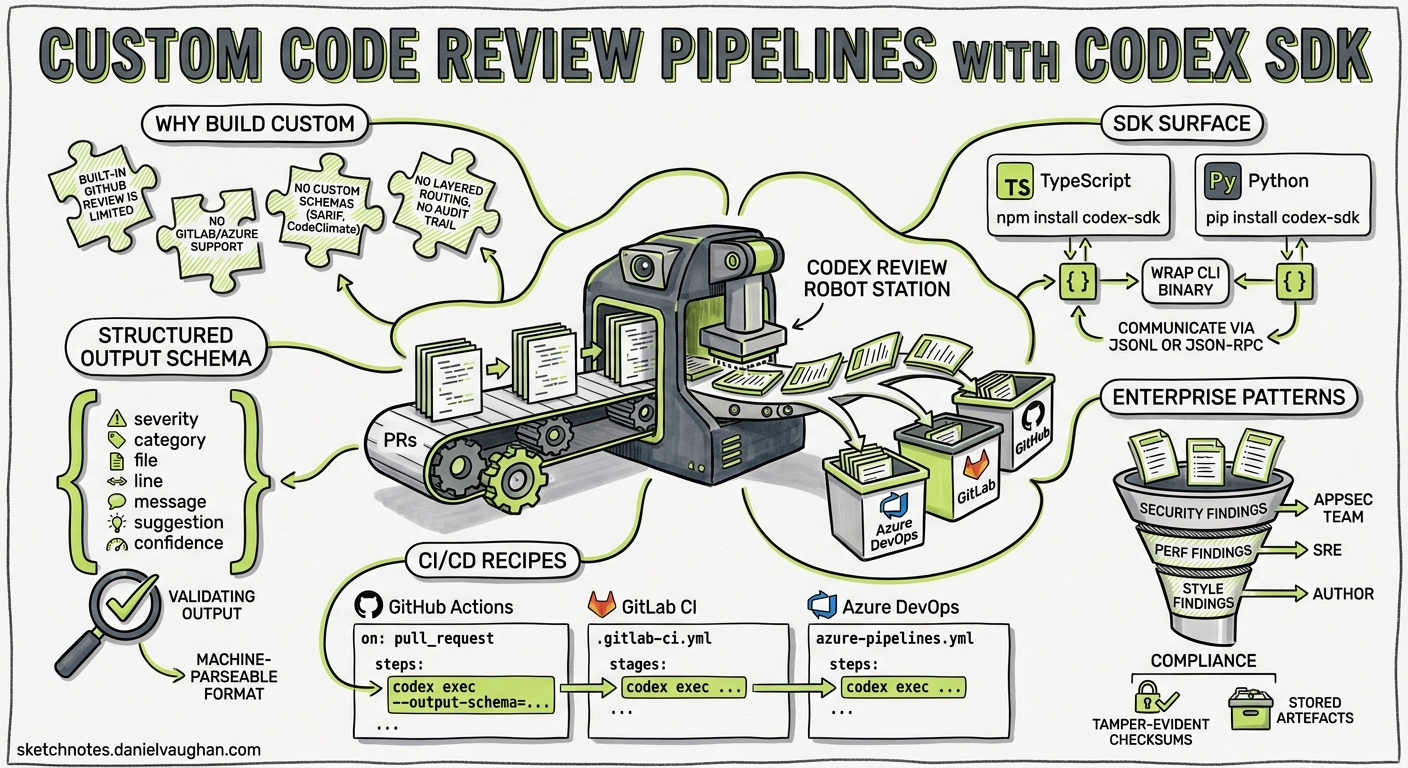
Codex ships with built-in GitHub pull request review — enable it in settings and every PR gets an automatic @codex review pass 1. For teams on GitHub who only need that, the built-in integration is the shortest path. But the moment you need reviews on GitLab, Azure DevOps, Bitbucket, or a self-hosted forge — or you want to feed findings into a custom dashboard, compliance pipeline, or defect-tracking system — you need to build your own.
This article walks through the architecture of a custom Codex-powered code review pipeline: the SDK surface, the structured output schema that makes findings machine-parseable, and concrete CI/CD recipes for the three major platforms.
Why Build Custom Review Pipelines
The built-in Codex GitHub review is opinionated by design. It posts inline comments, gives a verdict, and moves on 1. That works for many teams, but several common scenarios fall outside its scope:
- Non-GitHub forges. GitLab, Azure DevOps, and Bitbucket Server have no native Codex review integration 2.
- Custom finding schemas. Security teams often need findings in CodeClimate, SARIF, or internal formats for aggregation dashboards 3.
- Layered review policies. Enterprise pipelines may require findings routed through separate approval gates — security findings to the AppSec team, performance findings to SRE, style findings to the author 4.
- Audit and compliance. Regulated environments need review artefacts stored with tamper-evident checksums, not just ephemeral PR comments 5.
The Codex SDK and codex exec non-interactive mode give you the primitives to cover all of these.
The Codex SDK: Two Languages, One Pattern
The SDK is available in TypeScript and Python 6. Both wrap the Codex CLI binary and communicate over a JSONL event stream (for codex exec) or JSON-RPC 2.0 (for the persistent app-server) 6.
TypeScript
npm install @openai/codex-sdk
import { Codex } from "@openai/codex-sdk";

const codex = new Codex();
const thread = codex.startThread();
const result = await thread.run(
  "Review the diff in STDIN for correctness, security, and performance issues."
);
console.log(result);
The TypeScript SDK requires Node.js 18+ and spawns the Codex CLI as a child process 6.
Python
pip install codex-sdk-py
from codex import Codex

with Codex() as codex:
    thread = codex.thread_start(model="gpt-5.5")
    result = thread.run(
        "Review the diff for correctness, security, and performance issues."
    )
    print(result)
The Python SDK supports both synchronous and asynchronous contexts via AsyncCodex 6. For CI/CD runners where you want fire-and-forget execution, codex exec is simpler than the full SDK — it runs a single prompt, streams progress to stderr, and prints the final output to stdout 7.
Designing the Structured Output Schema
The key to machine-parseable review output is --output-schema, which constrains the model’s final response to a JSON Schema you define 7. OpenAI’s cookbook recommends GPT-5.5 for code review accuracy and consistency 2.
Here is a minimal but production-useful schema:
{
  "$schema": "https://json-schema.org/draft/2020-12/schema",
  "type": "object",
  "properties": {
    "findings": {
      "type": "array",
      "items": {
        "type": "object",
        "properties": {
          "title": { "type": "string" },
          "body": { "type": "string" },
          "confidence_score": { "type": "number", "minimum": 0, "maximum": 1 },
          "priority": { "type": "integer", "minimum": 0, "maximum": 3 },
          "code_location": {
            "type": "object",
            "properties": {
              "relative_file_path": { "type": "string" },
              "line_range": {
                "type": "object",
                "properties": {
                  "start": { "type": "integer" },
                  "end": { "type": "integer" }
                },
                "required": ["start", "end"]
              }
            },
            "required": ["relative_file_path", "line_range"]
          }
        },
        "required": ["title", "body", "confidence_score", "priority", "code_location"]
      }
    },
    "overall_correctness": {
      "type": "string",
      "enum": ["patch is correct", "patch is incorrect"]
    },
    "overall_explanation": { "type": "string" },
    "overall_confidence_score": { "type": "number", "minimum": 0, "maximum": 1 }
  },
  "required": ["findings", "overall_correctness", "overall_explanation", "overall_confidence_score"],
  "additionalProperties": false
}
Save this as codex-review-schema.json in your repository root. The priority field uses a 0–3 scale: 0 = informational, 1 = low, 2 = medium, 3 = critical 2. The confidence_score lets downstream tooling filter noisy findings — a common pattern is to suppress anything below 0.7 in automated comments and surface low-confidence items in a digest instead.
Known Caveat: MCP and Tool Conflicts
When MCP servers or tools are active in the request context, the model can silently ignore --output-schema constraints 8. For review pipelines, run codex exec without MCP servers enabled — pass --no-mcp or ensure no MCP configuration is present in the runner’s environment. This is a known issue tracked in GitHub Issue #15451 8.
The Review Flow
flowchart LR
    A[CI Trigger] --> B[Fetch Diff]
    B --> C[codex exec + schema]
    C --> D[Parse JSON Findings]
    D --> E{Platform}
    E -->|GitHub| F[PR Review API]
    E -->|GitLab| G[MR Discussions API]
    E -->|Azure DevOps| H[PR Threads API]
    F --> I[Inline Comments]
    G --> I
    H --> I
The pattern is identical across platforms: fetch the diff, pipe it to codex exec with the output schema, parse the resulting JSON, and post findings through the platform’s API.
GitHub Actions Recipe
For GitHub, the official openai/codex-action provides a thin wrapper 2:
name: Codex Review
on:
  pull_request:
    types: [opened, synchronize]

permissions:
  contents: read
  pull-requests: write

jobs:
  review:
    runs-on: ubuntu-latest
    steps:
      - uses: actions/checkout@v4
        with:
          fetch-depth: 0

      - name: Generate diff
        run: |
          git diff origin/${{ github.base_ref }}...HEAD > /tmp/pr.diff

      - name: Codex review
        uses: openai/codex-action@main
        with:
          openai-api-key: ${{ secrets.OPENAI_API_KEY }}
          prompt-file: .codex/review-prompt.md
          output-schema-file: codex-review-schema.json
          sandbox: read-only
          model: gpt-5.5

      - name: Post findings
        uses: actions/github-script@v7
        with:
          script: |
            const fs = require('fs');
            const findings = JSON.parse(fs.readFileSync('codex-output.json', 'utf8'));
            for (const f of findings.findings) {
              await github.rest.pulls.createReviewComment({
                owner: context.repo.owner,
                repo: context.repo.repo,
                pull_number: context.issue.number,
                body: `**${f.title}** (priority: ${f.priority}, confidence: ${f.confidence_score})\n\n${f.body}`,
                path: f.code_location.relative_file_path,
                start_line: f.code_location.line_range.start,
                line: f.code_location.line_range.end,
              });
            }
The sandbox: read-only flag prevents the review agent from modifying files — it can only read the repository and produce findings 9.
GitLab CI/CD Recipe
GitLab requires installing the Codex binary directly since there is no native GitLab integration 3:
codex_review:
  stage: review
  image: node:22-slim
  rules:
    - if: '$CI_PIPELINE_SOURCE == "merge_request_event"'
    - if: '$CI_PIPELINE_SOURCE == "merge_request_event" && $CI_MERGE_REQUEST_SOURCE_PROJECT_ID != $CI_PROJECT_ID'
      when: never
  script:
    - apt-get update && apt-get install -y git ca-certificates
    - npm install -g @openai/codex@latest
    - git diff origin/$CI_MERGE_REQUEST_TARGET_BRANCH_NAME...HEAD > /tmp/mr.diff
    - |
      codex exec \
        --model gpt-5.5 \
        --output-schema codex-review-schema.json \
        --sandbox read-only \
        --no-mcp \
        "Review the diff in /tmp/mr.diff. Focus on correctness, security, and performance." \
        > codex-output.json
    - |
      node -e "
        const https = require('https');
        const findings = require('./codex-output.json');
        for (const f of findings.findings.filter(f => f.priority >= 2)) {
          const body = JSON.stringify({
            body: '**' + f.title + '** (P' + f.priority + ')\n\n' + f.body +
                  '\n\n📍 ' + f.code_location.relative_file_path +
                  ':' + f.code_location.line_range.start + '-' + f.code_location.line_range.end
          });
          const req = https.request({
            hostname: 'gitlab.com',
            path: '/api/v4/projects/${CI_PROJECT_ID}/merge_requests/${CI_MERGE_REQUEST_IID}/discussions',
            method: 'POST',
            headers: {
              'Content-Type': 'application/json',
              'PRIVATE-TOKEN': process.env.GITLAB_TOKEN,
              'Content-Length': Buffer.byteLength(body)
            }
          });
          req.write(body);
          req.end();
        }
      "
  artifacts:
    paths:
      - codex-output.json
    expire_in: 14 days
Note the fork protection rule: merge requests from forked projects are skipped to prevent API key exfiltration 3. The pipeline strips ANSI escape codes and validates JSON before posting to prevent injection via malformed output 3.
Azure DevOps Recipe
Azure DevOps uses the Pull Request Threads API for inline comments 2:
trigger: none

pr:
  branches:
    include:
      - main

pool:
  vmImage: 'ubuntu-latest'

steps:
  - checkout: self
    fetchDepth: 0

  - task: NodeTool@0
    inputs:
      versionSpec: '22.x'

  - script: |
      npm install -g @openai/codex@latest
      git diff origin/main...HEAD > /tmp/pr.diff
      codex exec \
        --model gpt-5.5 \
        --output-schema codex-review-schema.json \
        --sandbox read-only \
        --no-mcp \
        "Review the diff in /tmp/pr.diff for correctness, security, and performance." \
        > $(Build.ArtifactStagingDirectory)/codex-output.json
    displayName: 'Run Codex Review'
    env:
      OPENAI_API_KEY: $(OPENAI_API_KEY)

  - script: |
      node -e "
        const findings = require('$(Build.ArtifactStagingDirectory)/codex-output.json');
        const threads = findings.findings
          .filter(f => f.priority >= 2)
          .map(f => ({
            comments: [{ content: '**' + f.title + '**\n\n' + f.body, commentType: 1 }],
            threadContext: {
              filePath: '/' + f.code_location.relative_file_path,
              rightFileStart: { line: f.code_location.line_range.start },
              rightFileEnd: { line: f.code_location.line_range.end }
            },
            status: f.priority >= 3 ? 1 : 0
          }));
        console.log(JSON.stringify(threads));
      " | xargs -I{} curl -s -X POST \
        '$(System.CollectionUri)$(System.TeamProject)/_apis/git/repositories/$(Build.Repository.Name)/pullRequests/$(System.PullRequest.PullRequestId)/threads?api-version=7.1' \
        -H 'Authorization: Bearer $(System.AccessToken)' \
        -H 'Content-Type: application/json' \
        -d '{}'
    displayName: 'Post Review Threads'
The threadContext object anchors each comment to the correct file and line range in the PR diff view 2.
Security Hardening
Running Codex in CI/CD requires deliberate security boundaries:
- Read-only sandbox. Always pass
--sandbox read-onlyfor review jobs. The agent should never modify the repository during review 9. - Drop privileges. On self-hosted runners, drop sudo permissions before invoking Codex to prevent credential exfiltration 2.
- Fork protection. Skip review jobs on forked merge requests or pull requests from external contributors — the fork does not have access to your secrets, but a compromised fork could manipulate the diff to extract them through the review prompt 3.
- Output validation. Always validate the JSON output before feeding it to platform APIs. Strip ANSI escape codes, check for valid JSON structure, and reject outputs that contain unexpected fields 3.
- Disable MCP. Pass
--no-mcpto prevent the review agent from connecting to any MCP servers configured in the runner environment. Review agents should have zero external tool access 8.
Model Selection for Review
OpenAI explicitly recommends GPT-5.5 for code review pipelines 2. In practice:
| Model | Accuracy | Speed | Cost | Best For |
|---|---|---|---|---|
| GPT-5.5 | Highest | Moderate | Higher | Security-critical reviews, compliance |
| GPT-5.2-Codex | High | Faster | Moderate | General correctness reviews 10 |
| GPT-5.3-Codex-Spark | Good | Fastest | Lowest | High-throughput pre-commit checks 11 |
For most teams, GPT-5.5 on merge-to-main PRs and Spark for pre-commit or draft PR quick-scans strikes the right balance between thoroughness and token spend.
Filtering and Routing Findings
Raw findings from the model include confidence scores and priorities. A production pipeline should filter before posting:
const actionable = findings.findings.filter(
  (f) => f.confidence_score >= 0.7 && f.priority >= 2
);

const securityFindings = actionable.filter((f) =>
  f.title.toLowerCase().includes("security") ||
  f.title.toLowerCase().includes("injection") ||
  f.title.toLowerCase().includes("auth")
);

const performanceFindings = actionable.filter((f) =>
  f.title.toLowerCase().includes("performance") ||
  f.title.toLowerCase().includes("n+1") ||
  f.title.toLowerCase().includes("complexity")
);
Route securityFindings to your AppSec channel, performanceFindings to the SRE team, and post everything else as standard PR comments. The structured schema makes this trivial — without it, you are parsing free-text comments with regex.
Limitations
- Output schema and MCP conflicts. As noted,
--output-schemacan be silently ignored when MCP servers are active. Always disable MCP for review jobs 8. - Large diffs. Diffs exceeding the model’s context window will be truncated. For monorepo PRs with hundreds of changed files, consider splitting the review into per-package or per-directory
codex execcalls and merging the findings 7. - Structured output on resume. The
--output-schemaflag is not yet supported withcodex exec resume, limiting the ability to checkpoint long reviews 12. - Rate limits. High-throughput pipelines hitting hundreds of PRs per hour will encounter API rate limits. Implement exponential backoff and consider batching smaller PRs 7.
What Comes Next
The 0.131.0 alpha line includes 65 new features 13, and the SDK surface is expanding rapidly. Watch for first-class SARIF output support, which would eliminate the need for custom schema-to-SARIF transforms, and for improved --output-schema reliability when tools are present.
For now, the pattern described here — codex exec with a structured schema, platform-specific posting, and disciplined security boundaries — gives you a code review pipeline that works wherever your repositories live.
Citations
-
OpenAI, “Code review in GitHub – Codex,” developers.openai.com/codex/integrations/github (accessed 15 May 2026). ↩ ↩2
-
OpenAI, “Build Code Review with the Codex SDK,” developers.openai.com/cookbook/examples/codex/build_code_review_with_codex_sdk (accessed 15 May 2026). ↩ ↩2 ↩3 ↩4 ↩5 ↩6 ↩7 ↩8
-
OpenAI, “Automating Code Quality and Security Fixes with Codex CLI on GitLab,” developers.openai.com/cookbook/examples/codex/secure_quality_gitlab (accessed 15 May 2026). ↩ ↩2 ↩3 ↩4 ↩5 ↩6
-
OpenAI, “Agent approvals & security – Codex,” developers.openai.com/codex/agent-approvals-security (accessed 15 May 2026). ↩
-
OpenAI, “Running Codex safely at OpenAI,” openai.com/index/running-codex-safely/ (accessed 15 May 2026). ↩
-
OpenAI, “SDK – Codex,” developers.openai.com/codex/sdk (accessed 15 May 2026). ↩ ↩2 ↩3 ↩4
-
OpenAI, “Non-interactive mode – Codex,” developers.openai.com/codex/noninteractive (accessed 15 May 2026). ↩ ↩2 ↩3 ↩4
-
GitHub, “Issue #15451: –json and –output-schema are silently ignored when tools/MCP servers are active,” github.com/openai/codex/issues/15451 (accessed 15 May 2026). ↩ ↩2 ↩3 ↩4
-
OpenAI, “Best practices – Codex,” developers.openai.com/codex/learn/best-practices (accessed 15 May 2026). ↩ ↩2
-
OpenAI, “Introducing GPT-5.2-Codex,” openai.com/index/introducing-gpt-5-2-codex/ (accessed 15 May 2026). ↩
-
OpenAI/Cerebras, “Introducing GPT-5.3-Codex-Spark,” openai.com/index/introducing-gpt-5-3-codex-spark/ (accessed 15 May 2026). ↩
-
GitHub, “Issue #14343: Add –output-schema support to codex exec resume,” github.com/openai/codex/issues/14343 (accessed 15 May 2026). ↩
-
GitHub, “Releases – openai/codex – 0.131.0-alpha.18,” github.com/openai/codex/releases (accessed 15 May 2026). ↩