Configuration-Based Sandbox Escape: The Attack Class Every Codex CLI User Should Understand
Configuration-Based Sandbox Escape: The Attack Class Every Codex CLI User Should Understand
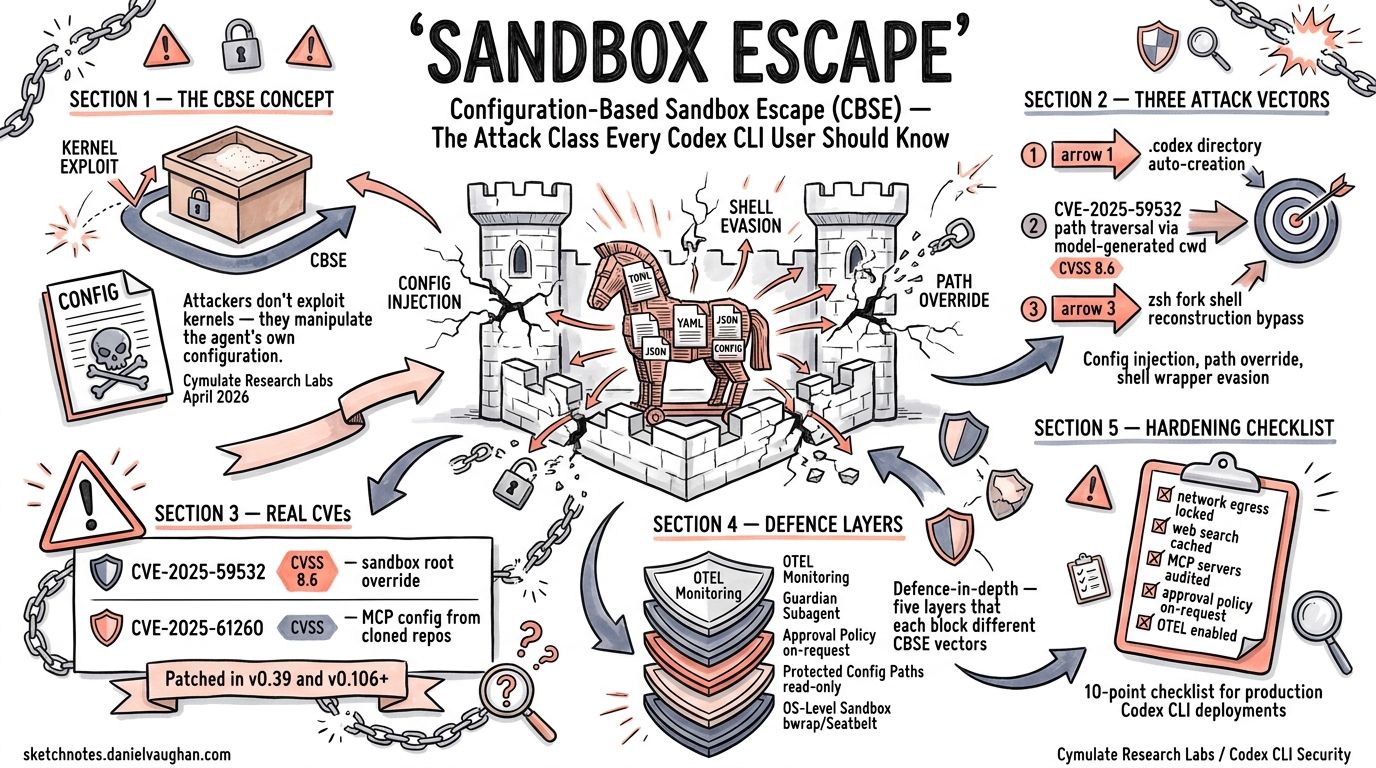
In April 2026, Cymulate Research Labs published findings on a vulnerability class they termed Configuration-Based Sandbox Escape (CBSE) — a category of attack that bypasses coding agent sandboxes not by exploiting kernel bugs or container breakouts, but by manipulating the agent’s own configuration, startup behaviour, and trust boundaries1. The research confirmed that CBSE vulnerabilities exist across Claude Code, Gemini CLI, Codex CLI, Cursor, and GitHub Copilot1. This article explains the attack class, examines the real CVEs it has produced, and provides a concrete hardening guide for Codex CLI deployments.
Why Traditional Sandbox Thinking Falls Short
The mental model most developers carry is straightforward: the sandbox is a container, and escaping it requires a kernel exploit or a privilege escalation. CBSE inverts that assumption. Instead of attacking the sandbox from below, attackers compromise the agent’s configuration from within the workspace — the very files the sandbox is designed to protect2.
The NVIDIA AI Red Team articulated the core problem clearly: “once control passes to a subprocess, the application has no visibility into or control over the subprocess”3. Application-level sandboxing cannot enforce policy on code it spawns unless the operating system kernel cooperates.
flowchart TD
    A[Attacker plants malicious repo] --> B[Developer clones repo]
    B --> C{Does .codex/ directory exist?}
    C -- No --> D[Agent creates .codex/ on first run]
    C -- Yes --> E[Agent reads existing config]
    D --> F[Attacker-controlled AGENTS.md or hooks loaded]
    E --> F
    F --> G[Malicious payload executes inside sandbox context]
    G --> H{Can it write to config paths?}
    H -- Yes --> I[Sandbox policy overwritten]
    H -- No --> J[Attack contained]
    I --> K[Persistent compromise survives session restarts]
    J --> L[Defence-in-depth holds]
The CBSE Attack Surface in Codex CLI
CBSE attacks exploit a fundamental tension: coding agents need to read project configuration to be useful, but that same configuration can be weaponised. In Codex CLI, the attack surface includes three vectors.
1. Directory Auto-Creation and Config Injection
When the .codex directory does not exist — the default state for any freshly cloned project — the agent may create it during its first run4. If an attacker can influence the repository contents (via a pull request, a shared branch, or a supply-chain compromise), they can pre-seed configuration files that alter the agent’s behaviour. Every subsequent session from that directory inherits the compromised configuration4.
2. Path Traversal via Model-Generated Working Directories
CVE-2025-59532 (CVSS 8.6) demonstrated this vector concretely5. A bug in Codex’s sandbox configuration logic allowed model-generated cwd values to override the intended workspace boundaries. The sandbox treated the model’s chosen directory as the writable root, enabling file writes and command execution outside the user’s session origin. The vulnerability affected Codex CLI versions 0.2.0 through 0.38.0 and was patched in v0.39.05.
3. Shell Fork Path Reconstruction
In v0.106.0, a subtler bypass was discovered: zsh fork execution reconstructed commands without preserving sandbox wrappers6. The CoreShellCommandExecutor re-ran a freshly constructed shell command instead of using the sandboxed ExecRequest produced by the sandbox envelope. The fix required three changes: preserving the sandboxed request through the zsh fork path, executing the sandboxed command and working directory from the envelope, and making zsh-fork script extraction robust to wrapped invocations by scanning for -c/-lc arguments rather than matching only the first positional form6.
Real-World CVEs and Incidents
| CVE | CVSS | Tool | Vector | Patched |
|---|---|---|---|---|
| CVE-2025-59532 | 8.6 | Codex CLI | Model-generated cwd overrides sandbox root |
v0.39.05 |
| CVE-2025-61260 | — | Codex CLI | MCP server config executed from cloned repos without warning | v0.106+7 |
| CVE-2025-54794 | — | Claude Code | Prefix-based path validation bypass | Patched8 |
| CVE-2025-54795 | — | Claude Code | Command injection via whitelisted command sanitisation | Patched8 |
The apply_patch utility was another historically significant vector. Before v0.39.0, apply_patch ran in-process without leveraging the sandbox, creating a loophole where symlinks could bypass path restrictions. The fix moved virtual execution into actual sandboxed execution using codex --codex-run-as-apply-patch PATCH, subjecting it to the same sandbox policy as any other shell call9.
Codex CLI’s Defence Architecture
Codex CLI has evolved significantly since the early CVEs. Understanding the current defence layers is essential for configuring them correctly.
OS-Level Sandbox Enforcement
Codex does not rely on application-level sandboxing alone. It delegates to OS-level mechanisms10:
- Linux:
bwrap(Bubblewrap) pipeline withseccompfilters - macOS: Seatbelt policies via
sandbox-exec - Windows: WSL2 Linux sandbox or native Windows sandbox with proxy-only networking
As of v0.121.0, Codex also ships a hardened devcontainer profile that uses Bubblewrap inside Docker containers, adding a second isolation layer11.
Protected Configuration Paths
In workspace-write sandbox mode, Codex CLI explicitly protects configuration directories as read-only, even within writable workspace roots10:
# These paths remain read-only regardless of workspace-write policy:
# .git/        — repository integrity
# .agents/     — agent configuration
# .codex/      — CLI configuration
This directly mitigates the CBSE pattern of overwriting configuration to achieve persistence.
Approval Policy Layers
The approval system adds a human-in-the-loop checkpoint at security boundaries10:
# Recommended production configuration
approval_policy = "on-request"
sandbox_mode = "workspace-write"
For higher-security environments, granular approval control separates sandbox, rule, MCP, permission, and skill approvals:
approval_policy = { granular = {
  sandbox_approval = true,
  rules = true,
  mcp_elicitations = true,
  request_permissions = false,
  skill_approval = false
} }
Hardening Codex CLI Against CBSE
The following configuration patterns implement defence-in-depth against CBSE attacks.
1. Lock Down Network Egress
Default network policy is disabled, but verify it explicitly:
[sandbox_workspace_write]
network_access = false
For projects requiring network access, use domain allowlists rather than blanket access12:
[sandbox_workspace_write]
network_access = true

[sandbox_workspace_write.network]
allowed_domains = ["registry.npmjs.org", "pypi.org"]
2. Use Web Search Caching Over Live Fetch
Live web search enables prompt injection via fetched pages10:
web_search = "cached"   # Default — uses OpenAI-maintained index
# web_search = "live"   # Higher injection risk
# web_search = "disabled"  # Maximum restriction
3. Audit MCP Server Configuration
MCP servers run outside the sandbox context. Treat them as trusted code7:
# Review all configured MCP servers before running
cat ~/.codex/config.toml | grep -A5 '\[mcp'

# Never accept MCP configurations from cloned repositories blindly
4. Route Approvals Through Guardian
For team deployments, route eligible approvals through the Guardian subagent to enforce policy even when developers might approve hastily10:
approvals_reviewer = "guardian_subagent"
5. Enable OpenTelemetry for Sandbox Denial Monitoring
Track sandbox denials to detect CBSE attempts:
[otel]
environment = "production"
exporter = "otlp-http"
log_user_prompt = false
OTEL events include sandbox denials, tool decisions, and approval outcomes — the signals you need to detect configuration-based attacks before they succeed10.
flowchart LR
    subgraph "Defence Layers"
        A[OS-Level Sandbox<br/>bwrap / Seatbelt] --> B[Protected Config Paths<br/>.codex, .agents, .git read-only]
        B --> C[Approval Policy<br/>on-request / granular]
        C --> D[Guardian Subagent<br/>Policy enforcement]
        D --> E[OTEL Monitoring<br/>Sandbox denial alerts]
    end

    subgraph "CBSE Attack"
        F[Malicious Repo Config] -.->|Blocked by| B
        G[Model-Generated cwd] -.->|Blocked by| A
        H[Shell Fork Bypass] -.->|Blocked by| A
    end
The Architectural Lesson
Mike Lukianoff’s analysis frames the broader challenge precisely: local agents running on developer machines have inherent visibility into their execution environment, enabling them to reason about and circumvent constraints2. The NVIDIA AI Red Team’s recommendation to “sandbox ALL spawned functions, including hooks and MCP initialisation scripts” and to “never cache approvals” reflects the same principle3.
Codex CLI’s architecture has moved substantially in this direction. The v0.121.0 removal of the danger-full-access denylist-only network mode11 signals that OpenAI is systematically closing permissive defaults. But the CBSE research makes clear that sandbox hardening is not a one-time configuration — it requires ongoing attention to:
- Version hygiene — older versions (≤ v0.38.0) contain known path escape vulnerabilities5
- Repository trust — every cloned repo is a potential CBSE vector until its configuration is audited
- MCP server provenance — MCP servers execute outside the sandbox and must be treated as trusted code7
- Approval discipline —
full-automode eliminates the human checkpoint that catches CBSE payloads
The race between shipping AI tools and securing them is not over. But for Codex CLI users who understand CBSE, the defensive tooling is now mature enough to close the most critical vectors.
Checklist: CBSE Defence for Codex CLI
- Running Codex CLI ≥ v0.121.0
sandbox_mode = "workspace-write"or stricter.codex/,.agents/,.git/confirmed as read-only within sandboxnetwork_access = falseunless explicitly required (with domain allowlists)web_search = "cached"or"disabled"- MCP servers audited before first run on new repositories
approval_policy = "on-request"(never"never"without strict sandbox)- Guardian subagent enabled for team deployments
- OTEL enabled with sandbox denial event monitoring
- ⚠️ Repository
.codex/and.agents/contents reviewed on clone
Citations
-
Cymulate Research Labs, “Configuration-Based Sandbox Escape (CBSE) in AI Coding Tools,” April 2026. https://cymulate.com/blog/the-race-to-ship-ai-tools-left-security-behind-part-1-sandbox-escape/ ↩ ↩2
-
Mike Lukianoff, “The Agent Escaped — What Now?”, Substack, 2026. https://mikelukianoff.substack.com/p/the-agent-escaped-what-now ↩ ↩2
-
NVIDIA AI Red Team, “Practical Security Guidance for Sandboxing Agentic Workflows and Managing Execution Risk,” NVIDIA Technical Blog, 2026. https://developer.nvidia.com/blog/practical-security-guidance-for-sandboxing-agentic-workflows-and-managing-execution-risk/ ↩ ↩2
-
Cymulate Research Labs, CBSE analysis of Codex CLI
.codexauto-creation behaviour, April 2026. ↩ ↩2 -
GitHub Security Advisory GHSA-w5fx-fh39-j5rw, “Sandbox bypass due to bug in path configuration logic,” CVE-2025-59532, CVSS 8.6. https://github.com/openai/codex/security/advisories/GHSA-w5fx-fh39-j5rw ↩ ↩2 ↩3 ↩4
-
PR #12800, “fix: enforce sandbox envelope for zsh fork execution,” openai/codex, 2026. https://github.com/openai/codex/pull/12800 ↩ ↩2
-
Techzine Global, “OpenAI Codex CLI contained dangerous MCP security gap,” CVE-2025-61260, 2026. https://www.techzine.eu/news/security/136946/openai-codex-cli-contained-dangerous-mcp-security-gap/ ↩ ↩2 ↩3
-
Cymulate Research Labs / Elad Beber, Claude Code CVE-2025-54794 and CVE-2025-54795, prefix-based path validation and command injection via whitelisted commands, 2026. ↩ ↩2
-
PR #1705, “fix: run apply_patch calls through the sandbox,” openai/codex, 2025. https://github.com/openai/codex/pull/1705 ↩
-
OpenAI, “Agent approvals & security — Codex,” OpenAI Developers, April 2026. https://developers.openai.com/codex/agent-approvals-security ↩ ↩2 ↩3 ↩4 ↩5 ↩6
-
OpenAI, “Codex CLI v0.121.0 Release Notes,” April 15, 2026. https://github.com/openai/codex/releases ↩ ↩2
-
OpenAI, “Advanced Configuration — Codex,” OpenAI Developers, April 2026. https://developers.openai.com/codex/config-advanced ↩