The Deep Researcher Pattern: Building 24/7 Autonomous Experimentation Loops with Codex CLI
The Deep Researcher Pattern: Building 24/7 Autonomous Experimentation Loops with Codex CLI
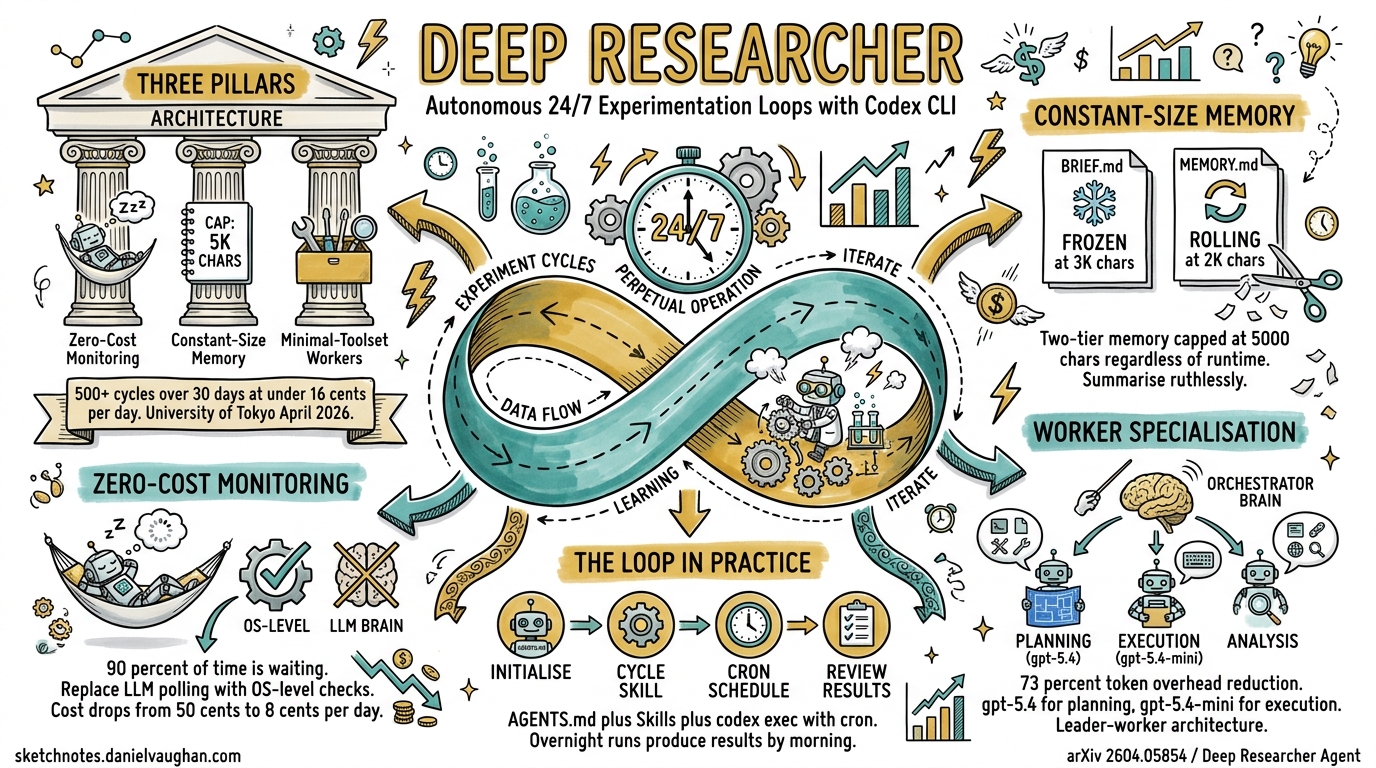
A new open-source framework called Deep Researcher Agent, published by Xiangyue Zhang at the University of Tokyo in April 2026, demonstrates that an LLM agent can run 500+ autonomous experiment cycles over 30+ continuous days at under $0.16 per day in API costs1. The trick is not a bigger model or a longer context window — it is three architectural patterns that any Codex CLI practitioner can adopt today: zero-cost monitoring, constant-size memory, and minimal-toolset worker specialisation.
This article translates the Deep Researcher Agent’s architecture into practical Codex CLI configurations, combining it with OpenAI’s own long-horizon task guidance2 and the thread automations system3 to build experimentation loops that run overnight, over weekends, or indefinitely.
Why Experimentation Loops Matter
Most developers use Codex CLI for single-session tasks: fix a bug, generate tests, review a PR. But the highest-value applications — performance tuning, algorithm comparison, migration validation, regression hunting — require iterative loops where each cycle’s output feeds the next cycle’s input. The Deep Researcher Agent paper showed a 52% metric improvement across four concurrent projects through 200+ automated experiment cycles1. The core insight: sustained iteration at low cost beats expensive one-shot attempts.
Codex CLI already supports sessions lasting up to seven hours with automatic context compaction4, and OpenAI’s 25-hour demo generated approximately 30,000 lines of code across 13 million tokens2. The missing piece for most teams is not capability — it is the operational architecture to sustain these loops without runaway costs or context degradation.
The Three Pillars
graph TD
    A[Deep Researcher Pattern] --> B[Zero-Cost Monitoring]
    A --> C[Constant-Size Memory]
    A --> D[Minimal-Toolset Workers]
    B --> B1[OS-level process checks]
    B --> B2[Log file reads only]
    B --> B3["$0.08/day vs $0.50/day"]
    C --> C1["Project Brief ~3K chars"]
    C --> C2["Rolling Memory Log ~2K chars"]
    C --> C3[Automatic compaction]
    D --> D1["3-5 tools per worker"]
    D --> D2[73% token overhead reduction]
    D --> D3[Specialised subagents]
Pillar 1: Zero-Cost Monitoring
The Deep Researcher Agent’s most counterintuitive insight is that 90% of an autonomous agent’s wall-clock time is spent waiting — for builds, tests, training runs, or deployments1. During these periods, conventional agent loops burn tokens polling for status. The zero-cost monitoring pattern replaces LLM polling with OS-level checks: process liveness verification, GPU/CPU utilisation confirmation, and log file reads. This reduced monitoring costs from approximately $0.50 to $0.08 per 24-hour cycle1.
In Codex CLI, you can replicate this pattern using thread automations with a wake-up schedule rather than a continuous session:
# In your Codex App automation configuration:
# Schedule: Every 30 minutes (or custom cron: */30 * * * *)
# Prompt: Check the experiment status and decide next steps
The automation prompt should instruct Codex to:
- Read the process status file or CI output
- Parse the latest log entries
- Decide whether the current cycle completed, failed, or is still running
- If complete, analyse results and launch the next cycle
- If still running, report status and go back to sleep
This mirrors the Deep Researcher Agent’s Think → Execute → Monitor → Reflect loop1, but each “Monitor” phase costs zero tokens when the experiment is still running — the automation simply does not wake up Codex until the next scheduled interval.
Pillar 2: Constant-Size Memory
Unbounded context growth is the silent killer of long-running agent sessions. The Deep Researcher Agent maintains a strict two-tier memory capped at approximately 5,000 characters regardless of runtime duration1:
- Project Brief (~3,000 characters): Frozen at session start. Contains goals, constraints, success metrics, and architectural decisions that must not drift.
- Rolling Memory Log (~2,000 characters): Updated after each cycle. Contains only the most recent results, active hypotheses, and next-step decisions.
OpenAI’s own long-horizon guidance uses a similar four-file pattern2:
| File | Purpose | Deep Researcher Equivalent |
|---|---|---|
Prompt.md |
Goals + constraints freeze | Project Brief |
Plan.md |
Milestone checkpoints | Rolling Memory Log (planned) |
Implement.md |
Execution runbook | Rolling Memory Log (active) |
Documentation.md |
Audit log | Rolling Memory Log (historical) |
For Codex CLI, implement constant-size memory using AGENTS.md directives and a pair of markdown files:
<!-- AGENTS.md excerpt -->
## Experimentation Loop Protocol

### Memory Files
- `experiment/BRIEF.md` — DO NOT MODIFY after initial creation.
  Contains: research question, success metric, hard constraints, baseline.
- `experiment/MEMORY.md` — UPDATE after every cycle.
  Maximum 2,000 characters. Summarise: last result, delta from baseline,
  current hypothesis, next planned action. Delete older entries that
  exceed the character budget.

### Rules
- Always read BRIEF.md and MEMORY.md before starting any cycle.
- Never exceed 2,000 characters in MEMORY.md — summarise ruthlessly.
- Log raw results to `experiment/results/cycle-NNN.json`, not to memory.
This pattern works with Codex CLI’s built-in context compaction5. When auto-compaction triggers — at approximately context_window - 13,000 tokens6 — the externalised memory files ensure that critical state survives the compaction without the re-read cascade that plagued earlier Codex versions7.
Pillar 3: Minimal-Toolset Worker Specialisation
The Deep Researcher Agent equips each worker with only 3–5 tools, achieving a 73% reduction in token overhead compared to agents with 15+ tools1. Every tool definition consumes prompt tokens on every call, so fewer tools means cheaper cycles.
In Codex CLI, this translates to subagent delegation with scoped permission profiles:
# config.toml — Experimenter profile
[profiles.experimenter]
model = "gpt-5.4-mini"
approval_policy = "auto-edit"

[profiles.experimenter.sandbox]
allow_commands = ["python", "pytest", "git diff", "cat"]
sequenceDiagram
    participant O as Orchestrator<br/>(gpt-5.4)
    participant E as Experimenter<br/>(gpt-5.4-mini)
    participant A as Analyser<br/>(gpt-5.4)

    O->>O: Read BRIEF.md + MEMORY.md
    O->>O: Plan next cycle
    O->>E: Execute experiment<br/>(3 tools: run, read, write)
    E->>E: Run experiment script
    E->>E: Capture results
    E-->>O: Return cycle-NNN.json
    O->>A: Analyse results vs baseline
    A->>A: Statistical comparison
    A->>A: Update hypothesis
    A-->>O: Return analysis summary
    O->>O: Update MEMORY.md
    O->>O: Commit cycle artefacts
The orchestrator uses the full model (gpt-5.4) for planning and analysis, while the experimenter subagent uses gpt-5.4-mini with a minimal tool surface for raw execution8. This mirrors the Deep Researcher Agent’s leader-worker architecture whilst keeping per-cycle costs low.
Putting It Together: A Complete Loop
Here is a concrete example — automated performance benchmarking across configuration variants:
Step 1: Initialise the Experiment
mkdir -p experiment/results
codex "Create experiment/BRIEF.md for this task: benchmark our API
  response times across 3 database connection pool sizes (10, 25, 50).
  Success metric: p99 latency. Baseline: current production config.
  Constraint: each cycle must complete in under 10 minutes.
  Then create experiment/MEMORY.md with the initial plan."
Step 2: Create the Cycle Skill
<!-- .codex/skills/run-experiment/SKILL.md -->
---
description: "Run one experiment cycle from the current plan"
---

Read experiment/BRIEF.md and experiment/MEMORY.md.
Determine the next planned experiment variant from MEMORY.md.
Execute the benchmark script with the planned configuration.
Save raw results to experiment/results/cycle-NNN.json.
Analyse: compare p99 against baseline and previous cycles.
Update experiment/MEMORY.md (max 2000 chars): last result, delta,
next hypothesis, next action.
Commit all changes with message "experiment: cycle NNN — [result summary]".
If all planned variants are complete, write "COMPLETE" to MEMORY.md.
Step 3: Schedule the Automation
In the Codex App, create a thread automation:
- Schedule: Every 15 minutes
- Prompt:
Run /run-experiment. If MEMORY.md contains "COMPLETE", report final results and stop. - Project: Your repository
Alternatively, use codex exec with cron for pure CLI workflows:
# crontab entry — run every 15 minutes
*/15 * * * * cd /path/to/repo && codex exec "Run /run-experiment" \
  --approval-mode full-auto -m gpt-5.4-mini --json \
  >> /var/log/experiment.jsonl 2>&1
Step 4: Review Results
# Next morning — check what happened overnight
codex "Read experiment/MEMORY.md and experiment/results/.
  Summarise all cycle outcomes, identify the winning configuration,
  and draft a PR with the recommended change."
Cost Projections
The Deep Researcher Agent achieved $0.08 per 24-hour cycle for monitoring phases and $0.16 average total daily cost including active LLM calls1. Applying similar patterns to Codex CLI:
| Component | Estimated Cost per Cycle | Notes |
|---|---|---|
| Orchestrator planning (gpt-5.4) | ~$0.02 | Short prompt, scoped context |
| Experimenter execution (gpt-5.4-mini) | ~$0.005 | Minimal tools, small context |
| Analysis (gpt-5.4) | ~$0.015 | Results comparison only |
| Total per cycle | ~$0.04 | |
| 24 cycles (6-hour overnight run) | ~$0.96 |
These are estimates based on current gpt-5.4 pricing ($2.50/M input, $15/M output) and gpt-5.4-mini rates9. Actual costs depend on context size and output length. The key saving comes from not running the LLM during experiment execution — mirroring the zero-cost monitoring pattern.
Dry-Run Validation
One underappreciated finding from the Deep Researcher Agent paper: 18% of planned experiments were caught during mandatory dry-runs before committing compute resources1. Implement this in your AGENTS.md:
## Dry-Run Rule
Before executing any experiment script, run it with `--dry-run` or
equivalent flag. Verify:
1. No syntax errors
2. Expected output format matches the analysis parser
3. Estimated runtime is within the cycle budget
If dry-run fails, fix the issue and retry. Never skip dry-run validation.
This catches misconfigurations before they waste 10-minute benchmark cycles — or worse, corrupt results that propagate through subsequent cycles.
Limitations and Caveats
⚠️ Thread automations require the Codex App — the CLI alone does not support scheduled wake-ups natively. The cron-based codex exec workaround lacks session continuity between cycles, meaning each invocation starts with a cold context read from the memory files.
⚠️ Context compaction quality varies. Issue #16812 documented a regression in CLI v0.118 where compactions triggered twice as frequently, causing 10-20× token multiplication from file re-reads7. Monitor your token usage across cycles and adjust the compaction threshold if needed.
⚠️ The 52% improvement figure from the Deep Researcher Agent paper applies to deep learning hyperparameter tuning across specific benchmarks. Your mileage will vary depending on the search space and task type. The architectural patterns — not the specific numbers — are what transfer.
Citations
-
Zhang, X. “Deep Researcher Agent: An Autonomous Framework for 24/7 Deep Learning Experimentation with Zero-Cost Monitoring.” arXiv:2604.05854, April 2026. https://arxiv.org/abs/2604.05854 ↩ ↩2 ↩3 ↩4 ↩5 ↩6 ↩7 ↩8 ↩9
-
OpenAI. “Run long horizon tasks with Codex.” OpenAI Developers Blog, 2026. https://developers.openai.com/blog/run-long-horizon-tasks-with-codex ↩ ↩2 ↩3
-
OpenAI. “Automations — Codex app.” OpenAI Developers Documentation, 2026. https://developers.openai.com/codex/app/automations ↩
-
OpenAI. “Features — Codex CLI.” OpenAI Developers Documentation, 2026. https://developers.openai.com/codex/cli/features ↩
-
Justin3go. “Shedding Heavy Memories: Context Compaction in Codex, Claude Code, and OpenCode.” April 2026. https://justin3go.com/en/posts/2026/04/09-context-compaction-in-codex-claude-code-and-opencode ↩
-
Badlogic. “Context Compaction Research: Claude Code, Codex CLI, OpenCode, Amp.” GitHub Gist, 2026. https://gist.github.com/badlogic/cd2ef65b0697c4dbe2d13fbecb0a0a5f ↩
-
“Context compaction regression in CLI v0.118 — 2x more frequent compactions cause token usage explosion.” GitHub Issue #16812, openai/codex. https://github.com/openai/codex/issues/16812 ↩ ↩2
-
OpenAI. “Models — Codex.” OpenAI Developers Documentation, 2026. https://developers.openai.com/codex/models ↩
-
OpenAI. “GPT-5.4 Model.” OpenAI API Documentation, 2026. https://developers.openai.com/api/docs/models/gpt-5.4 ↩