Codex CLI Cost Calculator: Building a Token Budget Estimator for Mixed-Model Workflows
Codex CLI Cost Calculator: Building a Token Budget Estimator for Mixed-Model Workflows
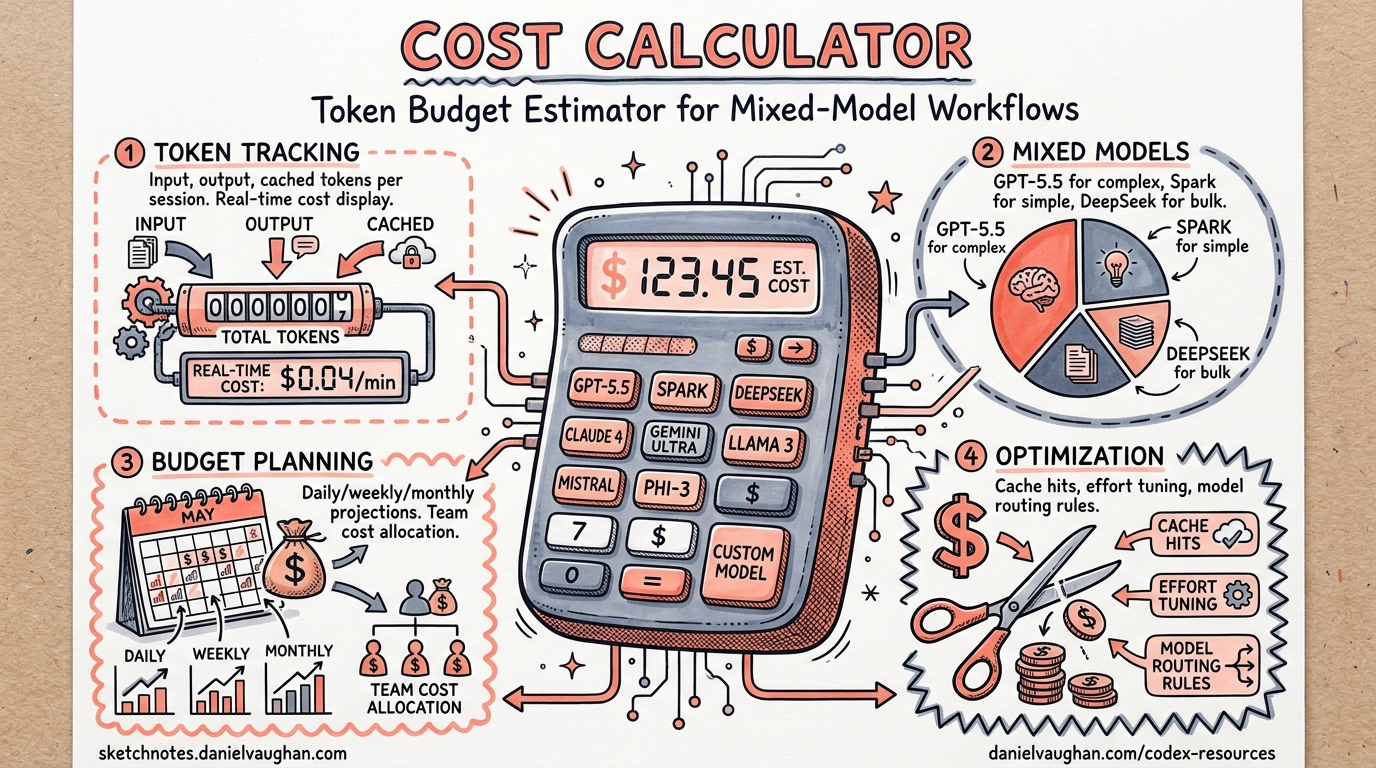
With OpenAI’s April 2026 shift to token-based billing for Codex1, understanding exactly where your credits go across models like o4-mini, gpt-5.4, and the new gpt-5.5 is no longer optional — it’s operational hygiene. This article walks through building a practical token budget estimator that parses Codex CLI session logs, applies current per-model pricing, and projects costs for mixed-model workflows.
The Pricing Landscape in April 2026
Codex now bills on three token categories: input, cached input, and output, each priced per million tokens1. The spread across models is significant:
| Model | Input ($/1M) | Cached Input ($/1M) | Output ($/1M) | Sweet Spot |
|---|---|---|---|---|
gpt-5.5 |
$5.00 | $0.50 | $30.00 | Complex multi-step reasoning2 |
gpt-5.4 |
$2.50 | $0.25 | $15.00 | General coding tasks2 |
gpt-5.4-mini |
$0.75 | $0.075 | $4.50 | Parallel subagent work2 |
gpt-5.4-nano |
$0.20 | $0.02 | $1.25 | Boilerplate, formatting2 |
gpt-5.3-codex |
$3.50 | $0.35 | $28.00 | Priority Codex tasks2 |
o3 |
$2.00 | $0.50 | $8.00 | Hard reasoning problems3 |
o4-mini |
$1.10 | $0.275 | $4.40 | Cost-effective reasoning3 |
The key insight: output tokens cost 6–10× more than input tokens across every model2. A workflow that generates verbose output on gpt-5.5 will burn budget dramatically faster than one using o4-mini for the same reasoning task.
How Codex CLI Tracks Token Usage
Since September 2025, Codex CLI emits cumulative token count events in its session JSONL files, stored in CODEX_HOME (defaulting to ~/.codex)4. Each turn records running totals for input, cached input, output, and reasoning tokens, tagged with the active model in the turn_context metadata4.
To recover per-turn usage, you subtract the previous cumulative total from the current one — the same approach used by the ccusage tool4.
flowchart LR
    A[Session JSONL] --> B[Parse token_count events]
    B --> C[Subtract previous totals]
    C --> D[Per-turn token deltas]
    D --> E[Apply model-specific pricing]
    E --> F[Cost per turn / session / day]
Building the Budget Estimator
Step 1: Parse Session Logs
The following Python script reads Codex session files and extracts per-turn token deltas grouped by model:
#!/usr/bin/env python3
"""codex_cost.py — Token budget estimator for Codex CLI sessions."""

import json
import os
from pathlib import Path
from collections import defaultdict
from dataclasses import dataclass, field

# Current pricing as of April 2026 (USD per 1M tokens)
MODEL_PRICING = {
    "gpt-5.5":        {"input": 5.00,  "cached": 0.50,   "output": 30.00},
    "gpt-5.4":        {"input": 2.50,  "cached": 0.25,   "output": 15.00},
    "gpt-5.4-mini":   {"input": 0.75,  "cached": 0.075,  "output": 4.50},
    "gpt-5.4-nano":   {"input": 0.20,  "cached": 0.02,   "output": 1.25},
    "gpt-5.3-codex":  {"input": 3.50,  "cached": 0.35,   "output": 28.00},
    "o3":             {"input": 2.00,  "cached": 0.50,   "output": 8.00},
    "o4-mini":        {"input": 1.10,  "cached": 0.275,  "output": 4.40},
}


@dataclass
class SessionCost:
    model: str
    input_tokens: int = 0
    cached_tokens: int = 0
    output_tokens: int = 0

    @property
    def cost_usd(self) -> float:
        pricing = MODEL_PRICING.get(self.model, MODEL_PRICING["gpt-5.4"])
        return (
            (self.input_tokens * pricing["input"] / 1_000_000)
            + (self.cached_tokens * pricing["cached"] / 1_000_000)
            + (self.output_tokens * pricing["output"] / 1_000_000)
        )


def parse_session(filepath: Path) -> dict[str, SessionCost]:
    """Parse a single session JSONL file into per-model costs."""
    costs: dict[str, SessionCost] = {}
    prev_totals: dict[str, dict] = {}

    with open(filepath) as f:
        for line in f:
            try:
                event = json.loads(line)
            except json.JSONDecodeError:
                continue

            if event.get("type") != "token_count":
                continue

            model = event.get("turn_context", {}).get("model", "unknown")
            usage = event.get("usageMetadata", {})

            # Current cumulative totals
            curr = {
                "input": usage.get("inputTokens", 0),
                "cached": usage.get("cachedInputTokens", 0),
                "output": usage.get("outputTokens", 0),
            }

            # Calculate deltas from previous totals
            prev = prev_totals.get(model, {"input": 0, "cached": 0, "output": 0})
            delta_input = max(0, curr["input"] - prev["input"])
            delta_cached = max(0, curr["cached"] - prev["cached"])
            delta_output = max(0, curr["output"] - prev["output"])

            if model not in costs:
                costs[model] = SessionCost(model=model)

            costs[model].input_tokens += delta_input
            costs[model].cached_tokens += delta_cached
            costs[model].output_tokens += delta_output

            prev_totals[model] = curr

    return costs
Step 2: Aggregate and Report
Add a reporting layer that scans all sessions within a date range:
def scan_sessions(
    codex_home: Path | None = None,
    days: int = 30,
) -> dict[str, SessionCost]:
    """Aggregate costs across all sessions in the last N days."""
    home = codex_home or Path(os.environ.get("CODEX_HOME", Path.home() / ".codex"))
    from datetime import datetime, timedelta

    cutoff = datetime.now() - timedelta(days=days)
    aggregated: dict[str, SessionCost] = {}

    for session_file in home.glob("sessions/**/*.jsonl"):
        # Filter by file modification time
        mtime = datetime.fromtimestamp(session_file.stat().st_mtime)
        if mtime < cutoff:
            continue

        for model, cost in parse_session(session_file).items():
            if model not in aggregated:
                aggregated[model] = SessionCost(model=model)
            aggregated[model].input_tokens += cost.input_tokens
            aggregated[model].cached_tokens += cost.cached_tokens
            aggregated[model].output_tokens += cost.output_tokens

    return aggregated


def print_report(costs: dict[str, SessionCost], days: int) -> None:
    """Print a formatted cost report."""
    total = 0.0
    print(f"\n{'Model':<18} {'Input':>10} {'Cached':>10} {'Output':>10} {'Cost':>10}")
    print("-" * 62)

    for model in sorted(costs, key=lambda m: costs[m].cost_usd, reverse=True):
        c = costs[model]
        print(
            f"{c.model:<18} {c.input_tokens:>10,} {c.cached_tokens:>10,} "
            f"{c.output_tokens:>10,} ${c.cost_usd:>9.2f}"
        )
        total += c.cost_usd

    print("-" * 62)
    print(f"{'Total':<18} {'':<10} {'':<10} {'':<10} ${total:>9.2f}")
    print(f"{'Projected/month':<18} {'':<10} {'':<10} {'':<10} ${total * 30 / days:>9.2f}")


if __name__ == "__main__":
    import argparse
    parser = argparse.ArgumentParser(description="Codex CLI cost estimator")
    parser.add_argument("--days", type=int, default=30, help="Look-back window")
    parser.add_argument("--codex-home", type=Path, help="Override CODEX_HOME")
    args = parser.parse_args()

    costs = scan_sessions(codex_home=args.codex_home, days=args.days)
    if costs:
        print_report(costs, args.days)
    else:
        print("No session data found. Check your CODEX_HOME path.")
Step 3: Run It
# Last 7 days
python codex_cost.py --days 7

# Custom CODEX_HOME
python codex_cost.py --codex-home ~/my-codex-data --days 30
Sample output:
Model              Input     Cached     Output       Cost
--------------------------------------------------------------
gpt-5.5           45,200     38,100     12,800     $0.62
gpt-5.4          312,000    287,000     85,400     $2.12
o4-mini          180,500    112,300     62,100     $0.58
gpt-5.4-mini     520,000    480,000     41,200     $0.61
--------------------------------------------------------------
Total                                              $3.93
Projected/month                                   $16.84
Mixed-Model Workflow Strategies
The cost difference between models is stark enough that model selection per task phase becomes a genuine optimisation lever5. A recommended pattern:
flowchart TD
    A[Task arrives] --> B{Complexity?}
    B -->|High: architecture, design| C[gpt-5.5 or o3]
    B -->|Medium: implementation| D[gpt-5.4]
    B -->|Low: formatting, linting| E[gpt-5.4-mini or gpt-5.4-nano]
    C --> F[Review output]
    D --> F
    E --> F
    F --> G{Tests pass?}
    G -->|No| H[o4-mini for debugging]
    G -->|Yes| I[Done]
    H --> F
Practical Cost Comparison
Consider a typical feature implementation session (planning → coding → testing → debugging):
| Phase | Tokens (in/out) | Model Choice | Estimated Cost |
|---|---|---|---|
| Planning | 50K / 5K | gpt-5.5 |
$0.40 |
| Implementation | 200K / 30K | gpt-5.4 |
$0.95 |
| Test writing | 100K / 15K | gpt-5.4-mini |
$0.14 |
| Debugging | 80K / 10K | o4-mini |
$0.13 |
| Total | Mixed | $1.62 |
Running the same workflow entirely on gpt-5.5 would cost approximately $4.60 — nearly 3× more2. The mixed approach preserves quality where it matters (planning) whilst keeping costs controlled for mechanical tasks.
Existing Tools Worth Knowing
Before building everything from scratch, consider these community tools:
- ccusage (
@ccusage/codex): Analyses local JSONL session files with per-model breakdowns, daily/monthly/session reports, and JSON output for automation. Pricing rates derive from LiteLLM’s dataset4. - tokscale: Tracks token usage across multiple AI coding tools including Codex, with a global leaderboard and contribution graphs6.
- Built-in request (Issue #5085): The community has requested native cost tracking with budget controls directly in Codex CLI, including soft/hard spending limits7.
Install ccusage for immediate visibility:
npx @ccusage/codex@latest daily --breakdown
npx @ccusage/codex@latest monthly --json  # pipe to dashboards
Setting Budget Guardrails
While Codex CLI doesn’t yet have built-in budget controls7, you can implement a lightweight wrapper:
#!/usr/bin/env bash
# codex-budgeted — wrapper that warns when daily spend exceeds threshold

DAILY_BUDGET="${CODEX_DAILY_BUDGET:-5.00}"
CURRENT_SPEND=$(python codex_cost.py --days 1 2>/dev/null | tail -1 | awk '{print $NF}' | tr -d '$')

if (( $(echo "$CURRENT_SPEND > $DAILY_BUDGET" | bc -l) )); then
    echo "⚠️  Daily spend \$$CURRENT_SPEND exceeds budget \$$DAILY_BUDGET"
    echo "Continue anyway? [y/N]"
    read -r confirm
    [[ "$confirm" != "y" ]] && exit 1
fi

exec codex "$@"
Set it as an alias:
alias codex='codex-budgeted'
export CODEX_DAILY_BUDGET=10.00
Key Takeaways
- Output tokens dominate costs — they’re 6–10× pricier than input tokens across all models2. Prompts that encourage concise responses save real money.
- Cache hits are nearly free — cached input tokens cost 90% less than fresh input2. Structuring sessions to maximise context reuse pays off.
- Mixed-model workflows cut costs 2–3× compared to using the flagship model for everything5.
- Measure before optimising — parse your session logs (or use ccusage) to understand your actual usage patterns before making changes4.
- Set budget guardrails — even simple wrappers prevent runaway spend during long autonomous sessions.
Citations
-
Codex Pricing — OpenAI Developers — Token-based billing model and credit rates for Codex, updated April 2026. ↩ ↩2
-
OpenAI API Pricing — Per-model token pricing for all current OpenAI models. ↩ ↩2 ↩3 ↩4 ↩5 ↩6 ↩7 ↩8 ↩9
-
OpenAI API Pricing 2026: GPT-5.4, o3, o4-mini & All Models — AI Pricing Guru — o3 and o4-mini pricing details and comparisons. ↩ ↩2
-
Codex CLI Overview — ccusage — Session JSONL parsing, token delta calculation, and cost reporting methodology. ↩ ↩2 ↩3 ↩4 ↩5
-
Model Selection in Codex CLI — Codex Blog — Per-phase model selection strategies for mixed-model workflows. ↩ ↩2
-
tokscale — GitHub — Multi-tool token usage tracking CLI with Codex support. ↩
-
Cost Tracking & Usage Analytics — GitHub Issue #5085 — Community request for built-in budget controls in Codex CLI. ↩ ↩2