DeepSeek V4 as a Codex CLI Provider: Frontier-Class Coding at a Fraction of the Cost
DeepSeek V4 as a Codex CLI Provider: Frontier-Class Coding at a Fraction of the Cost
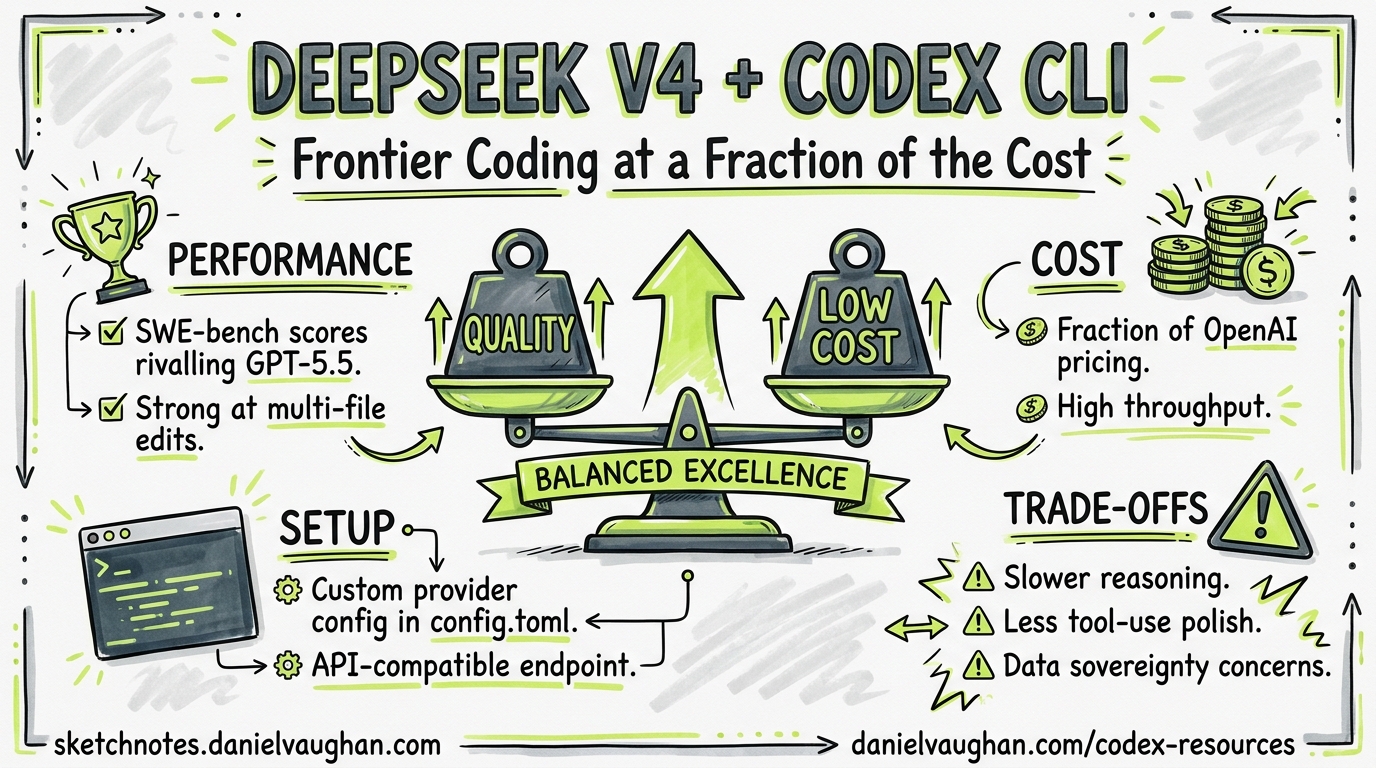
DeepSeek V4 landed today — 24 April 2026 — and the numbers deserve attention. V4-Pro scores 80.6% on SWE-bench Verified while charging $3.48 per million output tokens1. For comparison, Claude Opus 4.6 scores 80.8% on the same benchmark at $25 per million output tokens2. That is a 7× price gap at near-identical coding performance. This article walks through configuring DeepSeek V4 as a Codex CLI provider, examines where the benchmarks genuinely hold up, and identifies the workflows where GPT-5.5 or Claude remain the better choice.
What Shipped
DeepSeek released two models under the MIT licence1:
| V4-Pro | V4-Flash | |
|---|---|---|
| Total parameters | 1.6 trillion | 284 billion |
| Active parameters | 49 billion | 13 billion |
| Context window | 1 million tokens | 1 million tokens |
| Max output | 384K tokens | 384K tokens |
| Training tokens | 33 trillion | 32 trillion |
| Weights size | 865 GB | 160 GB |
Both use a Mixture-of-Experts (MoE) architecture with three key innovations: Hybrid Attention (CSA + HCA) that cuts KV cache to 10% of V3.2’s at 1M context, Manifold-Constrained Hyper-Connections that tame residual amplification from 3,000× to 1.6×, and the Muon optimiser for stable training at scale13.
Benchmark Reality Check
Headlines focus on SWE-bench, but the full picture is more nuanced:
| Benchmark | V4-Pro | V4-Flash | GPT-5.5 | Claude Opus 4.7 |
|---|---|---|---|---|
| SWE-bench Verified | 80.6% | 79.0% | ⚠️ not reported | 80.8% |
| SWE-bench Pro | 55.4% | — | 58.6% | 64.3% |
| Terminal-Bench 2.0 | 67.9% | 56.9% | 82.7% | 65.4% |
| LiveCodeBench | 93.5% | 91.6% | — | 88.8% |
| Codeforces | 3206 | — | — | — |
Three observations for practitioners:
- SWE-bench Verified is V4-Pro’s strong suit — it matches the frontier models on repository-level bug fixing1.
- Terminal-Bench 2.0 reveals the gap — GPT-5.5 leads V4-Pro by nearly 15 percentage points on complex multi-step terminal workflows4. If your work involves heavy iterative debugging and tool orchestration, GPT-5.5 remains substantially ahead.
- LiveCodeBench and Codeforces favour V4-Pro — pure algorithmic coding is a genuine strength, with V4-Pro’s 3206 Codeforces rating exceeding GPT-5.4’s 31681.
Pricing Comparison
The cost differential is the headline:
| Model | Input (cache miss) | Input (cache hit) | Output |
|---|---|---|---|
| DeepSeek V4-Flash | $0.14/M | $0.028/M | $0.28/M |
| DeepSeek V4-Pro | $1.74/M | $0.145/M | $3.48/M |
| GPT-5.4 | — | — | — |
| GPT-5.5 | ⚠️ credit-based | ⚠️ credit-based | ⚠️ credit-based |
| Claude Opus 4.6 | $5/M | — | $25/M |
A production agentic pipeline processing 50 million output tokens per month costs approximately $174 on V4-Pro versus $1,250 on Claude Opus 4.63. V4-Flash is even more dramatic — at $0.28/M output, it undercuts GPT-5.4 Nano1.
Configuring Codex CLI for DeepSeek V4
DeepSeek’s API is OpenAI-compatible6, which means a straightforward custom provider definition in config.toml:
# ~/.codex/config.toml

[model_providers.deepseek]
name = "DeepSeek V4"
base_url = "https://api.deepseek.com"
env_key = "DS_KEY"
wire_api = "chat"
Set the environment variable referenced by env_key to your DeepSeek API key:
export DS_KEY="sk-your-key-here"
Model Profiles
Define profiles for different workflows:
[profiles.ds-pro]
model = "deepseek-v4-pro"
model_provider = "deepseek"

[profiles.ds-flash]
model = "deepseek-v4-flash"
model_provider = "deepseek"
Launch with a profile:
codex --profile ds-pro "Refactor the payment module to use the strategy pattern"
codex --profile ds-flash "Add unit tests for the UserService class"
Reasoning Modes
V4-Pro and V4-Flash support three reasoning modes: non-thinking, thinking, and thinking_max6. The default is non-thinking. To enable extended reasoning, you currently need to pass the appropriate parameters through the API — Codex CLI’s reasoning_effort config maps to OpenAI’s reasoning effort parameter, so you may need to experiment with how DeepSeek interprets these values through the compatibility layer.
flowchart LR
    A[Task arrives] --> B{Complexity?}
    B -->|Simple fix / lint| C[V4-Flash\nnon-thinking\n$0.28/M]
    B -->|Standard feature| D[V4-Pro\nnon-thinking\n$3.48/M]
    B -->|Complex refactor| E[V4-Pro\nthinking\nhigher token use]
    B -->|Critical / high-stakes| F[GPT-5.5 or\nClaude Opus 4.7]
Non-Interactive Pipelines
DeepSeek V4 works with codex exec for CI/CD automation:
codex exec \
  --profile ds-flash \
  --approval-mode full-auto \
  "Run the test suite and fix any failing tests" \
  -o results.json \
  --output-schema ./ci-schema.json
For cost-sensitive CI pipelines, V4-Flash at $0.28/M output makes per-commit agent runs economically viable in a way that frontier models do not.
Two-Tier Routing: The Practical Architecture
The most effective pattern is not choosing one model — it is routing between them. Use DeepSeek for the bulk of your work and escalate to GPT-5.5 for the tasks where Terminal-Bench performance matters:
# Default: DeepSeek V4-Pro for everyday coding
model = "deepseek-v4-pro"
model_provider = "deepseek"

# Escalation profile for complex multi-step debugging
[profiles.frontier]
model = "gpt-5.5"

# CI profile: V4-Flash for cost-sensitive automation
[profiles.ci]
model = "deepseek-v4-flash"
model_provider = "deepseek"
flowchart TD
    subgraph "Daily Development"
        A[Interactive sessions] --> B[DeepSeek V4-Pro]
        C[Quick questions / tests] --> D[DeepSeek V4-Flash]
    end
    subgraph "Escalation"
        E[Complex debugging] --> F[GPT-5.5]
        G[Security review] --> F
    end
    subgraph "CI/CD"
        H[Per-commit checks] --> D
        I[Nightly full review] --> B
    end
Known Limitations and Caveats
Before committing to DeepSeek V4 as your primary provider, understand the trade-offs:
-
wire_apicompatibility — DeepSeek supports thechatwire API (OpenAI Chat Completions compatible), not theresponseswire API6. This means some Codex CLI features that rely on Responses API primitives (such as nativeapply_patchtool routing) may behave differently. Test your critical workflows thoroughly. -
Terminal-Bench gap — V4-Pro’s 67.9% versus GPT-5.5’s 82.7% on Terminal-Bench 2.04 translates to meaningfully worse performance on multi-step agentic workflows involving iterative tool use, error recovery, and plan revision. For complex debugging sessions, this gap is felt.
-
Reasoning mode support — Codex CLI’s
Alt+,/Alt+.reasoning effort shortcuts target OpenAI’s reasoning effort parameter. Mapping these to DeepSeek’sthinking/non-thinking/thinking_maxmodes requires care — the semantics are not identical6. -
Rate limits and availability — DeepSeek’s API has historically experienced availability issues during peak demand7. For production-critical workflows, configure failover:
# Primary: DeepSeek
model = "deepseek-v4-pro"
model_provider = "deepseek"

# Failover: switch profiles manually or via gateway
[profiles.fallback]
model = "gpt-5.4"
- Data residency — DeepSeek’s API routes through infrastructure in China7. Organisations with data sovereignty requirements should evaluate whether this meets their compliance posture, or consider self-hosting the open weights behind a private endpoint.
When to Use What
| Workflow | Recommended Model | Rationale |
|---|---|---|
| Feature implementation | V4-Pro | Strong SWE-bench, 7× cheaper than Claude |
| Unit test generation | V4-Flash | Adequate quality at $0.28/M |
| Complex multi-step debugging | GPT-5.5 | 82.7% Terminal-Bench dominance |
| CI/CD per-commit checks | V4-Flash | Economic at scale |
| Security-sensitive code review | GPT-5.5 / Claude Opus 4.7 | Higher precision on nuanced analysis |
| Competitive programming | V4-Pro | 3206 Codeforces, best-in-class |
| Regulated industries (data residency) | GPT-5.5 or self-hosted V4 weights | API routing considerations |
Migration from DeepSeek V3
If you are already using DeepSeek models, update your model identifiers. The deepseek-chat and deepseek-reasoner model IDs deprecate on 24 July 20266. The migration is a single-line change:
# Before
model = "deepseek-chat"

# After
model = "deepseek-v4-pro"   # or "deepseek-v4-flash"
Conclusion
DeepSeek V4 does not replace GPT-5.5 — it occupies a different point on the cost-performance curve. At $3.48/M output with 80.6% SWE-bench Verified, V4-Pro is the most cost-effective frontier-adjacent coding model available today. The practical architecture is two-tier: DeepSeek for the 80% of tasks where it matches the frontier, GPT-5.5 for the 20% where Terminal-Bench performance and deep agentic reasoning justify the premium. Configure both providers, define profiles, and let the task complexity guide your routing.
Citations
-
DeepSeek, “DeepSeek-V4-Pro Technical Report”, Hugging Face, 24 April 2026. https://huggingface.co/deepseek-ai/DeepSeek-V4-Pro ↩ ↩2 ↩3 ↩4 ↩5 ↩6 ↩7 ↩8
-
VentureBeat, “OpenAI’s GPT-5.5 is here: narrowly beats Claude Mythos Preview on Terminal-Bench 2.0”, 23 April 2026. https://venturebeat.com/ai/openais-gpt-5-5-is-here-and-its-no-potato-narrowly-beats-anthropics-claude-mythos-preview-on-terminal-bench-2-0 ↩ ↩2 ↩3
-
BuildFastWithAI, “DeepSeek V4-Pro Review: Benchmarks, Pricing & Architecture”, April 2026. https://www.buildfastwithai.com/blogs/deepseek-v4-pro-review-2026 ↩ ↩2
-
MarkTechPost, “OpenAI Releases GPT-5.5: Terminal-Bench 2.0 and GDPval Scores”, 23 April 2026. https://www.marktechpost.com/2026/04/23/openai-releases-gpt-5-5-a-fully-retrained-agentic-model-that-scores-82-7-on-terminal-bench-2-0-and-84-9-on-gdpval/ ↩ ↩2 ↩3
-
Lushbinary, “DeepSeek V4 vs Claude Opus 4.7 vs GPT-5.5: Benchmarks & Pricing”, April 2026. https://lushbinary.com/blog/deepseek-v4-vs-claude-opus-4-7-vs-gpt-5-5-comparison/ ↩
-
DeepSeek, “API Documentation — Integrate with Coding Agents”, April 2026. https://api-docs.deepseek.com/guides/coding_agents ↩ ↩2 ↩3 ↩4 ↩5
-
Simon Willison, “DeepSeek V4 — almost on the frontier, a fraction of the price”, 24 April 2026. https://simonwillison.net/2026/Apr/24/deepseek-v4/ ↩ ↩2