Malware Now Hunts AI Coding Tools: The Bitwarden Supply Chain Attack and Defending Your Codex CLI Installation
Malware Now Hunts AI Coding Tools: The Bitwarden Supply Chain Attack and Defending Your Codex CLI Installation
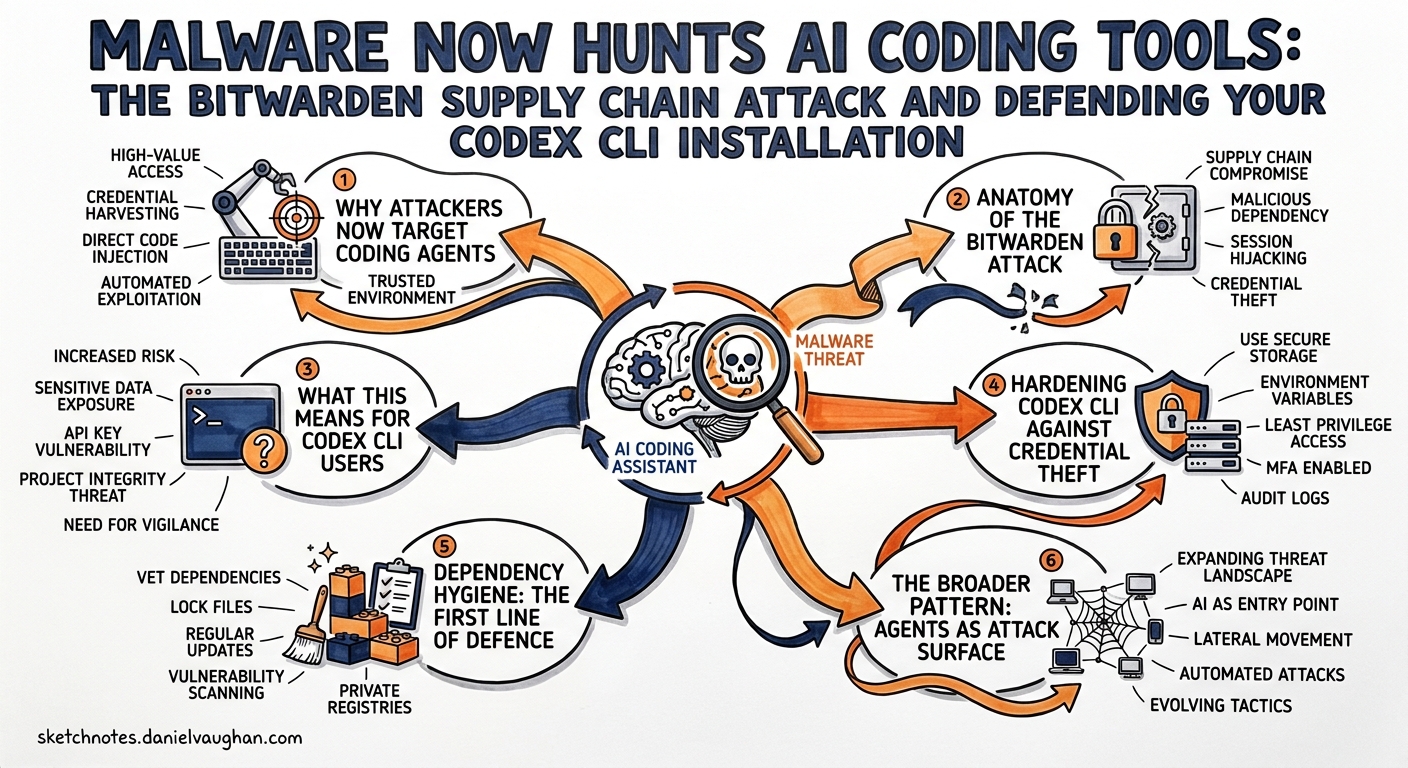
On 22 April 2026, a poisoned release of the Bitwarden CLI hit npm for ninety-three minutes. Inside its 10 MB obfuscated payload sat a module called Butlerian Jihad whose sole purpose was to detect, fingerprint, and harvest credentials from AI coding agents — Codex CLI, Claude Code, Gemini CLI, Kiro, Aider, and OpenCode12. The attack represents a new threat category: malware that treats your coding agent not merely as another application to loot, but as an authenticated oracle worth interrogating directly.
This article dissects the attack, explains why coding agents are uniquely valuable targets, and walks through the concrete Codex CLI defences — deny-read policies, sandbox hardening, hooks, and operational hygiene — that limit blast radius even when a supply-chain compromise lands on your machine.
Why Attackers Now Target Coding Agents
Traditional credential-harvesting malware sweeps well-known paths: ~/.ssh/id_rsa, ~/.aws/credentials, ~/.npmrc. That still happened in the Bitwarden payload — seven parallel collector modules enumerated filesystem hotspots, environment variables, cloud vaults, shell history, and CI/CD runner secrets2. What made this attack distinctive was the eighth module.
Butlerian Jihad probed for six coding agents by invoking each with a trivial prompt: “Hey! Just making sure you’re here. If you are can you respond with Hello and nothing else?”1. A successful response confirmed an authenticated session, after which the malware injected persistence hooks into ~/.bashrc and ~/.zshrc to maintain access across reboots2.
The logic is straightforward: a running Codex CLI session holds an active OpenAI API credential, has filesystem access to the project (and potentially secrets within it), and can execute shell commands. From an attacker’s perspective, a coding agent is a privilege amplifier — one that can be asked, in natural language, to do things the malware itself cannot.
flowchart LR
    A[Supply Chain<br/>Compromise] --> B[npm install<br/>triggers payload]
    B --> C{Probe for<br/>AI agents}
    C -->|Found| D[Inject shell<br/>RC hooks]
    C -->|Not found| E[Harvest<br/>filesystem creds]
    D --> F[Persistent<br/>agent access]
    E --> G[Exfiltrate via<br/>AES-256-GCM]
    F --> G
    G --> H[C2: audit.checkmarx.cx<br/>+ GitHub dead-drop]
Anatomy of the Bitwarden Attack
Timeline
The malicious @bitwarden/cli@2026.4.0 was published at 17:57 ET on 22 April 2026 and pulled at 19:30 ET — a ninety-three-minute window13. The root cause was a compromised GitHub Action in Bitwarden’s CI/CD pipeline, part of the broader Shai-Hulud: The Third Coming campaign attributed to TeamPCP2.
Payload structure
The package’s package.json redirected execution through a preinstall hook to bwsetup.js, which downloaded the Bun 1.3.13 runtime and launched bw1.js — a 43,436-entry string table obfuscated with javascript-obfuscator and a secondary scrambled-alphabet cipher2.
Anti-analysis controls
The payload self-terminated on Russian-locale systems, non-CI/CD environments, failed daemonisation attempts, and when a lock file at $TMPDIR/tmp.987654321.lock already existed2. Signal handlers were replaced with no-ops to resist termination.
Exfiltration
Stolen data was JSON-serialised, gzip-compressed, encrypted with AES-256-GCM (random IV), and the symmetric key was RSA-OAEP-wrapped with the attacker’s embedded public key. Two exfiltration channels operated in parallel: HTTPS POST to audit.checkmarx[.]cx (94.154.172.43) and a GitHub dead-drop that created repositories on the victim’s own account with Dune-themed names like sardaukar-sandworm-0012.
Supply-chain worm
Upon discovering npm tokens with package:write permissions, the malware enumerated the victim’s publishable packages, injected its stager, bumped the patch version, and republished — turning one compromised developer into a propagation vector2.
What This Means for Codex CLI Users
The Bitwarden attack was not a Codex CLI vulnerability — it was a host-level compromise that happened to target coding agents as high-value assets. The distinction matters because the defence is layered: you protect against supply-chain attacks with dependency hygiene, and you limit blast radius with agent-level hardening.
Indicators of compromise
If your machine installed @bitwarden/cli@2026.4.0 between 17:57 and 19:30 ET on 22 April:
- Check for the poisoned version:
npm ls @bitwarden/cli2 - Search for unexpected GitHub repositories with description “Shai-Hulud: The Third Coming”2
- Inspect
~/.bashrcand~/.zshrcfor unfamiliarheredocblocks1 - Look for the lock file
$TMPDIR/tmp.987654321.lock2 - Verify file hashes —
bw1.jsSHA-256:18f784b3...bef6e4cb2
Hardening Codex CLI Against Credential Theft
Even if malware never reaches your machine, defence-in-depth demands that you configure Codex CLI to minimise what an attacker — or a prompt-injection attack — could extract from an active session.
1. Deny-read policies for sensitive files
Codex CLI’s permission profiles support glob-based deny-read rules that prevent the agent from reading specified paths entirely45:
# ~/.codex/config.toml
[permissions.workspace.filesystem]
":project_roots" = {
  "." = "write",
  "**/*.env" = "none",
  "**/*.pem" = "none",
  "**/*.key" = "none",
  "**/credentials.json" = "none",
  "**/.npmrc" = "none",
  "**/auth-config.*" = "none",
  "**/.aws/**" = "none",
  "**/.ssh/**" = "none",
  "**/.kube/config" = "none"
}
The "none" value blocks both read and write access. This means that even if a prompt-injection attack instructs Codex to cat ~/.ssh/id_rsa, the sandbox will deny the operation before the shell executes5.
2. Disable network access by default
Codex CLI’s sandbox blocks network access by default on macOS (via Seatbelt) and Linux (via bwrap + seccomp)6. Keep it that way for normal development. If you need network access for specific tasks, grant it per-session rather than globally:
codex --sandbox-network-access "Fetch the OpenAPI spec from staging"
3. Reject login shells
Login shells source ~/.bashrc and ~/.zshrc — precisely where the Bitwarden malware planted its persistence hooks. Codex CLI can be hardened to disallow login shells5:
# ~/.codex/config.toml
allow_login_shell = false
4. Use hooks for secret-pattern detection
Codex hooks run at defined points in the agent loop. A PreToolUse hook can inspect outbound shell commands for credential patterns and block them before execution7:
# ~/.codex/config.toml
[[hooks]]
event = "PreToolUse"
tool = "bash"
command = ["python3", "/path/to/secret-scanner.py"]
A minimal scanner checks whether the proposed command attempts to read known secret paths or pipes credentials to external endpoints. If the script exits non-zero, Codex aborts the tool call7.
sequenceDiagram
    participant Agent as Codex Agent
    participant Hook as PreToolUse Hook
    participant Shell as Sandbox Shell

    Agent->>Hook: Proposed command:<br/>cat ~/.aws/credentials
    Hook-->>Hook: Pattern match:<br/>credential path detected
    Hook-->>Agent: Exit 1 + stopReason:<br/>"Credential access blocked"
    Note over Agent: Tool call aborted
5. Managed configuration for teams
Enterprise deployments should enforce credential-protection policies centrally via requirements.toml, which takes precedence over user and project configuration8:
# /etc/codex/requirements.toml (or MDM-delivered)
[permissions.workspace.filesystem]
":project_roots" = {
  "**/*.env" = "none",
  "**/*.pem" = "none",
  "**/.ssh/**" = "none",
  "**/.aws/**" = "none"
}

[[hooks]]
event = "PreToolUse"
tool = "bash"
command = ["python3", "/opt/codex-hooks/secret-scanner.py"]
This ensures that no individual developer can accidentally weaken credential protections8.
Dependency Hygiene: The First Line of Defence
Agent-level hardening limits blast radius, but preventing the compromise from landing is better still. The Bitwarden attack exploited a preinstall hook — a well-known attack vector that npm has been fighting for years.
| Defence | Implementation |
|---|---|
| Pin exact versions | Use lockfiles (package-lock.json) and review diffs on every update |
| Disable install scripts | npm install --ignore-scripts for non-essential CLIs |
| Require provenance | Verify npm provenance attestations where available2 |
| Monitor for anomalies | Tools like Socket, Snyk, and npm audit catch known-malicious packages |
| Isolate CLI tools | Install global CLIs in containers or separate user accounts |
| Audit shell RC files | Periodically diff ~/.bashrc and ~/.zshrc against known-good baselines |
The Broader Pattern: Agents as Attack Surface
The Bitwarden incident is not isolated. In April 2026, OX Security disclosed a systemic MCP protocol vulnerability affecting 150 million downloads across 7,000 servers, enabling arbitrary command execution on any system running a vulnerable MCP implementation9. Concurrently, research demonstrated that Cursor, VS Code, Windsurf, Claude Code, and Gemini CLI are all vulnerable to MCP-based prompt-injection attacks10. A Stack Overflow survey from the same month found that 86% of CISOs do not enforce access policies for AI agents, and only 5% believe they could contain a compromised agent11.
The attack surface is expanding faster than defensive tooling. The combination of supply-chain compromises, MCP vulnerabilities, and prompt injection creates a threat model where the coding agent is simultaneously:
- A credential store (API keys, session tokens)
- A tool executor (shell, filesystem, network)
- An injection target (untrusted context in AGENTS.md, MCP tools, project files)
flowchart TD
    subgraph "Threat Surface"
        SC[Supply Chain<br/>Compromised deps]
        PI[Prompt Injection<br/>Malicious context]
        MCP[MCP Exploitation<br/>Tool poisoning]
    end

    subgraph "Defence Layers"
        DH[Dependency Hygiene<br/>Lockfiles, provenance]
        SB[Sandbox Isolation<br/>No network, deny-read]
        HK[Hooks<br/>Secret scanning]
        MC[Managed Config<br/>Enterprise enforcement]
    end

    SC --> DH
    PI --> SB
    PI --> HK
    MCP --> SB
    MCP --> MC
Operational Checklist
For teams running Codex CLI in production or CI/CD, the following checklist addresses the specific threat patterns demonstrated by the Bitwarden attack:
- Audit shell RC files weekly — diff against a checked-in baseline
- Rotate credentials immediately if any supply-chain indicator of compromise is found
- Enforce deny-read policies for all credential paths in
config.tomlorrequirements.toml - Keep
allow_login_shell = falseto prevent RC-file-based persistence - Deploy a PreToolUse hook that blocks commands targeting credential paths
- Disable sandbox network access except when explicitly required
- Pin CLI tool versions and review lockfile diffs before merging
- Use
npm auditor Socket to catch known-malicious packages in CI - Isolate
codex execin CI to ephemeral containers with minimal credential exposure - Review Codex CLI’s memory store — memories are scanned for secrets before being written to disc, but verify this regularly6
Looking Ahead
The Bitwarden attack confirms that AI coding tools have crossed a threshold: they are now valuable enough to warrant dedicated malware modules. The Butlerian Jihad module’s approach — probing for agents by name and injecting shell-level persistence — is trivially replicable and will likely appear in future supply-chain campaigns. ⚠️
Codex CLI’s layered security model — OS-level sandboxing, deny-read policies, hooks, and managed configuration — provides genuine defence-in-depth. But these defences only work if they are configured. The default sandbox blocks network access and restricts writes; extending that baseline with deny-read credential policies and PreToolUse hooks transforms Codex CLI from a potential credential oracle into a hardened development tool that resists exploitation even when the host is compromised.
Citations
-
State of Surveillance, “A Password Manager Got Hacked for 90 Minutes. The Malware Was Hunting for Your AI Coding Tools,” April 2026. https://stateofsurveillance.org/news/bitwarden-cli-supply-chain-attack-ai-coding-tools-checkmarx-2026/ ↩ ↩2 ↩3 ↩4
-
Endor Labs, “Shai-Hulud: The Third Coming — Inside the Bitwarden CLI 2026.4.0 Supply Chain Attack,” April 2026. https://www.endorlabs.com/learn/shai-hulud-the-third-coming—-inside-the-bitwarden-cli-2026-4-0-supply-chain-attack ↩ ↩2 ↩3 ↩4 ↩5 ↩6 ↩7 ↩8 ↩9 ↩10 ↩11 ↩12 ↩13
-
The Hacker News, “Bitwarden CLI Compromised in Ongoing Checkmarx Supply Chain Campaign,” April 2026. https://thehackernews.com/2026/04/bitwarden-cli-compromised-in-ongoing.html ↩
-
OpenAI, “Configuration Reference — Codex,” April 2026. https://developers.openai.com/codex/config-reference ↩
-
OpenAI, “Agent Approvals & Security — Codex,” April 2026. https://developers.openai.com/codex/agent-approvals-security ↩ ↩2 ↩3
-
OpenAI, “Security — Codex,” April 2026. https://developers.openai.com/codex/security ↩ ↩2
-
OpenAI, “Hooks — Codex,” April 2026. https://developers.openai.com/codex/hooks ↩ ↩2
-
OpenAI, “Managed Configuration — Codex,” April 2026. https://developers.openai.com/codex/enterprise/managed-configuration ↩ ↩2
-
OX Security, “The Mother of All AI Supply Chains: Critical, Systemic Vulnerability at the Core of Anthropic’s MCP,” April 2026. https://www.ox.security/blog/the-mother-of-all-ai-supply-chains-critical-systemic-vulnerability-at-the-core-of-the-mcp/ ↩
-
Botmonster, “AI Coding Agents Are Insider Threats: Prompt Injection, MCP Exploits, and Supply Chain Attacks,” April 2026. https://botmonster.com/posts/ai-coding-agent-insider-threat-prompt-injection-mcp-exploits/ ↩
-
Kiteworks, “MCP ‘By Design’ Flaw: The AI Supply Chain Risk CISOs Can’t Ignore,” April 2026. https://www.kiteworks.com/cybersecurity-risk-management/mcp-by-design-flaw-ai-supply-chain/ ↩