From Code Generation to Delegated Execution: The Agentic SDLC and What It Means for Your Codex CLI Workflow
From Code Generation to Delegated Execution: The Agentic SDLC and What It Means for Your Codex CLI Workflow
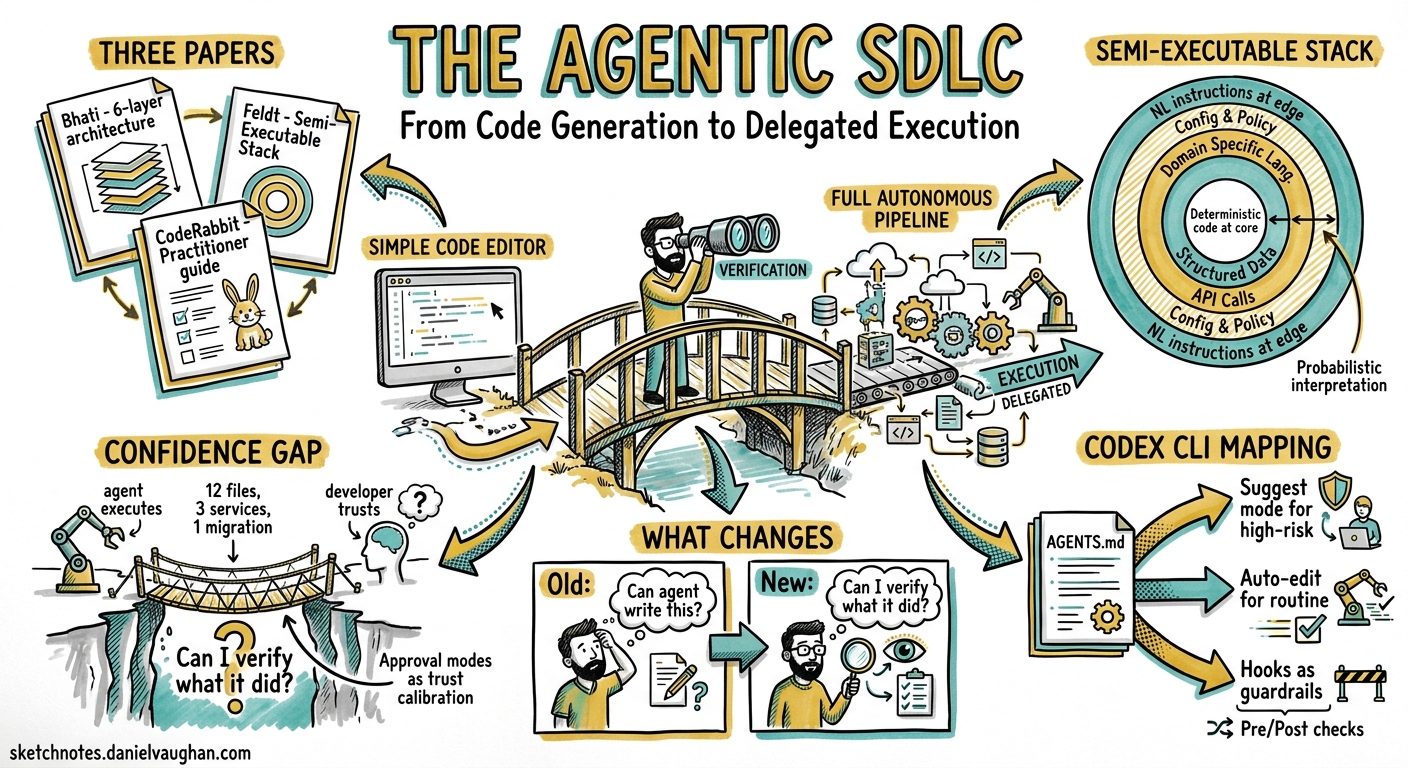
Three papers published between 16 and 29 April 2026 converge on the same thesis: coding agents have moved beyond generating code and into executing work — and the software engineering discipline must expand to match. For Codex CLI practitioners, the implications are concrete. The question is no longer “can the agent write this function?” but “can I verify what it did across twelve files, three services, and a migration script before I ship it?”
This article synthesises the research, maps it to Codex CLI primitives, and identifies the configuration decisions you should revisit today.
The Three Papers
Bhati (29 April 2026) published “Agentic AI in the Software Development Lifecycle: Architecture, Empirical Evidence, and the Reshaping of Software Engineering,” a synthesis covering systems from Codex CLI to Devin to AlphaEvolve.1 The paper proposes a six-layer reference architecture and contrasts the traditional SDLC with an emerging Agentic SDLC (A-SDLC), identifying five open problems that remain unsolved.
Feldt, Lenberg, Frattini & Parthasarathy (16 April, revised 23 April 2026) introduced “The Semi-Executable Stack,” a six-ring diagnostic model for understanding how software engineering’s scope is expanding beyond deterministic code into “semi-executable artifacts” — combinations of natural language, tools, workflows, and organisational routines whose enactment depends on human or probabilistic interpretation.2
CodeRabbit’s Agentic SDLC Guide (April 2026) formalises the practitioner perspective: the agentic SDLC is a delivery practice where AI agents participate meaningfully across the full lifecycle — planning, coding, reviewing, shipping, and operating — rather than sitting at a single checkpoint like autocomplete.3
The Core Shift: From Assistance to Delegation
The distinction matters. In an AI-assisted workflow, you prompt the agent, review its output, and incorporate what’s useful. In an agentic workflow, you specify intent and the agent pursues a goal across multiple steps — reading files, running tests, creating branches, filing PRs — before you review the outcome.
Codex CLI already supports both modes. The question is which you’re actually using.
graph LR
    A[AI-Assisted] -->|"Prompt → Response<br/>Human drives every step"| B[Review Output]
    C[Agentic] -->|"Intent → Multi-step execution<br/>Agent drives, human reviews"| D[Review Outcome]

    style A fill:#f0f0f0,stroke:#333
    style C fill:#e6f3ff,stroke:#0066cc
Bhati’s data makes the scale of this shift concrete. SWE-bench Verified performance rose from 1.96% in October 2023 to over 85% for GPT-5.3 Codex by April 2026.14 Controlled studies report productivity gains of 13.6% to 55.8%.1 The agents are no longer struggling to patch single functions — they’re operating at “the granularity of a repository, a feature, or an algorithm.”1
The Semi-Executable Stack: Where Your AGENTS.md Sits
Feldt et al.’s six-ring model offers a useful lens for understanding why some Codex CLI configurations work better than others:2
| Ring | Definition | Codex CLI Primitive |
|---|---|---|
| 1. Executable artifacts | Deterministic code, tests, infrastructure | Shell commands, apply_patch |
| 2. Instructional artifacts | Natural-language specifications that guide agent behaviour | AGENTS.md, SKILL.md, config.toml prompts |
| 3. Orchestrated execution | Multi-step workflows combining rings 1 and 2 | Subagents, codex exec, Symphony orchestration |
| 4. Controls | Permission boundaries, validation gates | Sandbox modes, requirements.toml, hooks |
| 5. Operating logic | Team processes, review cadences, delegation frameworks | Guardian approval, /review, CI pipelines |
| 6. Societal & institutional fit | Compliance, audit trails, governance | Managed configuration, rollout files, OTel traces |
Most teams invest heavily in rings 1 and 2 — writing code and crafting AGENTS.md files — whilst neglecting rings 4 through 6. The research suggests this is precisely backwards for agentic workflows: when you delegate multi-step execution, the controls and operating logic matter more than the instructions.2
The Confidence Gap: The Central Problem
CodeRabbit’s guide identifies the core challenge: agents generate code faster than teams can verify it.3 This creates four specific risks:
- Behavioural drift — changes spanning multiple files that individually look correct but collectively break assumptions
- Inconsistent standards — the agent applies different patterns depending on context window contents
- Security opacity — introduced vulnerabilities that pass linting but violate architectural invariants
- Governance gaps — no audit trail connecting the agent’s reasoning to the final commit
For Codex CLI users, the confidence gap maps directly to configuration decisions:
# config.toml — Addressing the confidence gap

[hooks]
# Ring 4: Controls — validate before the agent acts
[[hooks.pre_tool_use]]
event = "PreToolUse"
match_tool = "shell"
command = ["./scripts/validate-command.sh"]

# Ring 5: Operating logic — review after the agent acts
[[hooks.post_tool_use]]
event = "PostToolUse"
match_tool = "apply_patch"
command = ["./scripts/post-patch-lint.sh"]
Guardian approval with an automatic review policy addresses the confidence gap at the approval layer — but only if you’ve configured the reviewer model to check for the right things.5 A reviewer that rubber-stamps syntax correctness whilst missing architectural violations is worse than no reviewer at all, because it creates false confidence.
Five Open Problems and Their Codex CLI Implications
Bhati identifies five unresolved challenges.1 Each maps to a practical decision:
1. Evaluation Methodologies
SWE-bench measures isolated bug fixes. Real development involves feature work, refactoring, and migrations that span hours or days. SWE-EVO (April 2026) addresses this with tasks averaging 21 files, but even frontier models achieve only 25% there.6
Practical implication: Don’t judge agent capability by single-turn benchmarks. Use codex exec --json with JSONL trace analysis to build your own evaluation pipeline against your codebase.7
2. Governance Frameworks
Who is accountable when an agent introduces a vulnerability? The commit attribution shows the agent, but the human approved the session.
Practical implication: Use rollout files for full session recording.8 Configure managed requirements.toml at the organisational level to enforce sandbox and approval policies that users cannot weaken.9
3. Technical Debt Management
Agents optimise for the immediate task. They don’t refactor adjacent code unless instructed, and they don’t maintain architectural consistency across sessions.
Practical implication: Add architectural invariants to your AGENTS.md:
## Architectural Constraints
- All new API endpoints MUST follow the existing controller → service → repository pattern
- Database queries MUST go through the repository layer; never use raw SQL in controllers
- New dependencies require explicit justification in the PR description
4. Skill Redistribution
As agents handle more mechanical work, developers need stronger skills in architecture, review, and specification — precisely the areas most teams under-invest in.
Practical implication: Use plan mode (/plan) before delegating complex work. The planning phase is where architectural thinking happens; skipping it and jumping straight to full-auto mode is the fastest path to technical debt.10
5. Economics of Attention Allocation
The bottleneck shifts from writing code to reviewing agent output. If your review process can’t keep pace with agent throughput, you accumulate unreviewed changes.
Practical implication: Structure your workflow around right-sized delegations. Bhati’s data shows that productivity gains plateau and then reverse when task complexity exceeds the agent’s reliable capability boundary.1 Use named profiles to match agent configuration to task scope:11
# Quick, well-scoped tasks — lower reasoning, faster throughput
[profile.fast]
model = "gpt-5.3-codex"
reasoning_effort = "low"

# Complex, multi-file changes — higher reasoning, human review
[profile.deep]
model = "gpt-5.5"
reasoning_effort = "high"
The Preserve-Versus-Purify Heuristic
Feldt et al. propose a decision framework for teams transitioning to agentic workflows: for each existing process, ask whether it should be preserved (adapted to include agents) or purified (redesigned from scratch for agentic execution).2
flowchart TD
    A[Existing Process] --> B{Does it assume<br/>human execution<br/>at every step?}
    B -->|Yes| C{Can steps be<br/>decomposed into<br/>agent-delegatable units?}
    B -->|No| D[Preserve:<br/>Add agent at<br/>appropriate steps]
    C -->|Yes| E[Purify:<br/>Redesign for<br/>agent-first execution]
    C -->|No| F[Preserve:<br/>Keep human-driven,<br/>add agent assist]

    style E fill:#e6f3ff,stroke:#0066cc
    style D fill:#f0fff0,stroke:#006600
    style F fill:#f0fff0,stroke:#006600
Code review is a preserve candidate — add /review and guardian approval to the existing PR workflow. Test generation is a purify candidate — redesign around codex exec with --output-schema producing structured test plans rather than bolting an agent onto manual test-writing.12
What Changes Today
The research points to three immediate actions for Codex CLI practitioners:
-
Audit your ring coverage. If you have a detailed
AGENTS.md(ring 2) but no hooks, no guardian approval, and no rollout tracing (rings 4–6), your agentic workflow is under-governed. The instructions tell the agent what to do; the controls ensure it actually did it correctly. -
Right-size your delegations. The confidence gap widens with task scope. A well-scoped
codex exectask with clear success criteria and--output-schemavalidation is more valuable than a sprawlingfull-autosession that produces thirty commits you can’t meaningfully review. -
Measure your review throughput. If your team merges agent-generated PRs faster than humans can review them, you’re accumulating risk. Use ccusage or cross-agent analytics to track the ratio of agent-generated to human-reviewed changes.13
The agentic SDLC isn’t a future state — it’s the current state for teams using Codex CLI at scale. The question is whether your configuration, governance, and review processes have caught up.
Citations
-
Bhati, H. (2026). “Agentic AI in the Software Development Lifecycle: Architecture, Empirical Evidence, and the Reshaping of Software Engineering.” arXiv:2604.26275. https://arxiv.org/abs/2604.26275 ↩ ↩2 ↩3 ↩4 ↩5 ↩6
-
Feldt, R., Lenberg, P., Frattini, J. & Parthasarathy, D. (2026). “The Semi-Executable Stack: Agentic Software Engineering and the Expanding Scope of SE.” arXiv:2604.15468. https://arxiv.org/abs/2604.15468 ↩ ↩2 ↩3 ↩4
-
CodeRabbit. (2026). “Agentic SDLC: How AI Agents Are Changing SDLC.” https://www.coderabbit.ai/guides/agentic-sdlc ↩ ↩2
-
BenchLM.ai. (2026). “SWE-bench Verified Benchmark 2026.” https://benchlm.ai/benchmarks/sweVerified ↩
-
OpenAI. (2026). “Agent Approvals & Security — Codex.” https://developers.openai.com/codex/agent-approvals-security ↩
-
Zhang, Y. et al. (2025). “SWE-EVO: Benchmarking Coding Agents in Long-Horizon Software Evolution Scenarios.” arXiv:2512.18470. https://arxiv.org/abs/2512.18470 ↩
-
OpenAI. (2026). “Non-interactive Mode — Codex.” https://developers.openai.com/codex/noninteractive ↩
-
OpenAI. (2026). “Features — Codex CLI.” https://developers.openai.com/codex/cli/features ↩
-
OpenAI. (2026). “Managed Configuration — Codex Enterprise.” https://developers.openai.com/codex/enterprise/managed-configuration ↩
-
OpenAI. (2026). “Slash Commands in Codex CLI.” https://developers.openai.com/codex/cli/slash-commands ↩
-
OpenAI. (2026). “Advanced Configuration — Codex.” https://developers.openai.com/codex/config-advanced ↩
-
OpenAI. (2026). “Command Line Options — Codex CLI.” https://developers.openai.com/codex/cli/reference ↩
-
OpenAI. (2026). “Codex Changelog.” https://developers.openai.com/codex/changelog ↩