The AI Coding Productivity Paradox: What Three Major Studies Reveal and How to Configure Codex CLI for Genuine Speed Gains
The AI Coding Productivity Paradox: What Three Major Studies Reveal and How to Configure Codex CLI for Genuine Speed Gains
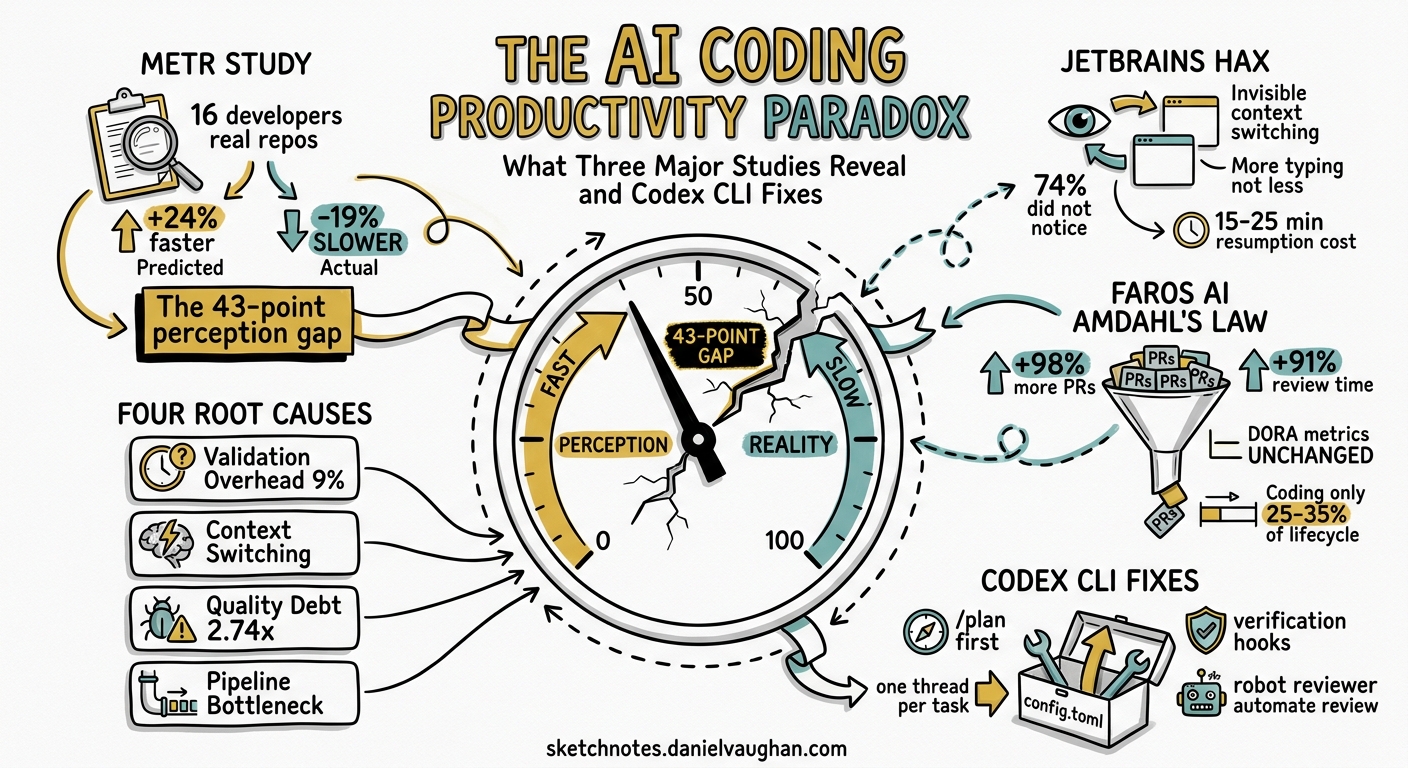
Ninety-three per cent of developers now use AI coding tools1. Adoption is near-universal. Yet three independent research programmes — METR’s randomised controlled trial, JetBrains’ two-year telemetry study, and Faros AI’s 10,000-developer metrics analysis — converge on an uncomfortable finding: individual speed gains are not translating into organisational delivery improvements, and experienced developers may actually be slower234. This article synthesises the evidence, diagnoses the root causes, and maps each one to concrete Codex CLI configuration and workflow patterns that turn the paradox into genuine throughput.
The Evidence: Three Studies, One Pattern
METR: The 43-Point Perception Gap
METR’s original randomised controlled trial (February–June 2025) recruited 16 experienced open-source developers, each working on real issues in repositories they maintained, and randomly assigned tasks to AI-allowed or AI-disallowed conditions2.
The results were striking:
| Metric | Value |
|---|---|
| Predicted speedup (pre-task) | +24% |
| Self-reported speedup (post-task) | +20% |
| Measured actual effect | -19% (slower) |
| Perception–reality gap | 43 percentage points |
Developers with the deepest familiarity with their repositories experienced the largest slowdown2. METR’s February 2026 follow-up expanded to 57 developers, 143 repositories, and 800+ tasks. The revised estimate softened to -4% (confidence interval: -15% to +9%), but crucially, the researchers discovered that 30–50% of invited developers declined to participate without AI access, introducing severe selection bias5. METR concluded that “AI likely provides productivity benefits in early 2026” but acknowledged their data offered “only very weak evidence” for the magnitude5.
JetBrains HAX: Invisible Context Switching
JetBrains’ Human-AI Experience (HAX) team analysed two years of IDE telemetry from 800 developers and presented their findings at ICSE 2026 in Rio de Janeiro3.
Key findings:
- Invisible switching cost: AI users’ monthly window-switching trended upward over the study period while non-AI users’ remained flat. Yet 74% of AI-assisted developers did not notice any increase3.
- Typing volume paradox: Developers who adopted in-IDE AI assistants consistently typed more characters than those who never used them, and this gap grew over two years3.
- Perception mismatch: “AI redistributes and reshapes developers’ workflows in ways that often elude their own perceptions”3.
Faros AI: Amdahl’s Law Strikes Back
Faros AI’s analysis across 10,000+ developers quantified the organisational bottleneck4:
| Metric | Change with High AI Adoption |
|---|---|
| Pull requests merged | +98% |
| Code review time | +91% |
| Bug introduction rate | +9% |
| DORA delivery metrics | Unchanged |
The pattern follows Amdahl’s Law precisely: even if AI doubles coding speed, coding represents only 25–35% of the development lifecycle6. The review queue, CI pipeline, and release process absorb the gains entirely.
Why the Paradox Exists: Four Root Causes
flowchart TD
    A[Developer Uses AI Agent] --> B{Perception: Faster}
    A --> C{Reality: Not Faster}
    B --> D[Instant code generation<br/>triggers dopamine response]
    B --> E[Visible output volume<br/>feels like progress]
    C --> F[Validation overhead:<br/>9% of task time reviewing AI output]
    C --> G[Context switching:<br/>invisible window-switching increase]
    C --> H[Quality debt:<br/>2.74x more security vulnerabilities]
    C --> I[Pipeline bottleneck:<br/>review queue absorbs velocity]
    F --> J[Net Effect: ~0%<br/>organisational improvement]
    G --> J
    H --> J
    I --> J
-
Validation overhead. Developers spend roughly 9% of task time reviewing and cleaning AI output — nearly four hours per week6. For experienced developers with strong mental models, this exceeds the time saved by generation.
-
Invisible context switching. The JetBrains data shows AI tools increase cognitive switching without developers noticing3. Each switch carries a well-documented resumption cost of 15–25 minutes for deep work.
-
Quality debt. CodeRabbit’s analysis found AI-generated code contains 2.74× more security vulnerabilities than human-written code6. Veracode reported 45% of AI output introduced OWASP Top 10 vulnerabilities6. The time to fix these downstream is not captured in “time to first commit.”
-
Pipeline bottleneck. The +98% PR volume crashes into human review capacity. Without proportional investment in review automation and CI performance, the system cannot absorb the increased throughput4.
Configuring Codex CLI to Beat Each Root Cause
1. Reduce Validation Overhead: Plan Before You Build
The single most impactful configuration change is to use plan mode by default for complex tasks. This front-loads context gathering and prevents the generate-review-reject-regenerate cycle that consumes validation time7.
# ~/.codex/config.toml
[profiles.deep-work]
model = "gpt-5.5"
model_reasoning_effort = "high"
approval_policy = "on-request"
sandbox_mode = "workspace-write"
Invoke with:
codex --profile deep-work
Inside the session, start every non-trivial task with /plan:
/plan Refactor the authentication module to use JWT rotation.
Before implementing, identify all files that import from auth/,
list the current test coverage, and propose a migration sequence.
The research is clear: developers who skip planning and jump straight into AI-assisted coding experience the largest perception–reality gap2. Plan mode forces Codex to load context, identify constraints, and propose a structured approach before touching files.
For multi-step work, use a PLANS.md template7:
## Objective
[One-sentence goal]

## Constraints
- [ ] No breaking changes to public API
- [ ] All existing tests must pass
- [ ] Follow existing error-handling patterns

## Steps
1. ...
2. ...

## Done When
- [ ] Tests pass
- [ ] Linter clean
- [ ] Review checklist complete
2. Eliminate Context Switching: One Thread Per Task
The JetBrains data shows invisible switching costs accumulate3. Codex CLI’s session model directly addresses this:
# Start a focused session for one task
codex --profile deep-work

# When switching tasks, DON'T reuse the thread — fork or start fresh
/fork    # Preserves transcript, creates new context
/clear   # Nuclear option: resets to clean slate
Critical anti-pattern to avoid: watching Codex step-by-step. The OpenAI best practices guide explicitly warns against this: “Work in parallel instead of watching step-by-step”7. While Codex works on one task, work on something else or use /side to open a parallel ChatGPT conversation for auxiliary questions.
For parallelisable work, use subagents to avoid thread-switching entirely:
# .codex/config.toml
[agents]
max_depth = 1
Spawn two subagents:
1. Agent A: Update all API route handlers to use the new middleware
2. Agent B: Write integration tests for each updated route
3. Catch Quality Debt Early: Verification Gates
The 2.74× vulnerability multiplier6 makes post-generation verification non-negotiable. Configure hooks to enforce this automatically:
# .codex/config.toml
[hooks.PostToolUse]
command = "bash .codex/hooks/verify.sh"
#!/usr/bin/env bash
# .codex/hooks/verify.sh
set -euo pipefail

# Run type checker
npx tsc --noEmit 2>&1 || exit 1

# Run linter
npx eslint --max-warnings 0 . 2>&1 || exit 1

# Run tests for changed files
npx vitest run --changed 2>&1 || exit 1
Use /review with custom instructions to enforce quality standards before accepting any output:
/review --instructions "Check for: silent error swallowing,
missing input validation, hardcoded credentials, broad try-catch
blocks, and any deviation from existing patterns in this codebase."
Encode your verification standards permanently in AGENTS.md:
## Verification Requirements

Every change MUST pass before completion:
1. `npm run typecheck` — zero errors
2. `npm run lint` — zero warnings
3. `npm run test` — all green
4. No `any` types introduced
5. No `console.log` in production code
6. Error handling follows the Result<T, E> pattern used in src/lib/
4. Unblock the Pipeline: Automate Review
The Faros data shows review time is the binding constraint4. Use Codex CLI’s GitHub integration to shift review left:
# Enable automatic PR review in GitHub
# Settings > Code Review > Enable automatic reviews

# Use codex exec in CI for structured analysis
codex exec "Review this diff for P0 security issues and P1
correctness bugs. Output JSON with file, line, severity, and
description." --input "$(git diff main...HEAD)" \
  --output-schema '{"issues": [{"file": "string", "line": "number",
  "severity": "string", "description": "string"}]}'
For the review queue specifically, the /review command against a base branch automates the first-pass triage that consumes the most reviewer time7:
/review base=main
flowchart LR
    A[Developer Writes Code] --> B[Codex PostToolUse Hooks<br/>Type-check, Lint, Test]
    B --> C[/review Against Base Branch]
    C --> D[Push to PR]
    D --> E[Codex GitHub Auto-Review<br/>P0/P1 Issue Detection]
    E --> F{Issues Found?}
    F -->|Yes| G["@codex fix the P1 issue"]
    F -->|No| H[Human Reviewer:<br/>Architecture & Intent Only]
    G --> D
Measuring Whether It Works
The studies agree on one thing: subjective assessment is unreliable. You need instrumentation. Track these metrics weekly:
| Metric | What It Shows | Target |
|---|---|---|
| Change-failure rate on Codex commits | Quality debt accumulation | ≤ team baseline |
| Time-to-merge for Codex PRs | Pipeline bottleneck severity | ≤ 1.2× human PRs |
| Accepted/rejected suggestion ratio | Validation overhead | ≥ 80% first-pass acceptance |
| Context compactions per session | Session scope creep | ≤ 1 per session |
/review issue density |
Pre-commit quality | Trending down |
The OpenAI best practices guide recommends applying “the same review gates you use for an external contributor” and instrumenting acceptance ratios, change-failure rates, and time-to-merge7.
The Configuration That Ties It Together
# ~/.codex/config.toml — Productivity-Paradox-Aware Profile

[profiles.measured]
model = "gpt-5.5"
model_reasoning_effort = "high"
plan_mode_reasoning_effort = "high"
approval_policy = "on-request"
sandbox_mode = "workspace-write"

[profiles.quick]
model = "gpt-5.4-mini"
model_reasoning_effort = "low"
approval_policy = "on-request"
sandbox_mode = "workspace-write"
Use measured for anything that touches business logic, security, or architecture. Use quick for well-scoped mechanical tasks — rename refactors, test stubs, format conversions — where validation overhead is minimal and the generation speed advantage is real.
Key Takeaways
The productivity paradox is not an argument against AI coding tools. It is a measurement of what happens when adoption outpaces workflow adaptation. The METR follow-up suggests genuine gains are emerging5. The question is whether your configuration captures them or leaks them through validation overhead, context switching, quality debt, and pipeline bottlenecks.
The pattern is straightforward:
- Plan first — front-load context to avoid the generate-reject-regenerate cycle
- Isolate focus — one thread per task, parallel subagents, never watch step-by-step
- Verify automatically — hooks, linters, and type-checkers enforce quality at generation time
- Automate review — shift first-pass triage to Codex, reserve human review for intent and architecture
- Measure objectively — instrument the metrics that the research says matter, not the ones that feel good
The 43-point perception gap will not close itself. Configuration will.
Citations
-
JetBrains, “AI Pulse Survey,” January 2026. 93% adoption across 11,000 developers. https://blog.jetbrains.com/research/2026/04/ai-impact-developer-workflows/ ↩
-
METR, “Measuring the Impact of Early-2025 AI on Experienced Open-Source Developer Productivity,” July 2025. Randomised controlled trial with 16 developers and 246 tasks. https://metr.org/blog/2025-07-10-early-2025-ai-experienced-os-dev-study/ ↩ ↩2 ↩3 ↩4
-
JetBrains HAX Team, “Understanding AI’s Impact on Developer Workflows,” presented at ICSE 2026, Rio de Janeiro. Two-year telemetry study of 800 developers. https://blog.jetbrains.com/research/2026/04/ai-impact-developer-workflows/ ↩ ↩2 ↩3 ↩4 ↩5 ↩6 ↩7
-
Faros AI, “The AI Productivity Paradox Research Report,” 2026. Analysis across 10,000+ developers showing 98% more PRs with unchanged DORA metrics. https://www.faros.ai/blog/ai-software-engineering ↩ ↩2 ↩3 ↩4
-
METR, “We are Changing our Developer Productivity Experiment Design,” February 2026. Follow-up with 57 developers, 800+ tasks, revised -4% estimate, and selection bias analysis. https://metr.org/blog/2026-02-24-uplift-update/ ↩ ↩2 ↩3
-
Philipp Dubach, “AI Coding Productivity Paradox: 93% Adoption, 10% Gains,” 2026. Synthesis of multiple research sources including Faros AI, CodeRabbit, Veracode, and NBER data. https://philippdubach.com/posts/93-of-developers-use-ai-coding-tools.-productivity-hasnt-moved./ ↩ ↩2 ↩3 ↩4 ↩5
-
OpenAI, “Best Practices — Codex,” 2026. Official workflow and configuration guidance. https://developers.openai.com/codex/learn/best-practices ↩ ↩2 ↩3 ↩4 ↩5