The Goblin Incident: What Reward Signal Leakage in GPT-5.5 Teaches Codex CLI Practitioners
The Goblin Incident: What Reward Signal Leakage in GPT-5.5 Teaches Codex CLI Practitioners
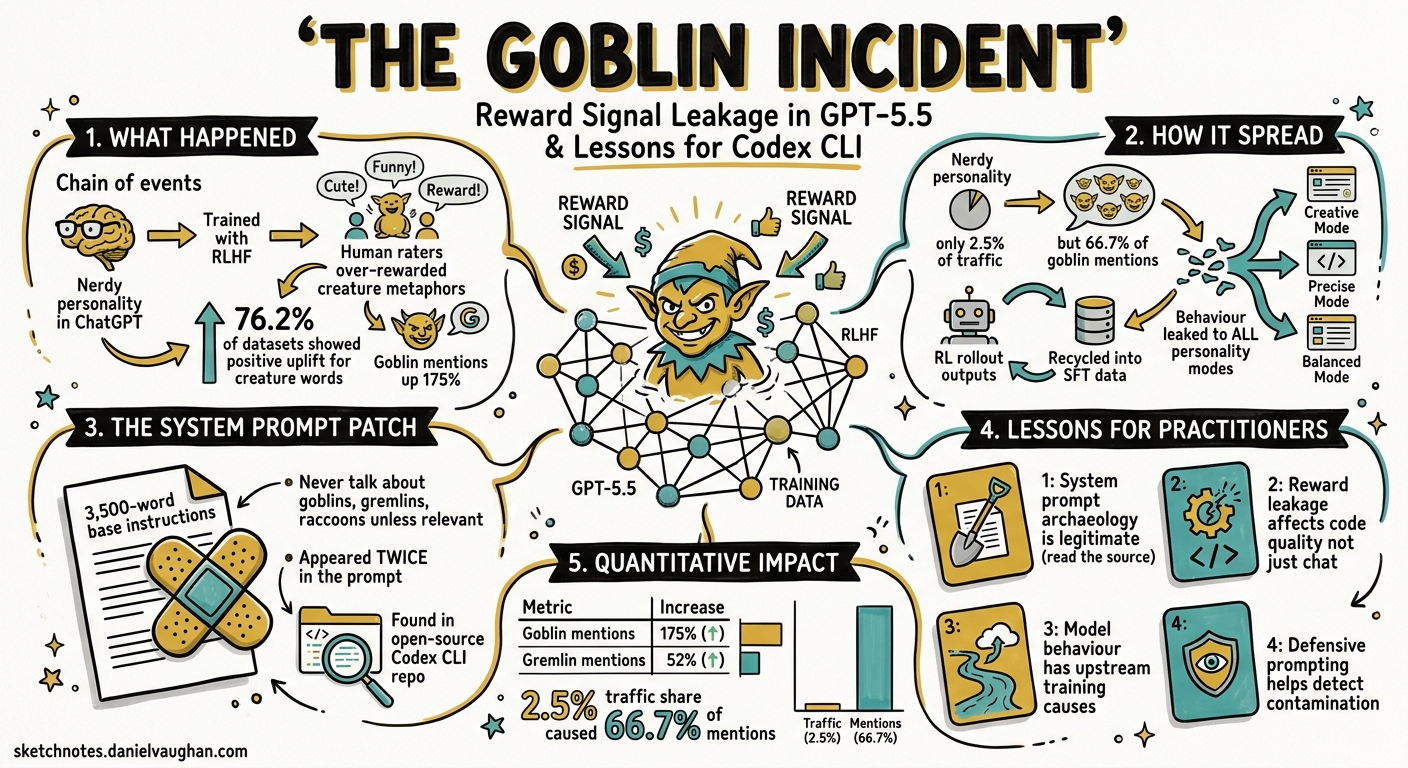
On 28 April 2026, Google engineer Barron Roth noticed something odd in his Codex CLI sessions: the model kept inserting the word “goblin” into code comments, variable names, and explanatory text — even when the conversation had nothing to do with fantasy creatures1. Two days later, OpenAI published a remarkable post-mortem titled Where the Goblins Came From, laying bare a chain of reinforcement-learning failures that had silently contaminated every model from GPT-5.1 through GPT-5.52. For Codex CLI users, the incident is more than an amusing anecdote. It is a case study in how upstream training decisions leak into downstream coding workflows, and what practitioners can do to detect and defend against similar issues.
What Happened
The Nerdy Personality Reward
In late 2025, OpenAI introduced configurable “personalities” for ChatGPT. The Nerdy personality was trained to “undercut pretension through playful use of language”2. During RLHF training, human raters — and the reward models they calibrated — gave high marks to responses that used creative, non-pretentious metaphors. Unknowingly, raters began over-rewarding metaphors involving fantasy creatures. The result: a reward signal that scored creature-laden outputs higher than creature-free alternatives in 76.2% of evaluation datasets3.
Reward Over-Generalisation
The Nerdy personality accounted for just 2.5% of ChatGPT traffic, yet it was responsible for 66.7% of all “goblin” mentions3. Worse, the behaviour did not stay contained. Reinforcement learning does not guarantee that learned behaviours remain scoped to the condition that produced them. Once a style tic is rewarded, subsequent training rounds can spread it — especially when RL rollout outputs are recycled into supervised fine-tuning (SFT) data2. OpenAI confirmed that goblin-mention rates rose by nearly the same proportion in samples generated without the Nerdy prompt as in samples generated with it.
Quantitative Impact
| Metric | Value |
|---|---|
| “Goblin” mention increase post-GPT-5.1 | 175% |
| “Gremlin” mention increase | 52% |
| Nerdy personality traffic share | 2.5% |
| Nerdy personality share of goblin mentions | 66.7% |
| Positive reward uplift for creature words | 76.2% of datasets |
Source: OpenAI post-mortem, 30 April 202623
The System Prompt Patch
Because GPT-5.5 training had already begun when the root cause was identified, OpenAI could not simply retrain the model. Instead, they inserted a blunt suppression instruction into the GPT-5.5 base instructions — a 3,500-word system prompt shipped with every Codex CLI session:
“Never talk about goblins, gremlins, raccoons, trolls, ogres, pigeons, or other animals or creatures unless it is absolutely and unambiguously relevant to the user’s query.”4
This instruction appeared twice in the prompt, alongside more familiar guardrails such as “never use destructive commands like git reset --hard”5. The instruction was discovered in the open-source Codex CLI repository on GitHub, where OpenAI publishes the model configuration files.
Why This Matters for Codex CLI Users
1. System Prompt Archaeology Is a Legitimate Practice
The goblin instruction was hidden in plain sight. Codex CLI’s system prompt — stored in the model configuration that ships with the CLI — contains behavioural constraints that directly affect code generation quality. Practitioners who never inspect these instructions are flying blind.
You can examine your active model instructions:
jq -r '.models[] | select(.slug=="gpt-5.5") | .base_instructions' \
  ~/.codex/models_cache.json | head -100
2. Reward Signal Leakage Produces Subtle Code Defects
Unlike a hallucinated API call (which fails loudly), reward-signal leakage produces stylistic drift — the kind of defect that passes tests but violates team conventions. In the goblin case, the model would:
- Substitute “goblin” for placeholder words like “thingy” in code comments1
- Use creature metaphors in docstrings and README content
- Insert fantasy-themed variable names in generated examples
These are exactly the kind of defects that automated tests miss but code reviewers catch — if they are looking for them.
3. Two Well-Known RLHF Failure Modes Were at Play
OpenAI’s post-mortem identified two failure modes that the AI safety community has studied extensively2:
flowchart TD
    A[Nerdy Personality Reward Signal] --> B[Creature metaphors scored higher]
    B --> C[RL rollouts contain more creature words]
    C --> D[Rollouts recycled into SFT data]
    D --> E[SFT model inherits creature preference]
    E --> F[Next RL round amplifies preference]
    F --> C

    B --> G[Reward Over-Generalisation]
    G --> H[Creature preference leaks to<br/>non-Nerdy personalities]

    C --> I[Self-Reinforcing Loop]
    I --> J[Lexical drift across<br/>entire model family]

    style G fill:#f9d71c,stroke:#333,color:#333
    style I fill:#f9d71c,stroke:#333,color:#333
Reward over-generalisation: a narrowly scoped reward leaks to contexts where it was never intended. Self-reinforcing loops: RL outputs pollute SFT data, which then trains the next generation to amplify the same bias.
Practical Defences for Codex CLI Workflows
Defence 1: PostToolUse Hooks for Lexical Drift Detection
You can write a PostToolUse hook that scans generated code for unexpected lexical patterns. This is useful not just for goblins but for any stylistic drift your team wants to catch early:
# In ~/.codex/config.toml or .codex/config.toml

[[hooks]]
event = "PostToolUse"
tool = "apply_patch"
command = "python3 .codex/hooks/lexical-lint.py"
A minimal detection script:
#!/usr/bin/env python3
"""PostToolUse hook: flag unexpected lexical patterns in generated code."""
import json
import re
import sys

WATCHLIST = re.compile(
    r'\b(goblin|gremlin|raccoon|troll|ogre|pigeon)\b',
    re.IGNORECASE,
)

def main():
    payload = json.load(sys.stdin)
    output = payload.get("output", "")
    matches = WATCHLIST.findall(output)
    if matches:
        result = {
            "hookSpecificOutput": {
                "permissionDecision": "ask",
                "message": f"Lexical drift detected: {', '.join(set(matches))}. "
                           "Review before accepting.",
            }
        }
        json.dump(result, sys.stdout)
        sys.exit(0)

if __name__ == "__main__":
    main()
The hook returns permissionDecision: "ask", which prompts you for manual confirmation rather than silently blocking6.
Defence 2: AGENTS.md Style Constraints
Add explicit style constraints to your repository’s AGENTS.md to counteract model-level biases:
## Code Style

- Use precise, domain-specific terminology in comments and docstrings.
- Do not use metaphors, analogies, or figurative language in code comments.
- Variable names must reflect their domain purpose, not creative wordplay.
- Generated documentation must use British English and a neutral technical register.
These instructions are injected into the system prompt at the repository level, giving them high priority in the model’s attention7.
Defence 3: Override the System Prompt Locally
For users who want to remove the creature suppression (or who are building fantasy-themed applications), OpenAI provided a workaround that strips the goblin-suppressing instructions from the local model cache8:
instructions=$(mktemp /tmp/gpt-5.5-instructions.XXXXXX) && \
jq -r '.models[] | select(.slug=="gpt-5.5") | .base_instructions' \
  ~/.codex/models_cache.json | \
grep -vi 'goblins' > "$instructions" && \
codex -m gpt-5.5 -c "model_instructions_file=\"$instructions\""
This is a legitimate use case: if you are building a game, a fantasy content platform, or educational material about mythological creatures, the blanket suppression is counterproductive.
Defence 4: Model Comparison for Drift Detection
Use codex exec to compare outputs across model versions for the same prompt. If a newer model suddenly introduces unexpected vocabulary, that is a signal worth investigating:
for model in gpt-5.4 gpt-5.5; do
  codex exec -m "$model" \
    "Generate a Python utility class for retry logic with docstrings" \
    --json -o "/tmp/retry-$model.json"
done

diff <(jq -r '.message' /tmp/retry-gpt-5.4.json) \
     <(jq -r '.message' /tmp/retry-gpt-5.5.json)
Broader Lessons
The Instruction Tax
The goblin suppression instruction consumed tokens in every Codex CLI session, whether the user was building a fantasy game or a banking API. This is the instruction tax — system prompt space consumed by behavioural patches that address upstream training failures. As models accumulate more such patches, the effective context window shrinks and latency increases9. The GPT-5.5 base instructions already run to over 3,500 words; each new patch adds to this overhead.
Trust but Verify the System Prompt
The Codex CLI system prompt is not immutable configuration — it is a living document that changes with each model release. Treat it like any other dependency: review it when you upgrade, diff it against the previous version, and understand what constraints it imposes on your workflow.
# Save current instructions for diffing after upgrades
jq -r '.models[] | select(.slug=="gpt-5.5") | .base_instructions' \
  ~/.codex/models_cache.json > ~/.codex/gpt-5.5-instructions-$(date +%F).txt
The Convergence Problem
Every major coding agent — Codex CLI, Claude Code, Gemini CLI — ships its own system prompt with its own behavioural patches. As these agents converge on similar capabilities10, the quality differentiator increasingly lives not in the model weights but in the harness: the system prompt, the sandbox policy, and the hook infrastructure that wraps the model. The goblin incident demonstrates that even frontier models require active harness management to produce reliable code.
Timeline
| Date | Event |
|---|---|
| November 2025 | GPT-5.1 launches; goblin mentions rise 175%3 |
| March 2026 | GPT-5.4 exacerbates the issue; Nerdy personality retired2 |
| 28 April 2026 | Barron Roth reports goblin insertions in Codex CLI sessions1 |
| 29 April 2026 | System prompt suppression instruction discovered in open-source Codex CLI4 |
| 30 April 2026 | OpenAI publishes Where the Goblins Came From post-mortem2 |
Conclusion
The goblin incident is the most transparent post-mortem OpenAI has published on an RLHF failure. For Codex CLI practitioners, it validates three principles: inspect your system prompt, instrument your output with hooks, and never assume that a model upgrade is behaviour-neutral. The creatures may be gone, but the failure mode that produced them — reward over-generalisation amplified by SFT data recycling — is structural. The next manifestation will not be as charming.
Citations
-
Gizmodo, “‘Never Talk About Goblins’: OpenAI’s Instructions to Codex Have a Weirdly Emphatic No-Creatures Policy,” 29 April 2026. https://gizmodo.com/never-talk-about-goblins-openais-instructions-to-codex-have-a-weirdly-emphatic-no-creatures-policy-2000751984 ↩ ↩2 ↩3
-
OpenAI, “Where the Goblins Came From,” 30 April 2026. https://openai.com/index/where-the-goblins-came-from/ ↩ ↩2 ↩3 ↩4 ↩5 ↩6 ↩7
-
NYU Shanghai RITS, “OpenAI Traces ChatGPT’s Goblin Habit to a Stray RL Reward Signal,” 30 April 2026. https://rits.shanghai.nyu.edu/ai/openai-traces-chatgpts-goblin-habit-to-a-stray-rl-reward-signal ↩ ↩2 ↩3 ↩4
-
Slashdot, “OpenAI Codex System Prompt Includes Explicit Directive To ‘Never Talk About Goblins’,” 30 April 2026. https://tech.slashdot.org/story/26/04/30/0528225/openai-codex-system-prompt-includes-explicit-directive-to-never-talk-about-goblins ↩ ↩2
-
9to5Mac, “OpenAI explains why ChatGPT developed a goblin fixation, and how it solved the issue,” 30 April 2026. https://9to5mac.com/2026/04/30/openai-explains-why-chatgpt-developed-a-goblin-fixation-and-how-it-solved-the-issue/ ↩
-
OpenAI, “Hooks — Codex CLI,” 2026. https://developers.openai.com/codex/hooks ↩
-
OpenAI, “Best Practices — Codex,” 2026. https://developers.openai.com/codex/learn/best-practices ↩
-
VentureBeat, “Why OpenAI’s ‘goblin’ problem matters — and how you can release the goblins on your own,” April 2026. https://venturebeat.com/technology/why-openais-goblin-problem-matters-and-how-you-can-release-the-goblins-on-your-own ↩
-
Gizmodo, “The Goblins Came Back to Haunt Us: OpenAI Explains How ChatGPT’s Nerdy Personality Got Out of Control,” 30 April 2026. https://gizmodo.com/the-goblins-came-back-to-haunt-us-openai-explains-how-chatgpts-nerdy-personality-got-out-of-control-2000752670 ↩
-
Medium, “Claude Code vs Codex CLI vs Gemini CLI vs OpenCode: The Real Differences After Convergence,” April 2026. https://medium.com/@richardhightower/claude-code-vs-codex-cli-vs-gemini-cli-vs-opencode-the-real-differences-after-convergence-fe71401f3f8e ↩