The Amazon Q Developer Sunset: Migration Paths for AWS Teams Moving to Codex CLI, Kiro, or Bedrock
The Amazon Q Developer Sunset: Migration Paths for AWS Teams Moving to Codex CLI, Kiro, or Bedrock
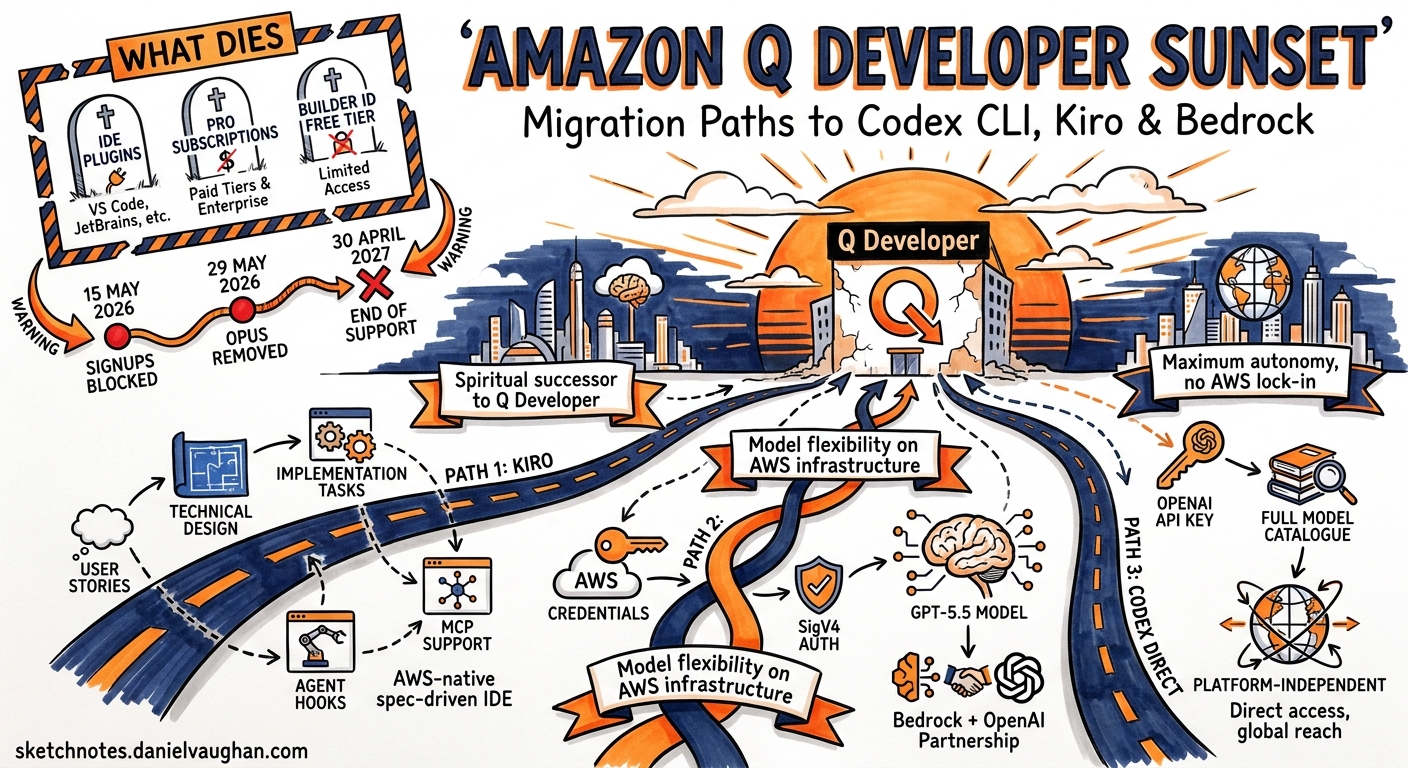
The End of an Era
On 30 April 2026, AWS announced that Amazon Q Developer IDE plugins and paid subscriptions will reach end of support on 30 April 20271. New signups are blocked from 15 May 2026. Starting 29 May 2026, Opus 4.6 is removed from Q Developer Pro, with the latest coding models (including Opus 4.7) available exclusively on Kiro2.
This is not a quiet deprecation. AWS is actively steering its developer tooling strategy in two directions simultaneously: their own spec-driven IDE (Kiro) and a deep partnership with OpenAI to bring Codex and GPT-5.5 to Amazon Bedrock3. For teams that built workflows around Q Developer, the clock is ticking.
What Survives and What Dies
Not everything is disappearing. Q Developer in the AWS Management Console, documentation website, console mobile app, and Slack/Teams integrations continues unaffected1. Critical bugfixes ship to existing IDE plugin users through the transition window.
What ends:
- IDE plugins (VS Code, JetBrains, Visual Studio, Eclipse) — end of support 30 April 2027
- Q Developer Pro subscriptions — no new signups after 15 May 2026
- Q Developer Free Tier via Builder ID — account creation blocked from 15 May 2026
- Opus 4.6 model access — removed from Q Developer Pro on 29 May 20262
The Three Migration Paths
AWS teams face a three-way decision. Each path has different trade-offs for autonomy, model access, and infrastructure control.
flowchart TD
    A[Amazon Q Developer User] --> B{Primary Requirement?}
    B -->|Spec-driven workflow<br/>AWS-native| C[Kiro CLI + IDE]
    B -->|Model flexibility<br/>OpenAI models on AWS| D[Codex CLI on Bedrock]
    B -->|Maximum autonomy<br/>Direct API| E[Codex CLI Direct]

    C --> F[AWS Builder ID / IAM<br/>Bedrock foundation models<br/>Spec-driven development]
    D --> G[AWS credentials<br/>SigV4 auth<br/>GPT-5.5 / GPT-OSS via Bedrock]
    E --> H[OpenAI API key<br/>Full model catalogue<br/>Platform-independent]
Path 1: Kiro (AWS-Native Replacement)
Kiro reached general availability in May 2026 with full CLI support4. It is the spiritual successor to Q Developer, built on VS Code foundations with spec-driven development at its core.
What you gain over Q Developer:
- Spec-driven development (user stories → technical design → implementation tasks)4
- Agent hooks for event-driven automation
- Custom subagents with pre-approved tool permissions
- MCP server support
- Property-based testing from natural-language specifications5
What you lose:
- Q Developer’s inline suggestions model (replaced by Kiro’s own completions)
- Eclipse and Visual Studio native plugins (CLI-only access for those editors)6
Configuration migration is straightforward for VS Code users — Kiro imports extensions, themes, keybindings, and settings automatically on first launch6. JetBrains users integrate via the Agent Client Protocol (ACP).
Path 2: Codex CLI on Amazon Bedrock
For teams that want OpenAI’s models within AWS infrastructure, Codex on Bedrock (limited preview since 28 April 2026) provides the bridge3. You authenticate with AWS credentials, run inference through Bedrock, and apply usage toward your AWS cloud commitments.
config.toml for Bedrock:
[model_providers.amazon-bedrock]
name = "Amazon Bedrock"

# SigV4 authentication via environment or ~/.aws/credentials
# Note: profile-only auth currently requires env vars as fallback

[model_providers.amazon-bedrock.env]
AWS_ACCESS_KEY_ID = ""
AWS_SECRET_ACCESS_KEY = ""
AWS_DEFAULT_REGION = "us-east-1"

# Disable web_search to avoid Bedrock Mantle compatibility issues
web_search = "disabled"
Available models on Bedrock Mantle:
gpt-oss-120b— full-size open modelgpt-oss-20b— compact variant for cost-sensitive workloads
⚠️ GPT-5.5 is not yet available on Bedrock Mantle as of this writing. Teams requiring GPT-5.5 should use the direct API path.
Enterprise controls inherited from Bedrock:
- IAM-based access management
- AWS PrivateLink connectivity
- CloudTrail logging
- Guardrails integration
- Encryption at rest and in transit7
Path 3: Codex CLI Direct (Platform-Independent)
The simplest migration for teams not locked into AWS billing. Direct API access gives you the full model catalogue (GPT-5.5, GPT-5.2-Codex, Codex-Spark, GPT-5.4-mini) without Bedrock’s preview limitations.
# ~/.codex/config.toml — direct API
model = "gpt-5.5"

[profiles.fast]
model = "gpt-5.3-codex-spark"
model_reasoning_effort = "low"

[profiles.deep]
model = "gpt-5.5"
model_reasoning_effort = "high"

[profiles.ci]
model = "gpt-5.4-mini"
Feature Mapping: Q Developer → Codex CLI
| Q Developer Feature | Codex CLI Equivalent | Notes |
|---|---|---|
| Inline completions | Not applicable | Codex CLI is agentic, not autocomplete |
| Chat in IDE | TUI interactive mode | Terminal-native; IDE via app-server |
| Code generation | codex exec or TUI prompt |
Full file generation + editing |
| Security scanning | codex exec + SAST skills |
Via Codex Security or custom skills |
| Code transformation | /goal workflows |
Persistent multi-turn refactoring |
| Agent mode | Default behaviour | Codex is agent-first |
| Customisation rules | AGENTS.md + SKILL.md | Richer than Q Developer’s profiles |
| MCP support | Native since v0.121 | Full MCP client implementation |
The conceptual shift is significant. Q Developer was primarily a completion engine with an agent mode bolted on. Codex CLI is fundamentally an autonomous agent that you steer with configuration, skills, and approval policies8.
The Hybrid Strategy
Many enterprise teams will run both Kiro and Codex CLI:
- Kiro for spec-driven greenfield development where AWS-native billing and governance matter
- Codex CLI on Bedrock for existing AWS workflows that need OpenAI model quality
- Codex CLI direct for individual developers who want maximum flexibility
This is viable because both Kiro and Codex CLI support the Agent Skills open standard (SKILL.md)9. Skills you write for one tool work in the other. AGENTS.md files are read by both. The portability layer means you are not locked into a single agent.
graph LR
    subgraph "Shared Configuration"
        A[AGENTS.md]
        B[.agents/skills/]
        C[MCP Servers]
    end

    subgraph "Agent Runtimes"
        D[Codex CLI]
        E[Kiro CLI]
    end

    A --> D
    A --> E
    B --> D
    B --> E
    C --> D
    C --> E
Migration Checklist
For teams currently on Q Developer Pro planning their transition:
- Audit your Q Developer usage — identify which features you actually use (completions, chat, security scanning, agent mode)
- Export custom rules — translate Q Developer customisation profiles into AGENTS.md format
- Evaluate model needs — if you need GPT-5.5, Bedrock is not yet sufficient; use direct API
- Test Codex CLI in CI — replace Q Developer security scanning with
codex execpipelines using--output-schema - Set up credential management — for Bedrock, configure OIDC federation for CI/CD; for direct, set up
OPENAI_API_KEYin your secrets manager - Install skills — replace Q Developer’s built-in capabilities with equivalent SKILL.md packages from the marketplace (89,753 available as of March 2026)9
- Configure approval policies — Q Developer had implicit trust; Codex CLI requires explicit permission profiles10
Cost Comparison
| Plan | Monthly Cost | What You Get |
|---|---|---|
| Q Developer Free (ending) | $0 | Limited completions, basic chat |
| Q Developer Pro (ending) | $19/user | Unlimited completions, agent mode |
| Codex CLI (ChatGPT Plus) | $20/user | 5× usage multiplier, GPT-5.5 |
| Codex CLI (ChatGPT Pro) | $100/user | 10× usage (through 31 May), Spark access |
| Codex CLI (API pay-as-you-go) | Variable | Full control, no multiplier caps |
| Kiro Free | $0 | 50 agent interactions/month |
| Kiro Pro | $19/user | 1,000 agent interactions/month |
For teams spending $19/user on Q Developer Pro, the direct swap to Codex CLI via ChatGPT Plus at $20/user provides substantially more capability — particularly the full agentic workflow, 400K context window with GPT-5.5, and the skills ecosystem11.
Timeline Decision Framework
| Date | Action Required |
|---|---|
| Now (May 2026) | Begin evaluation; install Codex CLI alongside Q Developer |
| 15 May 2026 | No new Q Developer accounts — ensure all team members have access |
| 29 May 2026 | Opus 4.6 removed from Q Developer — verify no dependency |
| Q3 2026 | Complete migration for active development workflows |
| 30 April 2027 | Q Developer IDE plugins cease functioning |
Teams have a full year, but the smart move is to migrate active workflows now while Q Developer remains available as a fallback. The skills and AGENTS.md you write today work across both tools immediately.
What This Means for the Market
AWS’s decision to sunset their own AI coding assistant in favour of a partnership with OpenAI is a remarkable validation of the foundation-model-lab-as-tool-vendor model. Rather than competing on models, AWS is competing on infrastructure and governance — providing the enterprise wrapper (IAM, PrivateLink, CloudTrail, billing) around OpenAI’s agent technology3.
For Codex CLI practitioners, this means the AWS ecosystem is no longer adversarial territory. Your config.toml can route through Bedrock with full enterprise controls, your skills work in Kiro, and your AGENTS.md files are read by both. The fragmentation tax just got cheaper.
Citations
-
AWS DevOps Blog, “Amazon Q Developer end-of-support announcement”, 30 April 2026 — https://aws.amazon.com/blogs/devops/amazon-q-developer-end-of-support-announcement/ ↩ ↩2
-
Let’s Data Science, “Amazon Q Developer Announces End-of-Support Timeline”, April 2026 — https://letsdatascience.com/news/amazon-q-developer-announces-end-of-support-timeline-97a57c03 ↩ ↩2
-
OpenAI, “OpenAI on AWS”, 28 April 2026 — https://openai.com/index/openai-on-aws/ ↩ ↩2 ↩3
-
Kiro, “Kiro is generally available: Build with your team in the IDE and terminal”, May 2026 — https://kiro.dev/blog/general-availability/ ↩ ↩2
-
Tessl, “Kiro spec-driven development platform hits prime time with CLI support”, May 2026 — https://tessl.io/blog/kiro-spec-driven-development-platform-hits-prime-time-with-cli-support-in-tow/ ↩
-
Kiro, “Migrating from Amazon Q Developer”, May 2026 — https://kiro.dev/docs/migrating-from-q-developer/ ↩ ↩2
-
AWS, “Amazon Bedrock now offers OpenAI models, Codex, and Managed Agents”, 28 April 2026 — https://aws.amazon.com/about-aws/whats-new/2026/04/bedrock-openai-models-codex-managed-agents/ ↩
-
OpenAI Developers, “Codex CLI”, 2026 — https://developers.openai.com/codex/cli ↩
-
Paperclipped, “Agent Skills Open Standard Explained”, March 2026 — https://www.paperclipped.de/en/blog/agent-skills-open-standard-interoperability/ ↩ ↩2
-
OpenAI Developers, “Codex CLI v0.128.0 Changelog”, 30 April 2026 — https://developers.openai.com/codex/changelog ↩
-
OpenAI Developers, “Codex Pricing”, 2026 — https://developers.openai.com/codex/pricing ↩