Prompting GPT-5.5 in Codex CLI: Outcome-First Instructions, AGENTS.md Patterns, and Reasoning Effort Tuning
Prompting GPT-5.5 in Codex CLI: Outcome-First Instructions, AGENTS.md Patterns, and Reasoning Effort Tuning
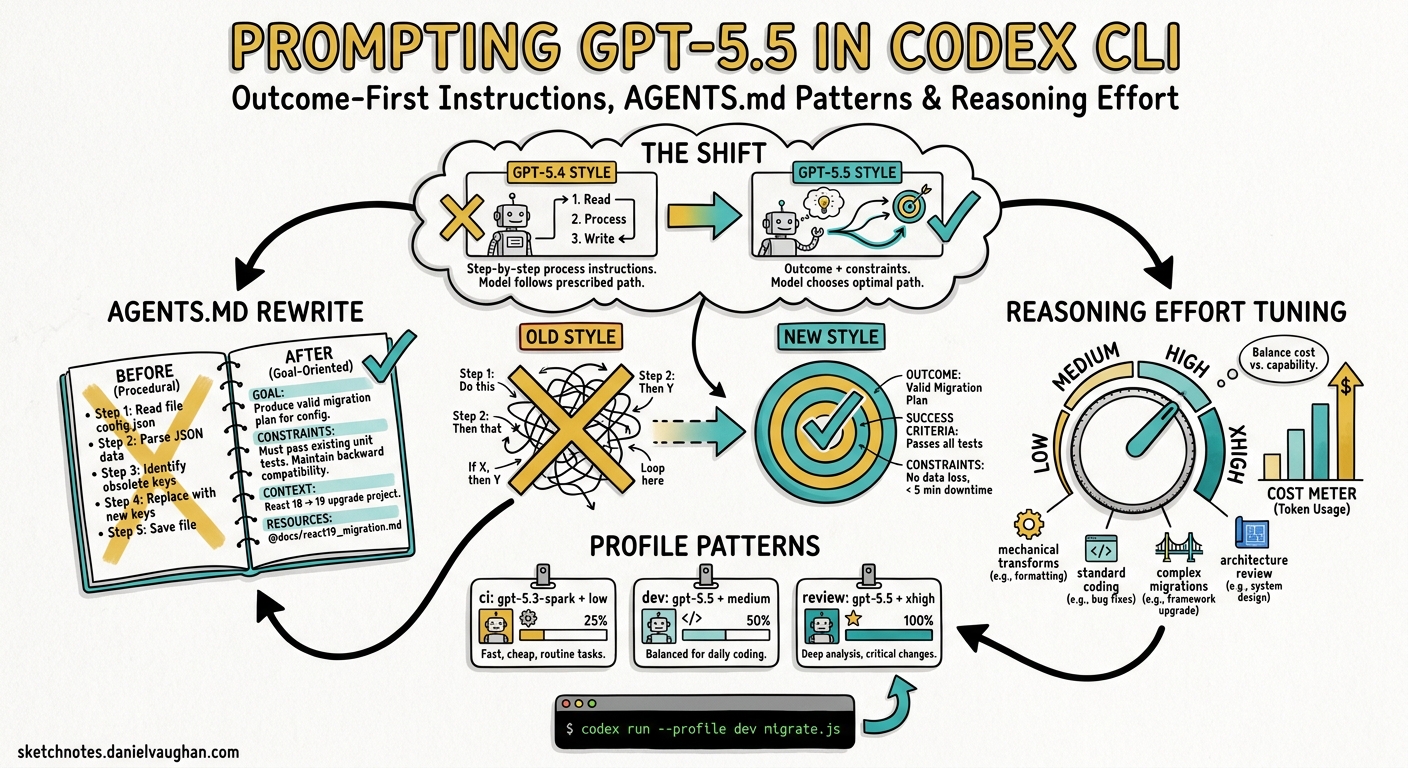
GPT-5.5 landed in Codex CLI in late April 2026 as OpenAI’s newest frontier model, bringing stronger planning, tool use, and multi-step follow-through1. It is not, however, a drop-in replacement for GPT-5.4 or GPT-5.3-codex. OpenAI’s own guidance is blunt: “Begin migration with a fresh baseline instead of carrying over every instruction from an older prompt stack”2. This article walks through the prompting patterns that actually matter when running GPT-5.5 inside Codex CLI — from rewriting your AGENTS.md to tuning reasoning effort per profile.
Why GPT-5.5 Prompting Is Different
Previous Codex models rewarded detailed, step-by-step process instructions. GPT-5.5 inverts this. The model is “strongest when the prompt defines the target outcome, success criteria, constraints, and available context, then lets the model choose the path”2. Prescriptive instructions now actively harm performance — the model wastes reasoning tokens reconciling your prescribed steps with its own (often superior) execution plan.
Three architectural changes drive this shift:
- Deeper autonomous planning. GPT-5.5 builds internal execution plans that are more reliable than manually scripted sequences1.
- Native date awareness. The model already knows the current UTC date — explicitly stating it wastes tokens and can conflict with the model’s internal clock2.
- Structured Outputs integration. Output schemas belong in the API layer (
--output-schema), not in the prompt text2.
flowchart LR
    A["GPT-5.4 Prompt Style"] --> B["Step-by-step process\ninstructions"]
    B --> C["Model follows\nprescribed path"]

    D["GPT-5.5 Prompt Style"] --> E["Outcome + constraints\n+ success criteria"]
    E --> F["Model plans its\nown execution path"]

    style A fill:#ff9999
    style D fill:#99ff99
The Four-Element Prompt Framework
Codex CLI’s official best practices define a four-element structure that aligns perfectly with GPT-5.5’s outcome-first architecture3:
| Element | Purpose | Example |
|---|---|---|
| Goal | What are you building or changing? | “Add retry logic to the payment gateway client” |
| Context | Which files, errors, or docs matter? | “See src/gateway/client.ts and the failing test in __tests__/” |
| Constraints | Standards, architecture, safety rules | “Use exponential backoff, max 3 retries, preserve existing error types” |
| Done when | Verifiable completion criteria | “All existing tests pass, new tests cover retry and exhaustion paths” |
In an interactive Codex CLI session, this translates to prompts like:
Add retry logic to the payment gateway client in src/gateway/client.ts.
Use exponential backoff with jitter, max 3 retries, 1s initial delay.
Preserve existing GatewayError types. Done when all tests pass
including new tests for retry success and retry exhaustion.
Notice: no mention of which files to read first, no instruction to run grep, no prescribed order of operations. GPT-5.5 handles the exploration autonomously.
Rewriting AGENTS.md for GPT-5.5
The single highest-leverage change when switching to GPT-5.5 is rewriting your AGENTS.md. OpenAI’s guidance is clear: “A short, accurate AGENTS.md is more useful than a long file full of vague rules”3.
Before (GPT-5.4 Style)
# AGENTS.md

## Process
1. First, read the relevant source files
2. Then, run the existing tests to understand current behaviour
3. Plan your changes before implementing
4. Implement changes one file at a time
5. Run tests after each file change
6. Fix any failures before moving on

## Code Style
- Always use TypeScript strict mode
- Always add JSDoc comments to public functions
- Never use `any` type
- Always handle errors explicitly
After (GPT-5.5 Style)
# AGENTS.md

## Repository
- TypeScript monorepo: `packages/` contains `api`, `web`, `shared`
- Build: `pnpm build` | Test: `pnpm test` | Lint: `pnpm lint`

## Standards
- TypeScript strict mode; no `any` types
- Public functions require JSDoc
- Errors handled explicitly — no silent catches
- Tests required for new public APIs

## Verification
- All commands must pass: `pnpm lint && pnpm test`
The GPT-5.5 version is roughly half the length. The process section is gone entirely — GPT-5.5 determines its own execution order. What remains are facts (repository layout, commands) and genuine constraints (type safety, documentation, verification).
Reserve Absolute Language
A critical GPT-5.5 prompting principle: use MUST, NEVER, and ALWAYS only for genuine invariants — safety rules, required outputs, and hard constraints4. For judgment calls, use decision rules instead:
## Error Handling
- MUST: never swallow exceptions silently
- If the caller can recover, return a Result type. Otherwise, throw.
- If unsure whether to log at warn or error, prefer warn.
This gives the model room to make contextually appropriate choices while preserving your non-negotiable rules.
Reasoning Effort Configuration
GPT-5.5 supports five reasoning effort levels. The right level depends on the task, and Codex CLI lets you configure this per profile56:
# ~/.codex/config.toml

model = "gpt-5.5"
model_reasoning_effort = "medium"        # default for interactive work
plan_mode_reasoning_effort = "high"      # /plan always gets deeper thought

[profiles.ci]
model_reasoning_effort = "low"           # fast CI runs
model = "gpt-5.4-mini"                   # cost-efficient for CI

[profiles.review]
model_reasoning_effort = "high"          # thorough code review
model = "gpt-5.5"

[profiles.audit]
model_reasoning_effort = "xhigh"         # security/compliance deep analysis
model = "gpt-5.5"
graph TD
    A["Task Arrives"] --> B{Complexity?}
    B -->|"Classification,\nrouting, FAQ"| C["reasoning: low\n⚡ Fast, cheap"]
    B -->|"Standard dev,\nrefactoring"| D["reasoning: medium\n⚖️ Default"]
    B -->|"Complex debugging,\narchitecture"| E["reasoning: high\n🔍 Thorough"]
    B -->|"Security audit,\nfrontier problems"| F["reasoning: xhigh\n🧠 Maximum"]

    style C fill:#90EE90
    style D fill:#87CEEB
    style E fill:#FFD700
    style F fill:#FF6347
You can also switch mid-session without restarting:
# In the Codex CLI TUI
/effort high        # switch to high reasoning for a complex task
/effort medium      # drop back for routine work
The plan_mode_reasoning_effort key is particularly important — since a flawed plan compounds into a flawed implementation, running /plan at higher effort than your interactive default is a sensible baseline5.
Verbosity and Output Control
GPT-5.5 introduces a separate model_verbosity control that decouples output length from reasoning quality6:
model_verbosity = "low" # concise responses, same reasoning depth
This is distinct from model_reasoning_effort. You can have high reasoning effort (thorough internal thinking) with low verbosity (terse output), which is ideal for codex exec automation where you want quality without prose.
Tool Descriptions Over Prompt Instructions
GPT-5.5 performs better when tool guidance lives in tool descriptions rather than the system prompt2. For MCP servers, this means writing rich tool descriptions:
{
  "name": "run_tests",
  "description": "Run the project test suite. Use after making code changes to verify correctness. Input: optional test file glob pattern. Returns: exit code, stdout, stderr. Safe to retry on transient failures. Common error: missing build step — run build first if tests fail with module-not-found.",
  "inputSchema": {
    "type": "object",
    "properties": {
      "pattern": {
        "type": "string",
        "description": "Glob pattern to filter tests, e.g. 'src/**/*.test.ts'"
      }
    }
  }
}
The description includes purpose, triggers, inputs, side effects, retry safety, and common error modes — exactly what OpenAI recommends placing in tool descriptions for GPT-5.52.
Prompt Layout for Cache Efficiency
Codex CLI supports prompt caching, and GPT-5.5 prompts should be structured to maximise cache hits7. The rule is simple: static content first, dynamic content last.
# AGENTS.md (static — cached across sessions)

## Repository
[repository layout — rarely changes]

## Standards
[coding standards — rarely changes]

## Current Sprint Context
[dynamic — changes frequently, placed last]
The developer_instructions config key lets you inject session-specific context without modifying your cached AGENTS.md6:
developer_instructions = "Focus on the payments module. The Stripe webhook handler has a race condition — see issue #1234."
This keeps your AGENTS.md stable (maximising cache hits) while adding per-session context that only affects the dynamic tail of the prompt.
Migration Checklist: GPT-5.4 to GPT-5.5
When migrating an existing Codex CLI setup from GPT-5.4 to GPT-5.5, work through this checklist:
-
Start fresh. Do not copy your GPT-5.4
AGENTS.mdverbatim. Write a minimal version covering repository facts, hard constraints, and verification commands2. -
Remove process instructions. Delete any “first do X, then do Y” sequences. Replace with outcome descriptions and success criteria2.
-
Audit absolute language. Grep your
AGENTS.mdfor MUST, NEVER, ALWAYS. Keep only genuine safety invariants. Convert judgment calls to decision rules4. -
Move output schemas to the API layer. If your
AGENTS.mdcontains JSON schema definitions for output formatting, move them to--output-schemaflags incodex execinvocations2. -
Remove date statements. Delete any “Today’s date is…” lines. GPT-5.5 knows the date2.
-
Set reasoning effort per profile. Configure
model_reasoning_effortandplan_mode_reasoning_effortin yourconfig.toml5. -
Test with
/planfirst. Run a representative task in/planmode to verify that GPT-5.5’s autonomous planning produces sensible execution strategies with your new instructions3. -
Measure, then tune. Use
codex execwith--output-schemato run your standard tasks and compare quality against your GPT-5.4 baseline before adjusting reasoning effort upward2.
What Still Works
Not everything changes. These patterns carry over from GPT-5.4 without modification4:
- Structured Outputs via
--output-schemaincodex exec - Function calling and tool descriptions (though descriptions should be richer)
- Real safety rules — genuine MUST/NEVER constraints
- Factual guardrails — “Use only provided facts and cited sources”
- Short, clear system prompts with defined roles
- Hook configurations —
PreToolUseandPostToolUsehooks work identically
A Practical Example
Here is a complete GPT-5.5-optimised AGENTS.md for a production Node.js API:
# AGENTS.md

## Repository
Express API with PostgreSQL. Source in `src/`, tests in `__tests__/`.
ORM: Drizzle. Auth: JWT with refresh tokens. Deploy: Docker + ECS.

## Commands
- Build: `npm run build`
- Test: `npm test`
- Lint: `npm run lint`
- Migrate: `npm run db:migrate`

## Standards
- TypeScript strict. No `any`.
- All routes require auth middleware unless explicitly public.
- Database queries use Drizzle — no raw SQL outside migrations.
- Error responses follow RFC 7807 Problem Details format.
- MUST: never log PII (emails, tokens, passwords).

## Verification
Every change must pass: `npm run lint && npm test`
Forty-three words of standards. No process instructions. No step-by-step guides. GPT-5.5 fills in the execution strategy itself — and in practice, it does so more reliably than GPT-5.4 following a prescriptive script1.
Conclusion
The shift to GPT-5.5 in Codex CLI is less about learning new commands and more about unlearning old prompting habits. Write shorter AGENTS.md files. Describe outcomes, not processes. Reserve absolute language for genuine invariants. Tune reasoning effort per profile rather than per prompt. And start with a fresh baseline — the migration tax is real, but the payoff in task quality and token efficiency is measurable from day one.
Citations
-
OpenAI — Codex Models documentation — GPT-5.5 as newest frontier model with stronger planning, tool use, and multi-step follow-through. ↩ ↩2 ↩3
-
OpenAI — Using GPT-5.5 guide — Outcome-first prompting, fresh baseline migration, date awareness, schema placement, cache-friendly layout. ↩ ↩2 ↩3 ↩4 ↩5 ↩6 ↩7 ↩8 ↩9 ↩10 ↩11
-
OpenAI — Codex Best Practices — Four-element prompt framework (Goal, Context, Constraints, Done when), AGENTS.md brevity guidance, /plan mode. ↩ ↩2 ↩3
-
MindWired AI — GPT-5.5 Prompting Guide — Reserve absolute language, outcome-first structure, personality vs collaboration separation, migration carry-overs. ↩ ↩2 ↩3
-
OpenAI — Codex Configuration Reference — model_reasoning_effort, plan_mode_reasoning_effort, model_verbosity, developer_instructions keys. ↩ ↩2 ↩3
-
OpenAI — Codex Advanced Configuration — Profile-based configuration, OpenTelemetry, named profiles for CI/review/audit workflows. ↩ ↩2 ↩3
-
OpenAI — Codex Prompting Guide (Cookbook) — System prompt architecture, tool description placement, compaction strategy, prompt caching layout. ↩