OpenAI Daybreak and Codex Security: From Developer Tool to Enterprise Cyber Defence Platform
OpenAI Daybreak and Codex Security: From Developer Tool to Enterprise Cyber Defence Platform
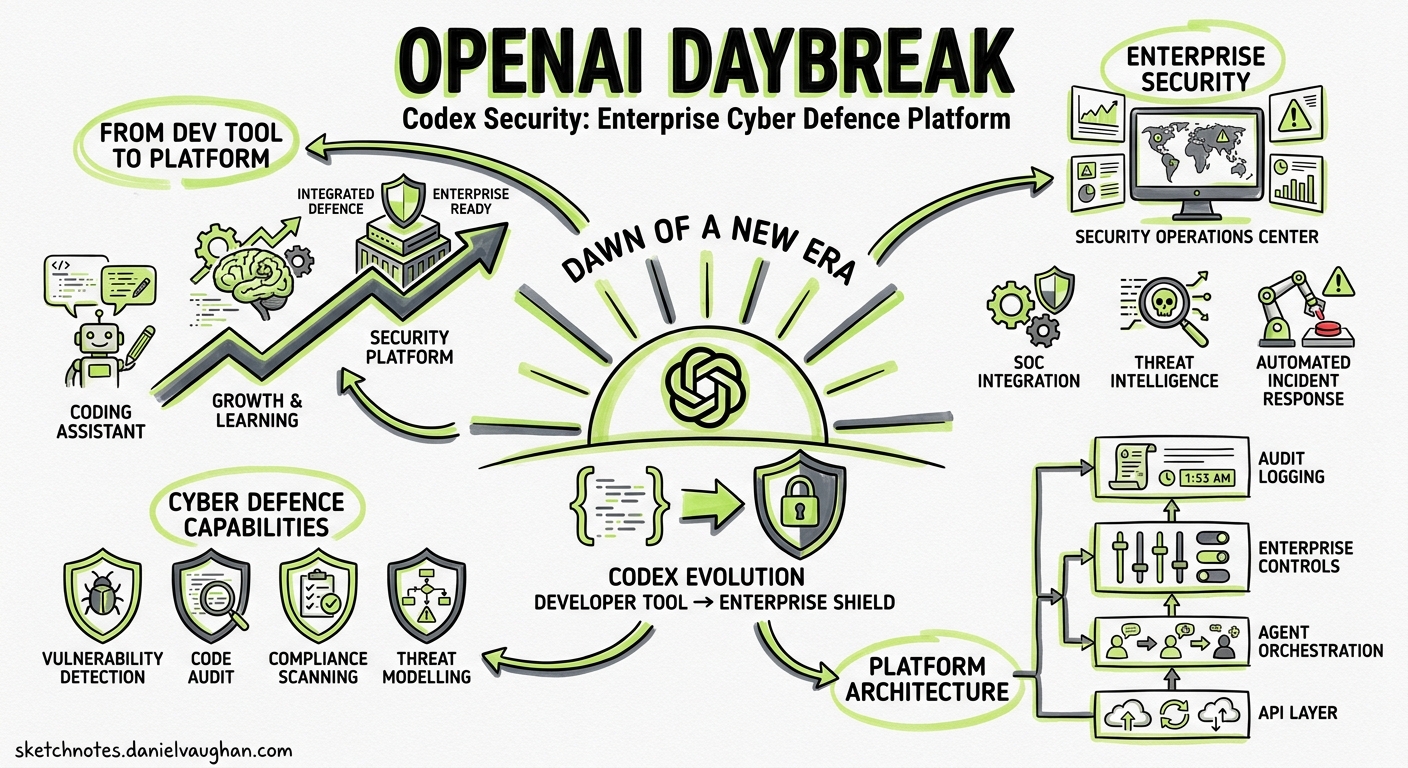
On 11 May 2026, OpenAI announced Daybreak, an umbrella cybersecurity initiative that bundles frontier AI models, the Codex Security application-security agent, and a partner network of over twenty security companies into a single programme aimed at embedding vulnerability detection and remediation directly into the software development lifecycle1. For Codex CLI practitioners who already use the tool for day-to-day coding, Daybreak reshapes the security surface from an afterthought into an integrated loop.
This article unpacks what Daybreak is, how its components relate to each other, what the three-tier model architecture looks like, and — most importantly — how CLI-native workflows fit into the picture.
What Daybreak Actually Is
Daybreak is not a product you install. It is a programme that ties together three layers:
- Codex Security — the application-security agent that scans connected GitHub repositories, builds codebase-specific threat models, validates findings in isolated environments, and proposes patches for human review2.
- Frontier model tiers — three variants of GPT-5.5 with progressively relaxed cyber-safety classifiers, each gated behind different verification requirements3.
- A partner ecosystem — Cloudflare, Cisco, CrowdStrike, Palo Alto Networks, Oracle, Zscaler, Akamai, Fortinet, Intel, Qualys, Rapid7, Tenable, Trail of Bits, SpecterOps, SentinelOne, Okta, Netskope, Snyk, Gen Digital, Semgrep, and Socket1.
The stated goal is to shift vulnerability discovery and remediation left — into the development loop rather than after deployment — while giving enterprise security teams a single pane of glass backed by an agentic workflow.
graph TD
    A[Daybreak Programme] --> B[Codex Security Agent]
    A --> C[Model Tiers]
    A --> D[Partner Ecosystem]
    B --> B1[Threat Modelling]
    B --> B2[Commit Scanning]
    B --> B3[Sandbox Validation]
    B --> B4[Patch Generation]
    C --> C1["GPT-5.5 Standard"]
    C --> C2["GPT-5.5 + Trusted Access"]
    C --> C3["GPT-5.5-Cyber"]
    D --> D1[SAST/DAST Vendors]
    D --> D2[Cloud Security]
    D --> D3[Identity & Access]
    D --> D4[Supply Chain]
The Three-Stage Codex Security Pipeline
Codex Security operates through a three-stage pipeline that runs against connected GitHub repositories24:
Stage 1 — Threat Modelling
When Codex Security connects to a repository, it builds a codebase-specific threat model capturing attacker entry points, trust boundaries, sensitive data paths, and high-impact code regions5. Teams can refine this model through the Codex Security web interface, and the documentation explicitly recommends editing the threat model as a first step when scan findings seem misaligned with actual risk5.
A well-written threat model should document:
- Entry points and untrusted inputs
- Trust boundaries and authentication assumptions
- Sensitive data paths and privileged actions
- Priority review areas the team cares about most
Stage 2 — Scanning and Validation
Subsequent scans review repository history commit-by-commit, building contextual understanding from the codebase4. High-confidence findings are then validated in isolated sandbox environments before being surfaced — the auto-validation step attempts to reproduce suspected issues, and only successfully reproduced findings are marked as validated4. This validation loop is critical: it directly reduces false-positive noise that plagues traditional SAST tools.
Stage 3 — Remediation
For validated findings, Codex Security generates concrete patches with file locations and line context4. These are not auto-applied; teams review them and raise pull requests manually. The output includes criticality rankings, validation status, and supporting evidence for each finding.
The Three-Tier Model Architecture
Daybreak formalises OpenAI’s tiered approach to cyber-capable models36:
| Tier | Model | Access | Use Case |
|---|---|---|---|
| Standard | GPT-5.5 | All paid users | General development with baseline safety classifiers |
| Trusted Access | GPT-5.5 + Trusted Access for Cyber | Identity-verified defenders | Secure code review, vulnerability triage, malware analysis, patch validation |
| Specialist | GPT-5.5-Cyber | Invite-only programme | Red teaming, penetration testing, controlled validation with stronger verification |
The standard tier applies classifier-based monitors that detect suspicious cyber activity signals and reroute high-risk traffic to GPT-5.2 as a fallback3. OpenAI states that the expected traffic impact from these mitigations is minimal for legitimate defensive work.
Individual access to the Trusted Access tier requires identity verification at chatgpt.com/cyber3. Enterprise access is provisioned through OpenAI account representatives. The specialist GPT-5.5-Cyber tier remains invite-only for qualified security researchers.
How Daybreak Relates to the CLI
Codex Security itself runs as a cloud-hosted agent accessed through the Codex web interface — it scans connected GitHub repositories and surfaces findings in a dashboard2. There is no codex security scan CLI subcommand.
However, Codex CLI practitioners interact with the Daybreak ecosystem at three integration points:
1. Remediation via codex exec
When Codex Security surfaces validated findings, the natural remediation path for CLI users is codex exec. The OpenAI Cookbook documents a pattern for security-aware CI pipelines where codex exec --full-auto processes SAST scanner output and generates patches7:
# Triage Codex Security findings with codex exec
codex exec --full-auto \
  "Read the Codex Security findings in findings.json. \
   For each VALIDATED finding, generate a unified diff patch. \
   Print ONLY between these markers: \
   === BEGIN_SECURITY_PATCH === \
   ... \
   === END_SECURITY_PATCH ==="
The marker-based extraction pattern ensures reliable parsing in CI environments7.
2. Cyber-Safety Classifier Interaction
CLI sessions using GPT-5.3-Codex or GPT-5.5 are subject to the same cyber-safety classifiers that gate Daybreak access3. If a CLI prompt triggers the classifier — for example, asking Codex to analyse a binary or explain an exploit path — the request may be rerouted to a less capable model. Users who encounter false positives can report them via the /feedback command in the TUI3.
For teams with Trusted Access, configuring a dedicated profile in config.toml ensures the correct model tier is used for security work:
[profiles.security-audit]
model = "gpt-5.5"
reasoning_effort = "high"

[profiles.security-audit.sandbox]
permissions = ":read-only"
3. AGENTS.md Security Conventions
Codex Security’s threat model output can inform the AGENTS.md file in your repository, creating a bridge between the cloud scanner’s understanding and the CLI agent’s behaviour:
# Security Context

## Trust Boundaries
- All input from `/api/v2/` endpoints is untrusted
- Internal service-to-service calls use mTLS — treat as trusted
- File uploads are processed in an isolated worker pool

## Priority Review Areas
- Authentication middleware in `src/auth/`
- Payment processing in `src/billing/`
- File upload parsing in `src/uploads/`

## Codex Security Scan Policy
- All VALIDATED findings with criticality >= HIGH must be patched before merge
- Unvalidated findings require manual triage
The Partner Ecosystem in Practice
The twenty-plus Daybreak partners span four categories relevant to Codex CLI workflows1:
graph LR
    subgraph "SAST & Supply Chain"
        Snyk
        Semgrep
        Socket
    end
    subgraph "Cloud & Network"
        Cloudflare
        Akamai
        Zscaler
    end
    subgraph "Endpoint & Detection"
        CrowdStrike
        SentinelOne
        Fortinet
    end
    subgraph "Vulnerability Mgmt"
        Qualys
        Rapid7
        Tenable
    end
    subgraph "Identity"
        Okta
        Netskope
    end
For CLI practitioners, the most immediately actionable integrations are with Snyk, Semgrep, and Socket — tools that already have MCP servers or CLI-native interfaces. A practical pattern is to run these scanners in CI, pipe their output to codex exec for triage and patch generation, and feed the results back into Codex Security’s threat model for continuous refinement.
Performance Track Record
OpenAI reports that since its research preview launch, Codex Security has contributed to fixing more than 3,000 critical and high-severity vulnerabilities across the ecosystem8. Over a 30-day measurement window, the agent scanned more than 1.2 million commits, identifying 792 critical findings, with false-positive rates falling by more than 50% across all scanned repositories9.
The predecessor agent, Aardvark, shipped as a research preview on 6 March 2026 and focused on automated vulnerability hunting9. Codex Security builds on Aardvark’s architecture but adds the threat-modelling and validation stages that distinguish it from a conventional scanner.
Competitive Context
Daybreak arrives two weeks after Anthropic’s Project Glasswing, which counts Apple, Microsoft, Google, and Amazon as adopters8. The two programmes share a similar thesis — that frontier models can materially improve defensive security — but differ in execution:
| Dimension | Daybreak | Project Glasswing |
|---|---|---|
| Agent harness | Codex Security (GitHub-integrated) | Claude Code |
| Model gating | Three-tier (Standard / Trusted / Cyber) | ⚠️ Details not fully public |
| Partner count | 20+ named partners | 4 named adopters |
| Validation | Sandbox auto-validation before surfacing | ⚠️ Not documented publicly |
Practical Takeaways for CLI Users
-
Connect your repositories to Codex Security if you have Pro, Enterprise, Business, or Edu access. The threat model it generates is a valuable input even if you primarily work through the CLI.
-
Wire scan findings into
codex execremediation pipelines using the marker-based extraction pattern from the OpenAI Cookbook. This closes the loop between cloud-side scanning and local-side patching. -
Verify your Trusted Access tier if your work involves security-sensitive code. False-positive rerouting from the cyber-safety classifier can disrupt vulnerability analysis workflows. Register at
chatgpt.com/cyberfor individual access. -
Update your AGENTS.md with security context derived from Codex Security’s threat model. This ensures the CLI agent respects the same trust boundaries the scanner identified.
-
Watch the partner integrations — as Snyk, Semgrep, and Socket MCP servers mature, expect tighter bidirectional data flow between Daybreak findings and CLI-side remediation.
Current Limitations
- Codex Security scans are GitHub-only — GitLab, Bitbucket, and self-hosted Git are not yet supported2.
- Initial scans can take hours to days depending on repository size and build complexity4.
- The tool is language-agnostic but effectiveness varies by language and framework4.
- Codex Security does not replace code-level validation, exploitability checks, or human threat assessment4.
- Daybreak partner integrations are not yet live as bidirectional data flows — the current model is side-by-side rather than embedded1.
- Broader Daybreak deployment with industry and government partners is planned for coming weeks; availability is currently limited to organisations that contact OpenAI sales1.
Citations
-
OpenAI, “Daybreak OpenAI for cybersecurity,” openai.com/daybreak/, 11 May 2026. -
OpenAI Developers, “Security — Codex,” developers.openai.com/codex/security, accessed 12 May 2026. ↩ ↩2 ↩3 ↩4
-
OpenAI Developers, “Cyber Safety — Codex,” developers.openai.com/codex/concepts/cyber-safety, accessed 12 May 2026. ↩ ↩2 ↩3 ↩4 ↩5 ↩6
-
OpenAI Developers, “FAQ — Codex Security,” developers.openai.com/codex/security/faq, accessed 12 May 2026. ↩ ↩2 ↩3 ↩4 ↩5 ↩6 ↩7
-
OpenAI Developers, “Improving the threat model — Codex Security,” developers.openai.com/codex/security/threat-model, accessed 12 May 2026. ↩ ↩2
-
OpenAI, “Trusted access for the next era of cyber defense,” openai.com/index/scaling-trusted-access-for-cyber-defense/, accessed 12 May 2026. ↩
-
OpenAI Cookbook, “Automating Code Quality and Security Fixes with Codex CLI on GitLab,” developers.openai.com/cookbook/examples/codex/secure_quality_gitlab, accessed 12 May 2026. ↩ ↩2
-
MacRumors, “OpenAI’s New Daybreak Platform Uses GPT-5.5 to Find Software Vulnerabilities,” macrumors.com, 11 May 2026. ↩ ↩2
-
OpenAI, “Codex Security: now in research preview,” openai.com/index/codex-security-now-in-research-preview/, March 2026. ↩ ↩2