Codex CLI's Extension-First Architecture: Guardian as a Plugin, Namespaced Extensions, and Modular Governance
Codex CLI’s Extension-First Architecture: Guardian as a Plugin, Namespaced Extensions, and Modular Governance
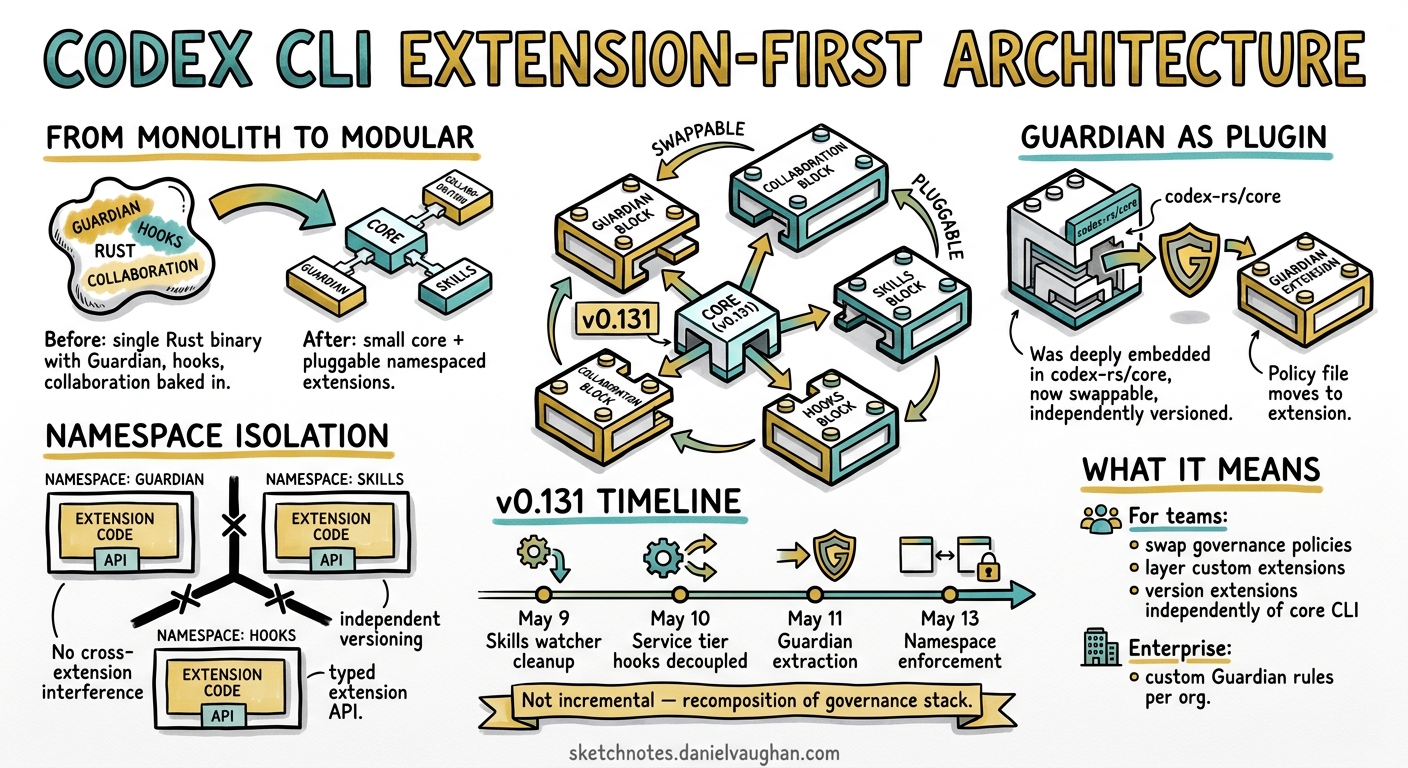
The v0.131 alpha track (May 9–13 2026) reveals a fundamental architectural shift inside Codex CLI: core features that were once monolithic internal components are migrating to pluggable, namespaced extensions 1. Guardian — the approval reviewer that sits between the agent and every sandbox-crossing action — is becoming an extension 2. Collaboration mode is an optional configuration toggle 3. The extension framework now enforces namespace isolation 4. This is not incremental improvement; it is a recomposition of the governance stack.
This article traces what changed, how the extension framework operates, and what it means for teams building on Codex CLI.
The Monolithic Starting Point
Until v0.130, Codex CLI’s architecture followed a familiar pattern: core features compiled into a single Rust binary, with extensibility limited to three surfaces:
- Plugins — installable bundles packaging skills, app integrations, MCP servers, and hooks into a distributable unit 5
- Hooks — PreToolUse and PostToolUse lifecycle callbacks configured in
config.tomlorhooks.json6 - MCP servers — external tool servers connected via stdio or streaming HTTP 7
Guardian, the auto-review subsystem, was deeply embedded in the core. Its policy lived at codex-rs/core/src/guardian/policy.md 8. Hooks were explicitly disabled during Guardian review sessions to prevent interference 8. The collaboration mode instructions were unconditionally injected. None of these could be swapped, layered, or independently versioned.
What Changed in v0.131
The alpha PRs tell a clear story:
timeline
    title v0.131 Extension-First Migration
    section May 9
        Skills watcher and apply_patch cleanup : Infrastructure for extension-managed skills
    section May 10
        Service tier hooks and trust refactor : Hook system decoupled from core
    section May 11
        Extension API and tool contracts : Extension framework formalised
    section May 12
        Guardian as extension : Core governance becomes pluggable
        Collaboration mode config toggle : Feature made optional
    section May 13
        Namespace in extension framework : Extension isolation via namespaces
        Plugin ID canonicalisation : Identity hygiene for multi-extension environments
        PreToolUse additionalContext spill fix : Hook robustness for extension-injected context
Three changes deserve particular attention.
Guardian Becomes an Extension
PR #22216 (May 12) moved Guardian from a hardcoded internal component to a pluggable extension 2. The immediate practical consequence: enterprises can configure whether Guardian loads at all, and the architecture now supports layering additional governance extensions alongside or instead of Guardian.
Guardian’s policy is configured via [auto_review] in config.toml:
approval_policy = "on-request"
approvals_reviewer = "auto_review"

[auto_review]
policy = """
Deny any command that writes outside the workspace.
Deny any network request to non-allowlisted domains.
Allow read-only filesystem operations.
"""
With Guardian as an extension, managed requirements can override this at the organisation level using guardian_policy_config, whilst project-level config.toml can refine policies for specific repositories 8. The extension boundary means Guardian’s review model (currently GPT-5.4 Thinking at low reasoning effort 9) can be updated independently of CLI version upgrades.
Namespace Isolation
PR #22556 (May 13) introduced namespacing into the extension framework 4. Plugin names already served as component namespaces — Codex uses the plugin name as the identifier and namespace throughout a session 5. The extension framework now extends this principle to all extensions, not just marketplace plugins.
The disambiguation rule follows the pattern $EXTENSION_NAME@$SOURCE:
guardian@core
my-policy@acme-marketplace
lint-reviewer@local
This prevents name collisions when multiple governance extensions coexist. A security team’s custom reviewer extension cannot accidentally shadow Guardian’s tool definitions, and two marketplace plugins from different vendors cannot claim the same hook namespace.
Plugin ID Canonicalisation
PR #22564 (May 13) enforced canonical plugin identifiers for shared workspace environments 3. When multiple developers share a workspace plugin configuration, slight variations in plugin naming (case differences, path differences) previously caused duplicate installations or broken references. Canonicalisation ensures that my-plugin, My-Plugin, and ./plugins/my-plugin all resolve to the same identity.
The Extension Framework Architecture
The extension framework that emerged from v0.131 supports three categories of extension:
graph TD
    A[Codex CLI Core] --> B[Extension Loader]
    B --> C[Governance Extensions]
    B --> D[Tool Extensions]
    B --> E[Workflow Extensions]

    C --> C1["Guardian (built-in)"]
    C --> C2[Custom Policy Engines]
    C --> C3[Compliance Reviewers]

    D --> D1[MCP Servers]
    D --> D2[Plugin-Bundled Tools]
    D --> D3[Skill Libraries]

    E --> E1[Collaboration Mode]
    E --> E2[Hooks Pipelines]
    E --> E3[Slash Commands]

    style C1 fill:#2d6a4f,color:#fff
    style C2 fill:#40916c,color:#fff
    style C3 fill:#52b788,color:#fff
Building a Plugin with Bundled Hooks
The plugin manifest at .codex-plugin/plugin.json declares all extension components:
{
  "name": "security-reviewer",
  "version": "1.0.0",
  "description": "Custom security review extension",
  "skills": "./skills/",
  "hooks": "./hooks/hooks.json",
  "mcpServers": "./.mcp.json",
  "interface": {
    "displayName": "Security Reviewer",
    "category": "Security",
    "capabilities": ["Read"]
  }
}
The hooks field accepts a path to a lifecycle JSON file, an array of paths, an inline object, or an array of inline objects 5. When Codex loads the plugin, its hooks are namespaced under the plugin name — a PreToolUse hook from security-reviewer cannot interfere with hooks from lint-checker.
The directory structure follows a strict convention:
security-reviewer/
├── .codex-plugin/
│   └── plugin.json
├── skills/
│   └── review/
│       └── SKILL.md
├── hooks/
│   └── hooks.json
├── .mcp.json
└── assets/
    └── icon.png
Hook Precedence with Extensions
When multiple hook sources exist — core configuration, project-level .codex/config.toml, and one or more plugin-bundled hooks — Codex loads all matching hooks 6. Higher-precedence config layers do not replace lower-precedence hooks; they accumulate. This means:
- A project’s
PreToolUsehook runs alongside a plugin’sPreToolUsehook - Either hook can block an action (PreToolUse supports blocking)
- PostToolUse hooks from all sources observe the same tool execution
The additionalContext spill fix in PR #22529 addressed a robustness issue where extension-injected context could overflow into unrelated hook evaluations 1.
Marketplace Distribution
Plugins distribute through marketplaces — local, git-backed, or (soon) the official Plugin Directory 5:
# Add a git-backed marketplace
codex plugin marketplace add owner/plugins-repo --ref main

# Install from CLI
codex plugin install security-reviewer@acme-marketplace

# Inspect bundled hooks before installing
codex plugin inspect security-reviewer --hooks
Local marketplaces use a marketplace.json manifest at $REPO_ROOT/.agents/plugins/:
{
  "name": "team-governance",
  "plugins": [
    {
      "name": "security-reviewer",
      "source": {
        "source": "local",
        "path": "./plugins/security-reviewer"
      },
      "policy": {
        "installation": "INSTALLED_BY_DEFAULT"
      }
    }
  ]
}
Setting installation to INSTALLED_BY_DEFAULT ensures every team member loading the repository gets the governance extension automatically 5.
What This Means for Enterprise Teams
Composable Governance Stacks
The extension-first pattern enables layered governance where each concern is an independent, versioned extension:
graph LR
    subgraph "Governance Stack"
        G[Guardian - sandbox policy] --> R[Compliance Reviewer - regulatory checks]
        R --> S[Security Scanner - SAST integration]
        S --> A[Audit Logger - OTEL export]
    end

    subgraph "Configuration"
        MT["Managed requirements.toml"] --> G
        PC[".codex/config.toml"] --> R
        PL["Plugin marketplace"] --> S
        PL --> A
    end
Each layer can be updated independently. A security team can ship a new version of their scanner extension without waiting for a CLI release. Regulated environments where CLI updates require change approval can pin the core CLI version whilst still receiving governance policy updates 10.
Selective Feature Loading
Features like collaboration mode (include_collaboration_mode_instructions) are now configuration toggles rather than unconditional injections 3. This reduces both attack surface and token consumption — collaboration mode instructions that are irrelevant for solo developers no longer consume context window budget.
The codex doctor Diagnostic Command
PR #22336 introduced codex doctor, a diagnostic command that checks extension health 1. Whilst current documentation focuses on /status and /debug-config for inline diagnostics 11, codex doctor provides a pre-flight check that validates:
- Extension manifest integrity
- Hook configuration consistency
- MCP server connectivity
- Plugin version compatibility
Comparison with Other Agent Architectures
| Capability | Codex CLI v0.131 | Claude Code | GitHub Copilot |
|---|---|---|---|
| Core features as extensions | Yes (emerging) | No (monolithic) | Partial (providers) |
| Namespaced extension tools | Yes | No | No |
| Plugin-bundled hooks | Yes | No | No |
| Custom governance extensions | Yes (Guardian-as-ext) | No | Limited |
| Independent extension versioning | Planned | No | Yes (VS Code extensions) |
| Extension health diagnostics | Yes (codex doctor) |
No | No |
Claude Code bundles its governance, tool definitions, and hooks into a single binary with no extension seams 12. GitHub Copilot supports VS Code extension providers but does not expose its governance layer as swappable 13. Codex CLI’s approach is architecturally closer to a microkernel: the core handles the agent loop, sandbox, and model communication, whilst everything else migrates outward.
Practical Recommendations
For teams already using Codex CLI plugins:
- Audit plugin names — canonicalisation may surface duplicate installations. Run
codex plugin listand check for near-duplicates. - Move hooks into plugins — if you maintain separate
hooks.jsonfiles, bundle them into your plugin manifest for namespace isolation. - Pin marketplace refs — use
--refwith specific tags rather thanmainfor production governance plugins.
For enterprise platform teams:
- Design governance as extensions — build custom policy engines as plugins with bundled hooks, distributing via internal marketplaces with
INSTALLED_BY_DEFAULT. - Layer, don’t replace — Guardian remains a strong default. Add custom reviewers alongside it rather than disabling it.
- Use managed requirements — set
allowed_approvals_reviewersandguardian_policy_configin managedrequirements.tomlto enforce organisational baselines that project-level config cannot override 8.
For tool builders:
- Adopt kebab-case names now — plugin names are identifiers and namespaces. Renaming a published plugin is a breaking change 5.
- Ship hooks with your plugin — the
hooksmanifest field makes governance portable. A Terraform plugin can shipPreToolUsehooks that validate plan output before apply 6. - Test with
codex doctor— validate extension health before distribution.
What to Watch
The extension-first migration is incomplete. Guardian is the first core feature to cross the boundary, but the pattern suggests others will follow. Watch for:
- Extension SDK or template for third-party governance layers
- Extension marketplace (beyond the current plugin marketplace) for governance-specific extensions
- Cross-extension communication — whether extensions can declare dependencies on other extensions
- Extension sandboxing — whether extensions themselves run in isolated contexts to prevent a malicious plugin from compromising governance
The v0.131 track marks the point where Codex CLI stopped being a monolithic agent and started becoming an agent platform. For teams investing in Codex CLI for production workflows, the extension-first pattern is the architectural foundation everything else will build on.
Citations
-
Codex CLI v0.131 alpha PRs — GitHub openai/codex releases — v0.131.0-alpha.1 through alpha.9+, May 9–13 2026 ↩ ↩2 ↩3
-
Codex CLI PR #22216 — Guardian as extension — Guardian migration to pluggable extension, May 12 2026 ⚠️ PR number from internal research notes; verify against public PR list ↩ ↩2
-
Codex CLI PR #22383, #22564 — Collaboration mode toggle and plugin ID canonicalisation — May 12–13 2026 ⚠️ PR numbers from internal research notes ↩ ↩2 ↩3
-
Codex CLI PR #22556 — Namespace in extension framework — Extension isolation via namespaces, May 13 2026 ⚠️ PR number from internal research notes ↩ ↩2
-
Build plugins — Codex, OpenAI Developers — Plugin manifest format, directory structure, marketplace configuration, naming conventions ↩ ↩2 ↩3 ↩4 ↩5 ↩6
-
Hooks — Codex, OpenAI Developers — PreToolUse, PostToolUse lifecycle hooks, hook loading from multiple sources ↩ ↩2 ↩3
-
Features — Codex CLI, OpenAI Developers — MCP server configuration via config.toml and CLI commands ↩
-
Agent approvals and security — Codex, OpenAI Developers — Guardian policy, auto-review configuration, managed requirements override ↩ ↩2 ↩3 ↩4
-
Auto-review of agent actions without synchronous human oversight — OpenAI Alignment — Auto-review architecture, GPT-5.4 Thinking reviewer, 99.1% approval rate, safety claims ↩
-
Advanced Configuration — Codex, OpenAI Developers — Configuration layers, managed requirements, policy enforcement ↩
-
Command line options — Codex CLI, OpenAI Developers —
/status,/debug-configdiagnostic commands ↩ -
Codex CLI — OpenAI Developers — Codex CLI architecture overview, Rust implementation ↩
-
IDE extension — Codex, OpenAI Developers — Codex IDE extension and VS Code integration ↩