Codex CLI for Event-Driven Architecture: AsyncAPI Contracts, Schema Registry Workflows, and Consumer Generation
Codex CLI for Event-Driven Architecture: AsyncAPI Contracts, Schema Registry Workflows, and Consumer Generation
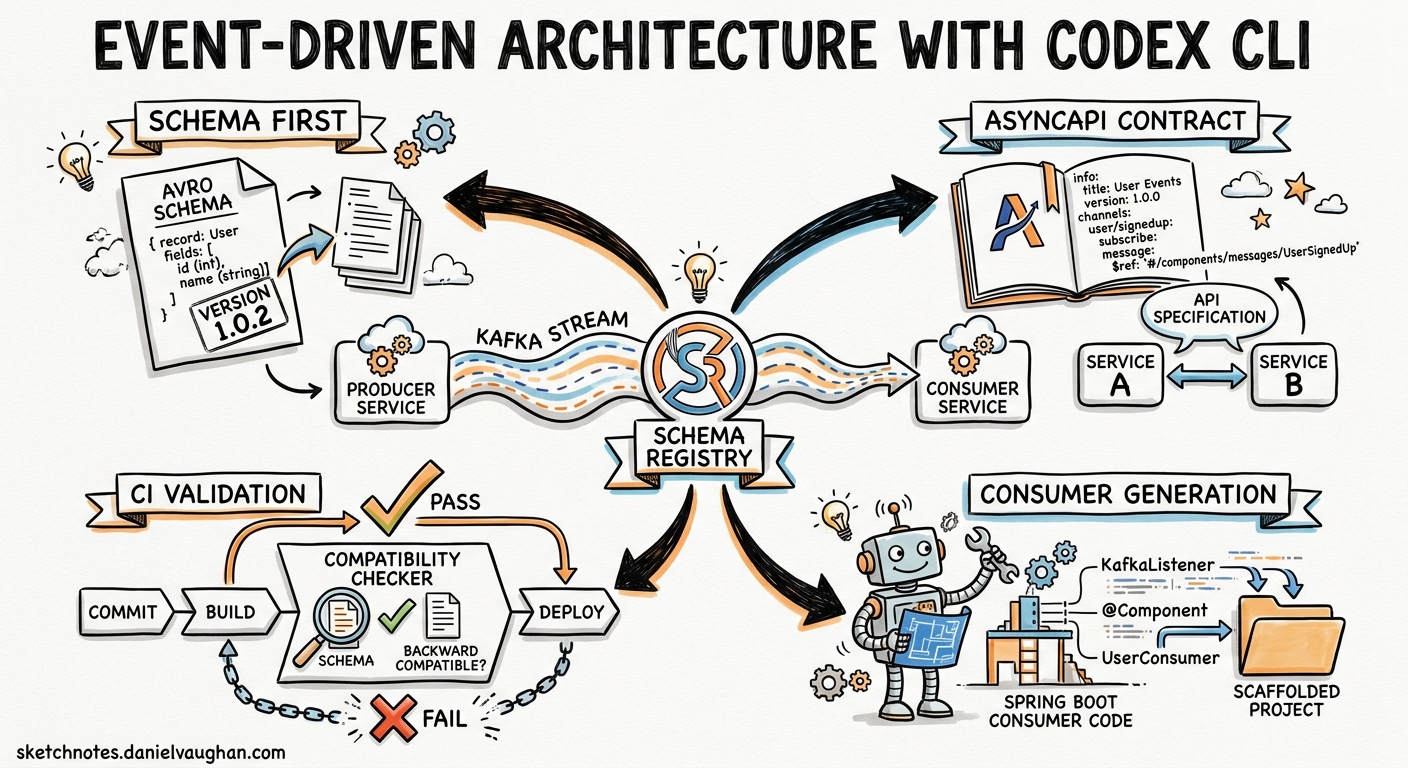
Event-driven architecture (EDA) is experiencing a renaissance. The convergence of streaming SQL, AI-powered state views, and the CloudEvents specification has moved EDA from “hard to get right” to “essential for scalable systems”.1 Yet the tooling gap remains: writing Avro schemas, maintaining AsyncAPI contracts, generating consumer boilerplate, and validating message flow compatibility are all tedious, error-prone tasks that sit squarely in Codex CLI’s sweet spot.
This article covers a complete agent-driven EDA development workflow — from schema-first contract design through consumer generation and CI validation — using Codex CLI’s skills, non-interactive pipelines, and structured output.
Why EDA Development Benefits from Agent Assistance
Three properties of EDA development make it particularly amenable to AI agents:
- High boilerplate-to-logic ratio. A Kafka consumer in Spring Boot requires serialiser configuration, error handling, retry policies, dead-letter routing, and schema binding — all before a single line of business logic.2
- Strict schema contracts. Avro, Protobuf, and JSON Schema enforce structural rules that an agent can validate mechanically.3
- Cross-service coordination. Schema evolution affects every downstream consumer; tracing compatibility is a graph problem that benefits from automated analysis.
AGENTS.md for Event-Driven Projects
Encode your EDA conventions in AGENTS.md so that every Codex session respects them without manual repetition:4
## Event-Driven Architecture Standards

### Schema Conventions
- All event schemas use Avro (.avsc) stored in `schemas/`
- Namespace pattern: `com.company.domain.events.v{major}`
- Every schema MUST include a `metadata` record with:
  - `event_id` (string, UUID)
  - `event_type` (string, CloudEvents `type` field)
  - `event_time` (long, Unix millis)
  - `source` (string, CloudEvents `source` URI)
- Schema evolution: BACKWARD compatibility enforced via Schema Registry

### Consumer Standards
- All consumers implement idempotent processing (dedup on event_id)
- Dead-letter topic naming: `{topic}.dlq`
- Retry policy: exponential backoff, max 3 attempts
- Consumer group ID pattern: `{service-name}.{topic}.{environment}`

### Validation Commands
- Schema compatibility: `mvn schema-registry:compatibility`
- AsyncAPI lint: `asyncapi validate asyncapi.yaml`
- Consumer contract test: `./gradlew contractTest`
Schema-First Development with Codex CLI
Generating Avro Schemas from Domain Events
Start by describing your domain events in natural language and let Codex generate compliant schemas:
codex "Generate an Avro schema for an OrderPlaced event following our
AGENTS.md conventions. Include fields: order_id (UUID), customer_id (UUID),
items (array of {sku, quantity, unit_price}), total_amount, currency (ISO 4217),
and our standard metadata record."
Codex reads AGENTS.md, understands the namespace pattern and metadata requirements, and produces:
{
  "type": "record",
  "name": "OrderPlaced",
  "namespace": "com.company.orders.events.v1",
  "fields": [
    {"name": "metadata", "type": "com.company.common.events.v1.EventMetadata"},
    {"name": "order_id", "type": {"type": "string", "logicalType": "uuid"}},
    {"name": "customer_id", "type": {"type": "string", "logicalType": "uuid"}},
    {"name": "items", "type": {"type": "array", "items": {
      "type": "record",
      "name": "OrderItem",
      "fields": [
        {"name": "sku", "type": "string"},
        {"name": "quantity", "type": "int"},
        {"name": "unit_price", "type": {"type": "bytes", "logicalType": "decimal", "precision": 10, "scale": 2}}
      ]
    }}},
    {"name": "total_amount", "type": {"type": "bytes", "logicalType": "decimal", "precision": 12, "scale": 2}},
    {"name": "currency", "type": "string"}
  ]
}
AsyncAPI Contract Generation
AsyncAPI serves as the “OpenAPI for event-driven APIs,” describing channels, operations, and message schemas in a single machine-readable document.5 Generate one from your existing schemas:
codex "Generate an AsyncAPI 3.0 document for our orders domain.
Channels: orders.placed (pub), orders.confirmed (pub), orders.cancelled (pub).
Use our Avro schemas in schemas/ as payload references.
Include Kafka bindings with partitionKey on order_id."
The resulting asyncapi.yaml provides a single source of truth for producers, consumers, and documentation generators.
Consumer Generation Skill
Package your consumer generation workflow as a reusable skill:
# .agents/skills/generate-consumer/SKILL.md

## Trigger
"generate consumer for {topic}", "scaffold kafka consumer", "new event handler"

## Workflow
1. Read the AsyncAPI document to identify the channel and message schema
2. Determine the target language from the project's build system
3. Generate consumer class with:
   - Schema-specific deserialiser configuration
   - Idempotency guard (dedup on event_id using a local cache or database)
   - Dead-letter routing on deserialisation failure
   - Structured logging with correlation ID from metadata
   - Health check endpoint integration
4. Generate corresponding integration test using Testcontainers + embedded Kafka
5. Update the AsyncAPI document's `x-consumers` extension

## Constraints
- Follow AGENTS.md consumer standards
- Never generate consumers without a corresponding test
- Use the project's existing error handling patterns
Invoke with:
codex "Generate a consumer for the orders.placed topic in the payments service"
Schema Evolution Validation Pipeline
Schema evolution is where EDA projects most frequently break. Use codex exec to build a CI gate that catches incompatible changes before they reach production:6
codex exec \
  -m gpt-5.4-mini \
  --output-schema '{"type":"object","properties":{"compatible":{"type":"boolean"},"breaking_changes":{"type":"array","items":{"type":"string"}},"migration_steps":{"type":"array","items":{"type":"string"}},"risk_level":{"type":"string","enum":["none","low","medium","high"]}},"required":["compatible","breaking_changes","risk_level"]}' \
  "Analyse the schema diff between schemas/v1/OrderPlaced.avsc and
   schemas/v2/OrderPlaced.avsc. Check BACKWARD compatibility per
   Confluent Schema Registry rules. Report breaking changes and
   suggest migration steps."
This produces structured JSON that your CI pipeline can parse:
{
  "compatible": false,
  "breaking_changes": [
    "Removed field 'currency' without default value",
    "Changed 'total_amount' from decimal to double (precision loss)"
  ],
  "migration_steps": [
    "Add default value 'GBP' to currency field before removal",
    "Introduce total_amount_v2 as double, deprecate original with default"
  ],
  "risk_level": "high"
}
End-to-End Workflow Diagram
flowchart TD
    A[Domain Event Design] --> B[Generate Avro Schema]
    B --> C[Register with Schema Registry]
    C --> D[Generate AsyncAPI Contract]
    D --> E[Generate Producer Code]
    D --> F[Generate Consumer Code]
    E --> G[Producer Integration Test]
    F --> H[Consumer Integration Test]
    G --> I{Schema Compatibility Check}
    H --> I
    I -->|Pass| J[Deploy to Staging]
    I -->|Fail| K[Agent Suggests Migration]
    K --> B

    style A fill:#e1f5fe
    style I fill:#fff3e0
    style J fill:#e8f5e9
    style K fill:#fce4ec
CloudEvents Envelope Validation
CloudEvents provides a standard envelope format for event data that ensures interoperability across platforms.7 Use a Codex hook to validate every generated event conforms:
# config.toml
[[hooks]]
type = "post-tool-use"
event = "file_write"
match_path = "schemas/**/*.avsc"
command = "python scripts/validate_cloudevents_envelope.py $FILE_PATH"
The validation script checks that every schema includes the required CloudEvents attributes (id, source, type, specversion, time) within its metadata record.
Model Selection for EDA Tasks
| Task | Recommended Model | Rationale |
|---|---|---|
| Schema generation from requirements | gpt-5.5 | Complex domain modelling requires strong reasoning8 |
| Consumer boilerplate generation | gpt-5.4-mini | Mechanical code generation, cost-efficient8 |
| Schema compatibility analysis | gpt-5.4 | Nuanced rule application (Avro compatibility matrix) |
| AsyncAPI document generation | gpt-5.4-mini | Structured YAML output, well-defined format |
| Migration strategy planning | gpt-5.5 | Cross-service impact analysis requires broad context |
GitHub Actions Integration
Wire the schema validation into your CI pipeline:
name: Schema Compatibility Gate
on:
  pull_request:
    paths:
      - 'schemas/**'
      - 'asyncapi.yaml'

jobs:
  validate-schemas:
    runs-on: ubuntu-latest
    steps:
      - uses: actions/checkout@v4
      - uses: openai/codex-action@v1
        with:
          model: gpt-5.4-mini
          prompt: |
            Validate all modified schemas in this PR for BACKWARD
            compatibility. Check the AsyncAPI document references
            are consistent. Report findings as GitHub PR comments.
          output-schema: |
            {"type":"object","properties":{"pass":{"type":"boolean"},"findings":{"type":"array","items":{"type":"string"}}}}
Multi-Service Schema Coordination with Subagents
For organisations with multiple services consuming shared events, delegate cross-service impact analysis to subagents:9
codex "I'm adding a 'loyalty_tier' field to OrderPlaced.
Use subagents to check each downstream consumer (payments-service,
inventory-service, analytics-service) for compatibility.
Report which services need updates and generate the required changes."
Each subagent analyses one service’s consumer code against the proposed schema change, then reports back with a structured compatibility assessment. This parallelises what would otherwise be a tedious manual review across repositories.
Anti-Patterns to Avoid
Schema sprawl without governance. Letting Codex generate schemas freely without AGENTS.md constraints leads to inconsistent naming, missing metadata, and undocumented evolution.
Skipping the AsyncAPI contract. Generating producers and consumers directly from Avro schemas without an intermediary contract document makes it impossible to understand the full system topology.
Testing only happy paths. Always generate tests for deserialisation failures, schema mismatches, and dead-letter routing — not just successful message processing.
Over-engineering schema versioning. Prefer BACKWARD compatibility (new schema can read old data) for most use cases. FULL compatibility adds complexity without proportional benefit unless you have genuine bidirectional version requirements.3
Known Limitations
- Sandbox network isolation. Codex CLI cannot connect to a live Schema Registry during generation.10 Pre-fetch compatibility rules or run validation as a post-generation CI step.
- Large schema graphs. Avro schemas with deep
$refchains may exceed context limits. Use subagents to handle individual schema files. - AsyncAPI 3.0 coverage. The specification is still maturing; Codex may occasionally generate AsyncAPI 2.x syntax. Pin version requirements in
AGENTS.md.
Citations
-
RisingWave, “Event-Driven Architecture in 2026: Kafka, Streaming SQL, and the AI Layer,” https://risingwave.com/blog/event-driven-architecture-2026/ ↩
-
Matthaios Stavrou, “Building a Kafka Event-Driven Spring Boot Application with Avro, Schema Registry and PostgreSQL,” Medium, January 2026, https://medium.com/@mstauroy/building-a-kafka-event-driven-spring-boot-application-with-avro-schema-registry-and-postgresql-45114526fb87 ↩
-
Confluent Documentation, “Schema Registry for Confluent Platform,” https://docs.confluent.io/platform/current/schema-registry/index.html ↩ ↩2
-
OpenAI Developers, “Best practices — Codex,” https://developers.openai.com/codex/learn/best-practices ↩
-
AsyncAPI Initiative, “AsyncAPI and CloudEvents,” https://www.asyncapi.com/blog/asyncapi-cloud-events ↩
-
OpenAI Developers, “CLI — Codex,” https://developers.openai.com/codex/cli ↩
-
CloudEvents Specification, via AsyncAPI, “AsyncAPI, CloudEvents, OpenTelemetry: Which Event-Driven Specs Should Your DevOps Include?” https://www.asyncapi.com/blog/async_standards_compare ↩
-
OpenAI Developers, “Models — Codex,” https://developers.openai.com/codex/models ↩ ↩2
-
OpenAI Developers, “Features — Codex CLI,” https://developers.openai.com/codex/cli/features ↩
-
OpenAI Developers, “CLI — Codex: Sandbox,” https://developers.openai.com/codex/cli ↩