Codex's Three-Tier Browser Architecture: Plugins, Chrome Extension, and Sandboxed Browser
Codex’s Three-Tier Browser Architecture
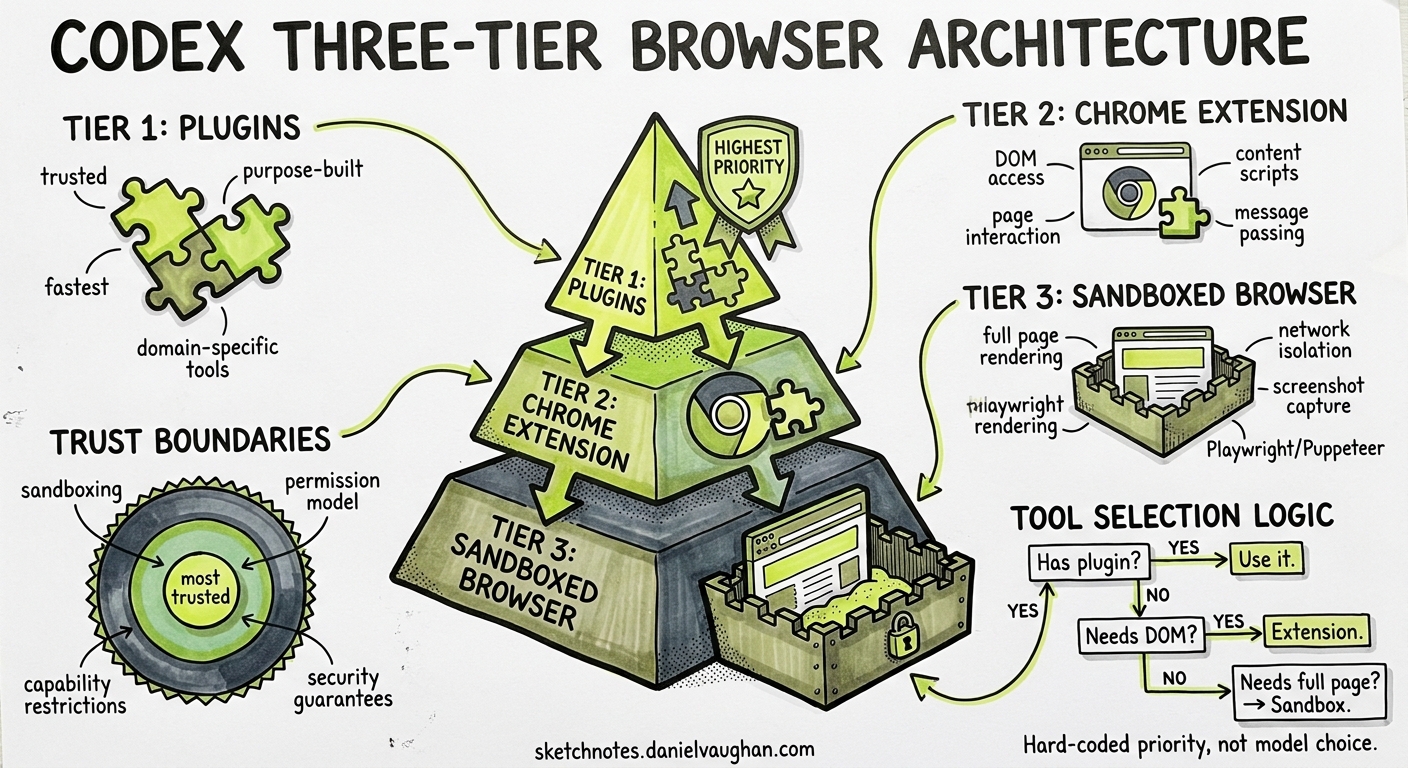
Codex implements a hierarchical browser tool system that solves a fundamental challenge in agentic systems: tool selection as a first-class problem. Rather than letting models freely choose among tools, Codex hard-codes selection priorities based on trust boundaries and sandboxing requirements.
The Three Tiers
Tier 1: Dedicated Plugins (highest priority)
Plugin integrations provide structured API access to services (GitHub, Slack, Figma, Linear, etc.). Benefits:
- API-grade reliability and predictable schemas
- Cleaner audit trails
- Faster performance for well-defined operations
- No browser state required
Tier 2: Chrome Extension (signed-in browser)
The Chrome extension (v1.1.4, released May 7 2026) operates inside your actual Chrome profile with existing cookies and authentication tokens. Use cases:
- Internal dashboards and staging environments
- Services requiring user sessions (LinkedIn, Salesforce, Gmail)
- Any site reachable through your current login state
- Runs in isolated Chrome tabs (doesn’t commandeer active browsing)
Explicit invocation: @Chrome open [tool] and do [thing]
Tier 3: In-App Browser (sandboxed)
Built on Atlas technology. Never reads from or writes to your Chrome profile. Handles:
- Localhost development servers
- Local file previews
- Public pages without authentication requirements
Tool Selection Mechanism
Deterministic priority stack: plugins -> Chrome -> in-app browser
Codex analyses the task description to select the appropriate tier automatically:
- If a dedicated plugin exists for the service, use it
- If the task requires authenticated browser access and no plugin exists, use Chrome
- If the task is local or doesn’t require authentication, use in-app browser
Developers can override automatic selection with explicit @Chrome syntax.
Implications for Agentic Workflows
Predictability over flexibility: By hard-coding selection priorities, Codex reduces tool selection errors that compound with task complexity. This is a deliberate architectural choice - trading model autonomy for deterministic routing.
Trust boundaries: Each tier operates within distinct security perimeters. Plugins have scoped API access, Chrome has user-session scope, and the in-app browser is fully sandboxed.
Enterprise governance: The tiered model means administrators can control which plugins are available, which sites Chrome can access (allowlist/blocklist), and what the sandboxed browser can reach - all independently.
Key Takeaway
“Tool selection is a first-class problem in agentic systems.” The three tiers are designed to work together, not replace each other. More precise tools are always preferred when available, with fallback mechanisms for less-structured interactions.