The Axios Supply Chain Attack: How It Hit Codex CLI's Signing Pipeline and What Teams Should Learn
The Axios Supply Chain Attack: How It Hit Codex CLI’s Signing Pipeline and What Teams Should Learn
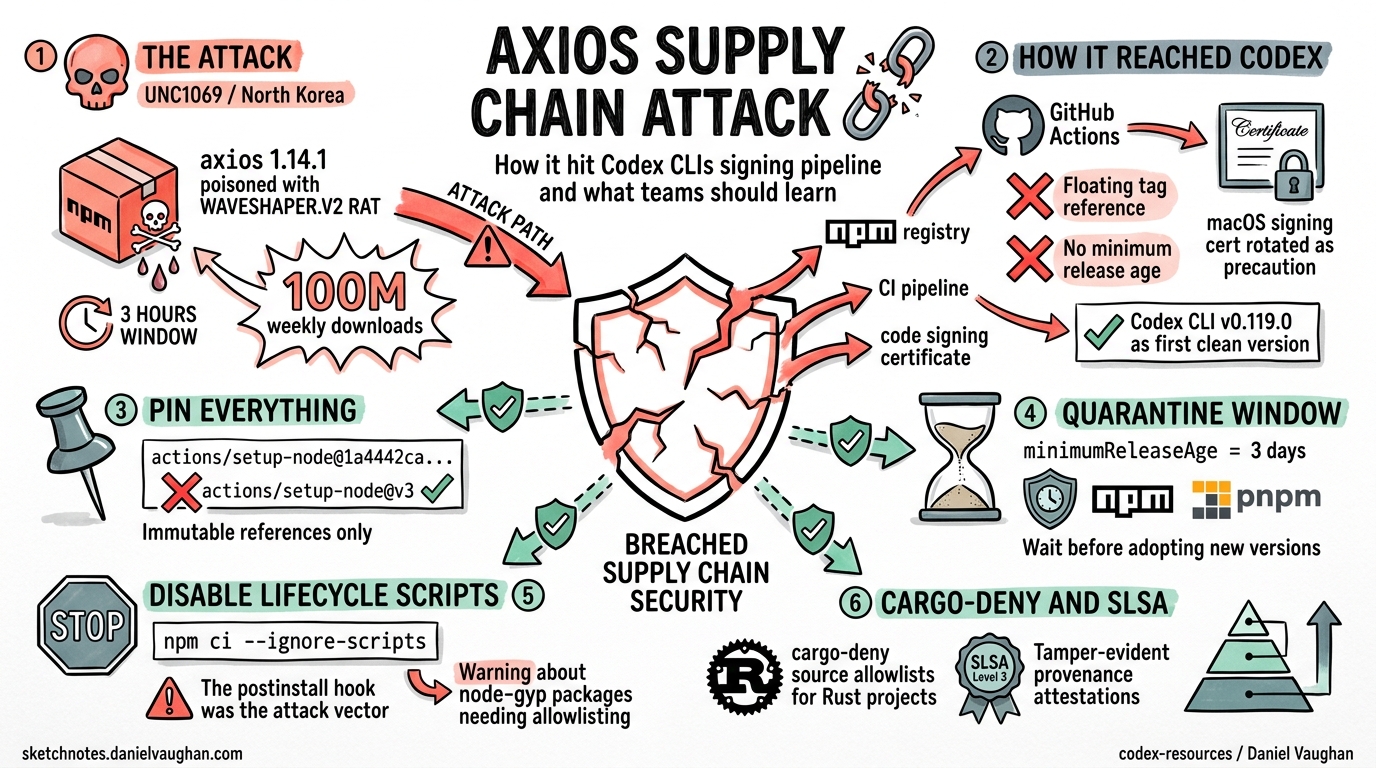
On 31 March 2026, a North Korean threat actor compromised the Axios npm package — the most popular HTTP client in the JavaScript ecosystem, with over 100 million weekly downloads 1. Within hours, the malicious payload had reached OpenAI’s macOS code-signing pipeline, touching Codex CLI, the Codex App, ChatGPT Desktop, and Atlas 2. No user data was compromised, but OpenAI revoked and rotated its macOS signing certificate as a precaution 2.
This article dissects what happened, why Codex CLI was exposed, and — most importantly — the concrete CI/CD hardening measures that OpenAI shipped in response. If you maintain a build pipeline that consumes npm packages or GitHub Actions, the lessons here apply directly.
The Attack: Three Hours, Global Blast Radius
Between 00:21 and 03:20 UTC on 31 March, an attacker who had compromised the Axios maintainer’s npm account published two poisoned versions: 1.14.1 and 0.30.4 1. Both injected a dependency called plain-crypto-js@4.2.1 whose postinstall hook silently deployed WAVESHAPER.V2, a cross-platform remote access trojan (RAT) 3.
Google’s Threat Intelligence Group attributed the attack to UNC1069, a financially motivated North Korea-nexus actor active since at least 2018 3. Microsoft independently attributed the infrastructure to Sapphire Sleet 4.
sequenceDiagram
    participant Attacker as UNC1069
    participant npm as npm Registry
    participant CI as OpenAI GitHub Actions
    participant Cert as macOS Signing Cert

    Attacker->>npm: Publish axios@1.14.1 (poisoned)
    Note over npm: plain-crypto-js postinstall hook
    CI->>npm: npm install (floating tag)
    npm-->>CI: axios@1.14.1 + WAVESHAPER.V2
    CI->>Cert: Workflow has access to cert material
    Note over CI,Cert: Certificate likely NOT exfiltrated<br/>(timing + sequencing mitigations)
    CI-->>Attacker: RAT beacon attempted
The poisoned versions were pulled from the registry approximately three hours later, but during that window roughly 3% of Axios’s user base downloaded them 1.
How It Reached Codex CLI
OpenAI’s macOS app-signing process ran inside a GitHub Actions workflow. That workflow consumed npm packages — including Axios — as part of its build tooling. Two misconfigurations created the exposure 2:
- Floating tag reference: The Actions workflow used a mutable version tag for a dependency rather than pinning to an immutable commit SHA.
- No minimum release age: There was no
minimumReleaseAgeconfigured, meaning freshly published (and potentially malicious) package versions were consumed immediately.
The workflow had access to Apple code-signing certificate material and notarisation credentials. OpenAI’s post-incident analysis concluded that the certificate was likely not exfiltrated due to the timing of payload execution relative to certificate injection into the job 2. Nevertheless, OpenAI treated it as compromised and rotated all signing material.
Affected Applications and New Certificate Versions
| Application | First Clean Version |
|---|---|
| ChatGPT Desktop | 1.2026.051 |
| Codex App | 26.406.40811 |
| Codex CLI | 0.119.0 |
| Atlas | 1.2026.84.2 |
Effective 8 May 2026, older macOS builds signed with the revoked certificate will no longer receive updates and may cease to function 2. If you’re running Codex CLI on macOS, ensure you’re on v0.119.0 or later.
OpenAI’s Hardening Response
The Codex CLI changelog for April 2026 includes a dedicated supply-chain hardening entry (PR #17471) 5 that addresses the root causes directly. Here’s what changed.
GitHub Actions Pinning
Every third-party GitHub Action in the Codex CI pipeline is now referenced by full-length commit SHA rather than a mutable tag 56.
Before (vulnerable):
# ❌ Floating tag — attacker can retag to malicious commit
- uses: actions/setup-node@v4
After (hardened):
# ✅ Immutable SHA pin — code can't change without updating hash
- uses: actions/setup-node@1a4442cacd436585916f13e47d78e0d8b4e9c8b3 # v4.2.0
This is the only way to reference an Action immutably 6. Tags and branches are mutable — an attacker with repository access can repoint them to arbitrary commits, as demonstrated in the tj-actions/changed-files compromise of March 2025 that affected over 23,000 repositories 6.
Cargo and Rust Supply Chain
The hardening extends beyond npm into Codex CLI’s Rust build pipeline 5:
- Cargo install pins: All
cargo installinvocations pin to exact versions with--lockedto respectCargo.lock. - Git dependency pins: Git-sourced crate dependencies use specific commit SHAs rather than branch references.
- V8 checksum verification: V8 engine binaries consumed during build are verified against known checksums.
- cargo-deny source allowlists: The
cargo-denytool enforces an explicit allowlist of crate registries and git sources, blocking unexpected dependency sources.
Bazel Release Verification
PR #17704 added Bazel release-build verification, ensuring release-only Rust code is compiled within PR CI 5. This catches divergence between what developers test and what ships in the release binary.
Defence-in-Depth: What Your Team Should Implement
The Axios incident and OpenAI’s response illustrate a layered defence model that any team running CI/CD pipelines should adopt.
1. Pin Everything to Immutable References
# GitHub Actions — pin to full SHA
- uses: actions/checkout@11bd71901bbe5b1630ceea73d27597364c9af683 # v4.2.2

# npm — use exact versions, commit lockfiles
npm config set save-exact true
npm ci  # Respects lockfile exactly, unlike npm install
Use Dependabot or Renovate to automate SHA updates when upstream actions release new versions 6. This gives you immutability without maintenance burden.
2. Enforce a Minimum Release Age
A minimumReleaseAge acts as a quarantine window, giving the security community time to detect poisoned packages before they enter your pipeline 7.
# Renovate config — wait 3 days before adopting new versions
[packageRules]
  minimumReleaseAge = "3 days"
# npm v11.10.0+ — reject packages published less than 7 days ago
npm config set min-release-age=7 --global
pnpm supports this natively too: setting minimumReleaseAge to 1440 blocks packages published less than 24 hours ago 7.
3. Disable Lifecycle Scripts in CI
The Axios attack relied on a postinstall hook to execute the dropper 1. Disabling lifecycle scripts in CI removes this attack vector entirely:
# In CI pipelines
npm ci --ignore-scripts

# Or globally
npm config set ignore-scripts true
⚠️ This may break packages that require postinstall compilation (e.g., node-gyp native addons). Test thoroughly and allowlist specific packages if needed.
4. Use cargo-deny for Rust Projects
If your project includes Rust (as Codex CLI does), cargo-deny provides static analysis of your dependency graph 5:
# deny.toml
[sources]
unknown-registry = "deny"
unknown-git = "deny"
allow-registry = ["https://github.com/rust-lang/crates.io-index"]
allow-git = []
This blocks any crate sourced from an unexpected registry or git repository.
5. Implement SLSA Provenance
The Supply-chain Levels for Software Artifacts (SLSA) framework provides a maturity model for build integrity 8. At SLSA Level 3, builds are performed on hosted infrastructure with tamper-evident provenance. npm now supports provenance attestations via --provenance on npm publish, and GitHub Actions can generate them automatically for supported CI platforms 8.
graph TD
    A[Developer Commits Code] --> B[CI Pipeline Triggers]
    B --> C{Dependency Resolution}
    C -->|Pin to SHA| D[Immutable Action Refs]
    C -->|min-release-age| E[Quarantine Window]
    C -->|ignore-scripts| F[No Lifecycle Hooks]
    D --> G[Build Artefact]
    E --> G
    F --> G
    G --> H[cargo-deny / npm audit]
    H --> I[SLSA Provenance Attestation]
    I --> J[Code Signing with Rotated Cert]
    J --> K[Release]

    style D fill:#2d6a4f,color:#fff
    style E fill:#2d6a4f,color:#fff
    style F fill:#2d6a4f,color:#fff
    style H fill:#2d6a4f,color:#fff
    style I fill:#2d6a4f,color:#fff
Broader Implications for Agentic Tooling
The Axios incident carries a specific warning for teams building on agentic coding tools. Codex CLI, Claude Code, Cursor, and similar tools all consume complex dependency trees — npm packages, Python packages, Rust crates, MCP servers, and community plugins. Each dependency is a potential entry point.
The Codex CLI ecosystem is particularly exposed because:
- Skills and plugins pull from git repositories and npm packages at install time.
- MCP servers run as subprocesses with access to the filesystem and network.
- GitHub Actions integrations (via
openai/codex-action) run in CI with elevated permissions.
OpenAI’s hardening of PR #17471 sets a baseline, but teams should extend the same discipline to their own skill installations, MCP server dependencies, and plugin marketplace sources. The requirements.toml feature for enterprise MCP whitelisting 9 and the execution policy rules system 10 provide additional layers of governance.
What to Do Right Now
If you’re a Codex CLI user on macOS:
- Update immediately to v0.119.0 or later — run
codex updateor reinstall via your package manager. - Verify your version:
codex --versionshould show 0.119.0+. - Before 8 May 2026: all macOS OpenAI apps on the old certificate will stop working 2.
If you maintain CI/CD pipelines:
- Audit your GitHub Actions for floating tag references — pin every action to a full SHA.
- Enable
minimumReleaseAgein Renovate or Dependabot. - Run
npm ci --ignore-scriptsin CI and allowlist only necessary lifecycle hooks. - For Rust projects, adopt
cargo-denywith explicit source allowlists. - Review your code-signing workflow — ensure certificate material is injected as late as possible and scoped to the minimum necessary job steps.
Citations
-
Google Cloud Blog, “North Korea-Nexus Threat Actor Compromises Widely Used Axios NPM Package in Supply Chain Attack,” April 2026. https://cloud.google.com/blog/topics/threat-intelligence/north-korea-threat-actor-targets-axios-npm-package ↩ ↩2 ↩3 ↩4
-
OpenAI, “Our response to the Axios developer tool compromise,” 13 April 2026. https://openai.com/index/axios-developer-tool-compromise/ ↩ ↩2 ↩3 ↩4 ↩5 ↩6
-
The Hacker News, “Google Attributes Axios npm Supply Chain Attack to North Korean Group UNC1069,” April 2026. https://thehackernews.com/2026/04/google-attributes-axios-npm-supply.html ↩ ↩2
-
Microsoft Security Blog, “Mitigating the Axios npm supply chain compromise,” 1 April 2026. https://www.microsoft.com/en-us/security/blog/2026/04/01/mitigating-the-axios-npm-supply-chain-compromise/ ↩
-
OpenAI Codex Changelog, “Hardened supply-chain and CI inputs,” April 2026. https://developers.openai.com/codex/changelog ↩ ↩2 ↩3 ↩4 ↩5
-
StepSecurity, “Pinning GitHub Actions for Enhanced Security: Everything You Should Know,” 2026. https://www.stepsecurity.io/blog/pinning-github-actions-for-enhanced-security-a-complete-guide ↩ ↩2 ↩3 ↩4
-
pnpm Documentation, “Mitigating supply chain attacks.” https://pnpm.io/supply-chain-security ↩ ↩2
-
Bastion, “12 Best Practices to Prevent Software Supply Chain Attacks (2026).” https://bastion.tech/blog/software-supply-chain-attack-prevention-best-practices/ ↩ ↩2
-
Socket.dev, “Axios Supply Chain Attack Reaches OpenAI macOS Signing Pipeline, Forces Certificate Rotation.” https://socket.dev/blog/axios-supply-chain-attack-reaches-openai-macos-signing-pipeline-forces-certificate-rotation ↩
-
OpenAI Codex Developers, “Security.” https://developers.openai.com/codex/security ↩