Codex CLI's Plugin Architecture Matures: codex-core-plugins Extraction and FedRAMP Routing
Codex CLI’s Plugin Architecture Matures: codex-core-plugins Extraction and FedRAMP Routing
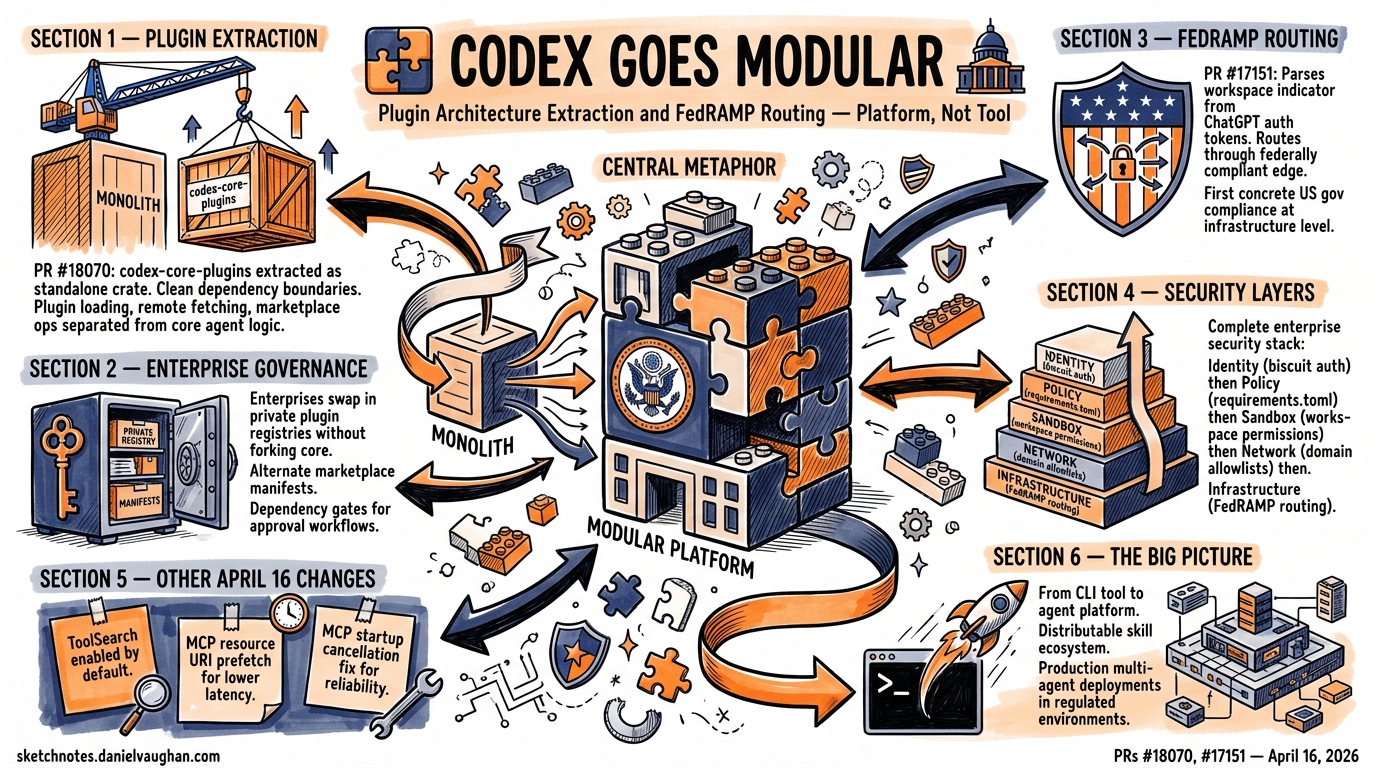
Two PRs merged on April 16, 2026 signal Codex CLI’s transition from a monolithic coding tool to a modular, enterprise-grade platform: the extraction of plugin infrastructure into a standalone codex-core-plugins crate (#18070), and FedRAMP-compliant authentication routing for government workspaces (#17151).
codex-core-plugins: The Modularization PR (#18070)
PR #18070 extracts all plugin loading and marketplace logic from codex-core into a dedicated codex-core-plugins module. This is architecturally significant for three reasons:
-
Clean dependency boundaries — Plugin infrastructure (loading, remote fetching, marketplace operations) no longer lives alongside core agent logic. Core can evolve independently of the plugin system.
-
Composable subsystems — The new crate structure (
codex-rs/core-plugins/src/loader.rs,codex-rs/core-plugins/src/remote.rs) enables plugin loading to be tested, versioned, and extended without touching core agent behavior. -
Enterprise plugin governance — Combined with alternate marketplace manifests (#17885) and dependency gates (#17960), this modularization enables enterprises to swap in private plugin registries without forking core.
The refactoring removed redundant proxy methods from core that merely forwarded to the plugin subsystem, consolidating remote plugin management into clean public APIs.
Why This Matters for the Agentic Pod
In a multi-agent setup, each agent may need different skills loaded from different sources (marketplace, local, enterprise registry). With plugins as a separate crate, orchestration layers can manage plugin lifecycles independently of agent sessions — load a skill for one agent without affecting others.
FedRAMP Routing (#17151)
PR #17151 adds FedRAMP-compliant infrastructure routing for ChatGPT-authenticated government users:
- Parses a FedRAMP workspace indicator from ChatGPT auth tokens
- Attaches routing headers to route requests through federally compliant edge infrastructure
- Covers both API requests and file uploads
- API-key authentication remains unchanged — only ChatGPT-authenticated FedRAMP accounts get special routing
This is the first concrete evidence of Codex CLI supporting US government compliance requirements at the infrastructure level, not just through policy files and sandboxing.
Enterprise Significance
FedRAMP compliance is a prerequisite for federal agency adoption. Combined with:
- SECURITY.md formal boundaries (#17848)
- Agent identity/biscuit auth (#17385-#17388)
- Conversational sandbox permissions (#17583)
- Network domain allowlists (requirements.toml)
Codex CLI now has a layered enterprise security story: identity → policy → sandbox → network → infrastructure routing.
Other Notable PRs Merged April 16
| PR | Change | Significance |
|---|---|---|
| #17854 | ToolSearch enabled by default | Tool discovery now standard — every user gets automatic tool finding without opt-in |
| #17831 | Resource URI meta on tool call items | MCP clients can prefetch resources immediately without waiting for MCP server status — reduces latency |
| #18078 | Fix MCP startup cancellation via app-server | Restores ability to cancel slow MCP server startup — critical reliability fix for multi-MCP setups |
The Pattern: Platform, Not Tool
These changes collectively show Codex CLI evolving from “a CLI tool that writes code” to “a platform for running code-writing agents”:
- Plugin modularization → distributable, governable skill ecosystem
- FedRAMP routing → infrastructure-level compliance
- ToolSearch default → self-describing tool discovery
- MCP resource prefetch → performance-optimized tool integration
For the agentic pod pattern, this means the infrastructure layer is maturing fast enough to support production multi-agent deployments in regulated environments.
Sources: PR #18070, PR #17151, PR #17854, PR #17831, PR #18078. Added 2026-04-16.