The Automated Review-Fix Loop: CodeRabbit, Cross-Provider Review, and Closing the Quality Gap in Agent-Generated Code
The Automated Review-Fix Loop: CodeRabbit, Cross-Provider Review, and Closing the Quality Gap in Agent-Generated Code
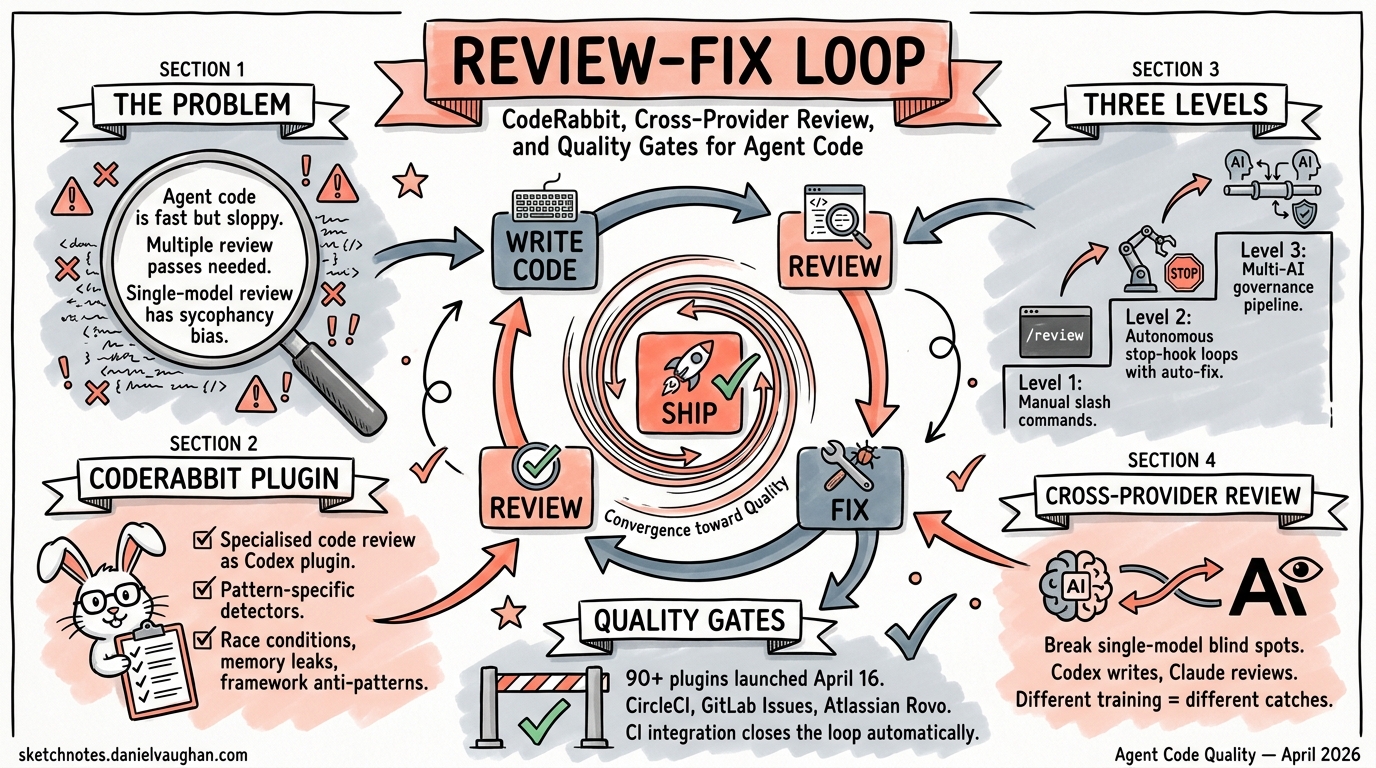
Agent-generated code ships fast, but quality remains the bottleneck. The Hacker News consensus on Codex is blunt: the code “can be quite sloppy” and “requires multiple review passes” 1. The April 16 plugin wave — over 90 new plugins including CodeRabbit, Atlassian Rovo, CircleCI, and GitLab Issues 2 — finally gives Codex CLI users the tooling to close this gap automatically, inside the same session where code is being written.
This article covers the three-level review-fix loop pattern: from manual slash commands through autonomous stop-hook loops to full multi-AI governance pipelines.
Why Built-In /review Isn’t Enough
Codex CLI’s native /review command inspects diffs against a base branch or uncommitted changes and reports prioritised findings 3. It works well for a quick sanity check, but it has structural limitations:
- Single-model sycophancy — the same model that wrote the code is reviewing it. Research consistently shows LLMs are less critical of their own output 4.
- No pattern-specific detectors —
/reviewapplies general reasoning rather than specialised analysis for race conditions, memory leaks, or framework-specific anti-patterns. - No autonomous remediation loop — findings are reported but not automatically acted upon.
The review-fix loop pattern solves all three by introducing an independent reviewer and automating the iteration cycle.
Level 1: CodeRabbit as a Codex Plugin
CodeRabbit’s Codex plugin, released April 15 2026 5, embeds specialised code review directly into the agent session. Installation takes under a minute:
# Install the CodeRabbit CLI
curl -fsSL https://cli.coderabbit.ai/install.sh | sh

# Authenticate
coderabbit auth login

# Install the plugin from the Codex marketplace
# In Codex App: Plugins → Search "CodeRabbit" → Add to Codex
# In Codex CLI: /plugins → search → install
Once installed, a natural-language prompt triggers the full review pipeline:
Review my current changes with CodeRabbit
The agent handles prerequisite checks (CLI installed? authenticated?), executes the review against the working branch, and returns findings ordered by severity — all without leaving the session 5.
The Three Output Modes
CodeRabbit’s CLI supports three output formats, each suited to different contexts 6:
coderabbit --agent          # Structured JSON for agent workflows
coderabbit --plain          # Human-readable terminal output
coderabbit --interactive    # Interactive TUI with navigation
The --agent flag is critical for plugin integration: it produces machine-parseable JSON that Codex can reason over, enabling the autonomous fix loop.
The Review-Then-Fix Pattern
The real power emerges when you chain review and remediation in a single prompt:
Implement the authentication middleware, then review the changes with
CodeRabbit and fix any issues found. Repeat until no critical or high
severity findings remain.
Codex implements the feature, triggers CodeRabbit, reads the severity-ordered findings, applies fixes, and re-reviews — iterating until the quality bar is met. CodeRabbit detects race conditions, memory leaks, and logic errors that generic linting misses 5, providing genuinely useful feedback rather than surface-level style complaints.
flowchart TD
    A[Developer Prompt] --> B[Codex Implements Feature]
    B --> C[CodeRabbit Reviews Changes]
    C --> D{Critical/High Findings?}
    D -->|Yes| E[Codex Applies Fixes]
    E --> C
    D -->|No| F[Changes Ready for PR]
    F --> G[Developer Final Review]
AGENTS.md Integration
On CodeRabbit’s Pro plan, the reviewer reads your AGENTS.md file for coding standards and architectural preferences 6, ensuring reviews are calibrated to your project’s conventions rather than generic best practices.
Level 2: Cross-Provider Review with codex-plugin-cc
The sycophancy problem runs deeper than single-session review. OpenAI’s official codex-plugin-cc 7 enables a fundamentally different pattern: one model writes, another reviews.
The plugin exposes Codex as a tool within Claude Code sessions (and vice versa), enabling cross-provider review where GPT-5.4 reviews Claude Opus 4.7’s output or Claude reviews Codex’s implementation. This eliminates the self-review bias entirely.
The SKILL.md Review Loop
The simplest cross-provider pattern uses a SKILL.md file to create a /codex-review slash command 8:
mkdir -p .claude/skills/codex-review
The skill writes a review plan to a temporary file, launches codex exec in read-only sandbox mode, and loops until the reviewer approves:
codex exec -m gpt-5.3-codex -s read-only \
  "Review the changes and respond with VERDICT: APPROVED or VERDICT: REVISE"
Key architectural decisions in this pattern:
- Read-only sandbox enforces separation between the reviewer and implementer roles
- Session IDs bound to temp file paths enable concurrent safety across multiple review loops
- Maximum 5 rounds prevents infinite loops when the implementer and reviewer disagree
The Stop Hook Auto-Trigger
Hamel Husain’s claude-review-loop plugin 9 takes cross-provider review further by using Claude Code’s Stop Hook to intercept session termination:
{
  "hooks": {
    "Stop": [{
      "command": "./review-loop.sh",
      "timeout_ms": 900000
    }]
  }
}
When Claude Code attempts to finish, the hook fires, launching up to four parallel Codex sub-agents for review. If issues are found, the hook returns {"decision": "block", "reason": "..."} and feeds the review findings back to Claude for remediation. The loop continues until all reviewers approve.
⚠️ The default configuration uses --dangerously-bypass-approvals-and-sandbox. For production use, override via the REVIEW_LOOP_CODEX_FLAGS environment variable with --sandbox read-only.
Level 3: Multi-AI Quality Gates for Teams
Enterprise teams need more than ad-hoc review loops. The third level introduces structured, multi-stage quality gates with governance controls.
The Sequential Pipeline
The claude-codex plugin by Z-M-Huang implements a five-stage pipeline 8:
flowchart LR
    A[Requirements<br/>Gatherer] --> B[Planner]
    B --> C[Plan<br/>Reviewer]
    C --> D[Implementer]
    D --> E[Code<br/>Reviewer]
    E -->|Revisions needed| D
    C -->|Revisions needed| B
Each stage can use a different model and provider, with the pipeline looping until all reviewers approve. This maps directly to Codex CLI’s multi-agent TOML configuration:
[agents.plan-reviewer]
model = "gpt-5.4"
sandbox_mode = "read-only"
instructions = "Review the implementation plan. Focus on architectural risks."

[agents.code-reviewer]
model = "gpt-5.3-codex"
sandbox_mode = "read-only"
instructions = "Review code changes. Check for security vulnerabilities, race conditions, and test coverage."
GitHub Agent HQ Integration
For teams already using GitHub’s Agentic Workflows, the review-fix loop integrates at the platform level 10. Copilot, Claude, and Codex can all be assigned to the same issue, with each agent producing independent implementations that compete for merge. The Codex Agent on GitHub supports automatic review via @codex mentions, with AGENTS.md steering the review criteria.
Enterprise Governance Considerations
The Futurum Group’s analysis of CodeRabbit’s plugin raises valid concerns about embedded AI review in enterprise contexts 11:
- Audit trails — review findings must be persisted and traceable for compliance (SOC 2, HIPAA)
- Customisable review policies — teams need control over which rules are enforced vs advisory
- Transparency — AI review decisions require explainable rationales, not opaque severity scores
Codex CLI’s PostToolUse hooks can capture review findings into structured logs 12, and the codex exec --json JSONL output provides the raw event stream for compliance systems.
Practical Configuration
A production-ready config.toml combining CodeRabbit with cross-provider review:
[model_providers.default]
model = "gpt-5.4"

[mcp_servers.coderabbit]
command = "coderabbit"
args = ["mcp-server"]
enabled = true

[[hooks.PostToolUse]]
command = "review-audit-logger.sh"
timeout_ms = 5000
Pair this with an AGENTS.md section:
## Code Review Standards
- All changes MUST pass CodeRabbit review before PR creation
- Critical and high severity findings MUST be resolved
- Medium findings SHOULD be resolved; document exceptions
- Use `coderabbit --agent` for structured review output
The Quality Ceiling Question
The review-fix loop pattern is powerful but not a silver bullet. Each iteration consumes tokens — a 5-round loop with CodeRabbit and a cross-provider reviewer can cost 3-5× a single implementation pass. The diminishing returns curve is steep: most value comes from the first review round, with subsequent rounds primarily catching edge cases introduced by the fixes themselves.
The pragmatic approach: use Level 1 (CodeRabbit plugin) for daily development, Level 2 (cross-provider) for security-sensitive or architecture-critical changes, and Level 3 (multi-AI pipeline) only for team-wide governance where the audit trail matters more than the token cost.
Citations
-
Hacker News discussion, “Ask HN: Is Codex really on Par with Claude Code?”, April 2026. https://news.ycombinator.com/item?id=47750069 ↩
-
OpenAI Codex Changelog, April 16 2026 — 90+ new plugins including Atlassian Rovo, CircleCI, CodeRabbit, GitLab Issues, Microsoft Suite. https://developers.openai.com/codex/changelog ↩
-
OpenAI Codex CLI Features — Review mode documentation. https://developers.openai.com/codex/cli/features ↩
-
ETH Zurich, Gloaguen et al. — LLM-generated AGENTS.md files hurt performance by 3% while increasing costs 20-23%, demonstrating self-review bias. Referenced in existing knowledge base analysis. ↩
-
CodeRabbit, “CodeRabbit Plugin for Codex”, April 15 2026. https://www.coderabbit.ai/blog/coderabbit-plugin-for-codex ↩ ↩2 ↩3
-
CodeRabbit Documentation — Codex Integration. https://docs.coderabbit.ai/cli/codex-integration ↩ ↩2
-
OpenAI,
codex-plugin-cc— Official Codex plugin for Claude Code enabling cross-provider review. https://github.com/openai/codex-plugin-cc ↩ -
SmartScope, “Automating the Claude Code × Codex Review Loop — Three Levels”, 2026. https://smartscope.blog/en/blog/claude-code-codex-review-loop-automation-2026/ ↩ ↩2
-
Hamel Husain,
claude-review-loop— Claude Code plugin for automated review with Codex. https://github.com/hamelsmu/claude-review-loop ↩ -
GitHub Changelog, “Model selection for Claude and Codex agents on github.com”, April 14 2026. https://github.blog/changelog/2026-04-14-model-selection-for-claude-and-codex-agents-on-github-com/ ↩
-
Futurum Group, “Does CodeRabbit’s Codex Plugin Signal the End of Context-Switching in Code Review?”, April 2026. https://futurumgroup.com/insights/does-coderabbits-codex-plugin-signal-the-end-of-context-switching-in-code-review/ ↩
-
OpenAI Codex Hooks documentation — PostToolUse event reference. https://developers.openai.com/codex/hooks ↩