When to Use Multi-Agent vs Single-Agent: A Practical Framework for Codex CLI Teams
When to Use Multi-Agent vs Single-Agent: A Practical Framework for Codex CLI Teams
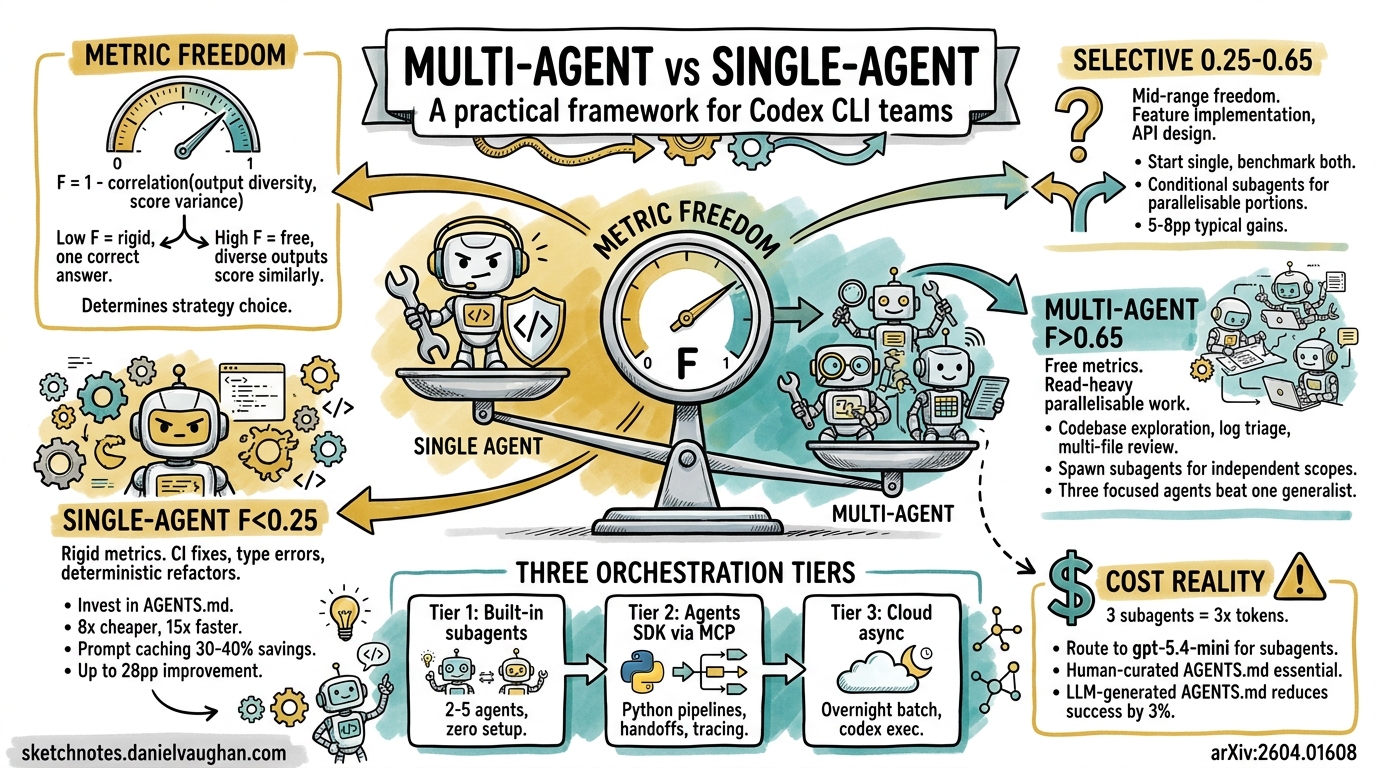
Codex CLI’s subagent system lets you spawn parallel agents for concurrent work — but more agents does not always mean better results. Recent academic research formalises what many practitioners have felt intuitively: the decision to go multi-agent or stay single-agent depends not on the task itself, but on the shape of the evaluation metric you are optimising for1. This article translates that research into a practical decision framework for Codex CLI teams.
The Core Insight: Metric Freedom Determines Strategy
In April 2026, Xu et al. published “From Multi-Agent to Single-Agent: When Is Skill Distillation Beneficial?”1, introducing the concept of Metric Freedom (F) — a measure of how rigidly a metric constrains acceptable outputs.
The formula is straightforward:
F = 1 − ρ(D_out, D_score)
Where ρ is the Spearman rank correlation between output diversity and score variance, computed via a Mantel test1.
- Low F (≈ 0, “rigid”) — One correct answer exists. Output variation maps directly to score variation. Single-agent with distilled skills excels.
- High F (≈ 1, “free”) — Diverse outputs score similarly. The raw agent already explores effectively. Multi-agent coordination overhead buys you nothing.
The striking finding: identical agent trajectories produced diametrically opposite outcomes depending on the metric. A skill that improved causal estimation by 28 percentage points degraded performance on a free-form metric for the same task1.
graph TD
    A[Compute Metric Freedom F<br/>from 10 baseline runs] --> B{F < 0.25?}
    B -->|Yes - Rigid| C[Single-Agent + Distilled Skills<br/>Preserve decomposition<br/>Encode all domain knowledge]
    B -->|No| D{F < 0.65?}
    D -->|Yes - Mid-range| E[Selective Approach<br/>Conditional hints only<br/>Test both configurations]
    D -->|No - Free| F[Raw Agent or Subagents<br/>Discard decomposition<br/>Minimal guidance]
    C --> G[Up to 28pp improvement<br/>8× cheaper, 15× faster]
    E --> H[Heterogeneous gains<br/>5-8pp typical]
    F --> I[Marginal gains ~1pp<br/>Multi-agent adds overhead]
How Codex CLI Subagents Work
Before applying the framework, you need to understand what Codex CLI actually offers. Subagents are parallel child agents spawned from your main session, each running independently and returning summaries2.
Key characteristics:
- Manual triggering only — Codex never spawns subagents autonomously. You must explicitly request them with prompts like “spawn two agents” or “use one agent per point”2.
- Each subagent runs its own model and tool calls — this means higher token consumption than equivalent single-agent work2.
- Results return as summaries — noisy intermediate output stays off the main thread2.
Model Selection for Subagents
Codex CLI supports per-agent model configuration2:
| Role | Recommended Model | Reasoning Effort |
|---|---|---|
| Main orchestrator | gpt-5.4 |
high |
| Read-heavy subagent | gpt-5.4-mini |
medium |
| Fast exploration | gpt-5.4-mini |
low |
| Security review | gpt-5.4 |
high |
You can set these in your agent configuration file:
[model]
name = "gpt-5.4-mini"
reasoning_effort = "medium"
The Decision Framework: When to Use Each Pattern
Pattern 1: Single-Agent with Skills (F < 0.25)
Use when: The task has a clear correct answer — CI/CD pipeline fixes, type error resolution, deterministic refactors, test generation against a specification.
Why it works: Rigid metrics mean the search space is narrow. A single well-prompted agent with encoded domain knowledge navigates it more efficiently than multiple agents coordinating1. The research showed cost reductions of 1.4–8× and latency reductions up to 15× compared to multi-agent configurations1.
Codex CLI approach: Invest in your AGENTS.md file and project-specific instructions rather than spawning subagents.
<!-- AGENTS.md -->
## CI Fix Protocol
1. Read the failing test output completely before proposing changes
2. Check if the failure is flaky (search git log for prior occurrences)
3. Fix the root cause, not the symptom
4. Run the full test suite before committing
Single-agent systems also exploit prompt caching effectively — achieving 30–40% cost savings on cached prompts — whilst multi-agent systems with dynamic inter-agent communication cannot cache effectively1.
Pattern 2: Multi-Agent Subagents (F > 0.65)
Use when: The task is read-heavy, highly parallelisable, and outputs are evaluated flexibly — codebase exploration, log triage, multi-file review, documentation generation.
Why it works: When diverse outputs score similarly, the overhead of coordination is wasted. Instead, use subagents for embarrassingly parallel read operations where each agent has a bounded, independent scope23.
Codex CLI approach:
Review this branch with parallel subagents.
Spawn one subagent for security risks,
one for test coverage gaps,
and one for maintainability issues.
Wait for all three, then summarise findings by category.
Research from Addy Osmani’s analysis of multi-agent coding patterns confirms this: “Three focused agents consistently outperform one generalist agent working three times as long” — but specifically for read-heavy, parallelisable work3.
Pattern 3: Selective (0.25 ≤ F ≤ 0.65)
Use when: The task has structure but permits variation — feature implementation, API design, refactoring with multiple valid approaches.
Why it works: Mid-range freedom metrics show heterogeneous gains. Text-to-SQL tasks (F ≈ 0.50) saw 5.8–8.8 percentage point improvements from skill distillation1, but results vary enough that you should benchmark both approaches.
Codex CLI approach: Start single-agent with conditional hints, then measure. If the task decomposes into independent subtasks, selectively spawn subagents for the parallelisable portions.
Beyond Subagents: The Three Orchestration Tiers
Codex CLI’s subagent model is one of three available orchestration approaches, each suited to different scales34:
graph LR
    subgraph Tier 1 - Subagents
        A[Main Agent] --> B[Subagent 1]
        A --> C[Subagent 2]
        A --> D[Subagent 3]
    end

    subgraph Tier 2 - Agents SDK
        E[PM Agent] --> F[Designer]
        E --> G[Frontend Dev]
        E --> H[Backend Dev]
        E --> I[Tester]
    end

    subgraph Tier 3 - Async Cloud
        J[Task Queue] --> K[Codex App Worker 1]
        J --> L[Codex App Worker 2]
        J --> M[Codex App Worker 3]
    end
Tier 1: Built-in Subagents
Zero setup. Single terminal. Best for ad hoc parallel reads with 2–5 agents2.
Tier 2: Agents SDK Orchestration
Expose Codex CLI as an MCP server and orchestrate with the OpenAI Agents SDK4:
codex mcp-server
Then build deterministic pipelines in Python:
from agents import Agent, Runner
from agents.mcp import MCPServerStdio

async with MCPServerStdio(
    name="Codex CLI",
    params={"command": "npx", "args": ["-y", "codex", "mcp-server"]},
    client_session_timeout_seconds=360000,
) as codex_mcp:
    reviewer = Agent(
        name="Reviewer",
        instructions="Review code for security issues.",
        mcp_servers=[codex_mcp],
    )
    implementer = Agent(
        name="Implementer",
        instructions="Implement features per spec.",
        mcp_servers=[codex_mcp],
    )
This tier supports handoffs between agents, file-existence verification gates, and full tracing via the OpenAI dashboard4. Use approval-policy: never and sandbox: workspace-write for unattended execution4.
Tier 3: Cloud Async
Assign tasks to Codex App workers for overnight batch processing. Combine with codex exec for CI integration5.
Practical Decision Tree
For teams adopting this framework, here is the concrete workflow:
- Characterise your metric. Run 10 baseline single-agent attempts. Compute F from the output diversity vs. score variance correlation1.
- Route by F value:
- F < 0.25 → Invest in
AGENTS.md, single-agent with rich context - 0.25 ≤ F ≤ 0.65 → A/B test both configurations, use conditional subagents
- F > 0.65 → Spawn parallel subagents for read-heavy work
- F < 0.25 → Invest in
- Select the orchestration tier based on team size and automation needs.
- Measure token costs. Multi-agent runs consume linearly more tokens3. Route subagents to
gpt-5.4-miniwhere possible2.
Cost Reality Check
Multi-agent workflows are not free. Key cost drivers to monitor:
- Token scaling: Each subagent runs its own context window. Three subagents ≈ 3× the token cost of a single agent23.
- Model routing: Using
gpt-5.4-minifor subagents whilst keepinggpt-5.4for the orchestrator can reduce costs by 40–60%2. - Prompt caching losses: Single-agent workflows benefit from 30–40% prompt cache savings; multi-agent workflows forfeit this1.
- AGENTS.md overhead: Research shows LLM-generated
AGENTS.mdfiles offer no benefit and can reduce success rates by ~3% whilst increasing inference costs by over 20%3. Human-curated context documents are essential.
When Not to Use Multi-Agent
Avoid multi-agent patterns when:
- Write-heavy work — multiple agents editing simultaneously creates merge conflicts and coordination overhead23
- Tight deadlines — subagent spawning adds latency for the initial fork and final aggregation
- Simple, sequential tasks — a single agent with a good
AGENTS.mdis faster and cheaper - Your metric is rigid (F < 0.25) — skill distillation into a single agent yields up to 28pp improvements1
Conclusion
The multi-agent vs. single-agent decision is not about capability — it is about the structure of what you are optimising for. Codex CLI gives you the tools for both approaches: rich AGENTS.md configuration for single-agent depth, built-in subagents for parallel breadth, and Agents SDK integration for full orchestration pipelines. The Metric Freedom framework provides the missing decision criterion: compute F, then route accordingly.
Citations
-
Xu, B., Fang, D., Li, H., & Zhang, K. (2026). “From Multi-Agent to Single-Agent: When Is Skill Distillation Beneficial?” arXiv:2604.01608. https://arxiv.org/abs/2604.01608 ↩ ↩2 ↩3 ↩4 ↩5 ↩6 ↩7 ↩8 ↩9 ↩10 ↩11
-
OpenAI. “Subagents – Codex.” OpenAI Developers Documentation. https://developers.openai.com/codex/concepts/subagents ↩ ↩2 ↩3 ↩4 ↩5 ↩6 ↩7 ↩8 ↩9 ↩10 ↩11
-
Osmani, A. “The Code Agent Orchestra — What Makes Multi-Agent Coding Work.” AddyOsmani.com. https://addyosmani.com/blog/code-agent-orchestra/ ↩ ↩2 ↩3 ↩4 ↩5 ↩6 ↩7
-
OpenAI. “Use Codex with the Agents SDK.” OpenAI Developers Documentation. https://developers.openai.com/codex/guides/agents-sdk ↩ ↩2 ↩3 ↩4
-
OpenAI. “Introducing Upgrades to Codex.” OpenAI Blog. https://openai.com/index/introducing-upgrades-to-codex/ ↩