Policy-as-Code for Coding Agents: From the OpenAI Governance Cookbook to Codex CLI guardrails
Policy-as-Code for Coding Agents: From the OpenAI Governance Cookbook to Codex CLI guardrails
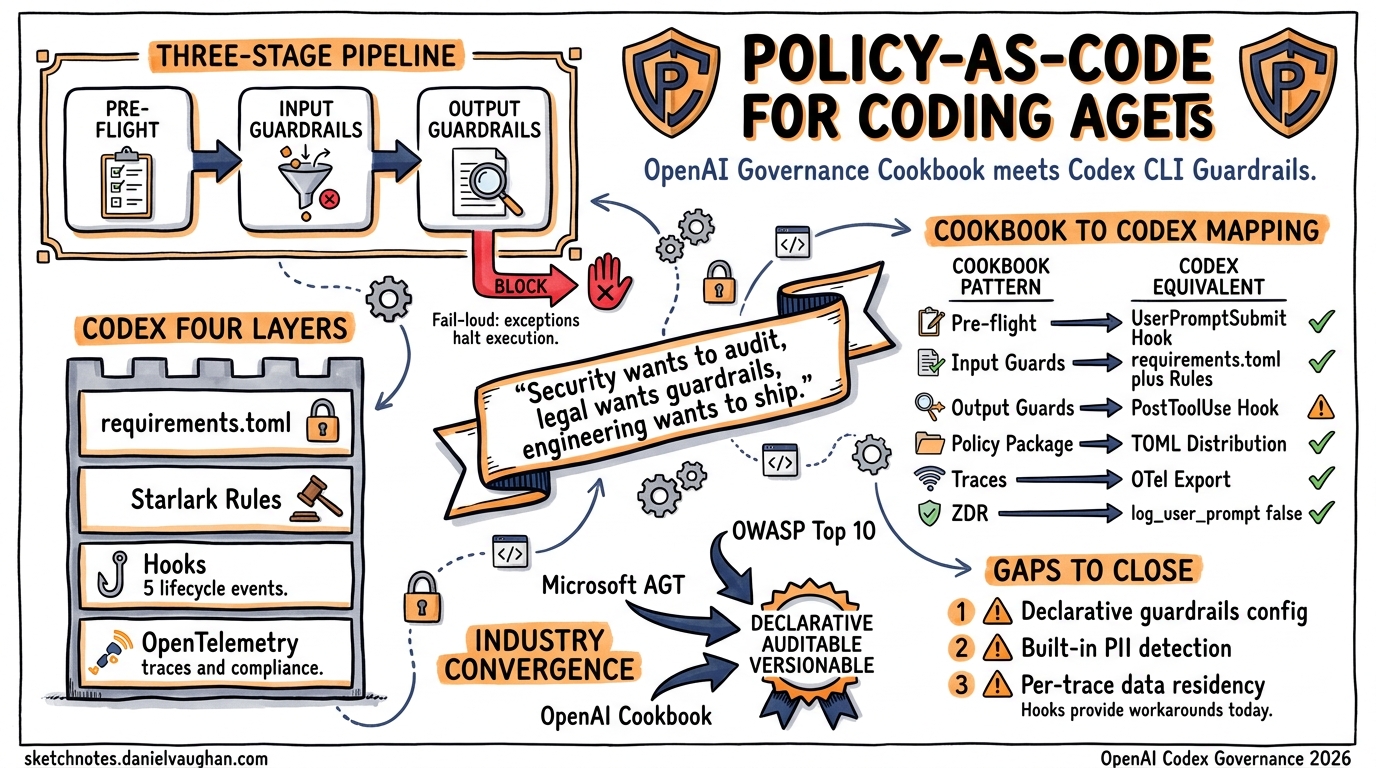
Every organisation deploying coding agents hits the same wall: security wants to audit, legal wants guardrails, and engineering wants to ship. OpenAI’s Building Governed AI Agents cookbook 1 provides a reference architecture for policy-as-code in multi-agent systems. This article maps that pattern onto Codex CLI’s enterprise governance stack — requirements.toml, execution policy rules, hooks, and OpenTelemetry — and identifies where Codex already delivers and where gaps remain.
The Cookbook’s Three-Stage Guardrails Pipeline
The governance cookbook defines a three-stage pipeline enforced through a GuardrailsOpenAI client wrapper 1:
flowchart LR
    A[User Prompt] --> B[Pre-flight]
    B --> C[Input Guardrails]
    C --> D[LLM / Agent]
    D --> E[Output Guardrails]
    E --> F[Response]
    B -->|Block| G[Reject]
    C -->|Block| G
    E -->|Redact / Block| G
| Stage | When | Purpose |
|---|---|---|
| Pre-flight | Before LLM call | Validate the request meets organisational policy — topic scope, format constraints |
| Input | On user input | PII detection, jailbreak prevention, content moderation |
| Output | On agent response | Content filtering, sensitive data redaction, hallucination flagging |
Critically, guardrails halt execution via exceptions rather than silently modifying responses 1. This fail-loud design prevents partially-compliant outputs from reaching production.
Policy-as-Code Distribution
The cookbook packages governance configuration as a pip-installable Python module 1:
pip install git+https://github.com/yourorg/policies.git
Any team importing the package inherits organisation-wide compliance controls. Configuration travels with the code — versioned, tested, and auditable through standard Git workflows.
Codex CLI’s Native Governance Stack
Codex CLI already ships a multi-layered governance system. The challenge is understanding how each layer maps to the cookbook’s patterns and where they diverge.
Layer 1: requirements.toml — Admin-Enforced Constraints
requirements.toml is Codex’s declarative policy-as-code mechanism 2. Administrators define constraints that users cannot override, applied across CLI, App, and IDE Extension surfaces.
# Restrict to safe execution modes
allowed_approval_policies = ["untrusted", "on-request"]
allowed_sandbox_modes = ["read-only", "workspace-write"]
allowed_web_search_modes = ["cached"]

# Pin feature flags
[features]
codex_hooks = true
multi_agent = false

# Block destructive commands organisation-wide
[rules]
prefix_rules = [
  { pattern = [{ token = "rm" }], decision = "forbidden" },
  { pattern = [{ token = "git" }, { any_of = ["push", "reset"] }],
    decision = "prompt",
    justification = "Require review before mutating remote history." }
]
The enforcement precedence is strict — earlier layers win per field 2:
- Cloud-managed requirements (ChatGPT Business/Enterprise)
- macOS managed preferences (MDM via
com.openai.codex:requirements_toml_base64) - System requirements.toml (
/etc/codex/requirements.tomlon Unix)
This maps directly to the cookbook’s policy distribution model: a central policy repository with immutable enforcement, except Codex uses TOML-based config rather than Python packages.
Layer 2: Execution Policy Rules — Command-Level Gating
Codex’s .rules files use Starlark syntax to define fine-grained command execution policies 3. Rules live in .codex/rules/ directories and are scanned across all config layers at startup.
# .codex/rules/security.rules
prefix_rule(
    pattern = ["docker", "run", "--privileged"],
    decision = "forbidden",
    justification = "Privileged containers violate security policy. Use rootless mode.",
    match = ["docker run --privileged nginx"],
    not_match = ["docker run --rm nginx"],
)

prefix_rule(
    pattern = ["gh", "pr", "merge"],
    decision = "prompt",
    justification = "PR merges require human review.",
)
When multiple rules match, the strictest decision wins: forbidden > prompt > allow 3. Rules can be validated offline using codex execpolicy check:
codex execpolicy check --pretty \
  --rules ~/.codex/rules/security.rules \
  -- docker run --privileged nginx
Administrators can enforce restrictive prefix_rule entries organisation-wide via requirements.toml 2, closing the loop between local development rules and enterprise policy.
Layer 3: Hooks — Procedural Guardrails
Hooks inject custom scripts into the agentic loop at five lifecycle events 4:
flowchart TD
    A[SessionStart] --> B[UserPromptSubmit]
    B --> C[PreToolUse]
    C --> D[Tool Execution]
    D --> E[PostToolUse]
    E --> F{More tools?}
    F -->|Yes| C
    F -->|No| G[Stop]
Enable hooks via config.toml:
[features]
codex_hooks = true
A hooks.json file placed at ~/.codex/hooks.json or <repo>/.codex/hooks.json defines handlers per event 4:
{
  "hooks": {
    "PreToolUse": [
      {
        "matcher": "Bash",
        "hooks": [
          {
            "type": "command",
            "command": "/usr/bin/python3 .codex/hooks/policy-check.py",
            "statusMessage": "Checking command against policy"
          }
        ]
      }
    ],
    "UserPromptSubmit": [
      {
        "matcher": "",
        "hooks": [
          {
            "type": "command",
            "command": ".codex/hooks/scan-secrets.sh",
            "statusMessage": "Scanning for credentials"
          }
        ]
      }
    ]
  }
}
A PreToolUse hook can block execution by returning a deny decision 4:
{
  "hookSpecificOutput": {
    "hookEventName": "PreToolUse",
    "permissionDecision": "deny",
    "permissionDecisionReason": "Command violates data residency policy."
  }
}
⚠️ Hooks are currently marked experimental and disabled on Windows 4.
Layer 4: OpenTelemetry — Compliance Observability
Codex exports traces via OpenTelemetry, covering API requests, tool invocations, and approval decisions 5:
[otel]
exporter = "otlp-http"
log_user_prompt = false
Setting log_user_prompt = false ensures raw prompts never leave the local environment — essential for Zero Data Retention (ZDR) compliance 5. Administrators can pin OTel settings in requirements.toml to prevent users from disabling observability.
Mapping: Cookbook Patterns to Codex CLI
graph LR
    subgraph "OpenAI Governance Cookbook"
        PF[Pre-flight]
        IG[Input Guardrails]
        OG[Output Guardrails]
        PAC[Policy Package]
        TR[Trace Observability]
        ZDR[Zero Data Retention]
    end
    subgraph "Codex CLI"
        UPS[UserPromptSubmit Hook]
        RPT[requirements.toml + Rules]
        PTU[PostToolUse Hook]
        REQ[requirements.toml Distribution]
        OT[OTel Export]
        LP[log_user_prompt = false]
    end
    PF --> UPS
    IG --> RPT
    OG --> PTU
    PAC --> REQ
    TR --> OT
    ZDR --> LP
| Cookbook Pattern | Codex CLI Equivalent | Coverage |
|---|---|---|
| Pre-flight guardrails | UserPromptSubmit hooks |
✅ Functional — scan prompts before agent acts |
| Input guardrails | requirements.toml + Starlark rules + sandbox restrictions |
✅ Strong — declarative + command-level gating |
| Output guardrails | PostToolUse hooks |
⚠️ Partial — cannot undo side effects from already-executed commands |
| Policy-as-code package | requirements.toml + MDM/cloud distribution |
✅ Native — multi-layer enforcement hierarchy |
| Trace observability | OTel export configuration | ✅ Native — OTLP-HTTP/gRPC with configurable verbosity |
| Zero Data Retention | log_user_prompt = false + custom hook redaction |
✅ Supported — hook lifecycle enables PII scrubbing |
| Exception-based halting | Hook exit codes (non-zero = block) | ✅ Functional — deny decisions halt execution |
Building a Complete Governance Pipeline
Here is a practical three-file setup that implements the full cookbook pattern within Codex CLI:
1. Organisation policy (/etc/codex/requirements.toml):
allowed_approval_policies = ["untrusted", "on-request"]
allowed_sandbox_modes = ["workspace-write"]
allowed_web_search_modes = ["disabled"]

[features]
codex_hooks = true

[rules]
prefix_rules = [
  { pattern = [{ token = "curl" }], decision = "prompt",
    justification = "Network requests require approval." },
  { pattern = [{ token = "rm" }, { token = "-rf" }], decision = "forbidden",
    justification = "Recursive deletion blocked by policy." }
]

[otel]
exporter = "otlp-http"
log_user_prompt = false
2. Secret scanning hook (.codex/hooks/scan-secrets.sh):
#!/usr/bin/env bash
# Pre-flight: block prompts containing API keys
INPUT=$(cat)
PROMPT=$(echo "$INPUT" | jq -r '.userPrompt // empty')

if echo "$PROMPT" | grep -qE '(sk-[a-zA-Z0-9]{20,}|ghp_[a-zA-Z0-9]{36})'; then
  echo '{"decision":"block","reason":"Prompt contains what appears to be an API key. Remove it before resubmitting."}'
  exit 0
fi
echo '{}'
3. Hook registration (.codex/hooks.json):
{
  "hooks": {
    "UserPromptSubmit": [
      {
        "matcher": "",
        "hooks": [
          {
            "type": "command",
            "command": "bash .codex/hooks/scan-secrets.sh",
            "statusMessage": "Scanning for credentials"
          }
        ]
      }
    ]
  }
}
The Wider Industry Context
Policy-as-code for coding agents is not an OpenAI-only concern. Microsoft’s Agent Governance Toolkit, released in April 2026 under the MIT licence, provides a seven-package runtime security system addressing all ten OWASP agentic AI risk categories 6. It includes execution rings modelled on CPU privilege levels, saga orchestration for multi-step rollback, and integration hooks for LangChain, CrewAI, and Google ADK 6.
The convergence is clear: every major platform is moving towards declarative, versionable, auditable policy enforcement for autonomous agents. Codex CLI’s requirements.toml + hooks architecture is well-positioned, but teams should track the emerging standards — particularly OWASP’s agentic AI top 10 7 — to ensure their governance configurations remain comprehensive.
Gap Analysis: Where Codex CLI Needs to Evolve
Three areas where the cookbook’s patterns expose limitations in the current Codex CLI governance story:
-
Declarative guardrails config — The cookbook uses a structured JSON schema defining pre-flight/input/output policies declaratively. Codex CLI’s equivalent requires writing procedural hook scripts. A native
guardrails.tomldefining entity detection rules, moderation categories, and content filters without custom code would close this gap. -
Built-in entity detection — The cookbook includes ready-made PII scanners (SSN, credit cards, medical licences, crypto addresses) with configurable confidence thresholds. Codex CLI has no built-in entity detection; teams must bring their own scanning in hooks.
-
Trace-level data residency — While
log_user_prompt = falseprovides session-level ZDR, the cookbook supports per-trace data residency routing via custom trace processors. Codex CLI’s OTel integration does not yet support per-trace routing decisions.
These gaps represent genuine feature requests rather than architectural limitations — the hook system provides the extensibility to work around each one today, but native support would reduce the governance burden for enterprise teams.
Citations
-
OpenAI, “Building Governed AI Agents — A Practical Guide to Agentic Scaffolding,” OpenAI Cookbook, February 2026. https://developers.openai.com/cookbook/examples/partners/agentic_governance_guide/agentic_governance_cookbook ↩ ↩2 ↩3 ↩4
-
OpenAI, “Managed Configuration — Codex Enterprise,” OpenAI Developers, 2026. https://developers.openai.com/codex/enterprise/managed-configuration ↩ ↩2 ↩3
-
OpenAI, “Rules — Codex,” OpenAI Developers, 2026. https://developers.openai.com/codex/rules ↩ ↩2
-
OpenAI, “Hooks — Codex,” OpenAI Developers, 2026. https://developers.openai.com/codex/hooks ↩ ↩2 ↩3 ↩4
-
OpenAI, “Advanced Configuration — Codex,” OpenAI Developers, 2026. https://developers.openai.com/codex/config-advanced ↩ ↩2
-
Microsoft, “Introducing the Agent Governance Toolkit: Open-source runtime security for AI agents,” Microsoft Open Source Blog, April 2026. https://opensource.microsoft.com/blog/2026/04/02/introducing-the-agent-governance-toolkit-open-source-runtime-security-for-ai-agents/ ↩ ↩2
-
OWASP, “OWASP Top 10 for Agentic AI,” 2026. https://owasp.org/www-project-top-10-for-large-language-model-applications/ ↩