The Subagent Resource Leak Problem: Why MCP Process Trees Accumulate and What McpConnectionManager::shutdown() Fixes
The Subagent Resource Leak Problem: Why MCP Process Trees Accumulate and What McpConnectionManager::shutdown() Fixes
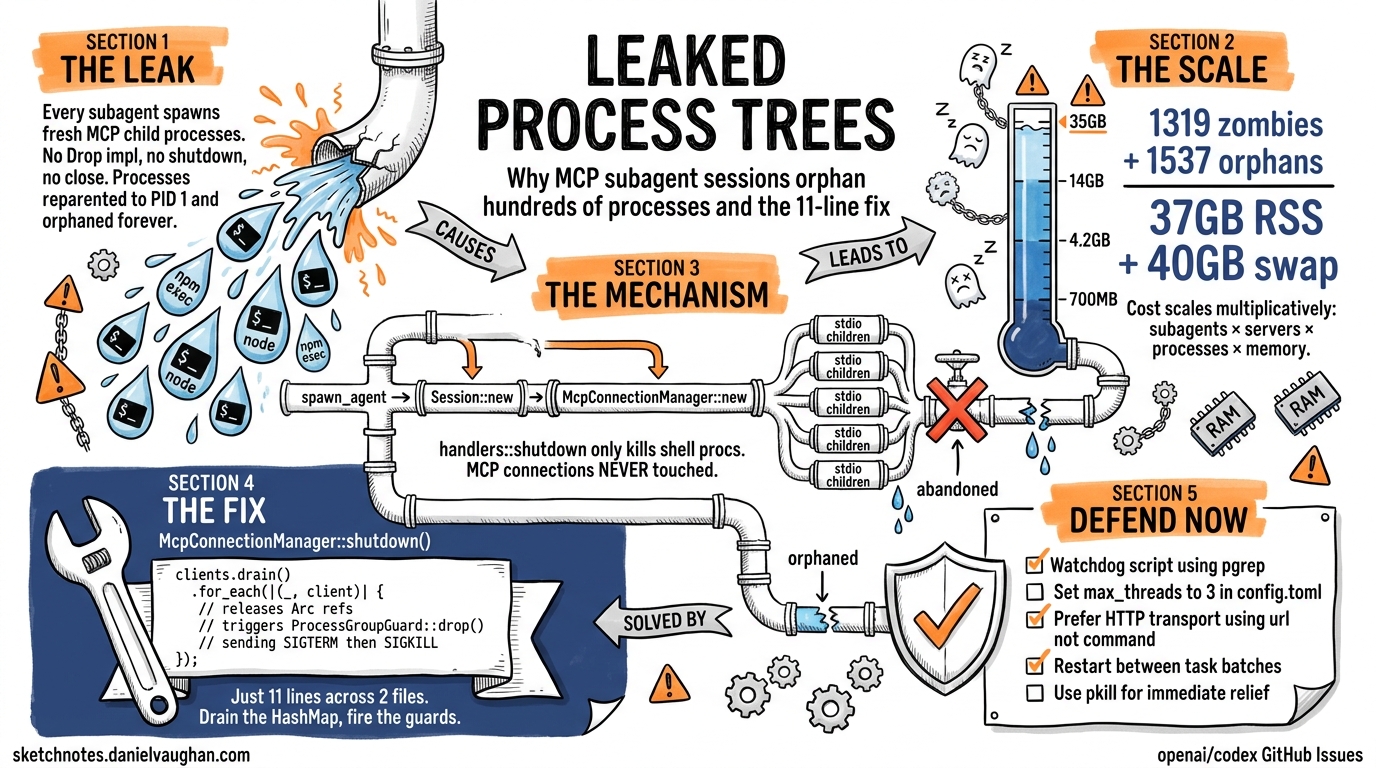
If you run Codex CLI with multiple MCP servers and use subagent workflows, you have almost certainly experienced the symptoms: swap pressure creeping up, fans spinning, and — when you finally check ps aux — hundreds of orphaned npm exec and node processes consuming double-digit gigabytes of RAM. This article dissects the root cause, traces the code path responsible, explains the proposed fix, and offers defensive patterns you can deploy today.
The Symptoms
The first major report surfaced as issue #12491, where a user running Codex.app v0.98.0 with five MCP servers (four oh-my-codex instances plus Serena) observed 1,319 zombie Codex processes and 1,537 orphaned Node processes consuming approximately 37 GB of RSS plus 40 GB of swap on a 64 GB machine1. By April 2026, issue #17574 documented the same pattern in Codex CLI v0.120.0: 791 accumulated processes totalling ~13.5 GB RSS across xcodebuildmcp and chrome-devtools-mcp server trees2. Days later, #17832 confirmed a regression where 213 leaked Playwright MCP process pairs consumed 13.6 GB on an M3 Pro with 36 GB RAM3.
The pattern is consistent: every subagent spawn leaves behind a process tree that is never reaped.
The Leak Mechanism
Understanding the leak requires tracing the subagent lifecycle from spawn to (missing) teardown.
sequenceDiagram
    participant Parent as Parent Session
    participant Spawn as spawn_agent()
    participant Session as Session::new()
    participant MCP as McpConnectionManager::new()
    participant Procs as MCP Child Processes
    participant Shutdown as handlers::shutdown()

    Parent->>Spawn: Delegate task to subagent
    Spawn->>Session: Initialise new session
    Session->>MCP: Create fresh McpConnectionManager
    MCP->>Procs: Spawn stdio child processes (npm exec, node, etc.)
    Note over Procs: Processes running, consuming memory
    Parent->>Shutdown: Subagent task complete
    Shutdown->>Session: Terminate shell processes only
    Note over Procs: MCP processes NOT terminated
    Note over Procs: Orphaned — reparented to init/launchd (PPID=1)
Step by Step
- Subagent spawn: When Codex receives a task delegation instruction, it calls
spawn_agent()to create a new thread4. - Session initialisation: Each subagent gets its own
Session::new(), which instantiates a dedicatedMcpConnectionManager::new(). This is not a shared pool — every subagent session creates fresh stdio child processes for every configured MCP server2. - MCP process creation: For each stdio-transport MCP server in
config.toml, the connection manager executes the configuredcommand(e.g.,npx -y @playwright/mcp@latest), spawning annpm execparent and anodechild. With five MCP servers configured, that is ten new processes per subagent1. - Task completion: When the subagent finishes,
handlers::shutdown()is called. This method invokesunified_exec_manager.terminate_all_processes()to clean up shell processes — but it never touches MCP connections3. - Orphaning: The
McpConnectionManagerhas noDropimplementation, noshutdown()method, and noclose()method. TheArc<RmcpClient>references are never released, soProcessGroupGuard::drop()never fires. The child processes are reparented to PID 1 and persist indefinitely23.
Why the Partial Fix in v0.120.0 Was Insufficient
Version 0.120.0 introduced a fix for app-server MCP cleanup on disconnect, ensuring that “unsubscribed threads and resources are torn down correctly”5. However, this fix addressed the app-server’s connection tracking rather than the per-session McpConnectionManager lifecycle. Subagent-spawned sessions continued to leak because the teardown path in handlers::shutdown() was not updated to include MCP cleanup3.
Quantifying the Impact
The resource cost scales multiplicatively: subagent_count × mcp_servers × processes_per_server × memory_per_process.
| Scenario | Subagents | MCP Servers | Leaked Processes | Estimated RSS |
|---|---|---|---|---|
| Light use (2 servers, 5 tasks) | 5 | 2 | 20 | ~700 MB |
| Moderate (3 servers, 20 tasks) | 20 | 3 | 120 | ~4.2 GB |
| Heavy (5 servers, 40 tasks) | 40 | 5 | 400 | ~14 GB |
| Enterprise CI pod (5 servers, 100 tasks) | 100 | 5 | 1,000 | ~35 GB |
Each npm exec parent process typically consumes ~35 MB RSS, with MCP server children adding 30–65 MB depending on the server3. On long-running CI pods or developer machines left running overnight, the accumulation can exhaust available RAM within hours.
The Proposed Fix: McpConnectionManager::shutdown()
The fix described in #17832 is remarkably small — an 11-line change across two files3:
1. Add a shutdown method to McpConnectionManager
impl McpConnectionManager {
    /// Drain all MCP client connections, releasing Arc<RmcpClient>
    /// references so ProcessGroupGuard::drop() fires and delivers
    /// SIGTERM/SIGKILL to each MCP process group.
    pub async fn shutdown(&self) {
        let mut clients = self.clients.lock().await;
        clients.drain();
    }
}
When drain() empties the HashMap, the last Arc<RmcpClient> reference for each connection is dropped. This triggers ProcessGroupGuard::drop(), which sends SIGTERM to the process group, waits briefly, then escalates to SIGKILL if the process has not exited2.
2. Call shutdown from handlers::shutdown()
async fn shutdown(session: &Session) {
    // Existing shell process cleanup
    session.unified_exec_manager.terminate_all_processes().await;

    // NEW: Clean up MCP connections
    session.mcp_connection_manager.shutdown().await;
}
This ensures the MCP cleanup runs alongside existing shell process teardown on every subagent session close3.
flowchart TD
    A[handlers::shutdown called] --> B[terminate_all_processes]
    A --> C[mcp_connection_manager.shutdown]
    B --> D[Shell processes terminated]
    C --> E[clients.drain]
    E --> F[Arc references released]
    F --> G[ProcessGroupGuard::drop fires]
    G --> H[SIGTERM to process groups]
    H --> I{Process exited?}
    I -->|Yes| J[Clean exit]
    I -->|No| K[SIGKILL after timeout]
    K --> J
Defensive Patterns for Today
Until the fix lands in a release, several strategies can limit the damage.
Monitor MCP Process Counts
Add a watchdog script to your session or CI pipeline:
#!/usr/bin/env bash
# mcp-watchdog.sh — alert when MCP process count exceeds threshold
THRESHOLD=${1:-50}
COUNT=$(pgrep -f 'npm exec.*mcp' | wc -l)
if [ "$COUNT" -gt "$THRESHOLD" ]; then
    echo "WARNING: $COUNT MCP processes detected (threshold: $THRESHOLD)"
    # Optionally kill orphans:
    # pkill -f 'npm exec.*mcp'
fi
Restart Long Sessions
The leak is proportional to subagent spawns within a single Codex process. Restarting the CLI between major task batches resets the process tree. For CI, prefer one Codex invocation per job rather than a persistent agent pod4.
Limit Subagent Concurrency
In your config.toml, constrain the blast radius:
[agents]
max_threads = 3      # Default is 6 — halving limits peak leak rate
max_depth = 1        # Prevent recursive subagent fan-out
Reducing max_threads from the default of 6 to 3 halves the peak leak rate per unit time4. Setting max_depth = 1 prevents nested subagent spawning, which would compound the leak exponentially.
Prefer HTTP Transport Where Possible
Streamable HTTP MCP servers (configured with url rather than command in config.toml) do not spawn local child processes and are therefore immune to this leak6:
[mcp_servers.my-server]
url = "https://mcp.example.com/sse"
bearer_token_env_var = "MCP_TOKEN"
The trade-off is latency and the need to host the MCP server externally, but for enterprise deployments already running shared infrastructure, this sidesteps the process accumulation entirely.
Manual Cleanup
For immediate relief on a machine already suffering from the leak:
# Kill all orphaned MCP stdio processes
pkill -f 'npm exec.*mcp'

# Verify recovery
echo "Recovered $(ps aux | grep -c '[n]pm exec.*mcp') processes"
The reporter of #17832 confirmed that pkill immediately recovered 13.6 GB, proving the processes were genuinely orphaned rather than legitimately retained3.
Broader Architectural Implications
This leak exposes a fundamental tension in Codex’s subagent architecture: session isolation versus resource sharing. Each subagent currently gets its own McpConnectionManager with dedicated child processes, providing strong isolation but no resource pooling2.
Issue #16256 proposed an alternative: a single MCP daemon per user handling multiple sessions, with process group management via setpgid() enabling clean subtree termination with a single kill(-pgid, SIGTERM) call7. This would eliminate the per-subagent spawn overhead entirely, though it would require significant architectural changes to the connection manager.
The v0.119.0 extraction of MCP into a dedicated codex-mcp crate suggests the team is laying groundwork for exactly this kind of architectural evolution5.
What to Watch For
- The shutdown fix: Track #17574 and #17832 for the
McpConnectionManager::shutdown()merge. The fix is small and well-understood; landing it is primarily a question of test coverage and edge cases around concurrent session teardown. - Connection pooling: A shared MCP connection pool across subagent sessions would eliminate the leak class entirely. Watch for changes to
codex-mcpcrate architecture. - Signal handling: Proper
SIGTSTPhandling (issue #16256) would address the related problem of suspended sessions holding process references7.
⚠️ The exact timeline for the fix is unconfirmed — the issues remain open as of 18 April 2026.
Citations
-
Codex.app GUI: MCP child processes not reaped after task completion — 1300+ zombies, 37GB memory leak · Issue #12491 ↩ ↩2
-
Subagents leak stdio MCP helper trees in Codex App; xcodebuildmcp and chrome-devtools-mcp accumulate indefinitely · Issue #17574 ↩ ↩2 ↩3 ↩4 ↩5
-
Regression: Playwright MCP stdio processes still leak after #16895 fix — 213 orphaned pairs, 13.6 GB RSS · Issue #17832 ↩ ↩2 ↩3 ↩4 ↩5 ↩6 ↩7 ↩8
-
[Subagents – Codex OpenAI Developers](https://developers.openai.com/codex/subagents) -
[Changelog – Codex OpenAI Developers](https://developers.openai.com/codex/changelog) -
[Model Context Protocol – Codex OpenAI Developers](https://developers.openai.com/codex/mcp) -
MCP sub-agent processes are never terminated when codex sessions are stopped/suspended · Issue #16256 ↩ ↩2