The Codex Subscription API: Programmatic Access to GPT-5.5 Through Your ChatGPT Plan
The Codex Subscription API: Programmatic Access to GPT-5.5 Through Your ChatGPT Plan
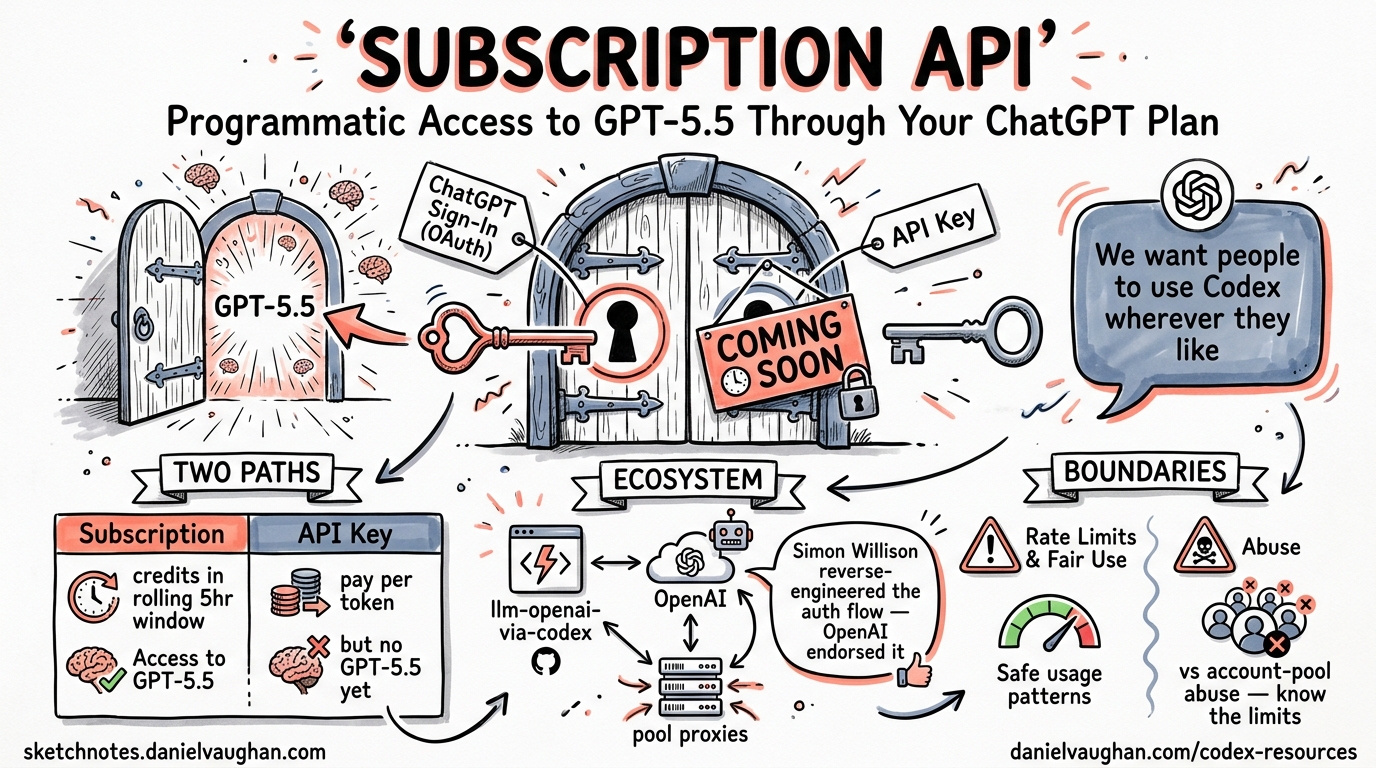
When OpenAI launched GPT-5.5 on 23 April 2026, a curious limitation accompanied the announcement: the model is available only through ChatGPT subscription authentication, not via API keys1. Within hours, Simon Willison had reverse-engineered the Codex CLI’s authentication flow and published llm-openai-via-codex, a plugin that routes arbitrary prompts through your existing subscription2. OpenAI’s response? “We want people to be able to use Codex, and their ChatGPT subscription, wherever they like”2. This semi-official endorsement has sparked an ecosystem of tools — from lightweight plugins to full account-pool proxies — that treat the Codex backend as a programmable API surface. This article dissects how the subscription API works, how to use it safely, and where the boundaries lie.
Two Authentication Paths, Two Pricing Models
Codex CLI supports two fundamentally different authentication methods, each with distinct pricing and model access implications3:
| Aspect | ChatGPT Sign-In | API Key |
|---|---|---|
| Authentication | Browser-based OAuth flow | OPENAI_API_KEY environment variable |
| Pricing | Subscription credits (rolling 5-hour window) | Pay-per-token at API rates |
| GPT-5.5 access | Yes (all paid tiers) | Not yet available |
| Token storage | ~/.codex/auth.json or OS keyring |
Environment variable |
| Enterprise controls | Workspace RBAC, retention policies | Organisation-level settings |
| Fast mode | Available | Not available |
The critical difference: ChatGPT sign-in routes requests through chatgpt.com/backend-api/codex/responses4, whilst API key authentication uses the standard api.openai.com/v1/ endpoints. The subscription path carries your plan’s credit allocation — Plus subscribers get 15–80 GPT-5.5 messages per five-hour window, Pro 20x subscribers get up to 1,6005.
flowchart TD
    A[Codex CLI] --> B{Auth Method?}
    B -->|ChatGPT Login| C[OAuth Browser Flow]
    B -->|API Key| D[OPENAI_API_KEY]
    C --> E[~/.codex/auth.json]
    E --> F[backend-api/codex/responses]
    D --> G[api.openai.com/v1/]
    F --> H[Subscription Credits]
    G --> I[Pay-per-token]
    H --> J[GPT-5.5 + GPT-5.4 + GPT-5.4-mini]
    I --> K[GPT-5.4 + GPT-5.4-mini only]
How auth.json Works
When you authenticate via codex --login, the CLI opens a browser, completes an OAuth handshake, and caches the resulting tokens locally. The cli_auth_credentials_store configuration key controls where credentials land3:
# ~/.codex/config.toml
cli_auth_credentials_store = "auto"  # "file" | "keyring" | "auto"
file— writes to$CODEX_HOME/auth.json(defaults to~/.codex/auth.json)keyring— uses the OS credential store (macOS Keychain, GNOME Keyring, Windows Credential Manager)auto— attempts the OS store first, falls back toauth.json
The auth.json file is not host-bound. You can copy it to a headless machine and Codex will authenticate without a browser3. Tokens refresh automatically during active sessions, so long-running CI jobs or automation scripts rarely hit expiry3.
Security note: treat
auth.jsonlike a private key. Never commit it to version control, paste it into issue trackers, or share it in Slack. If compromised, log out immediately withcodex --logout— this invalidates both CLI and IDE extension sessions3.
The Third-Party Ecosystem
llm-openai-via-codex
Simon Willison’s plugin is the canonical example of subscription API reuse2. It extracts credentials from your local Codex installation and routes llm prompts through the backend endpoint:
# Install
llm install llm-openai-via-codex

# List available models
llm models -q openai-codex

# Query GPT-5.5 with high reasoning effort
llm -m openai-codex/gpt-5.5 -o reasoning_effort xhigh \
  "Explain the CAP theorem in the context of CRDTs"
The plugin requires a valid Codex CLI installation with cached credentials — it reads ~/.codex/auth.json directly6. Model availability mirrors your subscription tier, so a Plus subscriber sees the same models they would in the CLI itself.
Codex2API
At the other end of the spectrum, Codex2API is an open-source proxy that manages a pool of Codex accounts behind an OpenAI-compatible API surface7. Built with Go and Gin, it exposes /v1/chat/completions whilst internally handling:
- Token pool scheduling — selects healthy accounts via SQL filters (
WHERE status = 'active') - Automatic credential refresh — rotates expired tokens on configurable intervals
- Rate limit recovery — parses 429 responses, pauses over-limit accounts, resumes after reset windows
- Usage tracking — per-account metrics with a React admin dashboard
# Quick deployment
git clone https://github.com/james-6-23/codex2api.git
docker compose pull && docker compose up -d
# Admin dashboard at http://localhost:8080/admin/
Codex2API supports both PostgreSQL/Redis for distributed deployments and SQLite for single-node setups7. It claims to handle 100+ accounts with automated refresh, reducing manual operations by approximately 90%7.
Terms of service warning: pooling multiple accounts through a proxy may violate OpenAI’s usage policies. The semi-official endorsement from Romain Huet applies to individual, personal use of your own subscription2. Account pooling and credential sharing sit in a greyer area. Proceed with caution and consult OpenAI’s terms before deploying this in production.
Enterprise Considerations
Managed Authentication Policies
Enterprise administrators can lock down authentication methods using requirements.toml, preventing users from switching between ChatGPT and API key authentication8:
# /etc/codex/requirements.toml
forced_login_method = "chatgpt"
forced_chatgpt_workspace_id = "ws_abc123"
This ensures all usage routes through the organisation’s workspace, preserving RBAC controls and data retention policies3. Mismatched credentials trigger automatic logout3.
Cost Arithmetic
Understanding when subscription credits beat API pricing matters for team budgeting. Using April 2026 token-based rates for Business plans5:
| Model | Input (per 1M tokens) | Cached (per 1M) | Output (per 1M) |
|---|---|---|---|
| GPT-5.5 | $125.00 | $12.50 | $750.00 |
| GPT-5.4 | $62.50 | $6.25 | $375.00 |
| GPT-5.4-mini | $18.75 | $1.875 | $113.00 |
A typical Codex CLI session consuming 50K input tokens and 10K output tokens on GPT-5.5 costs roughly $13.75 at API rates. A Pro subscriber at $100/month gets 80–400 such sessions included. The break-even sits at approximately 8–10 substantial sessions per month — most active developers exceed this comfortably.
graph LR
    subgraph "Cost Comparison"
        A["Light usage<br/>< 8 sessions/month"] -->|Cheaper| B["API Key<br/>Pay-per-token"]
        C["Moderate usage<br/>8-50 sessions/month"] -->|Cheaper| D["Plus $20/mo"]
        E["Heavy usage<br/>50+ sessions/month"] -->|Cheaper| F["Pro $100/mo"]
    end
Building Your Own Integration
If you want to build tooling that consumes your Codex subscription programmatically, the pattern is straightforward:
- Authenticate the CLI — run
codex --loginonce on the target machine - Read credentials — parse
~/.codex/auth.jsonfor the access token - Hit the endpoint — POST to
chatgpt.com/backend-api/codex/responseswith the Responses API schema - Handle refresh — tokens expire; re-read
auth.jsonafter a 401
However, there are significant caveats:
- No SLA. The backend endpoint is not a documented public API. It can change without notice2.
- Rate limits are subscription-bound. Your five-hour rolling window applies regardless of how you access the endpoint.
- No streaming guarantees. The endpoint’s streaming behaviour may differ from the public API’s SSE contract.
- Credential scope. The auth token carries your full workspace permissions. Any tool with access to
auth.jsoncan read your repositories, execute commands in your sandbox, and access your conversation history.
For production workflows, OpenAI recommends API key authentication3. The subscription path is best suited for personal tooling, local experimentation, and scenarios where GPT-5.5 access is essential and API availability has not yet arrived.
Security Hardening for auth.json
Given that auth.json is now a high-value target — it provides GPT-5.5 access worth hundreds of dollars per month — consider these hardening steps:
# Restrict file permissions (Unix)
chmod 600 ~/.codex/auth.json

# Use OS keyring instead of file storage
codex config set cli_auth_credentials_store keyring

# Verify no accidental git tracking
echo ".codex/" >> ~/.gitignore_global
git config --global core.excludesfile ~/.gitignore_global
For headless CI environments where you must use file-based storage, mount auth.json as a Kubernetes secret or inject it from your secrets manager at runtime. Never bake it into container images.
The Road Ahead
OpenAI’s stance — “use your subscription wherever you like” — suggests the backend endpoint will gain more official support over time2. The gap between ChatGPT and API key model availability (GPT-5.5 is currently subscription-only) creates natural pressure for tools like llm-openai-via-codex to exist. Two likely outcomes:
- GPT-5.5 reaches the API. This eliminates the primary motivation for subscription API usage. Historical precedent (GPT-5.4 followed this path) suggests a 4–8 week lag1.
- The endpoint gets formalised. A documented, stable subscription API with proper OAuth scopes and rate limit headers would replace the current reverse-engineered approach.
Until then, the ecosystem will continue to grow around the semi-official endpoint. Whether you use Willison’s lightweight plugin or a full proxy, the key principles remain: secure your credentials, respect your rate limits, and build with the understanding that undocumented endpoints can change without warning.
Citations
-
OpenAI, “Introducing GPT-5.5,” https://openai.com/index/introducing-gpt-5-5/, April 2026. ↩ ↩2
-
Simon Willison, “A pelican for GPT-5.5 via the semi-official Codex backdoor API,” https://simonwillison.net/2026/Apr/23/gpt-5-5/, April 2026. ↩ ↩2 ↩3 ↩4 ↩5 ↩6
-
OpenAI, “Authentication — Codex,” https://developers.openai.com/codex/auth, April 2026. ↩ ↩2 ↩3 ↩4 ↩5 ↩6 ↩7 ↩8
-
OpenAI, “Codex CLI Agent Loop Internals,” documented in Codex CLI source and community analysis of the
backend-api/codex/responsesendpoint. ↩ -
OpenAI, “Pricing — Codex,” https://developers.openai.com/codex/pricing, April 2026. ↩ ↩2
-
Simon Willison, “llm-openai-via-codex,” https://github.com/simonw/llm-openai-via-codex, April 2026. ↩
-
Codex2API, https://github.com/james-6-23/codex2api, 2026. ↩ ↩2 ↩3
-
OpenAI, “Managed configuration — Codex,” https://developers.openai.com/codex/enterprise/managed-configuration, April 2026. ↩