The Completions-to-Responses Migration Pack: Automating OpenAI API Migration with Codex CLI
The Completions-to-Responses Migration Pack: Automating OpenAI API Migration with Codex CLI
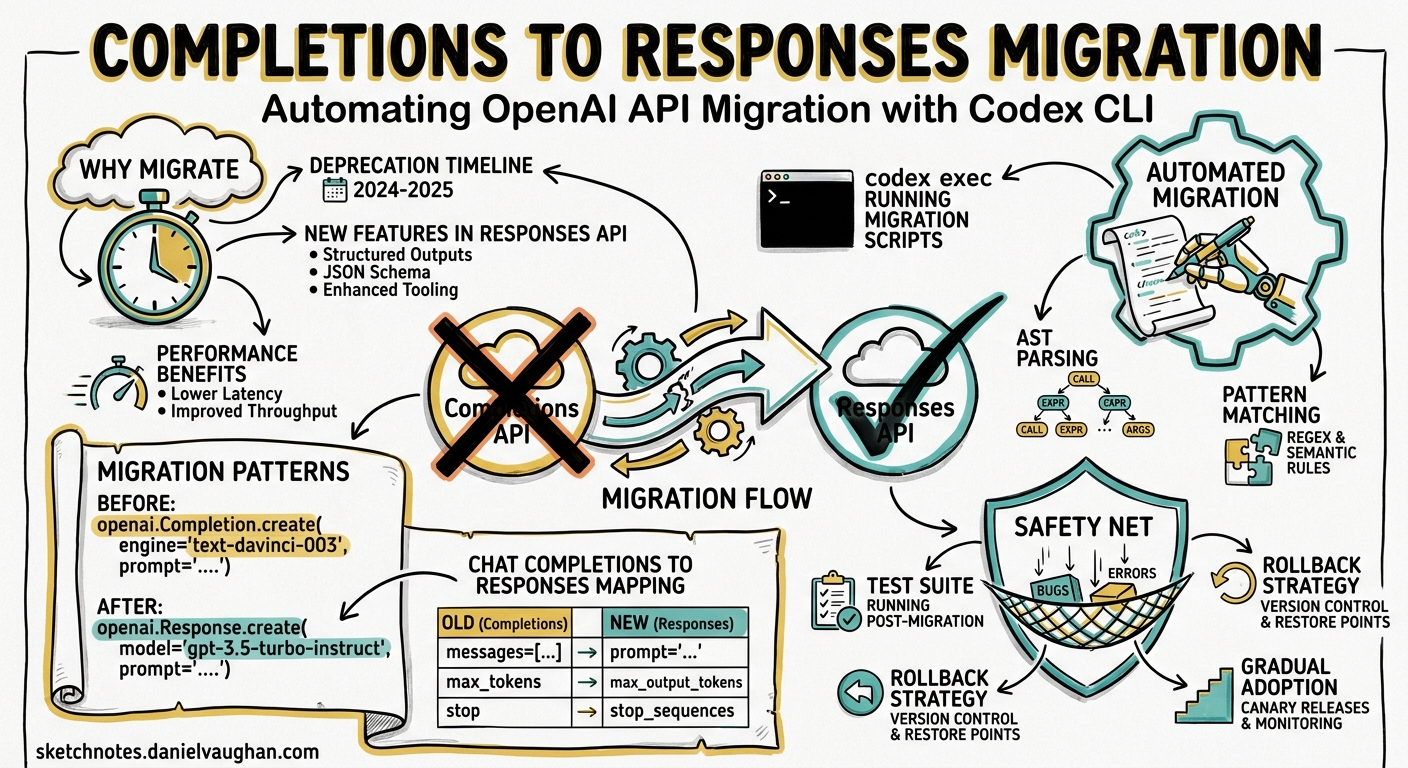
OpenAI’s Chat Completions API served the industry well from the GPT-3.5 era onwards, but it was never designed for reasoning models, multi-turn agentic workflows, or built-in tool orchestration1. The Responses API, introduced in early 2025 and now the sole wire protocol for Codex CLI itself2, addresses all of these gaps. Chat Completions support inside Codex was removed in February 20263, and the broader API deprecation timeline is well underway.
For teams maintaining applications that still call /v1/chat/completions, OpenAI has released an official open-source toolkit: the completions-responses-migration-pack4. It uses Codex CLI as a local coding agent to scan a repository, propose transformations, run tests, and open a clean pull request — all from a single shell command.
This article walks through the migration pack’s architecture, the key API differences it addresses, and practical patterns for integrating it into CI pipelines.
Why Migrate Now
The Responses API is not merely a renamed endpoint. It introduces a fundamentally different interaction model:
| Aspect | Chat Completions | Responses API |
|---|---|---|
| Input format | messages array |
input string/array + instructions |
| Response structure | choices[0].message.content |
output_text or typed output Items |
| Multi-turn state | Manual message array management | previous_response_id chaining |
| Tool definitions | Externally tagged, non-strict by default | Internally tagged, strict by default |
| Built-in tools | None | web_search_preview, file_search, code_interpreter, computer_use, MCP |
| Structured outputs | response_format parameter |
text.format parameter |
| Reasoning summaries | Not available | Native support |
GPT-5 models specifically benefit from the Responses API: the model orchestrates tools as part of its reasoning logic, which legacy endpoints cannot preserve — potentially causing repeated tool calls and degraded performance5. Empirical data shows 40-80% better cache utilisation compared to Chat Completions1, and a 3% improvement on SWE-bench with reasoning models1.
How the Migration Pack Works
The toolkit is a Bash script that orchestrates Codex CLI in non-interactive mode. The flow is straightforward:
flowchart TD
    A["Run upgrade script"] --> B["Verify Codex CLI installation"]
    B --> C["Create migration branch"]
    C --> D["Deploy AGENTS.md + docs pack"]
    D --> E["Codex scans for legacy API calls"]
    E --> F["Propose transformations"]
    F --> G{"Approval policy"}
    G -->|on-request| H["Developer reviews each change"]
    G -->|on-failure| I["Auto-apply, pause on test failure"]
    G -->|never| J["Fully automated"]
    H --> K["Run tests and linters"]
    I --> K
    J --> K
    K --> L["Generate summary report"]
    L --> M{"--open-pr flag?"}
    M -->|Yes| N["Create PR via gh CLI"]
    M -->|No| O["Changes on local branch"]
Quick Start
The one-liner fetches and runs the script directly:
/bin/bash -c "$(curl -fsSL https://raw.githubusercontent.com/openai/completions-responses-migration-pack/main/scripts/completions-to-responses-upgrade.sh)"
For production use, pin to a release tag and verify the checksum:
TAG=v0.1.0
curl -fsSL -o upgrade.sh \
  "https://raw.githubusercontent.com/openai/completions-responses-migration-pack/${TAG}/scripts/completions-to-responses-upgrade.sh"
shasum -a 256 upgrade.sh | grep "$(curl -fsSL \
  "https://raw.githubusercontent.com/openai/completions-responses-migration-pack/${TAG}/assets/SHA256SUMS" \
  | awk '{print $1}')"
bash upgrade.sh --repo /path/to/repo --no-interactive --write
Approval Policies
The --approval flag controls how much autonomy Codex has during migration:
| Policy | Behaviour | Best for |
|---|---|---|
on-request |
Prompts heuristically for approval | First migration on an unfamiliar codebase |
on-failure |
Auto-applies changes, pauses only when tests fail | Trusted codebases with good test coverage |
never |
Fully automated execution | CI/CD pipelines with post-merge review |
untrusted |
Maximum caution — approval for every action | Regulated environments |
Key Transformations
The migration pack handles several distinct transformation categories.
Endpoint and Client Updates
# Before
response = client.chat.completions.create(
    model="gpt-4o",
    messages=[
        {"role": "system", "content": "You are helpful."},
        {"role": "user", "content": "Explain caching."}
    ],
    max_tokens=500
)
print(response.choices[0].message.content)

# After
response = client.responses.create(
    model="gpt-5",
    instructions="You are helpful.",
    input="Explain caching.",
    max_output_tokens=500
)
print(response.output_text)
The parameter mapping is systematic: messages splits into instructions (for system content) and input (for user content), max_tokens becomes max_output_tokens, and the response access pattern changes from choices[0].message.content to output_text1.
Tool/Function Calling
Function definitions shift from externally tagged unions to internally tagged ones:
# Before (externally tagged)
tools = [{"type": "function", "function": {"name": "get_weather", "parameters": {...}}}]

# After (internally tagged, strict by default)
tools = [{"type": "function", "name": "get_weather", "parameters": {...}}]
The migration pack detects this pattern and restructures tool definitions automatically. It also enforces strict mode by default, which the Responses API requires unless explicitly opted out1.
Multi-Turn Conversation State
The most significant architectural change is conversation state management. Chat Completions requires manually accumulating and resending the full message array. The Responses API offers server-side state via previous_response_id:
res1 = client.responses.create(
    model="gpt-5",
    input="What is the capital of France?",
    store=True
)

res2 = client.responses.create(
    model="gpt-5",
    input="What is its population?",
    previous_response_id=res1.id,
    store=True
)
The migration pack sets store: false by default as a security-conscious choice — teams using zero-data-retention (ZDR) policies should keep this setting4. For applications that benefit from server-side state, enable store: true explicitly post-migration.
Structured Outputs
The schema location moves:
# Before
response_format={"type": "json_schema", "json_schema": {"name": "output", "schema": {...}}}

# After
text={"format": {"type": "json_schema", "name": "output", "schema": {...}}}
CI/CD Integration
The migration pack is designed for pipeline use. A GitHub Actions workflow might look like:
name: API Migration
on:
  workflow_dispatch:
    inputs:
      approval_policy:
        type: choice
        options: [on-failure, on-request, never]
        default: on-failure

jobs:
  migrate:
    runs-on: ubuntu-latest
    steps:
      - uses: actions/checkout@v4

      - name: Install Codex CLI
        run: npm install -g @openai/codex

      - name: Run migration
        env:
          OPENAI_API_KEY: ${{ secrets.OPENAI_API_KEY }}
        run: |
          TAG=v0.1.0
          curl -fsSL -o upgrade.sh \
            "https://raw.githubusercontent.com/openai/completions-responses-migration-pack/${TAG}/scripts/completions-to-responses-upgrade.sh"
          bash upgrade.sh \
            --repo . \
            --no-interactive \
            --write \
            --approval ${{ inputs.approval_policy }} \
            --open-pr
For teams that prefer dry-run validation before any changes:
bash upgrade.sh --repo . --no-interactive --dry-run
This generates a summary report of all proposed changes without modifying files — useful as a pre-migration audit step4.
What the Pack Does Not Handle
Several migration concerns fall outside the toolkit’s scope:
- Custom streaming parsers: Applications with bespoke SSE parsing logic need manual review. The Responses API emits semantic events (e.g.,
response.output_text.delta) rather than mutating a single content string, which is a fundamental architectural difference1. nparameter usage: Chat Completions supportsn > 1for parallel generations. The Responses API returns a single output — applications relying on multiple completions need restructuring1.- Temperature constraints for GPT-5: The pack enforces that
temperatureis either omitted or set to1for GPT-5 models, but does not refactor application logic that depends on variable temperature4. - Cache optimisation: While the Responses API offers better cache utilisation, achieving optimal caching with
previous_response_idrequires understanding your application’s conversation topology. Community feedback has noted that reasoning components can create unexpected cache breaks when state is not carefully managed6.
Practical Recommendations
- Run dry-run first on every repository. The summary report identifies the transformation scope before any files change.
- Pin to a release tag in CI. The
mainbranch moves; tagged releases have SHA256 checksums for integrity verification. - Start with
on-failureapproval for codebases with comprehensive test suites. Drop toon-requestfor legacy code with sparse coverage. - Review
storesettings post-migration. The pack defaults tostore: falsefor security, but applications requiring multi-turn state need explicitstore: true. - Test streaming paths separately. The event-driven model in Responses is semantically different from Chat Completions streaming and warrants dedicated integration tests.
The Broader Pattern
The migration pack is more than a one-off utility — it demonstrates a repeatable pattern for using Codex CLI as an automated codemod engine. The approach — deploy an AGENTS.md with migration rules, run codex exec against a repository, validate with tests, open a PR — generalises to any large-scale code transformation task. Framework upgrades, API version bumps, and deprecation sweeps all fit the same template.
For Codex CLI practitioners, the migration pack’s architecture is worth studying: it shows how to structure prompts, approval policies, and validation hooks for production-grade automated refactoring at scale.
Citations
-
OpenAI, “Migrate to the Responses API,” developers.openai.com/api/docs/guides/migrate-to-responses, 2026. ↩ ↩2 ↩3 ↩4 ↩5 ↩6 ↩7
-
OpenAI, “Deprecating chat/completions support in Codex,” GitHub Discussion #7782, github.com/openai/codex/discussions/7782, 2026. ↩
-
OpenAI, “Codex Changelog,” developers.openai.com/codex/changelog, 2026. ↩
-
OpenAI, “completions-responses-migration-pack,” GitHub Repository, github.com/openai/completions-responses-migration-pack, 2026. ↩ ↩2 ↩3 ↩4
-
OpenAI, “Introducing GPT-5.5,” openai.com/index/introducing-gpt-5-5, April 2026. ↩
-
OpenAI Developer Community, “Codex OpenAI Completions to Responses Migration Pack,” community.openai.com/t/codex-openai-completions-responses-migration-pack/1357034, 2026. ↩